Silica Dust Compliance in Australia: What Commercial Sites Must Do
Sydney City Rubbish team, updated 23 October 2026
If you run an office fit-out, a strip-out, a makegood or a demolition job in Australia, silica dust compliance comes down to four duties: keep worker exposure under 0.05 mg/m3, stop using banned engineered stone, control dust with wet methods and proper clean-up, and dispose of contaminated waste so that nobody downstream is exposed. This guide sets out what each duty means on a commercial site, what changed recently, and where waste removal fits in.
The rules are made under work health and safety (WHS) law, which the states and territories enforce. We refer mostly to NSW because that is where we work. If your site is in another state, check your own regulator’s page, because details such as notification systems differ.
TL;DR
- The workplace exposure standard for respirable crystalline silica is 0.05 mg/m3 as an eight-hour time-weighted average, and it is a ceiling, not a guarantee of safety.
- Engineered stone containing 1% or more crystalline silica has been banned nationally since 1 July 2024, but legacy installations still turn up in strip-outs and makegoods.
- Use wet methods or M- or H-class vacuums for clean-up. Never sweep dry or use compressed air.
- Silica-contaminated PPE, rags and tools are waste too, and must be labelled, bagged half-full at most, and handed to a disposal provider who knows what is in the load.
- The term “exposure standard” is being replaced by “exposure limit” from 1 December 2026.
Table of Contents
- Why silica dust is a commercial waste problem, not just a stonemason’s problem
- The exposure standard: 0.05 mg/m3 and what it really means
- What the 2025 model Code of Practice adds
- Engineered stone: the ban and the legacy problem
- Health monitoring and the NSW silica worker register
- Controlling dust on a live commercial job
- Clean-up: what to do and what to avoid
- Silica-contaminated waste: more than the stone itself
- Where other hazardous materials overlap
- A compliance checklist for a strip-out or makegood, in narrative form
- How we handle silica-affected waste in Sydney
- FAQ
- Sources
Why silica dust is a commercial waste problem, not just a stonemason’s problem
Crystalline silica occurs in most rocks, sand and clay, and in manufactured products such as bricks, concrete, tile and engineered stone. That list describes most of what comes out of a commercial building during demolition. Cutting a slab, grinding a floor, jackhammering a plinth or removing a tiled wet area all release fine dust that can be breathed deep into the lungs.
The risk does not end when the cutting stops. Settled dust on floors, dust in bags and rags, and slurry that dries overnight can all put dust back into the air. That is why the people who clean up and remove the waste are inside the compliance picture, alongside the people running the saw.
For property managers and head contractors, the practical consequence is simple. Silica control needs to be planned into the scope of a job, including how waste leaves the site, and not added after the dust is already in the air.
The exposure standard: 0.05 mg/m3 and what it really means
Safe Work Australia sets the eight-hour time-weighted average workplace exposure standard for respirable crystalline silica at 0.05 mg/m3. In practice, a person conducting a business or undertaking (PCBU) must make sure workers are not exposed above that level in their breathing zone over a shift.
Two points catch people out.
First, the number is a maximum. Safe Work Australia is clear that PCBUs must still eliminate or minimise exposure so far as is reasonably practicable, even where measured levels sit below the limit. A site that measures at 0.04 mg/m3 but has easy fixes available, such as water suppression or on-tool extraction, has not necessarily met its duty.
Second, the terminology is changing. Australia is moving to a list of workplace exposure limits (WELs), and until 1 December 2026 you must still comply with the existing workplace exposure standards. Update your safe work method statements (SWMS) and templates so that they use the new wording once it takes effect. The silica number discussed here is the figure we have confirmed, so check the current list before you cite it in a formal document.
What the 2025 model Code of Practice adds
In August 2025 Safe Work Australia published a new model Code of Practice on managing risks of respirable crystalline silica. It gives employers practical guidance on complying with the WHS Regulations. A model code only has legal force once a jurisdiction adopts it, so confirm the status in your state or territory. Queensland, for example, has had its own construction-specific silica code of practice since 1 May 2023, according to the search listing for that regulator’s guidance.
Even where a code is not yet adopted locally, regulators and courts commonly treat codes as a reference point for what is reasonably practicable. Reading it before you write a SWMS is time well spent.
Engineered stone: the ban and the legacy problem
The ban is national. Engineered stone benchtops, panels and slabs containing at least 1% crystalline silica have been prohibited since 1 July 2024, and the ban covers manufacture, supply, processing and installation. It does not extend to concrete, bricks, pavers or resin-free porcelain, according to SafeWork NSW’s explanation of crystalline silica and engineered stone.
The ban has not removed the stone from existing buildings. Offices, café fit-outs, retail kitchens, bathrooms and staff amenities installed before July 2024 may contain it. When you strip those spaces, the stone has to come out, and removing it is exactly the kind of work that releases dust.
Removing or modifying legacy stone in NSW
In NSW, work on legacy engineered stone needs notification. SafeWork NSW says that removal, repair or minor modification of products installed before the ban must be notified, including cases where cabinets are being replaced and stone is temporarily taken out. There is also a specific exemption covering reinstallation of an engineered stone benchtop, panel or slab removed so other work could be carried out, so read its conditions before assuming it applies to your job.
Before a makegood or strip-out is scoped, ask the building owner or tenant for fit-out drawings and finishes schedules, and have someone inspect benchtops and wet areas. If you cannot tell whether a slab is engineered stone, treat it as if it is until you know otherwise, and speak to your WHS adviser or SafeWork NSW.
Health monitoring and the NSW silica worker register
Where there is a significant risk to health from respirable crystalline silica, PCBUs must provide health monitoring. NSW has added a digital step: the silica worker register requires employers to register workers doing high-risk silica processing within 28 days of the worker starting that work. The register applies to workers doing high-risk processing on or after 1 October 2025, and each worker is notified once during their employment with the business.
A principal contractor should confirm that every subcontractor doing cutting, grinding or demolition has a plan for this. Our own crews work under the same expectations, and we are happy to discuss how a job’s silica controls sit alongside your site induction.
Controlling dust on a live commercial job
The hierarchy of control applies. Eliminate the dust-generating task where you can, substitute with lower-dust methods, then use engineering controls such as water suppression and on-tool extraction, and finally rely on respiratory protection. Respirators are the last line, not the plan.
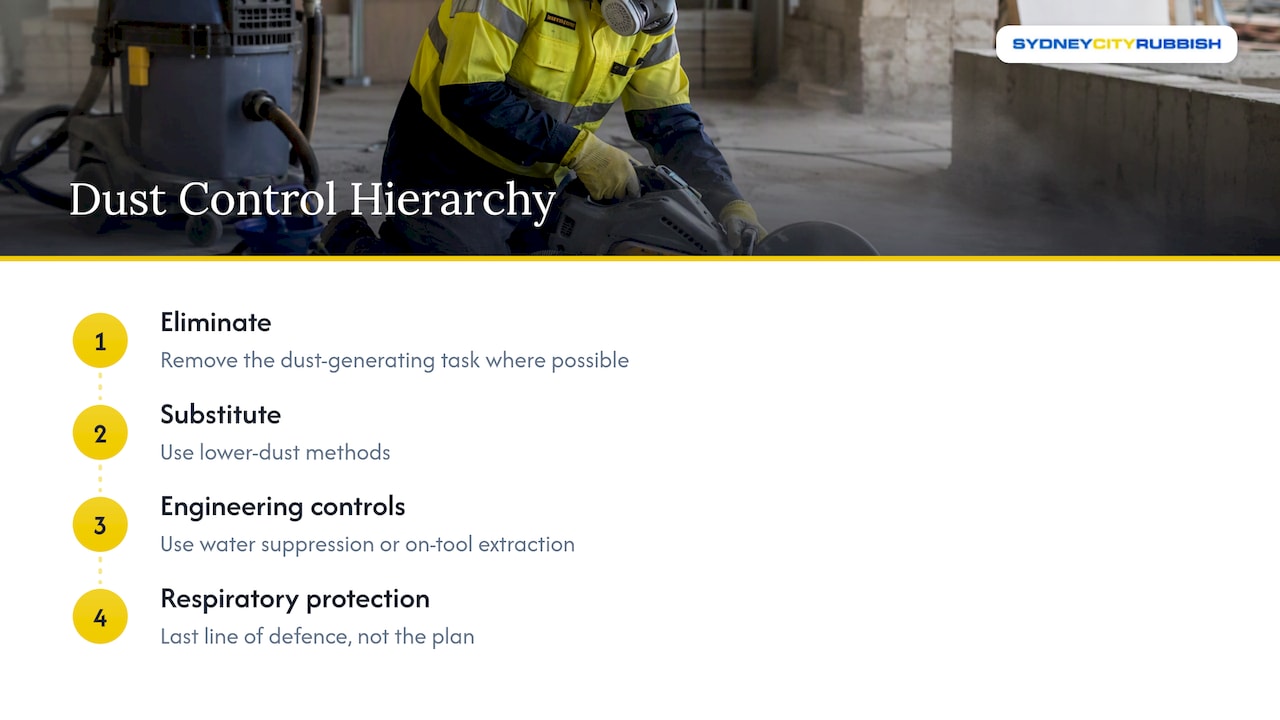
Wet slurry deserves its own attention on concrete jobs. SafeWork NSW explains that slurry from grinding or cutting is safe while wet but becomes an inhalation risk once it dries. The answer is to channel or curb it so it is captured, and to clean it up at the end of every shift, before it dehydrates overnight. In a tenancy with carpet tiles or timber next door, that means bunding the work area, not just wetting the blade.
We have written separately on how contractors can keep silica under 0.05 mg/m3 during concrete grinding, which goes deeper into the equipment side.
Floor finish removal and tile
Grinding off adhesives and screeds, lifting ceramic tiles and breaking up bedding all create dust. Tile waste is also heavy and sharp, so the dust and manual handling risks arrive together. Our guide to handling tile waste in Sydney covers separation and removal.
Clean-up: what to do and what to avoid
SafeWork NSW’s guidance on clean-up and disposal of silica dust is direct. Do not sweep dry and do not use compressed air, because both redistribute the dust. Use wet methods, or an M- or H-class rated vacuum cleaner, to capture slurry and settled dust before it dries and becomes airborne.
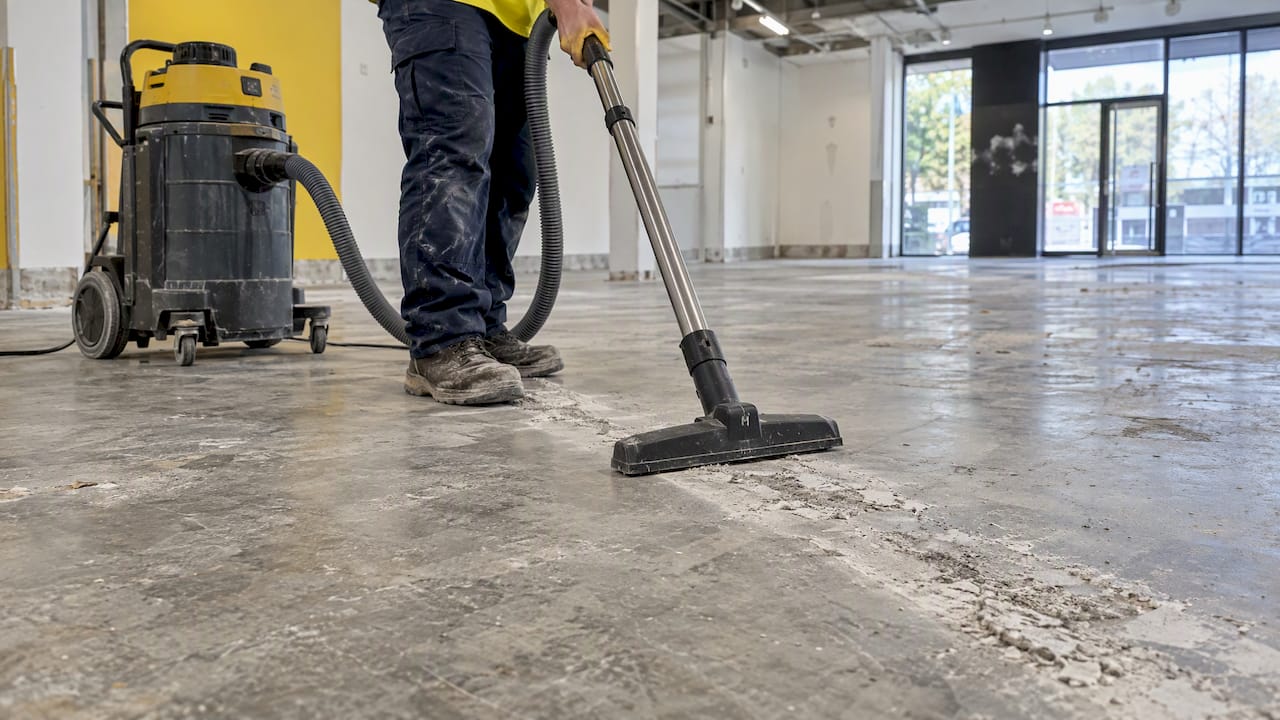
That guidance sits within the engineered stone code, but the physical behaviour of the dust is the same on a concrete or masonry job. A general-purpose workshop vacuum and a broom are the wrong tools on any site where crystalline silica has been disturbed.
Build the clean-up into the program. If the last hour of each shift is reserved for wet clean-up and vacuuming, the finish of the job is much less likely to leave dust for the next trade, the building manager or the incoming tenant.
Silica-contaminated waste: more than the stone itself
Waste from silica work is wider than the broken slab. SafeWork NSW explains that disposable PPE, cleaning rags and tools that cannot be fully decontaminated are also contaminated and should be labelled as a silica dust hazard, so anyone handling them later knows what they are dealing with.
The same guidance covers packaging. Bags for contaminated PPE and rags should never be more than half full, because a bag that tears or splits during transport releases the dust it was meant to hold. On a job with a tight program, this is the rule that gets skipped, usually when someone stuffs the last offcuts into an already full bag.
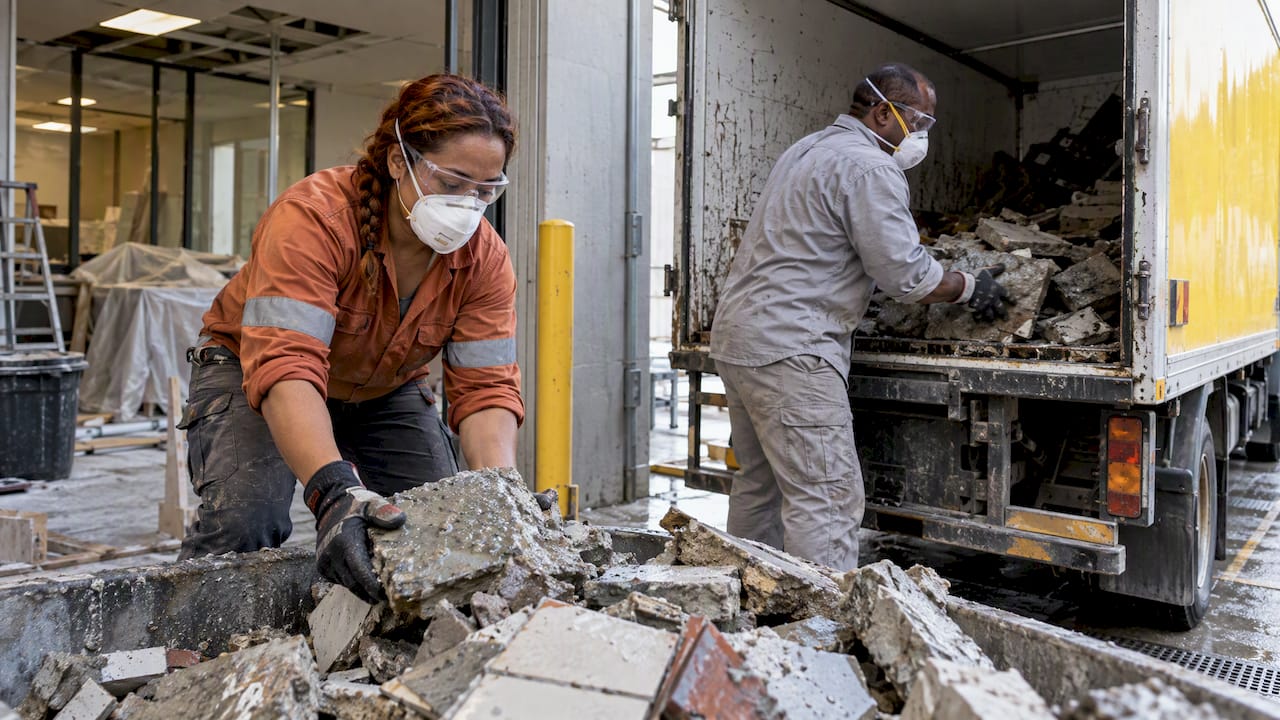
A workable waste routine for a silica job looks like this in plain terms. Dust-generating work is done wet. Debris is dampened and removed promptly. Contaminated PPE and rags go into labelled, half-filled bags. Heavy debris is loaded in a way that keeps it from drying and dusting while it is moved. And your waste contractor is told, before arrival, what is in the load.
That last step matters more than it appears. A driver and loader who know the load contains crushed concrete, tile or legacy engineered stone can plan their handling and PPE. A driver who is surprised by it cannot.
Keeping the volume down
Less contaminated waste means fewer handling events and less exposure. Planning cuts to reduce offcuts, salvaging and reusing clean materials, and keeping clean and contaminated streams separate all help. The principle is the same in other trades, and these ways to reduce workshop waste show how planning at the start of a process lowers what has to be disposed of at the end. Separating waste at source is also the theme of our piece on the importance of waste separation in construction and demolition.
Where other hazardous materials overlap
Silica rarely turns up alone. Older buildings in Sydney can also contain asbestos in sheeting, flooring and lagging, and a strip-out plan has to deal with each hazard under its own rules. If there is any doubt, stop work and have the material identified before you cut or grind. Our guides to asbestos disposal regulations in NSW and to what NSW businesses must do to dispose of hazardous waste legally explain the separate obligations. For waste planning on larger jobs, see our note on construction waste removal and staying compliant.
A compliance checklist for a strip-out or makegood, in narrative form
Before the job, identify what materials are in the space, including any legacy engineered stone, and check whether a notification applies in your state. Prepare a SWMS that names silica as a hazard and lists the controls. Confirm that your subcontractors are registered where the NSW silica worker register applies, and that health monitoring is arranged for workers doing high-risk processing.
During the job, keep the work wet, extract dust at the source, and keep the area isolated from occupied floors. Monitor the controls rather than assuming they work. If air monitoring is part of your plan, use a qualified provider and compare results against the standard that applies on the day.
At the end of each shift, clean up with wet methods or an M- or H-class vacuum, capture slurry before it dries, and bag contaminated PPE and rags half-full with a silica dust hazard label. At handover, keep your records of controls, clean-up and waste movements, because building managers and incoming tenants increasingly ask for them.
How we handle silica-affected waste in Sydney
Sydney City Rubbish removes waste from offices, retail spaces, construction sites and strata buildings, and we also carry out strip-outs, makegoods, floor finish removal, concrete grinding, cutting and demolition. We coordinate directly with building management for access, and we use registered recycling partners for responsible disposal. Clients can opt in to carbon-neutral waste removal.
If your job is likely to produce concrete, tile, masonry or legacy stone debris, tell us when you request a quote so we can plan loading and handling. You can start with our construction waste disposal service, see everything we do on our services page, or send the scope through for a fast electronic quote. Get a free quote now.
FAQ
What is the mandatory limit for silica dust exposure in Australia?
The eight-hour time-weighted average exposure standard for respirable crystalline silica is 0.05 mg/m3. It is a maximum, and employers must still reduce exposure as far as reasonably practicable. From 1 December 2026 the terminology moves from “standards” to “limits”.
Is engineered stone still legal in Australia?
New engineered stone containing 1% or more crystalline silica cannot be manufactured, supplied, processed or installed, and the ban has applied since 1 July 2024. Existing installations remain in buildings, and work to remove or modify them is regulated. In NSW that work requires notification to SafeWork NSW.
Does concrete count as a silica hazard?
Yes, in the sense that cutting, grinding or breaking it can release respirable crystalline silica. The engineered stone ban does not apply to concrete, but the exposure standard and your duty to control dust do. Wet methods and extraction are the usual controls.
How should silica-contaminated rags and PPE be disposed of?
Label them as a silica dust hazard and bag them without filling the bag more than half full, so it does not split in transit. SafeWork NSW’s clean-up and disposal guidance covers this. Tell your waste contractor what the load contains before collection.
Sources
- Workplace exposure standard for respirable crystalline silica, Safe Work Australia
- Workplace exposure standards/limits, Safe Work Australia
- New model Code of Practice to manage risks of silica dust in the workplace, Safe Work Australia
- What are crystalline silica and engineered stone, SafeWork NSW
- Work safely with crystalline silica and engineered stone, SafeWork NSW
- Reinstallation of engineered stone, SafeWork NSW
- Silica worker register notification, SafeWork NSW
- Clean-up and disposal of silica dust, SafeWork NSW