Concrete Slab Cutting in Sydney: Planning, Methods and Safety
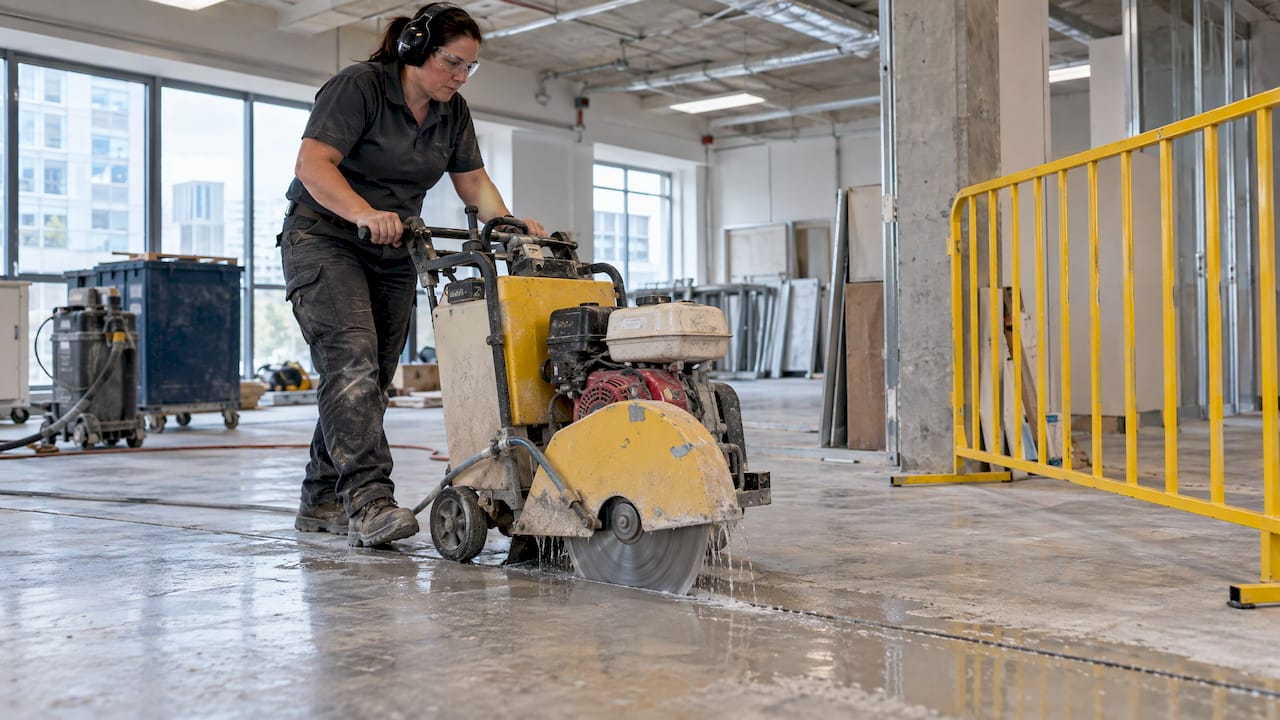
Concrete slab cutting is done with a floor saw, a road saw or a hand-held saw fitted with a diamond blade. On a commercial site, the cut itself is the short part. The work that decides cost and programme is the scanning before it, the silica controls during it and the slurry and concrete removal after it. Sydney City Rubbish cuts concrete as part of strip-outs, makegood and demolition, and removes the debris in the same job, so the slab is cut and cleared by one crew under one booking.
Updated November 2026 by the Sydney City Rubbish team.
TL;DR
- Slab cutting is used to open floors for plumbing, electrical and structural changes, and to trim or remove sections of hardened concrete.
- Scan for reinforcement, services and post-tensioning cables before any blade touches the slab, and mark the line clearly.
- Floor saws and road saws give straight, consistent cuts. Hand-held saws are for short, shallow work and carry a higher kick-back risk.
- In NSW, uncontrolled cutting of materials with 1% or more silica is banned, and high-risk cutting needs a written control plan.
- Wet cutting creates slurry, and the cut-out slab becomes heavy waste. Booking cutting and removal together keeps the site clear.
Table of Contents
- What slab cutting is used for
- Plan the cut before anyone starts a saw
- Choosing the saw: floor saw, road saw or hand-held
- How a slab cut is carried out
- Silica: the rule every Sydney contractor works under
- Dust, slurry and noise on a live site
- What happens to the concrete afterwards
- Scoping a slab cutting job for a quote
- Cut and clear with one crew
- FAQ
- Sources
What slab cutting is used for
Slab cutting means sawing through hardened concrete along a marked line, in a floor, a wall or a pavement. SafeWork NSW’s code of practice for cutting, drilling and grinding concrete and masonry lists the common tasks: cutting expansion cuts, chasing out blockwork for electrical or plumbing work, and trimming concrete or masonry products. It names the tools used as track-mounted wall saws, floor-cut saws (also called flat saws, road saws or walk-behind saws) and hand-held saws.
For offices, warehouses and retail fit-outs, the typical reasons are these:
- Opening a trench in a ground-floor slab for new drainage or a floor waste.
- Cutting a penetration for a lift, stair or services riser.
- Removing a slab section during a structural alteration.
- Isolating a damaged area so it can be removed without cracking the surrounding floor.
- Making a clean edge before demolition of a bay or mezzanine footing.
For strata and property managers, the same cuts often appear at the end of a lease, when a tenant’s fit-out has to be reversed. Plumbing runs, bolted plant bases and raised floor sections all need to come out and the slab made good. That is the work covered in makegood and de-fit.
Plan the cut before anyone starts a saw
The first question is what the concrete is holding up. A slab on ground that carries only floor loads is a different job from a suspended slab with a tenancy below it. If you are unsure, get the structural drawings and an engineer’s advice before you commit to a cutting layout.
Check thickness, reinforcement and services
Three things need confirming before cutting: how thick the slab is, what steel is inside it, and what is buried under or in it. Reinforcement is found with a concrete scanner or metal detector. Underground services such as power, water, gas and communications need to be located, and in Australia that starts with a Before You Dig Australia enquiry. Drawings help, but older slabs often differ from the plans, so scanning on site is the reliable check.
Post-tensioned slabs need particular care. These contain tensioned steel cables, and cutting one can release a great deal of stored energy. If the building was constructed with post-tensioning, cutting should not go ahead until the cable positions are confirmed and the engineer has signed off the layout.
Mark the line
WorkSafe Victoria’s industry standard, Safe concrete cutting and drilling, requires the cut line to be pre-marked with a waterproof crayon or permanent marker. It also calls for the right blade diameter for the cut and a pre-start check of the saw to the manufacturer’s instructions. Victoria’s rules are not NSW law, but the sequence is sound practice anywhere: mark it, check the machine, then cut. Wet slabs wipe off chalk, so a waterproof mark saves re-marking mid-job.
Plan where the cut slab goes, too. A section of 150 mm slab weighs far more than most people expect, and a loose piece needs a lifting method, a path out of the building and a truck. Settling that at the planning stage avoids a cut slab sitting in a corridor for days.
Choosing the saw: floor saw, road saw or hand-held
Floor saws and road saws
A floor saw is a walk-behind or ride-on machine with a large diamond blade. SafeWork NSW’s code treats the floor-cut saw, flat saw, road saw and walk-behind saw as one family of machines. For slabs, this is the standard tool for long, straight cuts of consistent depth. Because the machine rides on the slab and the operator walks behind, the cut stays on the marked line and the operator is not holding the weight of the saw.
The search term “road saw cutting” describes the same machine type used on pavements and road surfaces. Inside a building, the machine is typically a compact floor saw, often electric or hydraulic in enclosed spaces so that exhaust fumes are not a concern.
How deep can a saw cut?
Depth is set by the blade and the machine together, not by the blade diameter alone. The axle, flanges, guard and saw body all sit above the surface, so the usable reach is less than the blade’s radius. A larger blade also needs a machine built to carry it. For a deep slab, an experienced crew will tell you whether the job is one pass, several passes, or a cut from both sides.
WorkSafe Victoria’s standard advises starting with a first cut of about 25 to 50 mm deep so the saw tracks straight. From there, deeper cuts are made progressively. Cutting in stages reduces strain on the machine and the risk of the blade binding in the kerf (the slot the blade leaves).
Hand-held saws and circular saws
Hand-held petrol or electric saws with a diamond blade are used for short cuts, corners and places a floor saw cannot reach. They are not the right tool for long or deep cuts through a commercial slab. WorkSafe Victoria’s standard states that hand-held saws are more prone to potentially fatal kick-back, push-back and pull-in movements, and that a hand-held saw should never be used for inverted cutting, because an operator has little control of a machine held above shoulder height.
A standard workshop circular saw is a different matter again. It is not built for the heat, dust and vibration of cutting concrete, and a diamond blade does not change that. Commercial slab work belongs with purpose-built concrete saws and a trained operator.
How a slab cut is carried out
On a well-run job, the sequence is predictable.
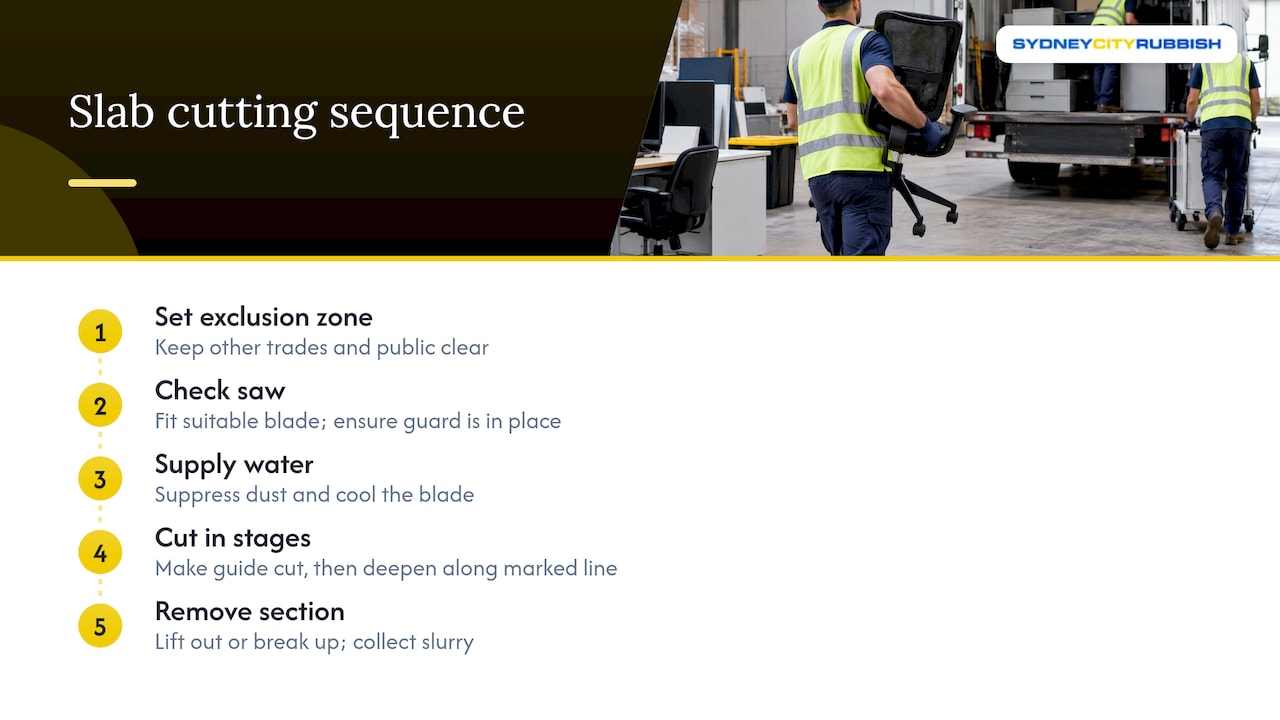
First, the area is set up. An exclusion zone is established around the work area so that other trades and the public stay clear, as the WorkSafe Victoria standard requires. In an occupied building, that includes arranging access, lift bookings and out-of-hours work with building management.
Second, the saw is checked, the blade is fitted correctly and the guard is in place. The blade must suit both the material and the machine’s power.
Third, water is supplied to the blade. The same standard requires enough water or coolant to suppress dust and cool the blade.
Fourth, the operator makes a shallow guide cut, then lowers the blade in stages along the marked line. Corners that the round blade cannot finish are completed with a hand-held saw or core drilling, so the saw does not overcut into the slab that is staying.
Fifth, the slab section is lifted out or broken up for removal, and the slurry is collected.
There is also a training benchmark. The national unit CPCCON3047 Cut concrete covers safely cutting concrete with saws to specification, and candidates must show they can saw-cut a joint at least five metres straight, or to the set line, on two different occasions. When you engage a contractor for slab cutting, you are paying for that kind of repeatable, straight-line skill.
Silica: the rule every Sydney contractor works under
Concrete contains crystalline silica, and cutting releases it as fine dust. Breathing it in can cause silicosis and other lung disease. The Australian Dust Diseases Research Institute lists dry brick, concrete and stone cutting among the high-risk practices for respirable silica exposure, and notes that wetting down tools and materials and using dust-collecting attachments help prevent it.
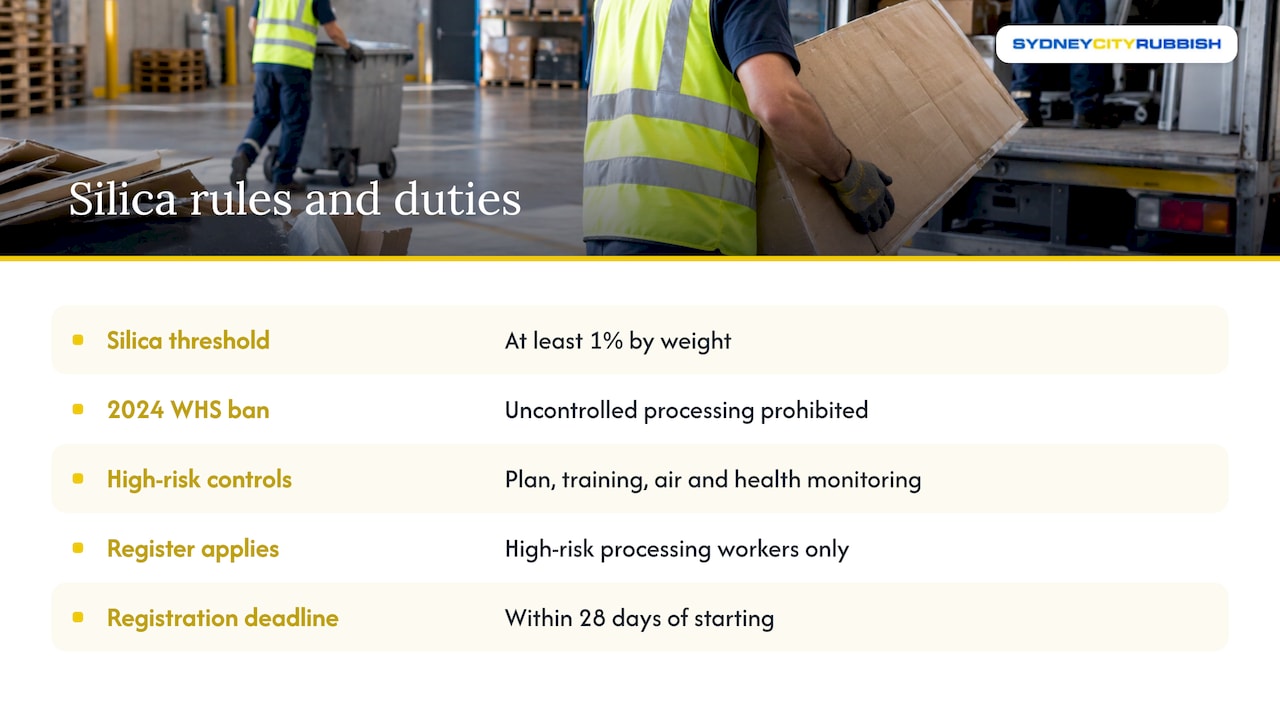
The law has tightened. The 2024 WHS Regulations ban the uncontrolled processing of a crystalline silica substance, such as cutting, drilling or grinding, in any material containing at least 1% silica by weight, as the HIA’s guidance on working with silica explains. Where the processing is high risk, there must be a written silica risk control plan, training, air monitoring and health monitoring.
SafeWork NSW’s code adds the detail for this state. From 1 October 2025, only workers doing high-risk crystalline silica processing need to be on the Silica Worker Register, registered within 28 days of starting that work. The person conducting the business or undertaking must prepare a silica risk control plan or a safe work method statement for high-risk construction work, make sure workers are trained, report exceedances of the workplace exposure standard and provide health monitoring. The register date and requirements are worth checking on SafeWork NSW’s site before each project, as the rules are still bedding in.
For a client, this means two things. A contractor who cannot show you a silica plan or SWMS for your slab is a risk to your project and to your own duties as a principal. And the cheapest quote may be the one that has left the controls out. Our page on concrete cutting safety sets out the controls every crew should apply, and the guide on keeping silica under the exposure limit during concrete grinding covers the grinding side.
Dust, slurry and noise on a live site
SafeWork NSW’s code lists the controls for cutting concrete: on-tool dust capture, electric saws with vacuum-bag ventilation, water to suppress dust, and respiratory protection used together with those higher-level controls, not in place of them. It also makes the operator responsible for cleaning up and disposing of dust, including slurry.
That last point matters for office and retail sites. Wet cutting turns dust into a grey slurry that runs across the floor, into drains and under doors. It needs containing at the saw, collecting and taking away. Letting it reach stormwater is a compliance problem, and leaving it to dry produces silica dust again.
WorkSafe Victoria’s standard also notes that concrete cutting involves hazardous manual handling, with equipment typically weighing up to 30 kg, and that operators face strains as well as sudden violent saw reactions if the blade hits a hidden obstruction or jams in the cut. That is why scanning, staged cutting and trained operators matter beyond the paperwork.
Noise and vibration are the other issues in tenanted buildings. Cutting is loud, so sequencing it for out-of-hours work, with building management informed and lift and dock access booked, is part of the plan. Sydney City Rubbish coordinates directly with building management for access, which takes that task off the property manager’s desk.
What happens to the concrete afterwards
A cut slab is not finished until the material has left the site. Concrete is dense, a cut-out section can weigh hundreds of kilograms, and mixed with tiles, screed, rebar or floor finishes it needs sorting. Separating clean concrete from contaminated or mixed material affects both disposal cost and how much can be recycled, as our guide to waste separation in construction and demolition explains.
This is the part many cutting-only contractors leave to the client. Sydney City Rubbish handles the removal side through brick and concrete removal and disposal, and uses registered recycling partners for responsible disposal, with concrete recycling available for clean loads. For larger scopes, such as a full strip-out or commercial demolition, cutting, breaking, loading and carting all sit under the one project. Corporate clients can also opt in to carbon-neutral removal through our partnership with Carbon Neutral.
Scoping a slab cutting job for a quote
When you ask for a quote, a few facts make it accurate and fast:
- The address, floor level and access route, including lift size and loading dock hours.
- The purpose of the cut: trench, opening, removal or joint.
- The approximate length, width and slab thickness, plus any structural drawings.
- Whether the slab is post-tensioned or has known services running through it.
- What needs removing afterwards, and whether floor finishes are bonded to the slab.
- Your working hours and any restrictions from the building or neighbours.
A quote built on these facts avoids variations later. Where the drawings are incomplete, a scan on site is the way to settle it before the saw goes in.
Cut and clear with one crew
If your project involves slab cutting in a Sydney office, warehouse, retail space or strata building, Sydney City Rubbish can cut, core drill, grind, remove and cart away under one booking. Our full range of services includes concrete cutting, concrete grinding, core drilling, jackhammering, building strip-out, makegood and truck and driver hire. We provide fast electronic quoting, and our punctuality guarantee includes compensation if we are late. Get a free quote now.
FAQ
What is the difference between a floor saw and a road saw?
They are the same family of machine. SafeWork NSW’s code groups floor-cut saws, flat saws, road saws and walk-behind saws together. “Road saw” usually describes use on pavements, while “floor saw” is used for slabs inside buildings, but both are walk-behind machines with a large diamond blade.
Can you use a circular saw to cut a concrete slab?
Not for commercial slab work. A workshop circular saw is not built for the heat, dust and vibration of concrete, and hand-held saws in general are more prone to kick-back, according to WorkSafe Victoria. Floor saws give a straighter, more consistent cut, and a trained operator should run them.
How deep can a concrete saw cut?
It depends on the blade and the machine together. The axle, guard and saw body sit above the surface, so the reach is less than the blade’s radius. Thick slabs are cut in stages, and sometimes from both sides, with a first shallow cut of about 25 to 50 mm to keep the saw straight.
Do I need a silica plan to cut concrete in NSW?
If the cutting is high-risk processing of material containing at least 1% silica, yes. The person conducting the business must have a silica risk control plan or SWMS, trained workers and health monitoring, and workers doing high-risk silica processing must be on the Silica Worker Register. Confirm current requirements with SafeWork NSW.
Who removes the concrete after cutting?
Sydney City Rubbish does. We cut the slab and remove the concrete, slurry and other debris in the same job, using registered recycling partners for responsible disposal.
Sources
- SafeWork NSW: Working safely when cutting, drilling and grinding concrete and masonry products
- WorkSafe Victoria: Safe concrete cutting and drilling industry standard (2017)
- HIA: Next steps, working with silica
- training.gov.au: CPCCON3047 Cut concrete
- ADDRI: Silicosis, causes, symptoms and prevention