What NSW businesses must do to dispose of hazardous waste legally
Classify your waste using the NSW EPA’s five-step process, or treat it as hazardous by default if you skip chemical assessment. Then obtain a Consignment Authorisation (CA) before any transport happens, and track the load through the Integrated Waste Tracking Solution (IWTS). That’s the compliance obligation in full, and everything else in hazardous waste disposal NSW businesses need to know builds on it.
The legal framework sits in three places: the Protection of the Environment Operations (Waste) Regulation 2014 (the POEO Waste Regulation), the NSW EPA’s Waste Classification Guidelines, and the IWTS itself. Miss any one of these and you’re exposed, even if the waste eventually ends up somewhere legitimate.
In the first 24 to 72 hours after you identify a suspect waste stream, segregate it from general waste, halt any transport that hasn’t been authorised, and arrange sampling through an accredited laboratory. Contact a licensed commercial operator rather than guessing at the classification yourself.
Before you move anything, check off:
- Has the waste been assessed against the pre-classification list (containers with residues, batteries, coal tar)?
- Does it show any of the hazardous characteristics under Step 4 (corrosive, flammable, toxic, reactive)?
- If Step 5 chemical assessment hasn’t happened, has it defaulted to hazardous?
- Is a CA in place before the truck leaves your premises?
Pro Tip: Never assume “no assessment” means “probably fine.” The EPA’s default rule cuts the other way. Skipping Step 5 means the law treats your waste as hazardous whether it actually is or not.
Key Takeaways
Lawful hazardous waste disposal in NSW depends on correct classification, a valid Consignment Authorisation, IWTS tracking, and disposal only through EPL-authorised facilities.
| Point | Details |
|---|---|
| Classify before you move anything | Apply the EPA’s five-step process; if Step 5 chemical assessment isn’t done, the waste defaults to hazardous. |
| Get the paperwork before the truck | A Consignment Authorisation must be obtained and the load tracked through IWTS before transport begins. |
| Check the facility, not just the licence | Verify the receiving site’s EPL actually covers your specific waste class via the POEO public register. |
| Keep records for three years | Retain sampling, characterisation, and Transport Certificate documentation to prove compliant handling. |
| Use a licensed commercial partner | Sydneycityrubbish provides on-site segregation, authorised transport, and carbon-neutral disposal options for NSW businesses. |
Table of Contents
- Identifying hazardous waste across common NSW industries
- How should you store hazardous waste before collection?
- Where can NSW businesses legally dispose of hazardous waste?
- What happens if your business gets hazardous waste disposal wrong?
- Getting compliant hazardous waste collection sorted in Sydney
- Where to check the rules yourself
- Frequently asked questions
- Sources
Identifying hazardous waste across common NSW industries
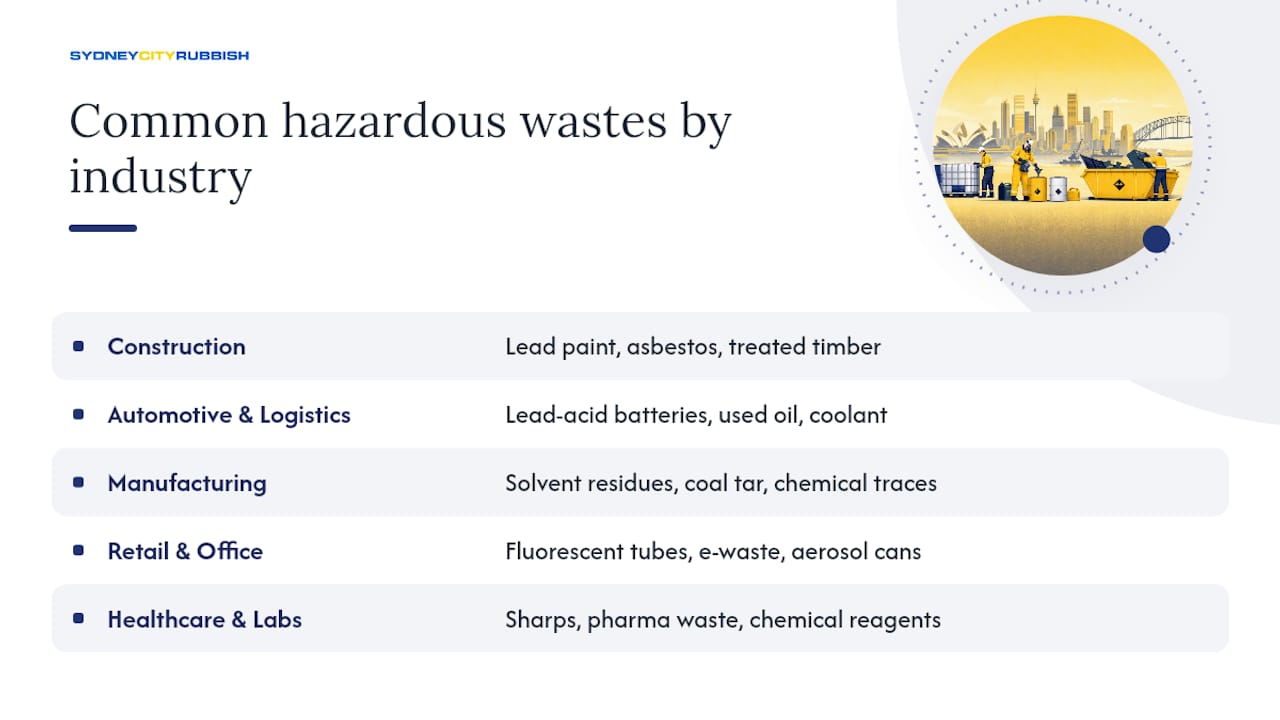
Hazardous waste doesn’t look the same in a construction yard as it does in a medical clinic or a print shop, and misclassifying it is one of the fastest ways to end up on the wrong side of an EPA audit.
Construction and demolition sites generate lead paint residues, asbestos-contaminated materials, and treated timber, all of which sit on the EPA’s pre-classified list under the Waste Classification Guidelines. Automotive and logistics businesses deal with lead-acid batteries, used oils, and coolant, which fall under Class 8 corrosive or Class 9 environmentally hazardous categories depending on their condition. Manufacturing and industrial operations often hold solvent residues, coal tar, and containers still bearing chemical traces from Class 1, 3, 4, 5 or 8 substances, all specifically named in the Guidelines’ pre-classification tables.
Retail and office fitouts throw up a quieter risk: fluorescent tubes, old IT equipment, and aerosol cans, none of which are dramatic but all of which require correct handling under the same regulatory framework. Healthcare and laboratory settings carry sharps, pharmaceutical waste, and reagents that almost always require chemical assessment rather than visual guesswork.
The common thread across every industry is this: don’t rely on how a substance looks or smells. The EPA’s pre-classified categories exist precisely because visual assessment misses contamination that only shows up under laboratory testing, and getting it wrong at this stage cascades into every step that follows, including tracking and disposal.
How should you store hazardous waste before collection?
Store it segregated, labelled, and contained in a way that matches its specific hazard class, not lumped in with general commercial waste awaiting pickup.
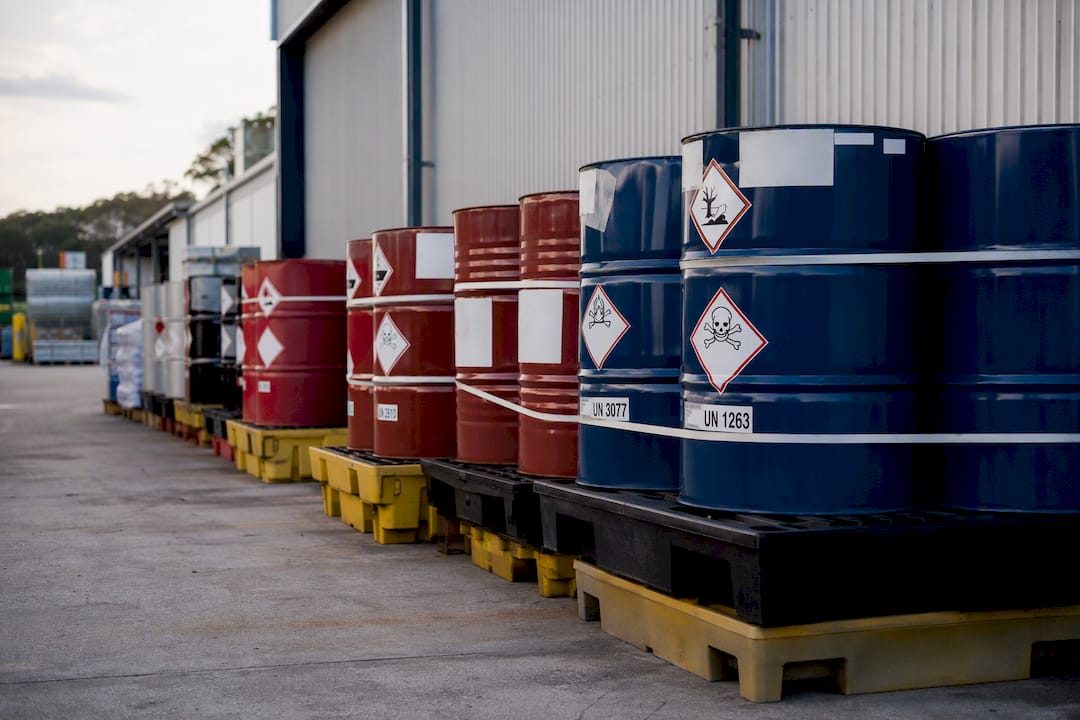
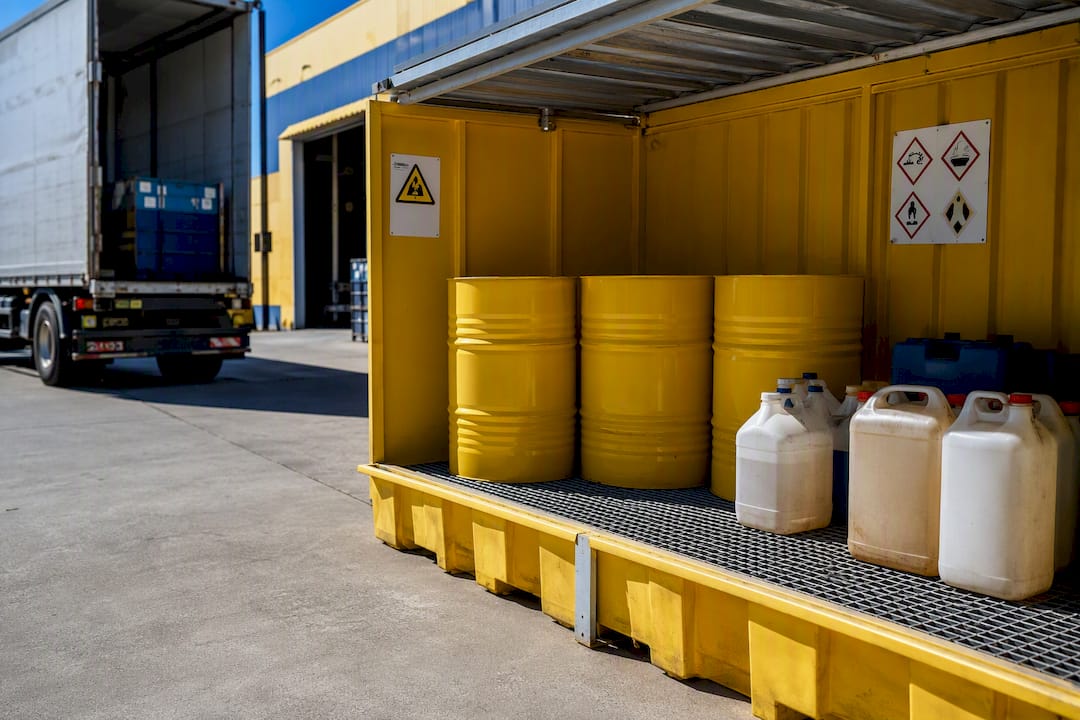
Start by separating waste streams the moment they’re generated. Corrosives, flammables, and reactive materials should never share a bin or a storage bay, because cross-contamination can trigger reactions you didn’t have on any risk assessment. Use containers rated for the specific waste type. This means bunded drums for liquids, sealed containers for anything with residual chemical content, and clearly marked bins for batteries or electronic waste.
Labelling matters more than most businesses assume. Every container should carry the waste code and classification determined during your assessment, along with any relevant dangerous goods information such as the UN number, hazard class, and packing group under the ADG Code. This documentation isn’t paperwork for its own sake. It’s what a transporter and receiving facility rely on to handle your waste safely and lawfully.
Keep storage areas covered where liquids are involved, away from stormwater drains, and accessible only to trained staff. Set a maximum holding period. Hazardous waste sitting on-site for weeks while you “get around to it” increases both the compliance risk and the physical risk to your workplace.
Finally, retain your sampling and characterisation records for three years. If the EPA ever queries a consignment, that documentation is your evidence the waste was handled correctly from the outset.
Where can NSW businesses legally dispose of hazardous waste?
Only through facilities holding a current environment protection licence (EPL) that specifically covers the waste class you’re consigning, not just any facility with a general waste licence.
Before booking disposal, check the facility’s EPL conditions against the POEO public register. A facility can be fully licensed and still lack authorisation for your particular waste stream. Many businesses assume that if a site takes commercial waste, it takes everything, and that assumption is exactly where compliance breaks down.
It’s worth being blunt about one common misconception: Household Chemical CleanOut events are for residents only, capped at small quantities per item, and explicitly exclude business or commercial waste. If your office or site tries to funnel waste through a household program, you’re not just risking rejection at the gate, you’re operating outside the regulation entirely.
Landfill disposal is rare and tightly conditioned. Waste with elevated contaminant levels can only go to landfill if the EPA has granted an immobilisation approval following treatment designed to prevent leachate release. Absent that approval, landfill is off the table regardless of how convenient it seems.
Commercial operators who handle transport and consignment on your behalf take on the logistics of matching your waste code to an authorised receiving site, which removes a significant point of failure for businesses without in-house environmental expertise.
What happens if your business gets hazardous waste disposal wrong?
Penalties escalate quickly, and the POEO Waste Regulation gives the EPA broad enforcement powers that go well beyond a warning letter.
Non-compliance can trigger clean-up notices, prevention notices, and on-the-spot penalty infringement notices for lower-level breaches such as incomplete tracking documentation. More serious matters, including illegal transport, unauthorised dumping, or supplying waste to an unlicensed facility, can escalate to prosecution under the Protection of the Environment Operations Act, with courts able to impose substantial fines against both companies and individual directors.
Enforcement isn’t limited to the business that generated the waste. Consignors carry legal responsibility for determining whether tracking applies and for obtaining a valid CA, so handing the job to a transporter and assuming they’ll “sort the paperwork” doesn’t shift that liability off your business. If a load is rejected at a receiving facility due to incorrect characterisation, that discrepancy is recorded against your consignment, and repeated issues attract closer regulatory scrutiny.
Beyond direct penalties, there’s reputational fallout. Strata managers, corporate tenants, and construction principals increasingly ask contractors for evidence of compliant waste handling before awarding work, and a documented enforcement history can quietly cost you contracts long after any fine is paid.
The safest position is straightforward: treat classification, tracking, and facility verification as non-delegable steps, and keep the records to prove it.
Getting compliant hazardous waste collection sorted in Sydney
Working through classification steps, chemical assessment, and IWTS documentation on top of running a business is a lot to carry, particularly when a project is already moving. Sydneycityrubbish handles licensed hazardous material removal for offices, construction sites, retail fitouts, and strata buildings across Sydney, with authorised transport arrangements and access to receiving facilities that hold the correct EPL for your waste class.
On-site, the team helps segregate hazardous streams from general waste, gathers the characterisation details needed to support a CA and Transport Certificate, and liaises directly with the receiving facility so nothing gets rejected at the gate. Before booking, have your sample information, waste codes, and container labels ready. Sydneycityrubbish retains supporting documentation for three years, matching the EPA’s recordkeeping expectation.
Corporate clients can also opt into carbon-neutral disposal through Sydneycityrubbish’s partnership with Carbon Neutral, adding a sustainability outcome to an already compliant process. If you need an on-site assessment or a straight quote for hazardous or general commercial waste removal, get in touch with Sydney City Rubbish and get the collection booked before your storage window becomes a liability.
Where to check the rules yourself
- NSW EPA Waste Classification Guidelines for the five-step process
- IWTS tracking overview for CA and Transport Certificate requirements
- POEO Waste Regulation 2014 for the legal basis
- Check facility EPLs on the POEO public register before finalising disposal
Frequently asked questions
Do all businesses need a Consignment Authorisation for hazardous waste?
Only if your waste appears in Schedule 1 of the POEO Waste Regulation or shows dangerous goods characteristics requiring tracking. Check your classification first, since that determines whether a CA applies.
Can a business use Household Chemical CleanOut for commercial waste?
No. CleanOut events accept residential quantities only, up to 20 litres or 20 kilograms per item, and specifically exclude business or commercial waste.
How long is a Consignment Authorisation valid?
A CA is typically valid for up to one year, though the exact period depends on your waste type and the conditions the EPA sets when issuing it.
What happens if a receiving facility rejects our waste?
The discrepancy is recorded against your consignment through the Transport Certificate, and repeated rejections can draw closer regulatory attention to your classification practices.
Is landfill disposal ever an option for hazardous waste?
Rarely, and only where the EPA has granted an immobilisation approval following treatment designed to stop leachate release. Without that approval, landfill disposal isn’t permitted.
This article is general information, not a substitute for advice from a qualified lawyer. Consult a qualified legal professional about your own circumstances before acting on anything here.
Sources
- Waste classification guidelines Part 1: Classifying waste
- Tracking and transporting hazardous waste | EPA
- Protection of the Environment Operations (Waste) Regulation 2014 — NSW legislation