Recycling vs Landfill in Sydney: What It Means for Business
By the Sydney City Rubbish team. Updated 26 October 2026.
For a Sydney business, the difference is simple to state and expensive to ignore. Waste that is sorted clean and sent for recycling is recovered as material, while everything else goes to landfill, where you pay a government levy on every tonne and the available space is shrinking. The more of your waste you keep out of the general bin, the lower your disposal cost and the smaller your risk when landfill gets tighter.
This guide explains what actually happens to each stream, what the numbers say about Sydney’s landfill capacity, and where a typical office, retail tenancy or construction site can divert waste without disrupting operations.
TL;DR
- Recycling keeps materials in use. Landfill buries what is left, and in the Sydney metropolitan area every tonne buried attracts a state waste levy.
- NSW recycling has sat at around 65% since 2015-16, short of the 80% target for 2030, and Greater Sydney’s landfill capacity is projected to run out by 2030 unless action is taken.
- Contamination is the main reason recyclable material ends up in landfill. Mixed, compacted loads are far harder to separate into quality streams.
- Furniture, e-waste and construction debris can each be recovered if they are separated at the source and collected by a provider using registered recycling partners.
- A fit-out, strip-out or end-of-lease clean-out is where businesses send the most waste to landfill by default, and where planning pays back fastest.
Table of Contents
- What the difference actually is
- How full is Sydney’s landfill, and what is the recycling rate?
- What landfill costs a Sydney business
- Does recycling just end up in landfill?
- Which business waste can be recycled in Sydney
- Environmental and resource impacts compared
- How Sydney businesses can send less to landfill
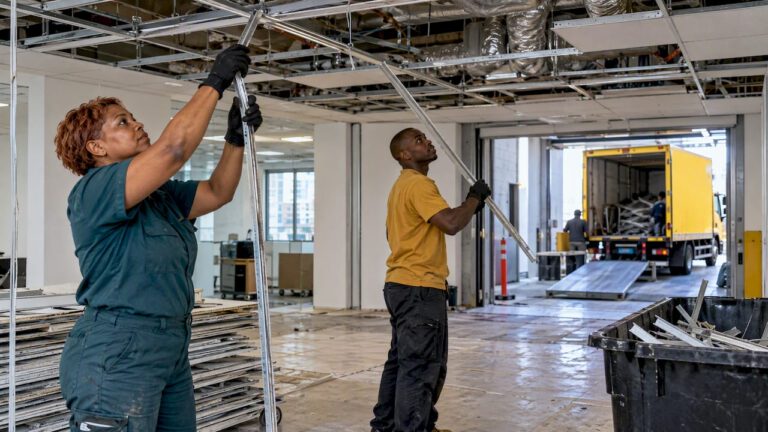
- End-of-lease, makegood and strip-out: where landfill creeps in
- Practical help from Sydney City Rubbish
- FAQ
- Sources
What the difference actually is
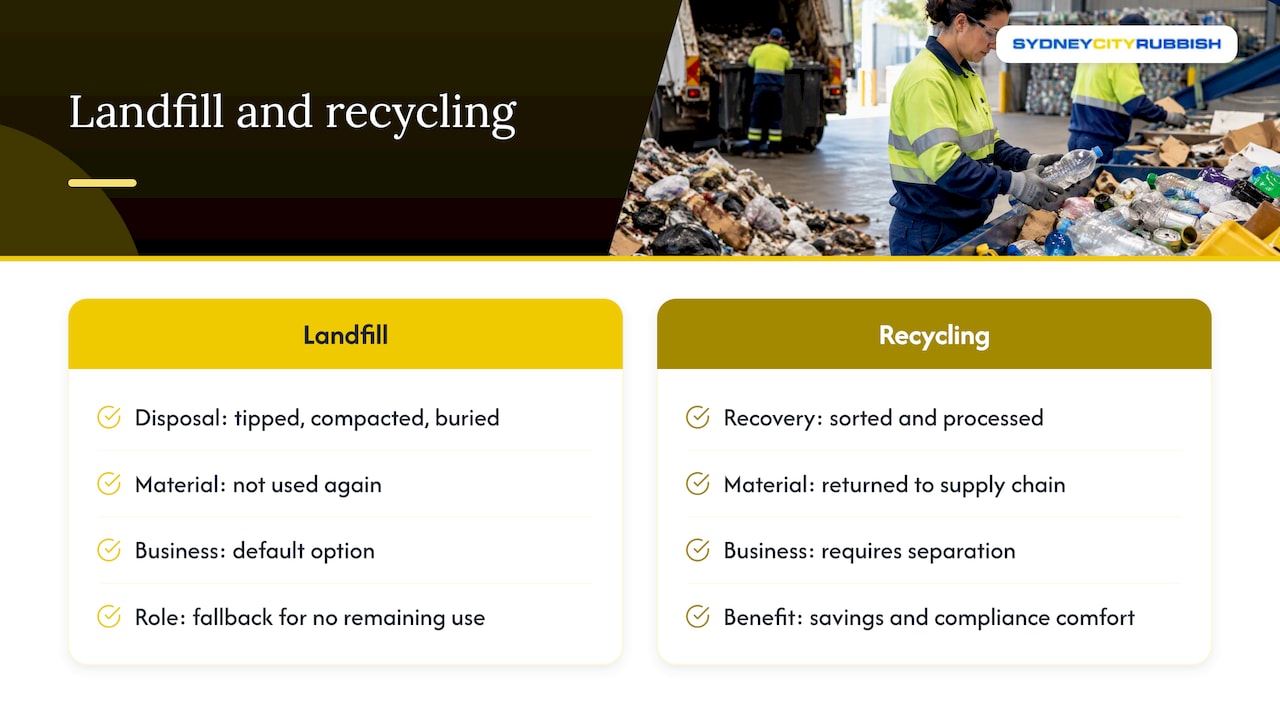
Landfill is disposal. Waste is tipped, compacted and buried at a licensed site, and the material is not used again. Some landfills capture gas or manage leachate, but the resource itself is gone.
Recycling is recovery. Paper, cardboard, metals, glass, plastics, timber, concrete, bricks and soil are sorted, processed and returned to the supply chain as raw material or products. In construction, that might mean crushed concrete used as road base, or timber chipped for reuse.
For a business, the practical difference shows up in three places: what you pay, what you must prove, and how much control you have. Landfill is the default, undifferentiated option. Recovery requires separation, but it is usually where the savings and the compliance comfort sit.
It also helps to separate three things people lump together. Reuse (a desk goes to another office) is better than recycling. Recycling (the desk is dismantled and the steel and timber recovered) is better than landfill. Landfill is the fallback for what has no remaining use.
How full is Sydney’s landfill, and what is the recycling rate?
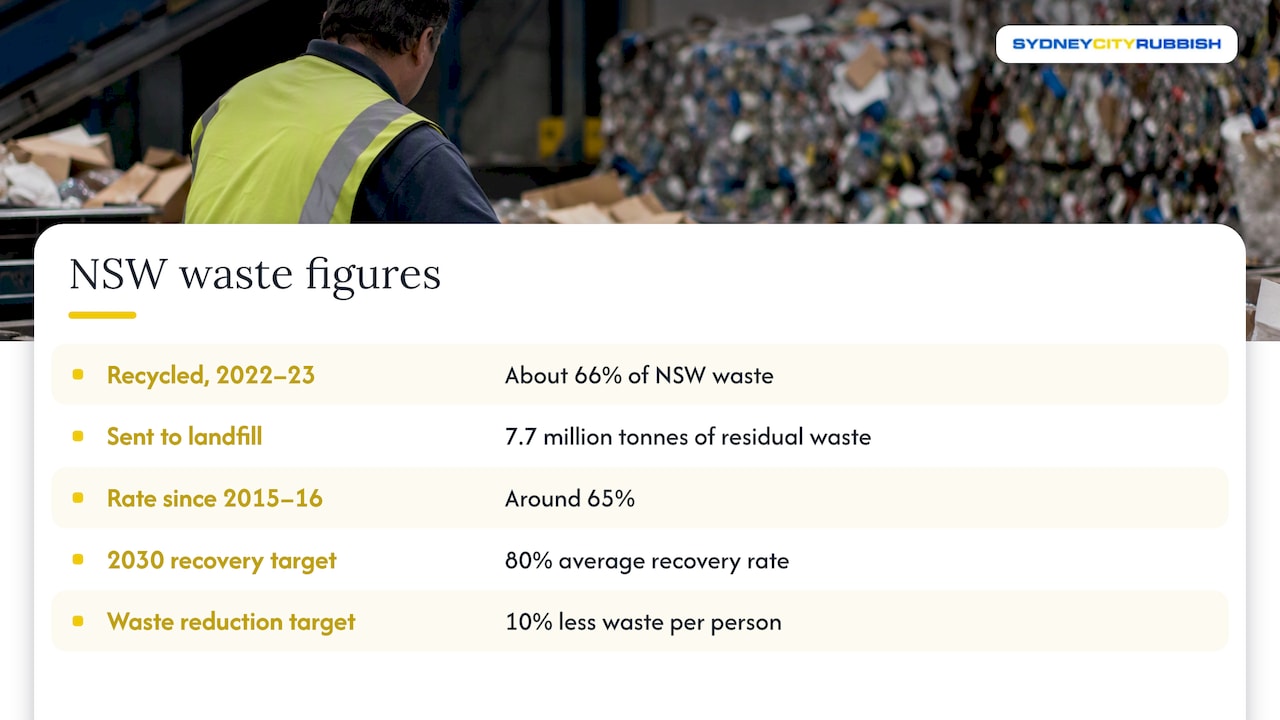
The NSW EPA states that Greater Sydney’s landfill capacity is projected to run out by 2030 unless urgent action is taken, and that Greater Sydney is home to 66% of the state’s population. The same page reports that in 2022-23 about 66% of the waste generated in NSW was recycled, with 7.7 million tonnes of residual waste sent to landfill.
The EPA also notes that recycling rates have stagnated at around 65% since 2015-16. The state’s Waste and Sustainable Materials Strategy sets a target of an 80% average recovery rate across all waste streams by 2030, along with a 10% per person reduction in waste generated.
What does this mean on the ground? When capacity is scarce, gate fees rise, trucks travel further and sites become more selective about what they accept. A business that already separates its waste is less exposed to each of those pressures.
What landfill costs a Sydney business
The tipping fee is only part of the cost. Waste sent to landfill in the Sydney metropolitan area also carries the NSW waste levy. For 2025-26, the Metropolitan Levy Area rate was $174.20 per tonne, adjusted in line with CPI from 1 July 2025. That rate is indexed, so check the EPA’s current figure when you budget.
The levy exists to make disposal more expensive than recovery. A tonne of clean timber, metal or concrete taken to a recovery facility generally avoids that charge being passed on to you, while the same tonne mixed into a general skip load does not.
Here is a worked example of why this matters. A mid-size office strip-out might generate a few tonnes of mixed waste: carpet tiles, plasterboard, ceiling grid, partitions, workstations and cabling. If it all goes into one general load, the whole load is priced as landfill. If metals, timber, e-waste and clean plasterboard are separated, a large share leaves the landfill stream. We quote per truckload or per project, so the separation plan directly changes your quote.
Does recycling just end up in landfill?
This is the question readers ask most, and the honest answer is: sometimes, and mostly because of contamination rather than because recycling does not work.
The Australian Government’s analysis of municipal recycling infrastructure notes that compacting co-mingled waste during collection increases contamination, which significantly limits the ability of material recovery facilities to separate materials into high-quality, recyclable streams. In plain terms, a load that is crushed together loses value. Clean cardboard soaked in food waste, glass mixed through paper, or soft plastics wrapped around hard plastics can all push material towards the residual pile.
For businesses, the lesson is practical. The cleaner and more separated the material is when it leaves your site, the more likely it is to be recovered. Separation at the source beats sorting after the fact.
Which business waste can be recycled in Sydney
Most commercial waste has a recovery route. The question is whether it reaches that route clean enough.
Office waste
Paper, cardboard, metal, glass and many hard plastics are routinely recovered, provided they are dry and free of food. Confidential paper should be handled through secure shredding before recycling. Items that commonly cause rejection include coffee cups with plastic linings, soiled packaging, and mixed bags of general waste placed in recycling bins. Our guide on items you cannot recycle covers the common problem materials, and our page on plastic recycling in Sydney explains which plastics are accepted and which are not.
Furniture and joinery
Office furniture is one of the best candidates for diversion. Desks, chairs, filing cabinets and storage units can often be reused or dismantled so that steel, aluminium and timber go to recovery. Built-in joinery is harder, but timber, laminate offcuts and metal fittings can be separated when it is stripped out by hand rather than demolished into a mixed pile. We explain more in our article on how to reuse and recycle office rubbish.
E-waste
Computers, monitors, phones, printers, cabling and batteries contain recoverable metals and components, and some contain materials that should never be buried. Keep e-waste out of general bins and out of mixed skips. Batteries in particular are a fire risk in compacting trucks and sorting facilities, so they need separate handling.
Construction and demolition debris
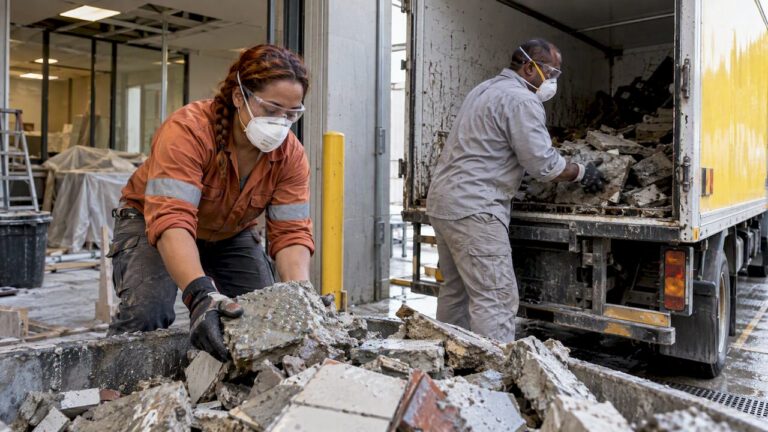
Concrete, bricks, tiles, soil, metal and clean timber are among the most recoverable materials in the commercial stream. Plasterboard, treated timber and anything that may contain asbestos need specific handling, and asbestos must only be dealt with by licensed professionals. Source separation on site is what makes recovery viable. Our articles on the importance of waste separation in construction and demolition and disposing of plaster products go through the specifics.
Food and organic waste
Cafes, restaurants and catering businesses generate the heaviest and wettest waste, and it is the stream most often sent to landfill by default. Organics that are separated can be composted, and compostable packaging only works when it reaches a facility that can process it. This overview of the compostable waste processing steps shows how the pathway works for hospitality businesses.
Environmental and resource impacts compared
The trade-off is not complicated, even if the exact figures vary by material.
Landfill removes material from the economy permanently. Organic waste buried without treatment breaks down without oxygen and produces methane, a potent greenhouse gas, and landfills must manage leachate and ongoing site obligations. Every tonne of concrete, metal or timber buried is a tonne of virgin material that has to be quarried, mined or harvested instead.
Recycling reduces demand for new raw material, and for metals and paper it generally takes less energy than producing from scratch. It is not free of impact: collection, sorting and reprocessing use fuel and energy, and contaminated loads waste that effort. That is why separation quality matters as much as the decision to recycle at all.
For corporate clients, there is one more layer. We offer an opt-in carbon-neutral removal service, through our partnership with Carbon Neutral, so a business can account for the emissions from its waste collection in its sustainability reporting.
How Sydney businesses can send less to landfill
Most of the gains come from a handful of habits applied consistently, rather than a large programme.
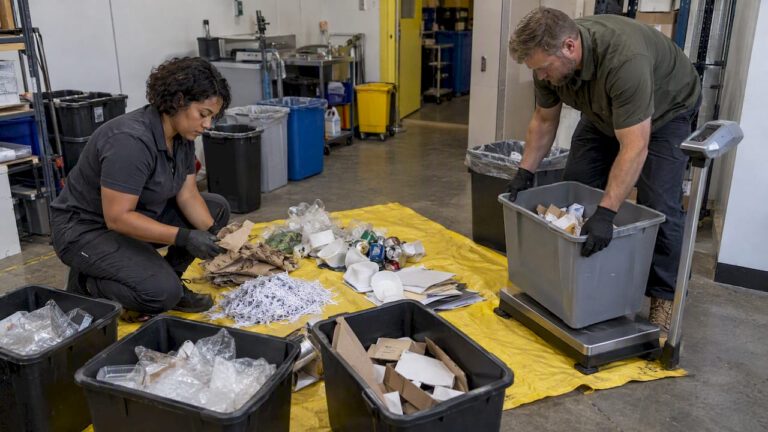
Audit what you throw out. Spend a week looking at what actually fills your bins. Most offices find that paper and cardboard dominate, and that general waste bins contain plenty that could have been recycled.
Separate at the source. Place clearly labelled bins where waste is created, and keep the streams distinct all the way to collection. Property and strata managers should check the building’s own arrangements. Our City of Sydney waste guide for property managers sets out how those arrangements typically work in the city.
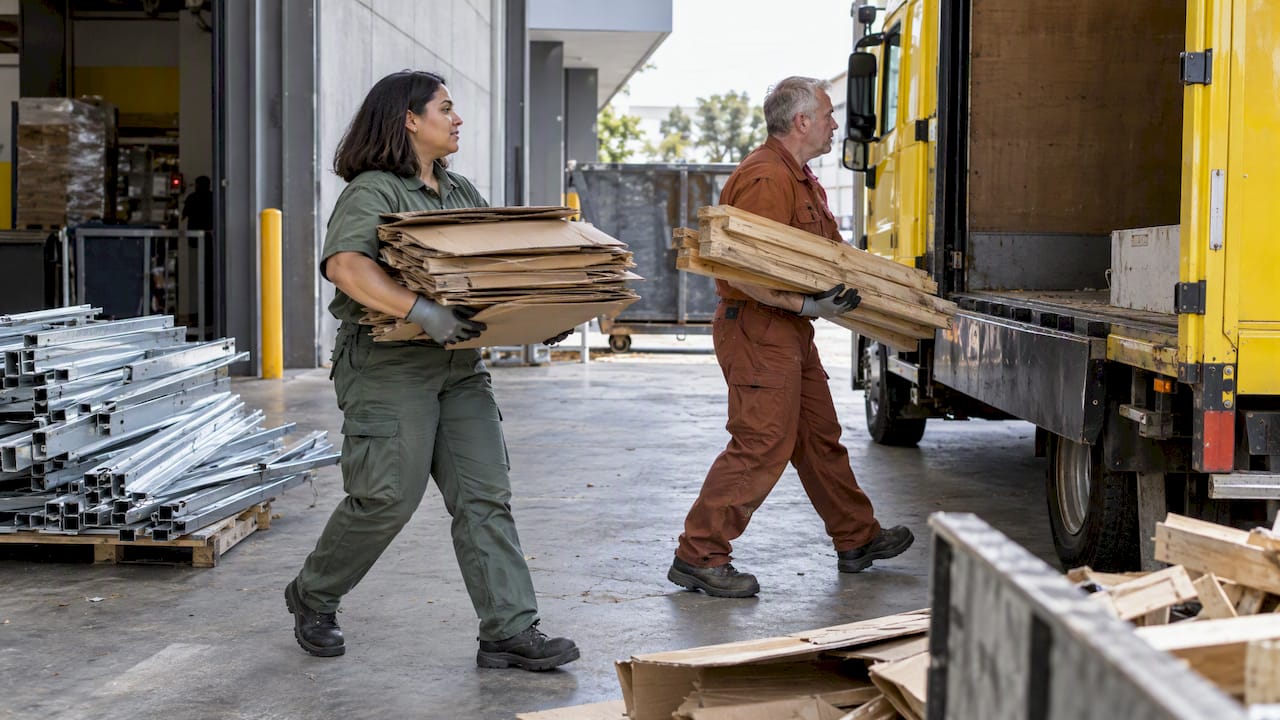
Plan big clearouts before they happen. Fit-outs, relocations and lease ends produce more waste in a few days than a year of normal operations. Decide in advance which furniture can be reused, which items go to recovery and which genuinely need disposal. Make sure the contractor tells you where each stream goes.
Keep contamination out. One bag of food scraps in a paper-and-cardboard load can downgrade the whole load. Brief cleaners and staff on what goes where.
Use a provider with registered recycling partners. Ask your collector where each stream ends up, and ask for documentation. A provider that can tell you which facility received your timber or e-waste is giving you a verifiable answer, rather than a promise.
Our broader overview of commercial waste management for Sydney businesses shows how these steps fit into an ongoing arrangement.
End-of-lease, makegood and strip-out: where landfill creeps in
These projects deserve particular attention, because speed is the enemy of separation. When a tenant has days to hand back a floor, the easy path is to fill skips with everything. That is also the costliest path once the levy and tip fees are counted.
A well-run makegood or strip-out removes items in a sensible order. Reusable furniture goes first, followed by e-waste and cabling, then metals, ceilings and partitions, and finally flooring and fixtures. Each stage is kept separate. Floor finish removal and concrete grinding produce their own dust and debris, which has to be managed on its own terms. Our team coordinates directly with building management for access, so loading docks, lifts and hours do not become the reason separation is abandoned.
If you manage a portfolio, a consistent approach across tenancies makes reporting simpler and results more predictable. Our guides to managing your construction waste and planning a successful commercial demolition give more detail for larger projects.
Practical help from Sydney City Rubbish
We remove rubbish for offices, retail tenancies, construction sites and strata-managed buildings across Sydney, including furniture, electronics, construction debris and end-of-lease clean-outs. We use registered recycling partners for responsible disposal, offer fast electronic quoting, and guarantee punctuality with compensation if we are late. Our commercial waste removal service is the best place to start, and you can get a free quote now to see how much of your load can be diverted from landfill.
For building sites, our construction waste disposal service covers debris from demolition and fit-out work.
FAQ
Does Australian recycling end up in landfill?
Some does, mainly when it is contaminated or too mixed to separate into saleable material. The Australian Government notes that compacting co-mingled waste raises contamination and limits how well facilities can separate it. Clean, separated streams have a much better chance of being recovered.
Is Sydney running out of landfill space?
The NSW EPA projects that Greater Sydney’s landfill capacity will run out by 2030 unless urgent action is taken. The state is responding with infrastructure planning and a recovery target of 80% by 2030. For businesses, the practical effect is likely to be higher disposal costs and more pressure to separate waste.
Is recycling cheaper than landfill for a business?
Often, yes, once the waste levy is included. Clean, separated material such as metal, timber and concrete can be taken to recovery facilities without the levy-driven cost of general landfill. The saving depends on how well the load is sorted, so ask your provider to quote streams separately.
Can all office furniture and e-waste be recycled?
Most can be reused, dismantled or recovered. Desks and chairs are often reusable, and the metal and timber can be recovered when they are not. E-waste should be kept out of general bins and handled through a provider that uses registered recycling partners.
Sources
- Sydney landfill shortage, NSW EPA
- Waste and Sustainable Materials Strategy, NSW EPA
- NSW waste levy rates for 2025-26, Inside Waste
- Analysis of Australia’s municipal recycling infrastructure, Australian Government