Avoid Fines and Landfill: Sydney Furniture Disposal for Residents

Book a council bulky-item pickup if you qualify as a resident, donate or resell furniture that’s still usable, or hire a professional removal service when the job involves offices, construction sites, or items councils won’t touch. The City of Sydney’s booking page confirms eligibility in minutes, while businesses and time-poor households typically get faster, fully documented results from a licensed operator like Sydney City Rubbish.
TL;DR:
- Most council bulky-item pickups require a booking online and have about a one-week lead time, with restrictions excluding commercial waste and hazardous materials.
- Businesses handling large or complex furniture clear-outs should hire licensed removal services that provide insured crews, waste sorting, and disposal documentation.
- Donations are suitable for furniture in good condition, with charities and online marketplaces offering quick pickup options that prioritize reuse over landfill.
- Specialty recycling is essential for mattresses, e-waste, or renovation debris, which council pickups do not cover and pose disposal liabilities if improperly handled.
- Proper preparation, including dismantling bulky items and securing loose parts, helps streamline collection and prevents injury or missed pickups.
Table of Contents
- What are the main furniture disposal options?
- How do council bulky-item pickups actually work?
- When should you hire a professional removal service?
- What are your donation and reuse options for furniture?
- How do you dispose of mattresses, electronics and renovation waste?
- What does furniture disposal actually cost?
- How should you prepare furniture for collection?
- Why choose Sydney City Rubbish for fast, responsible removal
- Sources
- FAQ
What are the main furniture disposal options?
Choosing the right route depends on who you are, what condition the furniture is in, and how quickly it needs to go.
- Council bulky-item pickup: Free for eligible residents, booked online, collected kerbside. Best for households with a handful of items and no urgent deadline.
- Donation or resale: Charities and online marketplaces take furniture in good condition. Best for anyone with usable pieces and a bit of time to arrange handover.
- Take-back and redistribution programmes: Manufacturer or commercial schemes reprocess or reallocate furniture. Best for businesses replacing fleets of chairs, desks, or workstations.
- Specialist recyclers: Handle mattresses, e-waste, and other materials councils won’t collect. Best for anyone with items that need particular processing.
- Paid removal services: A crew turns up, removes everything, and disposes of it correctly. Best for businesses, renovations, and anyone under time pressure.
Households generally start with council pickup or donation. Businesses almost always need a paid or redistribution route, because commercial waste is excluded from residential council services.
How do council bulky-item pickups actually work?
Most councils, including the City of Sydney, run a simple booking process, but the rules are stricter than people expect.
- Book online through your council’s waste portal, usually with a description and sometimes photos of the items.
- Wait out the lead time. In Sydney, that’s typically around one week from booking to collection.
- Place items kerbside on the scheduled date, not before, to avoid fines or missed collection.
- Check the exclusion list. Councils generally will not take commercial waste, renovation debris, or hazardous materials such as asbestos sheeting.
The service is free for residents, but it’s not a loophole for small businesses or landlords clearing rental properties. That distinction catches a lot of people out, and it’s the main reason commercial operators exist in the first place.
When should you hire a professional removal service?
Council pickups work fine for a single sofa. They fall apart fast when you’re clearing an entire office floor, a construction site, or a strata building with dozens of desks and workstations to shift.
Commercial premises are excluded from residential kerbside and bulky-item collections under most council rules, and businesses may need to show evidence of a contracted waste service on request, according to the City of Sydney’s guidance for businesses. That alone makes DIY disposal a compliance risk for offices and retail fitouts.
A professional removal service typically includes:
- Insured crews trained to move heavy or awkward items safely, including multi-floor buildings without lifts
- Separate handling for e-waste, including desk removal and workstation removal from fitouts being stripped
- Sorting at the point of collection to divert recyclable material away from landfill
- Disposal documentation that supports compliance and ESG reporting, a feature some commercial providers now offer as standard practice
Pro Tip: Ask any removal service whether they sort loads before tipping. Depots often charge less for clean, separated waste than mixed loads, and that difference flows straight back into your quote.
What are your donation and reuse options for furniture?
Councils consistently push reuse and repair ahead of disposal, and the ACT’s Recyclopaedia is explicit that furniture should never go into a household bin when it can be donated instead.
- Local charities: Most accept furniture in clean, working condition, though many will not collect stained upholstery or items needing repair.
- Online marketplaces: Listing with a clear pickup window and photos tends to move furniture fastest, since buyers want speed over negotiation.
- Commercial redistribution programmes: GreenChair audits office furniture during a fitout, matches usable stock to nonprofits, and issues reporting on landfill diversion and CO2 savings, which is valuable for businesses tracking sustainability metrics.
- Manufacturer take-back schemes: Sebel’s RePlay programme collects end-of-life chairs and reprocesses the plastic into new ones, a closed-loop model suited to items that can’t realistically be reused as-is.
Match the item to the channel rather than defaulting to the bin. A stained office chair might be RePlay material; a near-new desk is GreenChair material.
How do you dispose of mattresses, electronics and renovation waste?
Some items need handling that goes well beyond a standard collection, and getting this wrong creates real liability.
- Mattresses: Specialist recyclers strip foam, springs, and fabric into separate recoverable streams, something standard bulky pickups aren’t equipped to do properly.
- Electronics: Any furniture with integrated electronics, screens, or wiring needs e-waste handling, including secure data wiping before disposal. E-waste logistics guidance covers the practical separation process in more detail.
- Renovation and construction debris: This falls outside council bulky-item collections entirely and often requires licensed handling, particularly where materials like asbestos are suspected.
Commercial furniture waste is a genuinely large problem in Australia, with industry estimates putting the annual tonnage from commercial sources in the tens of thousands, a large share of which has historically gone straight to landfill. That’s the gap take-back and redistribution programmes exist to close.
What does furniture disposal actually cost?
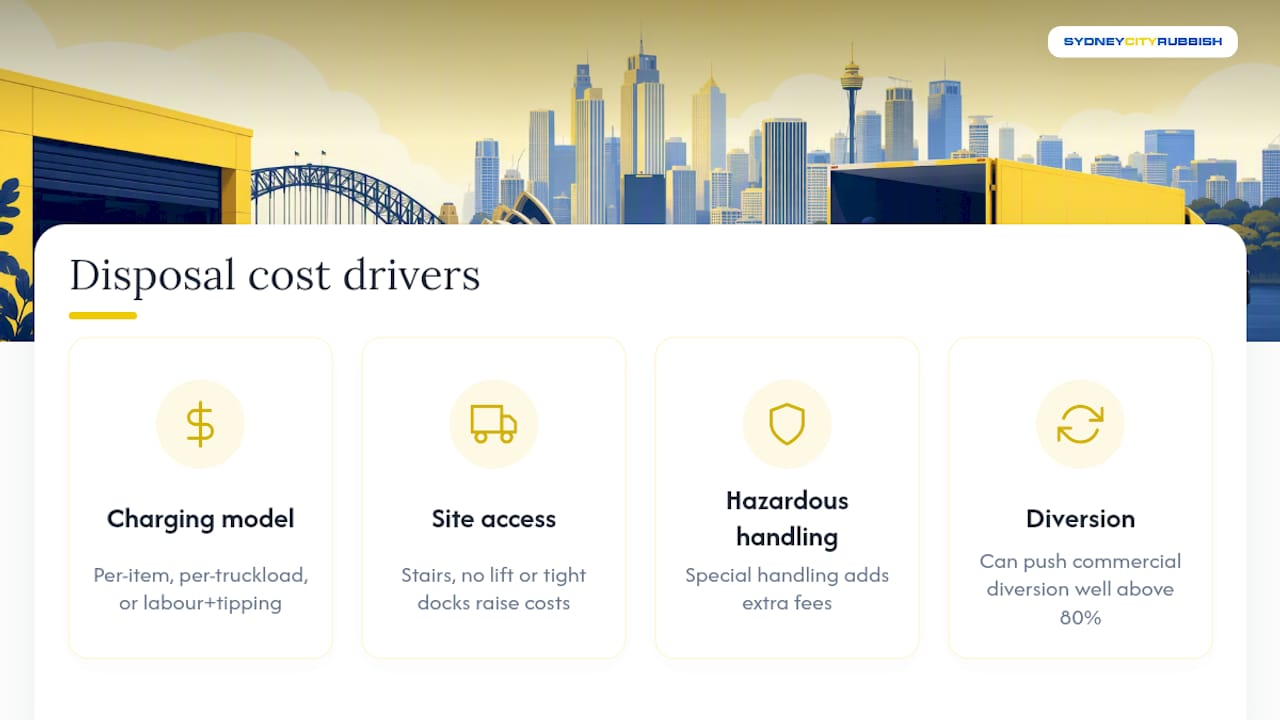
Council pickup is free for eligible residents, which makes it the default for small household jobs. Paid removal changes the maths depending on the model: some operators charge per item, others per truckload, and larger commercial jobs often combine labour plus tipping fees.
Costs climb with poor site access (stairs, no lift, tight loading docks), the volume of furniture involved, and any hazardous handling requirement. Businesses can often reduce total fees by auditing furniture before a fitout ends. Items diverted to reuse or redistribution programmes don’t attract tipping fees at all, which is one reason a staged de-fit with an asset audit and a documented diversion partner can push landfill diversion rates well above 80% for some commercial clear-outs.
How should you prepare furniture for collection?
A bit of preparation is the difference between a smooth pickup and a missed one.
- Dismantle bulky pieces where possible, and secure loose parts with tape or wrapping so nothing goes missing in transit.
- Photograph and label items if a council or charity requires descriptions ahead of collection.
- Wipe personal data from any furniture with integrated electronics or smart features before it leaves the property.
- Place items exactly where instructed, kerbside or otherwise, and never block footpaths or driveways.
Heavy or awkward pieces carry real injury risk. WorkSafe Victoria’s lifting guidance recommends mechanical aids or trained crews for anything beyond a light, easy two-person lift.
Pro Tip: If a piece needs three people to move it safely, that’s your cue to call a professional crew rather than risk a back injury for a $0 saving.
Why choose Sydney City Rubbish for fast, responsible removal
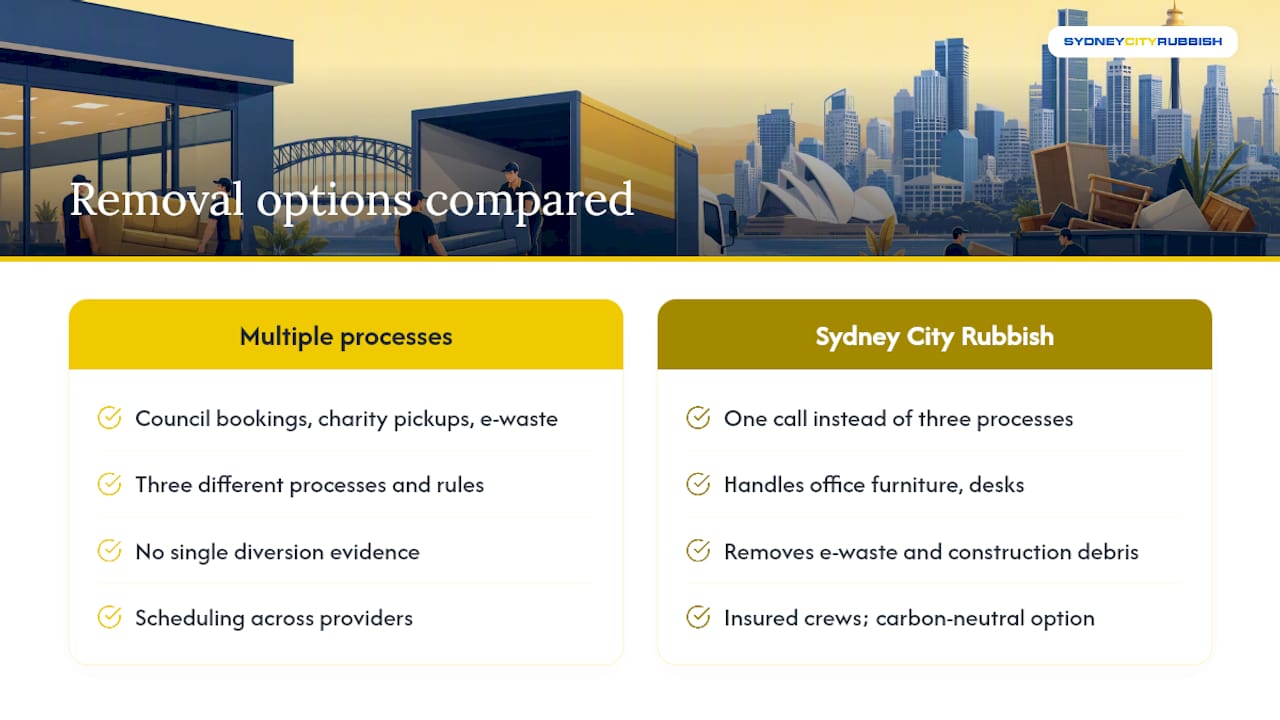
Sydney City Rubbish is the direct alternative to juggling council bookings, charity pickup schedules, and separate e-waste arrangements. For businesses clearing offices, retail fitouts, or construction sites, that means one call instead of three different processes with three different sets of rules. Sydney City Rubbish handles used office furniture, desk and workstation removal, e-waste, and construction debris, with insured crews and a carbon-neutral disposal option available through its partnership with Carbon Neutral. That’s a meaningful point of difference for organisations that need diversion evidence for ESG reporting, not just an empty office.
If your job involves multiple floors, tight deadlines, or materials council pickups simply won’t take, request a quote or schedule a collection and get it handled properly the first time.
Sources
- Book a pick-up for bulky items – City of Sydney
- Furniture (metal, plastic and wood) – Recyclopaedia
- GreenChair — business furniture reuse
- RePlay recycling programme – Sebel
- Moving or lifting objects – WorkSafe Victoria
FAQ
What is the easiest way to dispose of furniture?
For most households, booking a free council bulky-item pickup is the simplest route, provided the items are eligible and you can wait out the typical one-week lead time. For businesses or urgent jobs, hiring a removal service is faster and avoids council exclusions entirely.
How do I get rid of a piece of furniture?
Check condition first. If it’s still usable, donate it or list it for quick pickup online; if it’s worn out, book council collection if you’re an eligible resident, or use a specialist recycler for mattresses and e-waste.
How can I safely dispose of furniture if I’m outside standard council areas?
Local reuse guidance, such as the Recyclopaedia, recommends donation and repair channels first, with council drop-off or collection services as the fallback for anything that can’t be reused.
How do you dispose of furniture as a business?
Businesses can’t use residential council bulky-item pickups, so the practical options are a redistribution programme like GreenChair for usable stock, a manufacturer take-back scheme for specialised materials, or a professional removal service like Sydney City Rubbish for everything else.
Can I just leave furniture on the street?
No. Councils require items to be booked and placed out only on the scheduled collection date, and leaving furniture out unbooked can result in fines or it simply being left uncollected.