Business e-waste recycling: your compliance checklist
Businesses must arrange a licensed e-waste collection or authorised drop-off for every retired computer, phone, battery, or appliance. Never place e-waste in general waste or kerbside recycling bins. In Western Australia, sending regulated e-waste to landfill can trigger fines of significant amounts for non-compliant providers and businesses alike, and similar duty-of-care obligations apply nationally under schemes like the National Television and Computer Recycling Scheme (NTCRS) and standards such as AS/NZS 5377.
Do this before Friday:
- Segregate all e-waste from general waste and construction debris.
- Secure data-bearing devices in a locked area.
- Record serial numbers and asset tags for every item.
- Book a certified pickup with a licensed provider, such as Sydneycityrubbish, or locate an authorised drop-off point.
- Request a certificate of recycling and, where relevant, a certificate of destruction.
Key Takeaways
Compliant business e-waste recycling requires separating items, destroying data to a recognised standard, choosing an AS/NZS 5377-aligned provider, and keeping serialised certificates as audit evidence.
| Point | Details |
|---|---|
| Never bin e-waste | General waste and kerbside recycling bins are not compliant disposal channels for any electronic item. |
| Match channel to volume | Use council or NTCRS drop-offs for small quantities; use commercial recyclers for bulk or data-bearing fleets. |
| Sanitise data first | Follow NIST 800-88 or insist on documented, serialised destruction before devices leave your site. |
| Keep the paper trail | Retain transfer notes, certificates of destruction and recycling, and weight records for every collection. |
| Book a verified collector | Sydneycityrubbish handles on-site collection and manifesting, partnering with certified recyclers for compliant, documented processing. |
Table of Contents
- What counts as business e-waste
- Legal obligations every business needs to understand
- Where to recycle e-waste depending on volume
- Preparing e-waste for collection: data, batteries, and packaging
- Choosing a compliant e-waste recycler
- What records you need to keep
- What business e-waste recycling typically costs
- How a compliant collection actually works
- Book a compliant collection without the runaround
- Where to read more
- Sources
What counts as business e-waste
E-waste covers more than obsolete laptops. Businesses generate it constantly, often without realising the disposal rules that apply.
- Computers, servers, and laptops
- Mobile phones and tablets
- Printers, MFDs, and networking equipment
- Batteries (especially lithium)
- Monitors, TVs, and whitegoods
- Air conditioners and lighting (lamps and tubes)
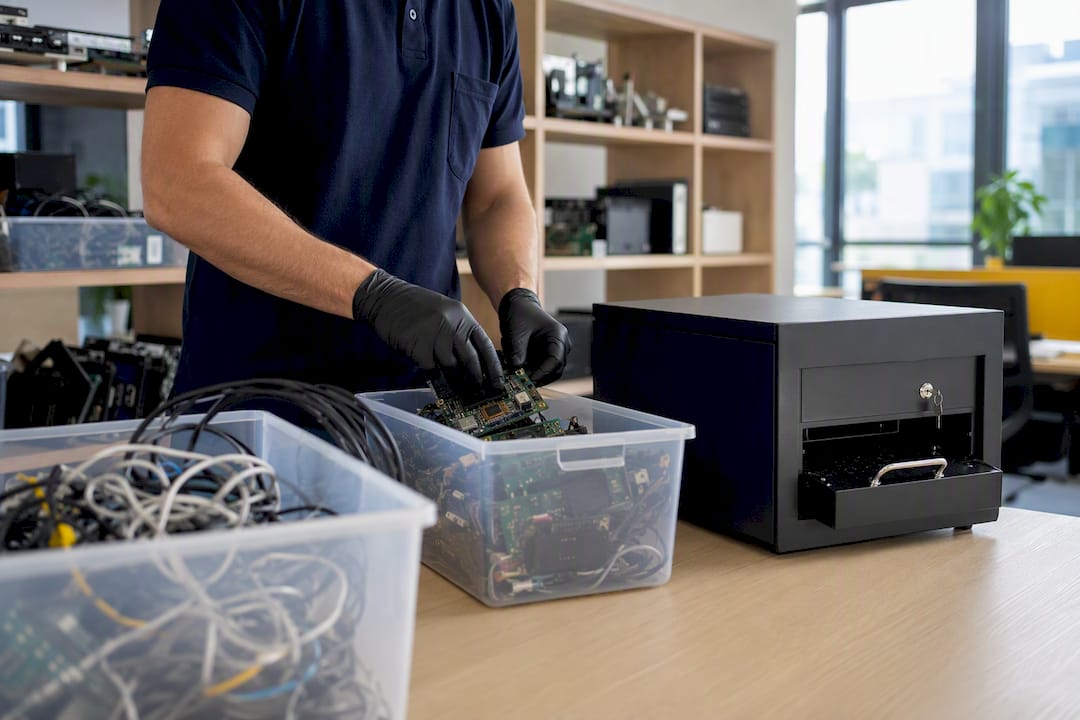
Components count too, not just whole units. Circuit boards, hard drives, and even shredded material remain classified as e-waste. Any device that once held data, storage drives, phones, servers, needs separate handling before it leaves your premises.
Legal obligations every business needs to understand
Australian e-waste law creates real duties, not just recommendations. Businesses carry a duty of care for waste they generate, and that duty doesn’t end when a truck drives away.
The NTCRS, established under the Recycling and Waste Reduction Act 2020, places recycling obligations on manufacturers and importers of televisions and computers. State rules layer on top. Western Australia’s e-waste regulations%20Regulations%202024%20-%20%5B00-00-00%5D.pdf?OpenElement=) require “significant entities” and e-waste providers to keep annual records, separate regulated e-waste from general waste, and lodge returns by set dates.
Multiple provisions in the WA regulations carry $10,000 penalties for breaches, covering storage failures, separation errors, and missed transfer documentation.
Export and import of hazardous e-waste components also fall under federal control. The Department of Climate Change, Energy, the Environment and Water tightened rules on international movement of non-hazardous e-waste from 1 January 2025, closing a gap that previously let unregulated material cross borders with minimal oversight.
Where to recycle e-waste depending on volume
Not every disposal channel suits every business. Matching volume and item type to the right pathway saves time and keeps you compliant.
Small offices clearing out a handful of old monitors or phones can often use council drop-off points or NTCRS-affiliated sites. Sustainability Victoria maintains practical guidance on local drop-off locations, and most councils publish similar lists for their areas.
- NTCRS and council drop-offs: suited to small volumes of TVs, computers, and general office electronics.
- Manufacturer takeback: often available for printers, toner, and branded hardware.
- Commercial e-waste recyclers or ITAD providers: necessary for bulk decommissions, data-bearing fleets, or mixed loads with hazardous components.
- Specialist handlers: required for appliances with refrigerants, batteries, and fluorescent lamps.
The NTCRS was built with households and small-volume drop-offs in mind, so a full office refresh or a server room decommission generally needs a commercial recycling arrangement rather than a free scheme drop-off.
Preparing e-waste for collection: data, batteries, and packaging
Preparation is where most compliance failures happen, usually because someone skips the data step under time pressure.
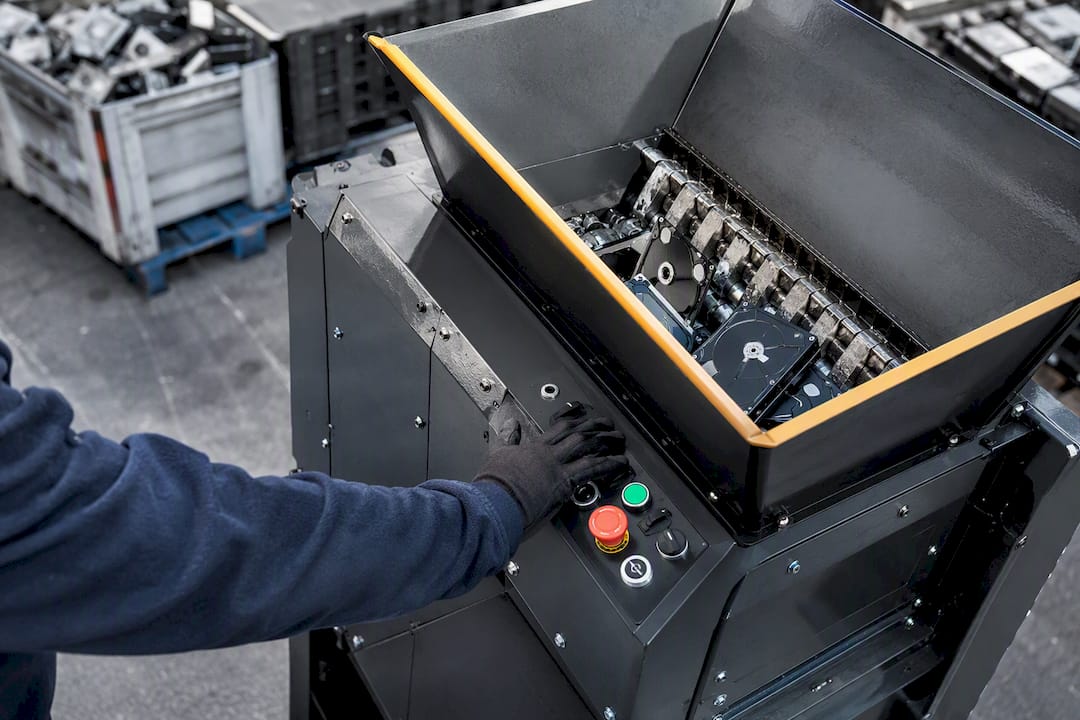
Back up anything you need, then sanitise or physically remove storage media from every device before it leaves the building. The recognised benchmark for this is the NIST 800-88 data sanitisation standard, and if you can’t sanitise on-site, insist on documented, serialised destruction from your provider instead.
Separate hazardous components. Lithium batteries, refrigerant-bearing appliances, and lamps all need distinct handling, and transport of some items falls under Dangerous Goods requirements.
- Pack devices to prevent damage in transit
- Label anything containing storage media clearly
- List serial numbers and asset tags against each item
- Keep everything dry and under cover before pickup
Pro Tip: Photograph asset tags before collection. If a certificate ever gets queried in an audit, a timestamped photo matched against your serial number list settles the question in minutes.
Choosing a compliant e-waste recycler
Not every operator calling themselves a “recycler” actually processes material responsibly. Vetting takes ten minutes and saves months of liability exposure.
Check for AS/NZS 5377 compliance as a baseline. This is the recognised Australian standard for collection, storage, transport, and treatment of end-of-life electrical equipment, covering everything from secure storage and bunding through to battery separation. ISO 14001 or ISO 27001 certification adds further assurance where data security matters.
- Documented chain of custody from collection to final processing
- Serialised certificates of destruction and recycling
- Current insurance and a valid EPA licence
Before booking, ask these questions:
- Where is material actually processed, and by whom downstream?
- Can you provide evidence of legitimate smelters or refiners in your supply chain?
- What’s your turnaround time from collection to certificate issuance?
- Are there items you won’t take, and why?
Vague answers about downstream processing, reluctance to provide certificates, or casual mentions of overseas disposal without documentation are all red flags. Walk away.
What records you need to keep
Auditors and regulators don’t ask for your memory of what happened. They ask for paper, or its digital equivalent.
Retain waste transfer notes, a serialised certificate of destruction for every data-bearing device, a certificate of recycling showing weights and downstream processors, and copies of any annual returns your state requires.
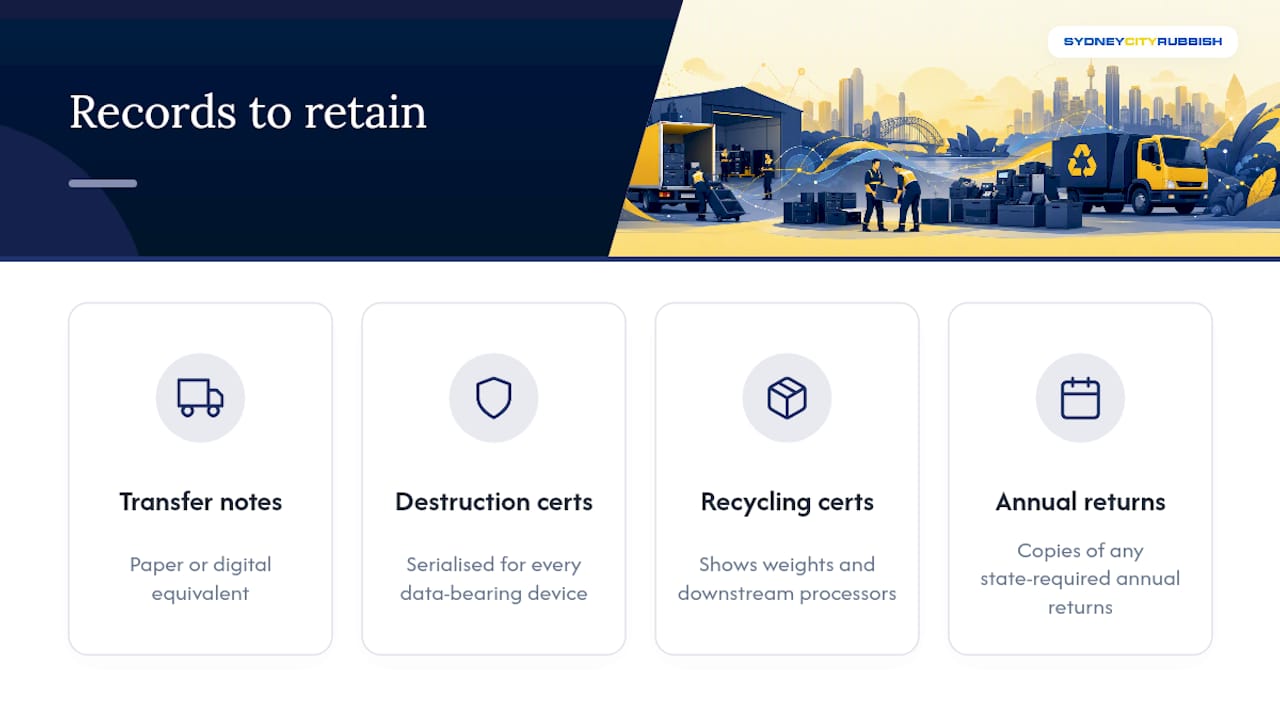
Keep both physical and digital copies. WA’s regulations set specific annual reporting deadlines for significant entities, and missing a lodgement date is its own compliance failure, separate from any handling breach.
What business e-waste recycling typically costs
Costs vary with item type, volume, and whether secure data destruction is required. CRTs and refrigerant appliances usually cost more to process than standard laptops or phones.
Expect a quote and scheduling within days, on-site collection completed in a single visit for most office volumes, and certificates issued within one to two weeks of processing. Batching collections, stripping out non-e-waste beforehand, and asking about remarketing for still-functional equipment all help offset costs.
How a compliant collection actually works
A properly run job follows a consistent sequence, and knowing it helps you judge whether a provider is cutting corners.
- Site assessment and volume estimate
- Asset tagging and manifest creation
- Secure transport to a licensed facility
- Data destruction or sanitisation, documented per device
- AS/NZS 5377-compliant processing and separation
- Certificate issuance with weight reporting
Sydneycityrubbish coordinates the on-site collection and manifest step, then hands data-bearing and hazardous items to certified downstream recyclers for processing. What you receive back is the evidence: serialised certificates, transfer notes, and weight records that satisfy both environmental duty-of-care and Privacy Act enquiries.
Book a compliant collection without the runaround
Sydneycityrubbish is the practical alternative to chasing multiple drop-off points and separate booking systems for offices, retail fitouts, and construction sites clearing electronics alongside general debris in one visit. You get a single quote, a single collection window, and a carbon-neutral disposal option through our partnership with Carbon Neutral, rather than juggling council schedules and separate hazardous-waste bookings.
When you book, ask for the provider’s EPA licence details, their chain-of-custody process, a sample Certificate of Recycling and Certificate of Destruction, current insurance, and exactly what’s included in the quoted price. Get these answers upfront and there are no surprises at invoice time.
Ready to clear e-waste from your office, site, or fitout? Request a quote or book a site assessment and get your collection scheduled this week.
Where to read more
For local drop-off points, check Sustainability Victoria or your state EPA’s e-waste page. Review AS/NZS 5377 guidance before vetting a provider, and keep every certificate and licence detail on file as audit evidence.
Sources
- Electrical and electronic waste (e-waste) — Waste Authority WA
- Control e-waste — Department of Climate Change, Energy, the Environment and Water
- Recycle e-waste — Sustainability Victoria