Suspended Ceiling Removal in Sydney: A Guide for Commercial Sites
Suspended ceiling removal is a short job when the ceiling is checked first, stripped in the right order and hauled away in the same visit. It becomes slow and costly when asbestos is suspected, when services sit hidden above the tiles, or when the debris has nowhere to go. For offices, retail tenancies, warehouses and strata buildings in Sydney, the simplest route is to have the strip-out and the waste removal run as one coordinated job. Sydney City Rubbish removes suspended ceilings as part of building strip-outs and makegood work, coordinates access directly with building management, and takes the tiles, grid and wire away with the rest of the debris.
This guide explains what comes out, what to check before anything is touched, how the work is done in sequence, and how to handle the waste.
TL;DR
- A suspended ceiling is a grid of main beams and cross tees hung on wire, carrying lift-out tiles. All of it, plus the hangers, comes out in a strip-out or makegood.
- Before removal, check the asbestos register and the building’s age. SafeWork NSW says any building constructed or renovated before 1990 could contain asbestos.
- Open one tile first and look above it. Cables, ducts and hangers are often in the way.
- Tiles, metal grid, insulation and wire should be separated at the source so more of the load can be recycled.
- We handle ceiling strip-out, haulage and recycling through registered partners, with building management coordination included.
Table of Contents
- What a suspended ceiling is and what comes out
- Check the building before the first tile comes down
- How a commercial ceiling strip-out runs, step by step
- Sorting and disposing of the debris
- Suspended ceilings in end-of-lease and makegood work
- Timing, access and avoiding delays
- Ceiling removal across Sydney
- Get the ceiling and the waste handled together
- FAQ
- Sources
What a suspended ceiling is and what comes out
A suspended ceiling, also called a drop ceiling or false ceiling, is a lightweight secondary ceiling hung below the structural slab. Its parts are main beams, cross tees, wall mouldings, ceiling tiles and hanger wires, and the gap above is called the plenum, according to Armstrong’s installation guide. That gap usually carries electrical cabling, data cabling, air-conditioning ducts, sprinkler pipework and light fittings.
The tiles themselves vary. A UK trade guide from the Finishes and Interiors Sector lists mineral wool, metal and gypsum as common exposed-grid tile materials, and concealed-grid systems may use other materials such as calcium silicate or glass wool. Acoustic ceiling tiles are usually the mineral wool or fibre type, chosen to absorb sound in open-plan offices and meeting rooms.
The same guide notes that exposed-grid systems hang from the soffit (the underside of the slab above) on pre-tensioned wire, rigid angle, rigid hangers or threaded rod. That matters in a strip-out because each hanger type comes down differently, and each leaves fixings in the slab that may need to be removed for a clean handback.
When people search for ceiling grid removal, drop ceiling removal or acoustic ceiling tile removal, they are describing the same job at different stages. In a commercial strip-out, everything below the slab that belongs to the ceiling system is removed: tiles, grid, wall angle, wire, and often the light fittings and diffusers set into it.
Check the building before the first tile comes down
This is the stage that decides how the job runs. Two checks matter: asbestos and live services.
Asbestos and the pre-1990 rule
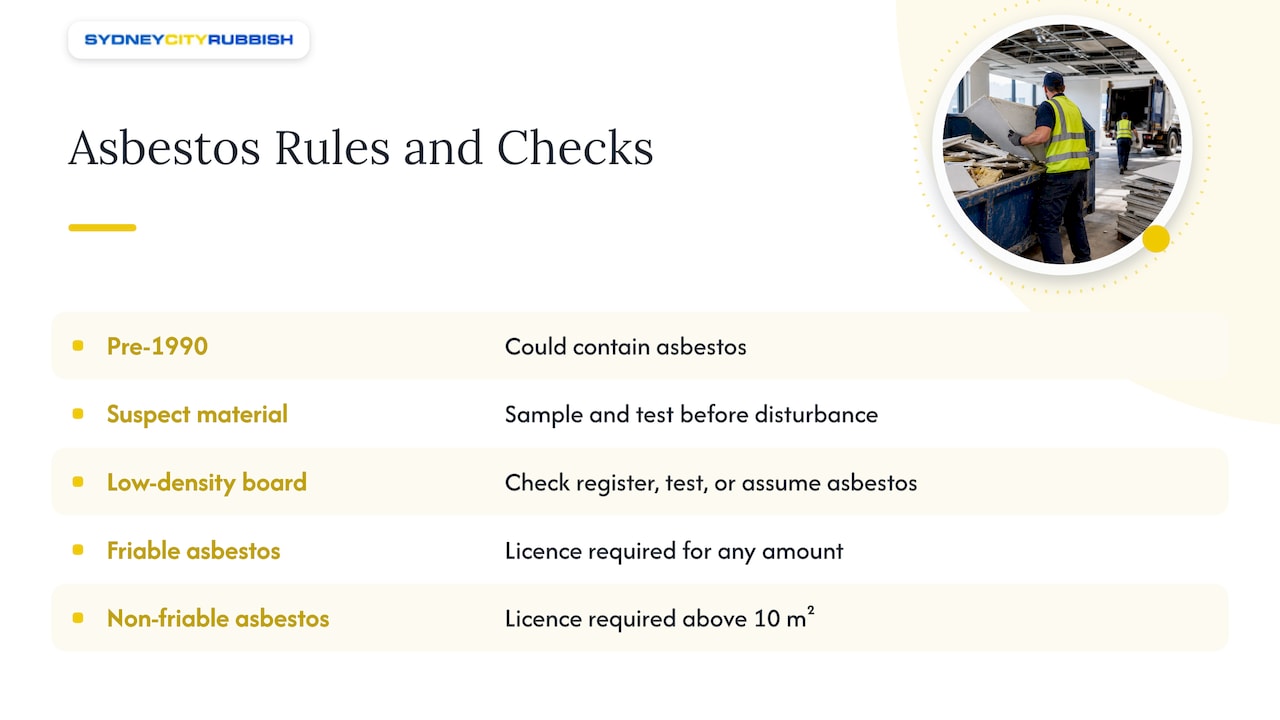
Asbestos cannot reliably be identified by sight. The Queensland Building and Construction Commission states that suspect material should be sampled and tested before it is disturbed. SafeWork NSW’s construction guidance says that any building constructed or renovated before 1990 could contain asbestos. A great many Sydney office floors, retail strips and warehouses fall inside that window, including ones refitted in the 1980s.
For low density board, which is the kind of sheet product sometimes found in ceilings, Safe Work Australia’s December 2024 guide says to consult the workplace asbestos register, have a sample analysed, or assume the material contains asbestos. The same guide asks you to assess how friable (easily crumbled) the material is, whether a licence is needed, and risks such as electricity, falls, manual handling and heat stress.
The licensing line is important to know. The guide states that a removal licence is required for any amount of friable asbestos, or more than 10 square metres of non-friable asbestos. The Work Health and Safety Regulations also set duties for identifying asbestos before demolition, licensed removal, removal control plans, notification, access restriction, decontamination, waste disposal and clearance. In New South Wales, SafeWork NSW is the regulator to contact about licensing and notification.
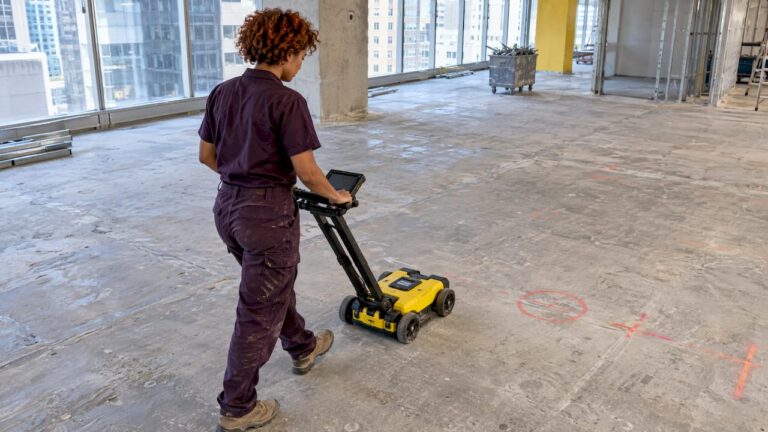
In practice, a property manager or tenant should ask the building owner for the asbestos register before booking any ceiling work. If the register is missing, out of date or silent on the ceiling, a licensed asbestos assessor takes a sample. If asbestos is confirmed, that part of the work goes to a licensed asbestos removalist, and the ordinary strip-out follows once clearance is given. Where the register shows the ceiling is clear, the job proceeds as a standard strip-out.
Services above the tiles
The void is not always empty. The UK trade guide advises looking above each tile before lifting it, because cables, ducts and hangers may be resting on or snagging the panel. A controlled first opening shows what is up there before the wider removal starts.
Safe Work Australia’s guide also says to isolate electrical equipment and roof-space power when accessing the cavity, and to turn off HVAC plant and cover supply and return vents with 200-micrometre plastic sheeting when low density board is being removed. Even where no asbestos is involved, live cabling and air-conditioning ducts are the reason a ceiling should be stripped with the services in mind rather than pulled down in one pass.
How a commercial ceiling strip-out runs, step by step
Here is the sequence on a typical office or retail tenancy. Each step shows where jobs go wrong and where an experienced strip-out crew saves time.
Step 1: Confirm access and sign-offs
Commercial buildings control lift bookings, loading dock times, after-hours entry and floor protection. A ceiling job that arrives without these confirmed is turned away at the dock. We coordinate directly with building management so that access, lift use and working hours are agreed before the crew and truck arrive, which takes that admin off the tenant or property manager.
Step 2: Clear and protect the floor
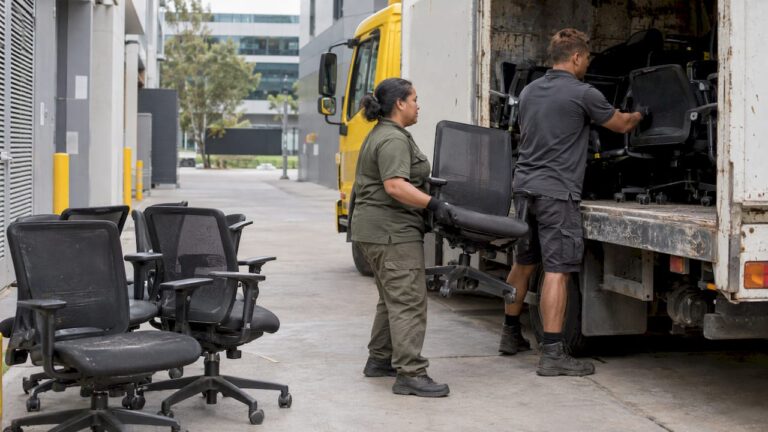
Furniture, partitions and loose fit-out are removed or moved first so ceiling debris does not land on workstations or carpet. If the lease requires furniture and joinery removal as well, it is efficient to do it in the same visit. We remove office furniture and joinery as part of the same strip-out and haulage.
Step 3: Open a tile and inspect
Push a tile gently upward, check what sits above it, then angle and rotate it clear of the grid. The UK trade guide describes this method for accessible exposed-grid tiles, and also notes that clean cotton gloves help avoid marking mineral-wool and gypsum panels. Armstrong’s guidance is similar: lift with both hands, angle the tile through the opening and lower it carefully. Damaged or crumbled tiles generate dust, so careful handling helps both air quality and the waste volume.
Step 4: Remove tiles in zones
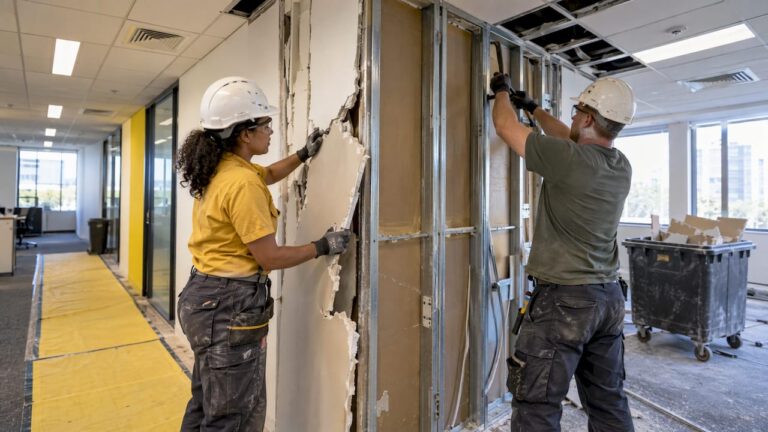
Work in bays, stacking tiles flat and carrying them straight to the collection point rather than letting them pile up on the floor. Light fittings and diffusers set into the grid are disconnected by a licensed electrician where they are wired in. Dust and fibre are easier to control in one zone at a time.
Step 5: Dismantle the grid
Once the tiles are out, cross tees are released from the main beams and the main beams are unhooked or cut at their hangers. Grid sections are bundled by type. Reusable grid pulled apart carefully can be stacked, but in most commercial makegoods the grid is scrap metal, and that is worth keeping separate.
Step 6: Take down hangers and wall angle
Hanger wires, rods and wall angle are removed last. Leftover wire is a hazard at head height and a snag risk for the next fit-out, so it goes before the floor is signed off. Any fixings left in the slab are addressed according to the makegood scope.
Step 7: Clean and hand back
A tenancy is not finished until the floor has been swept and vacuumed and nothing is left in the void. Our commitment is a meticulous clean-up so that no waste is left behind, ready for the building manager’s inspection.
Sorting and disposing of the debris
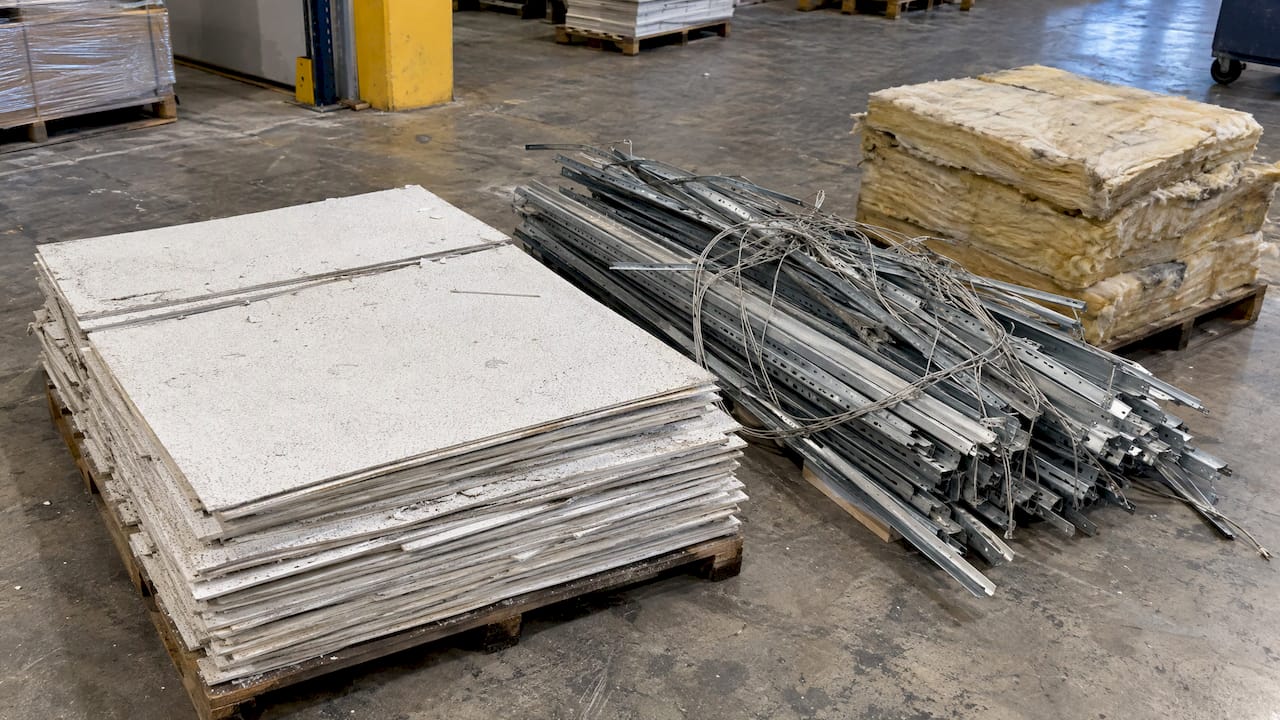
A ceiling strip-out produces mixed material: mineral fibre or gypsum tiles, steel grid and wire, sometimes insulation batts above the ceiling, and packaging and offcuts from other trades. The separation approach below keeps loads cleaner and makes recycling possible.
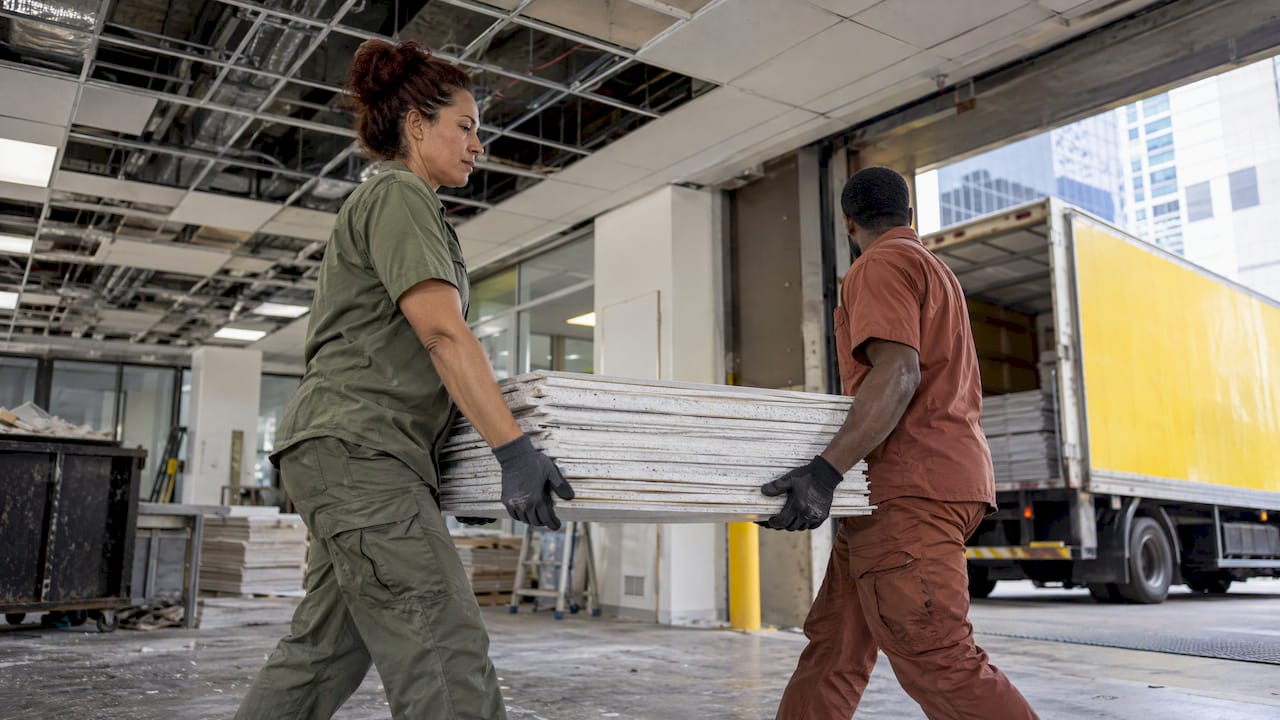
Keep tiles dry and flat, separate metal from tile, and keep insulation, cabling and other debris out of the tile stack. This simple discipline is what allows a recycler to accept a load. We dispose of waste responsibly through registered recycling partners, and a sorted load is easier to route that way.
Asbestos is different and must not be mixed in. Safe Work Australia’s code of practice states that asbestos waste and contaminated disposable PPE must be contained and labelled before it leaves the removal area, then disposed of as soon as practicable at a site authorised to accept it. The QBCC adds that asbestos must not go into household bins, skips or council waste collection. Because of those rules, an unconfirmed ceiling should never be stripped into a general skip. Confirm it first, and the rest of the debris can move without delay.
For the general stream, see our guides on the importance of waste separation in construction and demolition and managing your construction waste. If your ceiling work includes plasterboard bulkheads, the page on disposing of plaster products covers that material.
Carbon-neutral disposal
Corporate tenants often have sustainability targets or reporting obligations. We offer a carbon-neutral waste disposal opt-in, partnering with Carbon Neutral, so a business can choose it for the removal job. It is opt-in, so it can be written into the booking when the tenant’s reporting calls for it.
Suspended ceilings in end-of-lease and makegood work
For property managers and tenants leaving an office or warehouse, the ceiling is usually written into the makegood clause. Depending on the lease, the landlord may want the original ceiling reinstated, the tenant’s added ceiling removed, or an open-plenum finish with the services tidied. Read the lease and the original base-building condition report first, because the answer determines whether the grid comes out entirely or only the damaged tiles are replaced.
Our page on Defit vs make good explains the difference between the two in Sydney leases, and office makegood describes how the work is delivered. Our makegood and strip-out overview outlines how ceilings, walls, floors and joinery fit together. We also provide ceilings, walls and doors removal, floor finish removal and grinding, and furniture and joinery removal under one booking.
When an office closes while a business relocates, the ceiling job is one task among many. For the wider move, these commercial relocation planning tips are a useful starting point for sequencing. If the space is staying in use and being refitted, managing inventory during renovations shows how contractors keep stock and supplies organised while work is under way.
For strata managers, the principle is the same on common property. Check the register, confirm the building’s access rules, book the lift and dock, and have the haulage arranged so debris does not sit in a car park or stairwell.
Timing, access and avoiding delays
The delays on ceiling jobs rarely come from the ceiling. They come from four predictable gaps:
- no asbestos register or sample result on file when the crew arrives;
- no lift or loading dock booking;
- services still live in the void;
- no truck arranged for the debris, so material accumulates on site.
The last point is where combining the strip-out with the haulage helps. We provide truck and driver hire as well as removal, and we guarantee punctuality, with compensation if we are late. Electronic quoting is fast, so a property manager can have a figure on the file before a lease handback date tightens.
For larger scopes, such as full floors or multi-tenancy refits, the waste management for commercial renovations and new builds page describes how waste planning fits into the project. If the ceiling is one part of a bigger demolition scope, see commercial demolition in Sydney.
Ceiling removal across Sydney
We work across the Sydney CBD, Parramatta, Ryde, Macquarie Park, Sydney Olympic Park, North Sydney, and South West and Greater Western Sydney. In the CBD, loading dock windows and lift bookings are tight, and our pages on office rubbish removal in the Sydney CBD and rubbish removal in the Sydney Central Business District describe how we work with those constraints.
Get the ceiling and the waste handled together
If you are planning an office strip-out, a warehouse handback or a retail makegood in Sydney, we can quote the ceiling removal, grid and hanger clearance, and the haulage as one job. Start with our building strip-out and makegood services, or request a quote through the commercial waste removal page. Send the address, the approximate floor area and the building’s access rules, and we will come back with a quote.
FAQ
Do I need an asbestos test before removing a suspended ceiling?
If the building was constructed or renovated before 1990, SafeWork NSW says it could contain asbestos. Start with the building’s asbestos register. If it does not clearly cover the ceiling, a sample analysed by a licensed assessor settles the question before any tile is disturbed.
What is the difference between a suspended ceiling, a drop ceiling and a false ceiling?
They are different names for the same thing: a grid hung from the slab above on wires, holding lift-out tiles. In a commercial strip-out, drop ceiling removal and ceiling grid removal both mean taking out the tiles, the grid and the hangers.
Can acoustic ceiling tiles be removed without breaking them?
Often, yes, on an exposed grid. Lift the tile gently, check above it, angle and rotate it through the opening, and stack it flat. Armstrong’s guidance describes the same approach. Old or water-stained tiles tend to crumble, so they are usually disposed of rather than reused.
Can you remove the ceiling and take the waste away in one visit?
Yes. We handle ceiling, wall and door strip-out, furniture removal and haulage under one booking, coordinating access with building management. Send us the address and scope for a quote.
Who is responsible for removing a ceiling at the end of a lease?
That depends on the lease makegood clause and the base-building condition at the start of the tenancy. Check both, then confirm the scope with the landlord or their agent before booking the work.
Sources
- How To Install Drop Ceilings, Armstrong Kanopi
- How to remove drop ceiling tiles, Armstrong Kanopi
- Maintenance and Access into Suspended Ceilings, Finishes and Interiors Sector
- Guide to identifying and handling low density asbestos, Safe Work Australia, December 2024
- How to safely remove asbestos, Safe Work Australia, July 2020
- Asbestos safety, Queensland Building and Construction Commission
- Building and construction, SafeWork NSW
- Work Health and Safety Regulations 2011, 14 October 2024 compilation
- Commercial relocation planning tips
- Managing inventory during renovations