100 Litres Per Visit: Paint Disposal Rules for Sydney Businesses
If your leftover paint is unmixed, clearly labelled and within scheme limits, take it to Paintback or an accepting Community Recycling Centre. If it is bulk, mixed, solvent-based or unlabelled, treat it as hazardous waste and call a licensed contractor who can manage tracked collection and paperwork. There are contractors in Sydney that handle that second scenario for businesses, offering carbon-neutral disposal options and full documentation.
TL;DR:
- Unmixed, labeled, and within scheme limits paint is accepted at paint recycling centers or community facilities, while mixed, solvent-based, or unlabelled paint must be treated as hazardous waste with contractor management.
- Proper on-site segregation involves sorting by water- or solvent-based type, keeping containers upright and sealed, labeling clearly, and logging details to avoid costly hazardous waste procedures.
- Disposal of small volumes through Paintback or local recycling centers is free, but exceeding volume limits or handling unclassifiable paint incurs fees that reflect transport, labor, and documentation costs.
- Non-compliance with hazardous waste regulations can lead to substantial penalties, making professional, documented disposal a safer and often cheaper option in the long run.
- Sydney businesses should plan disposal early; for large or complex jobs, engaging licensed contractors with proper paperwork prevents environmental and legal risks.
Table of Contents
- Immediate on-site actions: segregate, label, store and triage paint safely
- How long does paint disposal actually take?
- What does paint disposal cost for a Sydney business?
- Sydney City Rubbish: compliant commercial paint and hazardous-waste collections
- Primary sources to verify rules and find local drop-off points
- Sources
- FAQ
Immediate on-site actions: segregate, label, store and triage paint safely
Most compliance failures happen before a single container leaves the site. Getting the first hour right determines whether your paint waste is a simple drop-off or a costly hazardous-waste job.
Start by checking whether the paint is genuinely “unmixed.” That means it is still in its original container, has not been combined with another product, and the label or a photo of the tin clearly shows whether it is water-based or solvent-based. If a supervisor has already tipped two half-tins together to save space, that decision has likely just changed the waste classification.
Here is the triage sequence worth running on every job site or warehouse clean-out:
- Sort by type — separate water-based (acrylic) from solvent-based (oil, enamel) paint before anything else.
- Check the container — original tin with a legible label, or a reasonable substitute label, is required for Paintback and most council centres.
- Seal and stand upright — lids fully closed, tins stored upright on a bunded tray or spill pallet, away from drains.
- Label clearly — product name, base type, and the date it was decanted or opened.
- Photograph and log — record volumes and container counts before collection, for your own records.
Never mix paint types or add solvents, thinners or other chemicals to “consolidate” containers. Once paints are blended or contaminated with an unknown substance, the waste usually can’t be confidently classified on-site, and current guidance treats unclassifiable paint as hazardous by default, which pushes you straight into contractor territory. Industry advice on paint handling backs the same principle: keeping paint in its original containers and avoiding mixed chemistries preserves both reuse options and Paintback eligibility, while combining paint with solvents commonly converts a recyclable leftover into tracked hazardous waste.
Pro Tip: Keep a simple paint register on a clipboard near your storage area. Every tin gets a line: product, base type, volume, date logged. It takes thirty seconds per tin and becomes your evidentiary record if a council or the EPA ever asks how the waste was handled.
How long does paint disposal actually take?
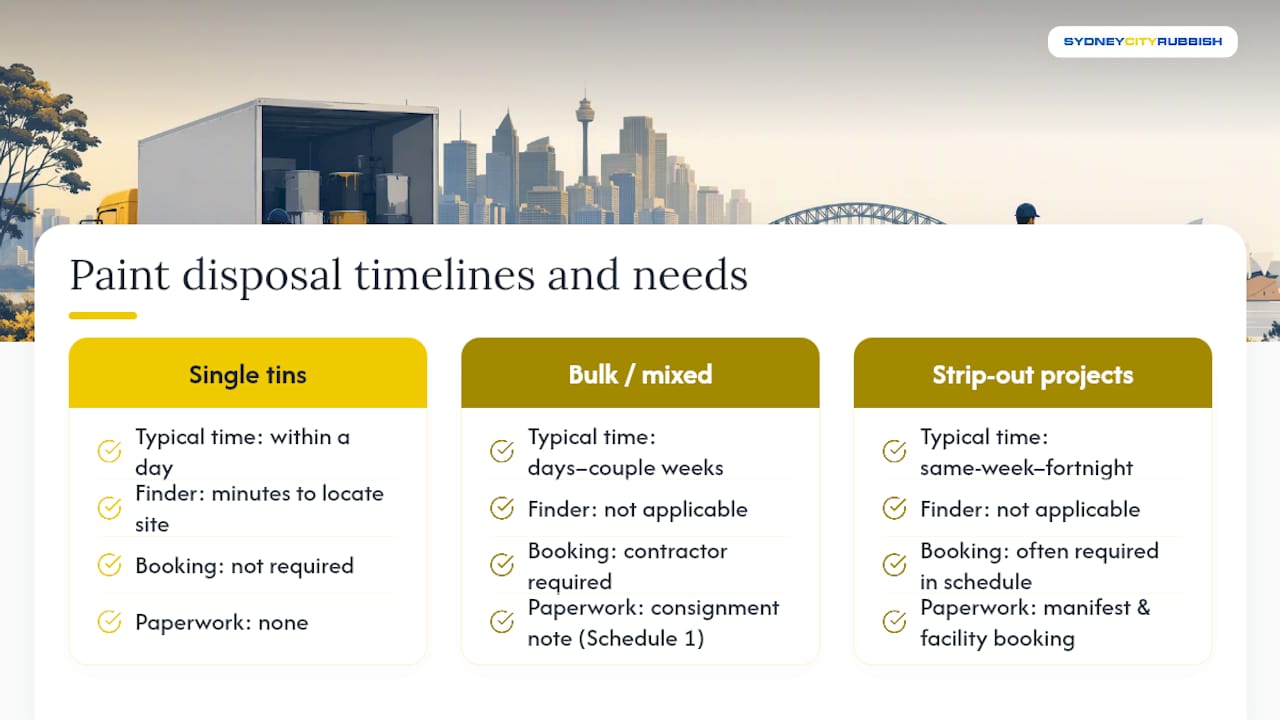
A single tin of labelled, unmixed paint can be off your premises within a day. A Paintback location finder search takes minutes, and most metro drop-off points operate during standard business hours with no booking required, subject to the container and per-visit limits Paintback publishes. Drive to the nearest site, hand over the tins, done.
Bulk or mixed paint runs on a different clock. Once you’ve triaged and logged the waste, engaging a licensed contractor typically involves a site assessment, scheduling a collection window, and the contractor completing on-site segregation and packing before transport. For paint that falls under Schedule 1 tracking requirements, the contractor issues a consignment note at collection, and you should expect confirmation of delivery to an authorised facility within days to a couple of weeks, depending on volume and the facility’s intake schedule.
For a strip-out or makegood project generating dozens of tins across a multi-week program, the realistic timeline runs from same-week collection for small volumes to a fortnight for larger jobs requiring manifest paperwork and facility booking. Businesses that plan disposal into the project schedule, rather than treating it as an afterthought once the job is finished, avoid the bottleneck of paint tins sitting in a corridor while someone tries to source a contractor at the last minute.
What does paint disposal cost for a Sydney business?
Drop-off through Paintback or an eligible Community Recycling Centre is free for the volumes those schemes accept, since the scheme is levy-funded rather than charged at the point of disposal. That covers most small trade quantities: Liverpool’s Community Recycling Centre accepts up to 100 litres of paint per day, and City of Canada Bay’s CRC applies a similar 100-litre limit for water and oil-based paint, though both are pitched at domestic quantities rather than ongoing commercial volumes.
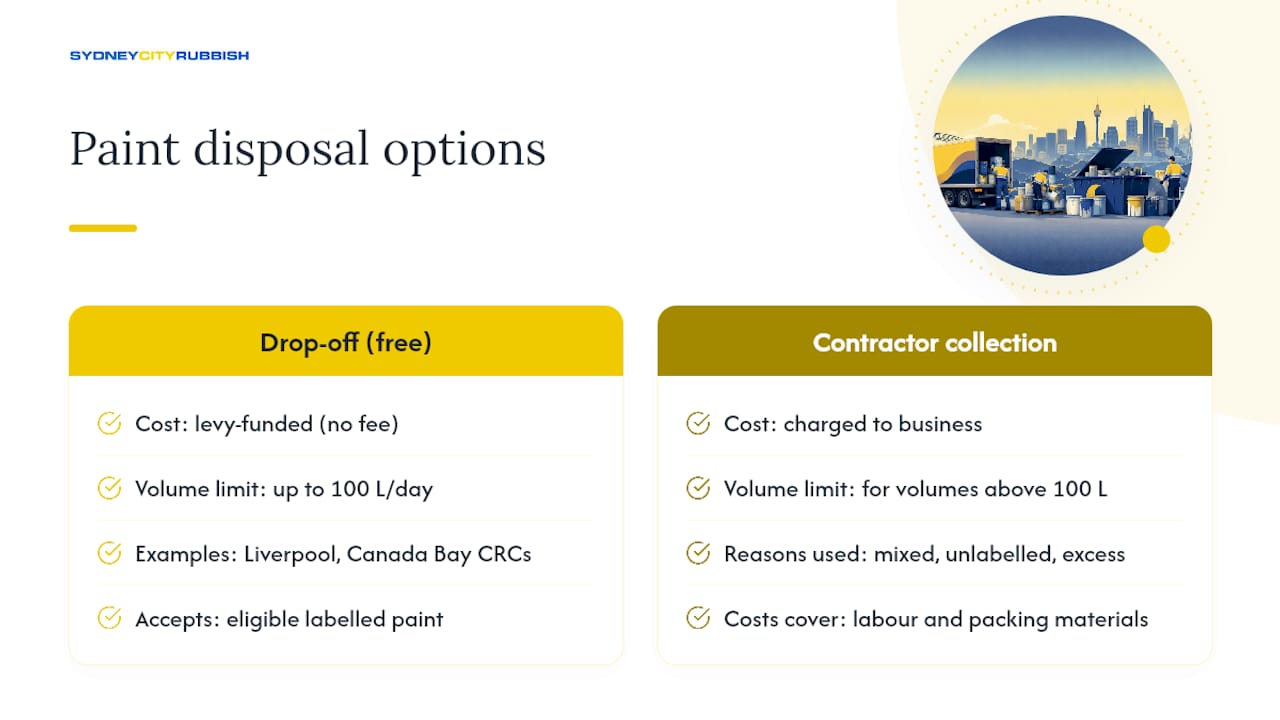
Once you exceed those limits, or the paint is mixed or unlabelled, cost shifts to contractor fees, which vary by volume, container type and whether tracked transport documentation is required. Expect this to sit well above a casual drop-off, reflecting the labour, packing materials, transport and facility gate fees involved in a compliant, tracked collection.
The real financial risk sits with non-compliance rather than the disposal fee itself. Improper disposal of hazardous waste under NSW environmental law can attract significant penalties for businesses, on top of clean-up costs if waste is found dumped or mishandled. Weighed against that, a contractor invoice for a documented, compliant collection is the cheaper outcome every time.
Sydney City Rubbish: compliant commercial paint and hazardous-waste collections
When paint waste moves past what Paintback or your local CRC can take, you need a contractor who understands both the volume and the paperwork. Sydney City Rubbish offers hassle-free commercial waste removal across Sydney, built around the reality that offices, retail fit-outs and construction sites generate hazardous material alongside everyday waste, not instead of it.
Some companies operate with carbon-neutral options through partnerships with environmental organizations, and work with registered recycling partners to ensure paint and other hazardous waste goes to authorised facilities rather than landfill bins, following Gestion des déchets d’immeuble : le plan qui évite les nuisances. That matters if your business faces an audit or insurance review, because you need proof of where the waste went, not just proof it left the building.
For bulk paint collections, scheduled hazardous-waste pick-ups, or jobs requiring chain-of-custody paperwork for compliance records, contact professional rubbish removal services. Get a free quote now through the commercial rubbish removal team and get the tins off your site before they become a bigger problem than they need to be.
Primary sources to verify rules and find local drop-off points
Confirm current limits and locations directly with these sources before your next collection:
- NSW EPA hazardous waste tracking guidance for classification and consignment obligations
- Paintback trade painter information for location finder and volume limits
- Liverpool Community Recycling Centre and Randwick City Council Recycling Centre
- City of Canada Bay CRC and Thornleigh Community Recycling Centre
- Northern Sydney Community Recycling Centre and Kimbriki Resource Recovery Centre
Sources
- Tracking and transporting hazardous waste — NSW Environment Protection Authority
- Liverpool Community Recycling Centre — Liverpool City Council
- City of Canada Bay Community Recycling Centre
FAQ
Can Sydney businesses use Paintback for trade paint waste?
Yes, trade painters can use Paintback subject to per-visit container and volume limits at each participating location. Check the specific site’s limits before loading up, since some councils restrict access to residents only.
What counts as hazardous paint waste in NSW?
Mixed, unlabelled, or unknown-solvent paint is treated as hazardous by default because it can’t be confidently classified on-site. Once paint falls under Schedule 1, NSW EPA tracking rules require consignment documentation for transport.
How much paint can I drop off at a Community Recycling Centre?
Most Sydney CRCs cap paint drop-off around 100 litres per visit, as seen at Liverpool and City of Canada Bay, and some, like Randwick, apply a per-container limit instead. These limits are generally aimed at domestic quantities, not ongoing commercial volumes.
When should a business call a licensed contractor instead of a CRC?
Call a contractor once paint volumes exceed CRC or Paintback limits, or when paint is mixed, solvent-contaminated or unlabelled. Sydney City Rubbish handles these commercial collections with tracked documentation for compliance records.
What documents should I keep after paint disposal?
Keep photographs of containers, a volume log, and any consignment note or proof-of-delivery a contractor issues for tracked hazardous waste. These records are what you’d need to show a council or the EPA that disposal was handled properly.