Sydney warehouse cleanout: $500–$700 truckload rates, lease and EPA risks
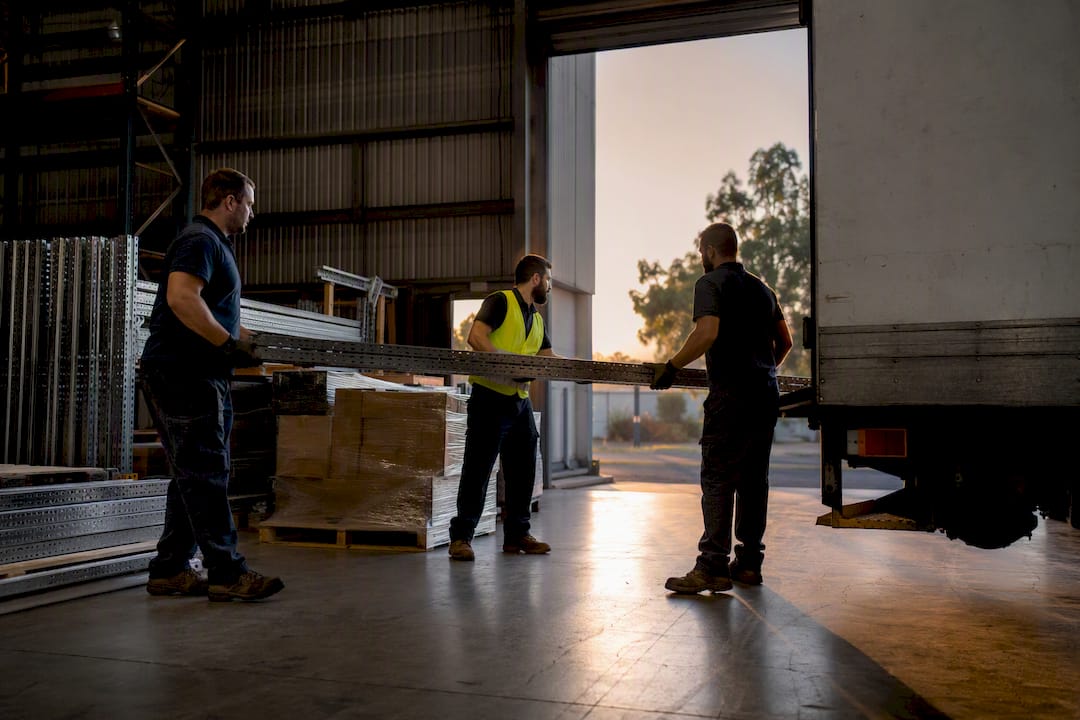
A typical Sydney warehouse cleanout runs from around $500 to $700 for a single large truckload up to tens of thousands of dollars for a full make-good project, quoted either per truckload or as a fixed project price once a provider inspects the site. The exact figure depends on volume, access, hazardous materials, and any lease-driven reinstatement work. Book a site inspection and written quote before you budget anything more precise.
TL;DR:
- Warehouse cleanout costs in Sydney range from around $500 to $700 for small truckloads, with larger or complex projects significantly more expensive.
- Pricing models include per truckload for straightforward jobs, per square metre for strip-outs, and fixed quotes for full make-good or hazardous waste removal.
- Lease obligations, especially make-good clauses, often drive final costs beyond simple rubbish removal, requiring proper documentation to avoid disputes.
- Waste classification and disposal in NSW require proof of permitted transporters and facilities to prevent legal liabilities and penalties.
- Booking at least two to three weeks in advance helps secure better rates and scheduling, especially during high-demand periods like lease expiry or financial year-end.
Table of Contents
- How warehouse cleanout cost works in Sydney
- Does your lease affect how much a cleanout will cost?
- What NSW rules govern warehouse waste disposal?
- How do you get an accurate cleanout quote?
- When should you schedule a warehouse cleanout, and does timing change the price?
- What’s actually included in a warehouse cleanout quote?
- What happens from your first enquiry to the final clean?
- How do you choose the right warehouse cleanout provider in Sydney?
- Why Sydneycityrubbish is a straightforward local option
- Sources
- FAQ
How warehouse cleanout cost works in Sydney
Sydney providers quote warehouse cleanouts three different ways, and knowing which one applies to your job changes how you should read any price you’re given.
Per truckload (cubic metre) pricing suits smaller, straightforward jobs: clearing out old pallets, damaged stock, redundant shelving, or general office debris left behind by a departing tenant. A provider fills a truck to a set volume and charges accordingly, which makes it easy to compare quotes if you’re only shifting a partial load.
Per square metre pricing usually applies to strip-outs, where fixtures, partition walls, flooring, and fit-out elements come out rather than loose junk. Office and strip-out work in Sydney commonly falls somewhere between $50 and $150-plus per square metre depending on scope, according to make-good clause guidance from Dettmanns, though a warehouse with heavy racking or contaminated flooring will sit at the higher end.
Fixed project quotes cover anything with genuine complexity: demolition, concrete work, hazardous waste, or a full make-good back to base building condition. Here’s a rough sense of what property managers typically budget for:
- Small truckload (general waste, single room or bay): falls in a moderate price range
- Large truckload (full bay clearance, old stock, pallets): typically costs more than smaller loads
- Strip-out work priced per square metre: cost varies significantly depending on fixtures and finishes
- Full make-good project (demolition, floor remediation, waste removal combined): can be costly for larger warehouses
A provider will usually convert from per-truck to a project quote once they see the site and realise labour, access constraints, or reinstatement work will outweigh the value of counting truckloads. That shift is a sign of an experienced contractor, not a red flag. Per-truck pricing rarely captures the real labour and disposal cost of a complex strip-out, which is why seasoned operators default to a scoped project quote rather than guessing at load counts.
Does your lease affect how much a cleanout will cost?
Almost certainly, yes. Most commercial and industrial leases in NSW include a make-good clause that obliges the tenant to return the warehouse to a defined condition, sometimes the state it was in at lease start, sometimes a specified “base building” standard. That clause, not the volume of rubbish sitting on the floor, is often what determines your final bill.
Make-good obligations frequently rank among the largest end-of-lease costs a commercial tenant faces, according to Jake Law’s overview of NSW commercial lease obligations. A cleanout that would otherwise be a couple of truckloads can balloon into a project quote once you add wall removal, floor grinding, ceiling grid reinstatement, or repainting because the lease demands it.
The single biggest lever you have is documentation. A schedule of condition recorded with dated photos at lease commencement gives you something concrete to argue from if a landlord tries to claim the warehouse needs work that predates your tenancy. Property managers who keep this record substantially reduce disputes over what “make-good” actually requires, per RICS guidance on make-good practice in Australia. If you can’t locate the original schedule, ask your provider to document current condition thoroughly before work starts, because that record protects you either way.
What NSW rules govern warehouse waste disposal?
Every business generating waste in NSW carries legal responsibility for how it’s handled, not just the transporter you hire. Service NSW is explicit that both the waste generator and the transporter can be held liable if material ends up at an unauthorised facility, and non-compliance carries serious legal and financial penalties.
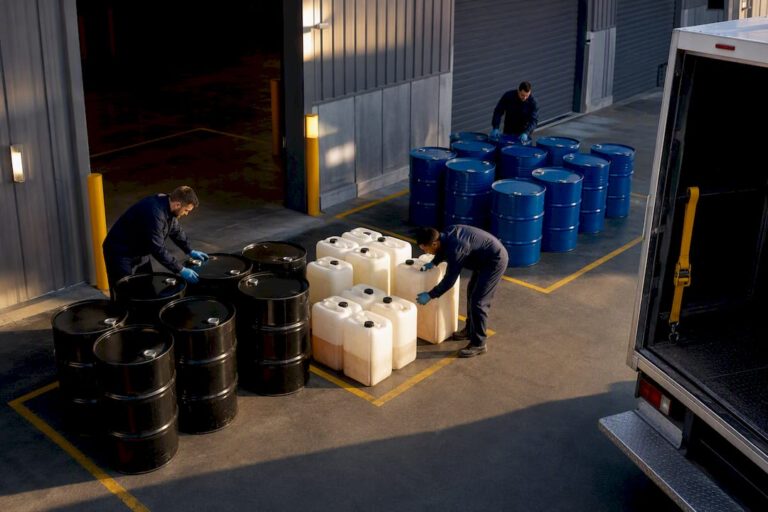
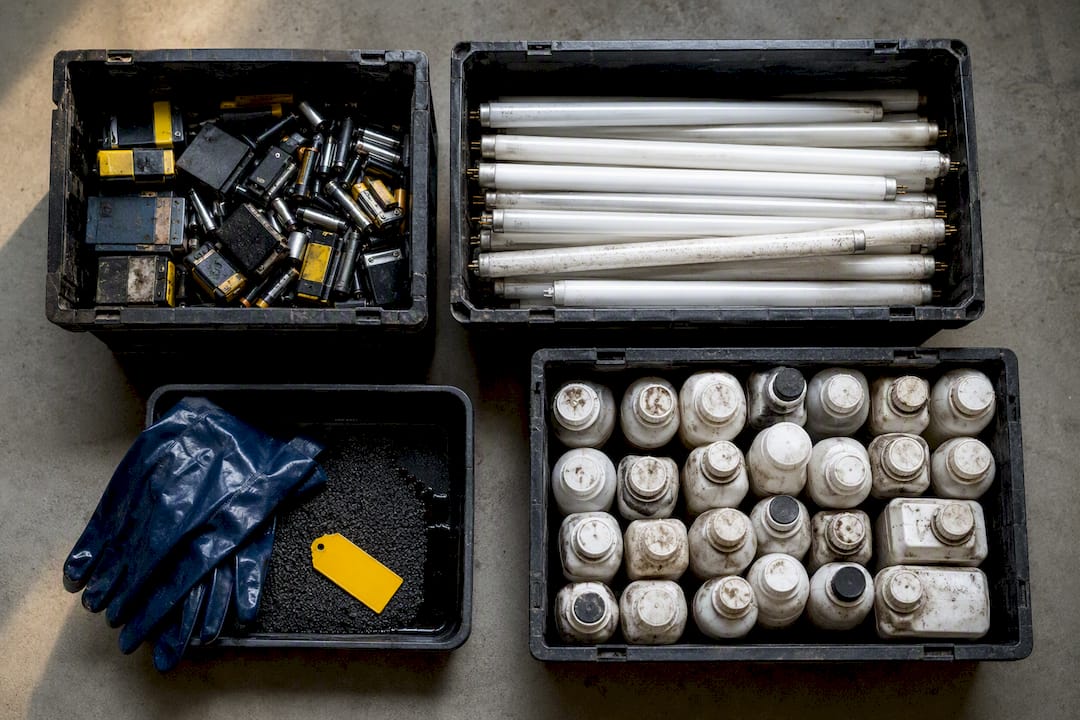
That liability is why the classification of your waste matters before a single truck leaves the dock. The NSW EPA sorts commercial waste into categories, general solid waste, putrescible waste, building and demolition waste, and hazardous waste, and some materials aren’t suitable for standard landfill without formal immobilisation approval, as outlined in the EPA’s waste classification guidelines. A warehouse cleanout that turns up old batteries, fluorescent tubes, asbestos-containing materials, or chemical residue needs separate handling, and mixing it in with general waste is where operators run into trouble.
Ask any provider for proof they use authorised transporters and permitted disposal facilities before you sign off. Weighbridge or tipping dockets and waste transfer documentation create the paper trail you’d need if a dispute ever surfaces about where your waste actually went, which matters more than most tenants realise until they’re asked to prove it.
How do you get an accurate cleanout quote?
An accurate quote starts with a site inspection, not a phone estimate. Photos and a rough description tell a provider almost nothing about access constraints, floor condition, or what’s hiding behind the racking.
Before the inspection, walk the space yourself and note anything unusual: chemical drums, old machinery, asbestos-era ceiling tiles, or stock that might be classified as hazardous. Flag lease obligations upfront too, since a provider quoting a simple clearance will miss reinstatement costs entirely if they don’t know make-good applies.
During the site visit, ask direct questions:
- Is this a per-truckload rate or a fixed project quote, and what triggers the switch?
- Does the price include disposal receipts and waste tracking documentation?
- How is hazardous or classified waste handled, and is that cost separate?
- What’s excluded from this quote, floor remediation, wall patching, final clean?
- What’s your typical lead time once I confirm the booking?
A written quote that itemises scope, exclusions, and disposal method is worth far more than a verbal ballpark. If a provider won’t commit anything to paper before starting, treat that as a warning sign rather than a convenience.
When should you schedule a warehouse cleanout, and does timing change the price?
Timing affects both cost and stress levels. Bookings made with two to three weeks’ notice generally get better rates and more flexible scheduling than jobs called in as an emergency, because providers can plan trucks and crew efficiently rather than reshuffling other bookings.
End-of-financial-year and end-of-lease periods, particularly the run-up to 30 June and common lease-expiry months, see genuine demand spikes across Sydney. If your make-good deadline falls in that window, lock in a provider well ahead of time rather than competing with every other tenant vacating on the same date.
Larger make-good or demolition projects also need staged scheduling. Waste removal, floor grinding, and reinstatement work don’t happen simultaneously. Expect a sequence: clearance first, then any concrete or floor work, then final waste removal and clean. Trying to compress that sequence to meet a tight deadline usually pushes the price up, since it often means multiple crews or extended hours rather than one straightforward pass through the site.
Weather and access also matter for outdoor loading bays or sites with limited truck access. A provider who can only load during specific council-permitted hours or around other tenants’ operations will factor that into scheduling and, sometimes, price.
What’s actually included in a warehouse cleanout quote?
The headline number in a quote rarely tells the whole story. A genuinely useful quote breaks the total into components you can check against the site yourself.
| Cost component | What it typically covers |
|---|---|
| Labour and loading | Crew time to sort, lift, and load waste |
| Truck and disposal fees | Vehicle hire and tipping fees at permitted facilities |
| Hazardous waste handling | Separate collection and disposal for classified materials |
| Floor or structural remediation | Concrete grinding, patching, wall removal for make-good |
| Waste levy pass-through | Landfill levy costs, which rise as Greater Sydney’s landfill capacity tightens |
| Documentation | Waste tracking, tipping dockets, disposal receipts |
Hidden costs tend to surface in a few predictable spots: additional charges for hazardous materials discovered mid-job, extra labour for stock that needs manual sorting rather than bulk removal, and disposal levy increases if the classification of your waste changes once it’s assessed. Ask upfront whether the quote is capped or subject to revision if the scope changes on site.
Sustainable disposal options can also shift where your money goes without necessarily changing the total. Diverting recyclable material away from landfill reduces exposure to the waste levy over time, an outcome the NSW EPA’s business recycling guidance links directly to landfill capacity pressure across Greater Sydney. A provider offering combined waste management for larger projects can usually report on how much material was recovered versus landfilled, which matters if your business reports on sustainability metrics.
What happens from your first enquiry to the final clean?
The process from enquiry to a completed cleanout typically follows a consistent sequence, though the timeframe stretches or compresses depending on project size.
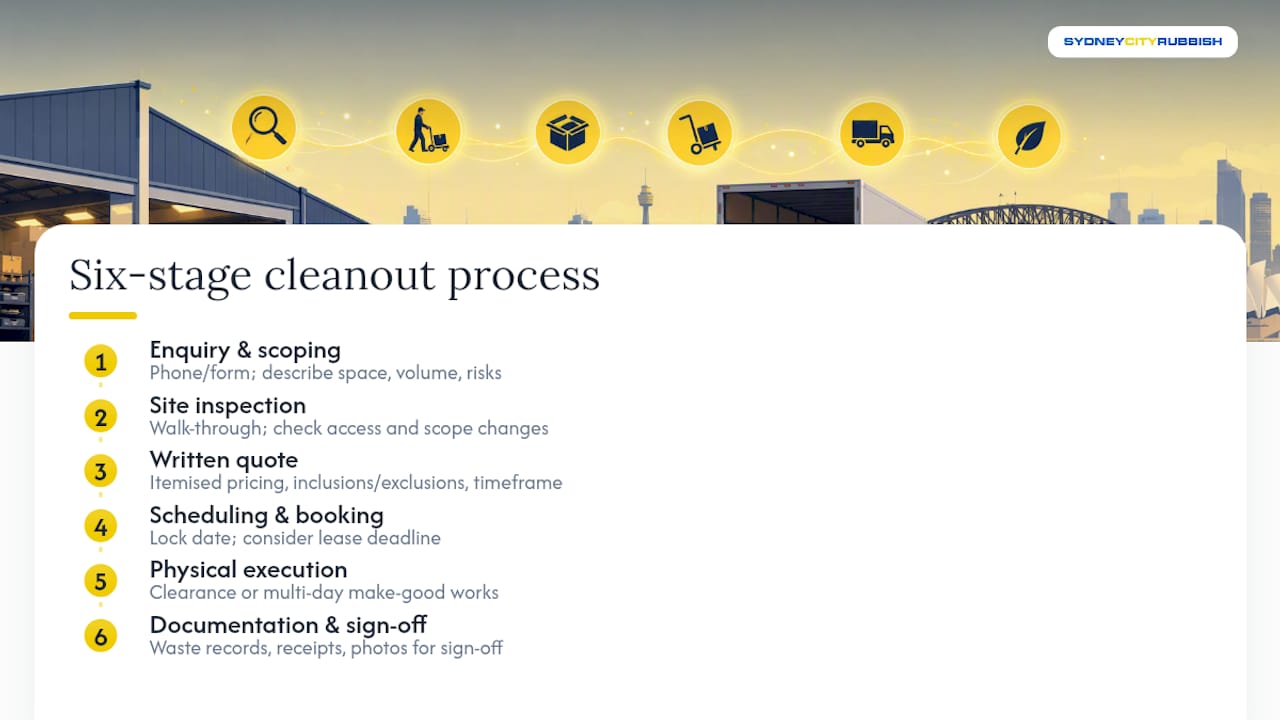
Enquiry and initial scoping happens first, usually a phone call or online form where you describe the space, rough volume, and any known complications like hazardous materials or make-good obligations. Site inspection follows within a few days, where the provider walks the warehouse, checks access, and identifies anything that changes scope. Written quote comes next, itemising pricing model, inclusions, exclusions, and estimated timeframe.
Once you accept, scheduling and booking locks in a date, factoring in your lease deadline if one applies. Execution is the physical work itself: for a simple clearance, this can be a single day; for a full make-good with demolition and floor remediation, expect it staged across a week or more. Documentation and sign-off closes the loop, with waste tracking records and disposal receipts handed over, and for lease-related jobs, photos confirming the space meets make-good standards.
A straightforward truckload clearance can go from enquiry to completion inside a week, especially with expert furniture removal services handling bulky items efficiently. A full make-good with concrete grinding and demolition needs realistic lead time, particularly if you’re booking during a high-demand period.
How do you choose the right warehouse cleanout provider in Sydney?
Price matters, but it shouldn’t be the only filter. A quote that looks unusually cheap often excludes disposal documentation, hazardous waste handling, or make-good scope, all of which resurface as extra charges once work starts.
Check for a written quote that itemises scope rather than a single lump figure. Ask whether the provider offers waste tracking and disposal receipts as standard, not as an optional extra, since you may need that documentation if a dispute over disposal ever arises. Confirm they carry insurance and follow standard safety compliance for warehouse work, particularly if the job involves demolition, concrete cutting, or working at height around racking.
Red flags worth taking seriously: a provider who won’t commit to a written quote, one who can’t explain how they classify or dispose of hazardous materials, or one offering a price well below the ranges outlined earlier in this guide without a clear reason. A price that low usually means something’s being cut, and it’s rarely the labour.
Local knowledge counts for more than it might seem. A provider familiar with Sydney’s make-good conventions and EPA classification requirements will scope a job accurately the first time, rather than discovering complications halfway through and revising the price upward.
Why Sydneycityrubbish is a straightforward local option
Some rubbish removal providers handle commercial warehouse cleanouts, strip-outs, and demolition projects, ranging from single truckload clearances up to full make-good projects involving concrete grinding and floor reinstatement. Reputable providers typically supply a written quote before work begins, along with waste tracking and disposal receipts, providing documentation needed for lease or audit purposes.
For businesses that want their disposal reported as carbon-neutral, Sydneycityrubbish offers that option through a partnership with Carbon Neutral, letting corporate clients opt into sustainable waste management without extra legwork on their end. Crews are insured and follow standard safety compliance for warehouse and demolition work.
The fastest way to get an accurate number for your site is to request a quote for commercial rubbish removal and strip-outs and have a written breakdown in hand before you commit to anything.
Sources
- Waste management for businesses | Service NSW
- Classify waste – NSW EPA
- Make-good clauses NSW commercial leases | Dettmanns
FAQ
How much does a warehouse cleanout cost in Sydney?
Small jobs typically run around $500 per truckload, larger loads $500 to $700, and strip-out or make-good work is usually quoted per square metre or as a fixed project price once a provider inspects the site.
Is warehouse cleanout priced per truckload or per project?
Both models exist locally: straightforward clearances are often quoted per truckload, while strip-outs and make-good work typically shift to a fixed project quote once labour and reinstatement scope become clear.
Who is legally responsible for warehouse waste disposal in NSW?
Both the business generating the waste and the transporter can be held liable if waste ends up at an unauthorised facility, so confirming your provider uses permitted facilities protects you as the generator.
Does my lease affect my warehouse cleanout cost?
Yes. Make-good clauses can require reinstatement work well beyond simple rubbish removal, and this obligation is often the single largest cost driver in an end-of-lease cleanout.
How far in advance should I book a warehouse cleanout?
Two to three weeks’ notice generally secures better pricing and scheduling flexibility, especially around end-of-financial-year and common lease-expiry periods when demand across Sydney spikes.
Does Sydneycityrubbish offer carbon-neutral disposal for warehouse cleanouts?
Yes, through a partnership with Carbon Neutral, Sydneycityrubbish lets corporate clients opt into carbon-neutral waste disposal for their warehouse cleanout or strip-out project.