Carpet Tile Uplift for Sydney Commercial Tenancies
Carpet tile uplift is the removal of modular carpet tiles from an office, shop or warehouse floor, and the part that decides cost and timing is rarely the tiles themselves. It is what sits underneath them (adhesive, possible asbestos, dust) and where the tiles go afterwards. Sydney City Rubbish lifts and removes commercial carpet tiles across Sydney, coordinates access directly with building management and takes the load to registered recycling partners, so the floor is handed back clean and the paperwork is in order.
This guide is written for property managers, strata managers, office and retail tenants and construction teams. It covers how tiles come up, what to check before anyone touches the floor, what happens to the adhesive, how tiles are recycled or disposed of in NSW, and how to plan the job around a lease.
TL;DR
- Carpet tiles are usually the easiest floor covering to lift, but the adhesive and subfloor underneath determine how long the job takes and what the next floor needs.
- In buildings of older vintage, test for asbestos in the tile backing or adhesive before any lifting or scraping begins. A positive result becomes a licensed asbestos job.
- Keep tiles clean, stacked and separate from adhesive and debris so they have a chance of being recycled rather than landfilled.
- Check the lease clause first: it decides whether the floor comes up at all and to what standard.
- Sydney City Rubbish handles uplift, removal and disposal together, with building management liaison and punctuality backed by compensation if we are late.
Table of Contents
- What carpet tile uplift actually involves
- Check for asbestos before anything is lifted
- Adhesive, subfloor and what the next tenant needs
- Recycling carpet tiles in Australia
- Disposal, dockets and who carries the risk
- Planning around the lease, the building and the clock
- Safe working basics
- What to ask for in a quote
- Book carpet tile uplift with Sydney City Rubbish
- FAQ
- Sources
What carpet tile uplift actually involves
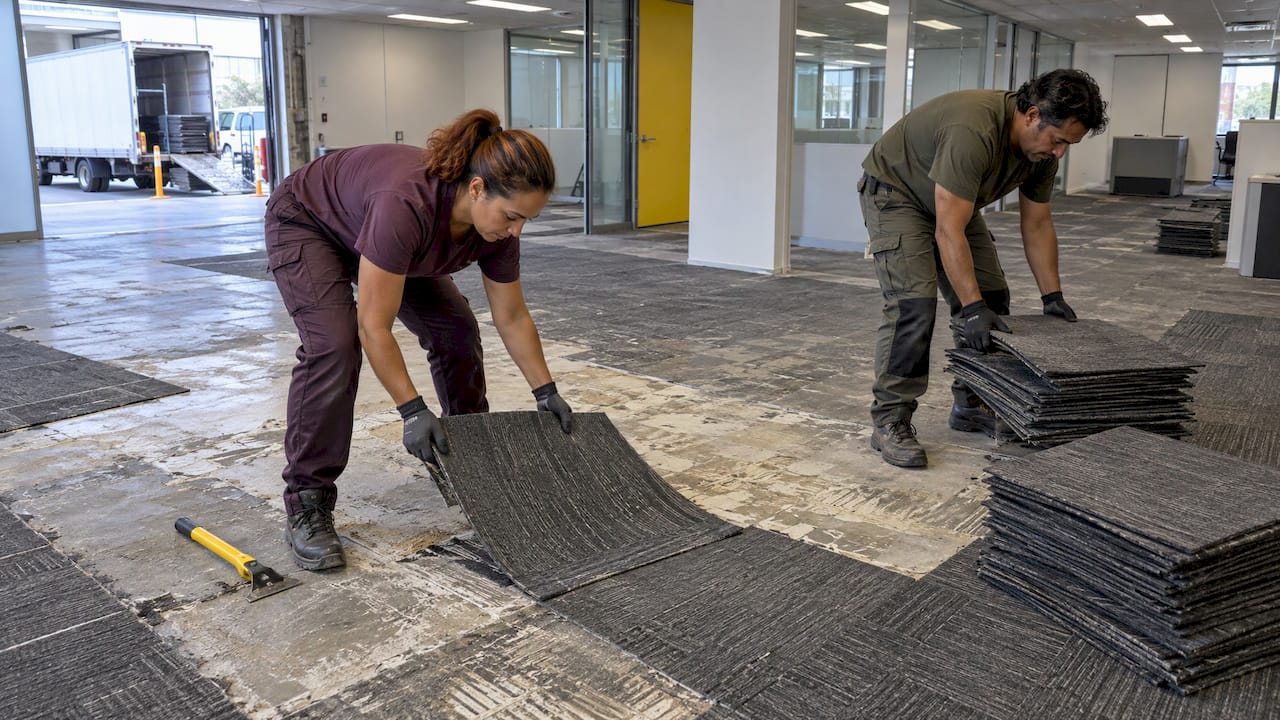
A carpet tile is typically a 50 cm square held to the floor either loose, on a releasable tackifier, or on a stronger pressure-sensitive adhesive. Loose and tackifier-laid tiles can be lifted by hand once a starting edge is open. Fully glued tiles need a scraper, and the glue and rubber backing can stay behind on the slab.
The national unit of competency for removing floor coverings gives a useful picture of what proper work looks like. MSFFL2031 Remove existing floor coverings expects the worker to plan the job, check the area for hazardous substances including asbestos before removal, choose techniques that suit the material, package the removed covering in manageable bundles, and clear protruding nails, grippers, adhesive and levelling compound from the exposed floor. That sequence, plan, check, lift, package, clean, is the structure of every job we run.
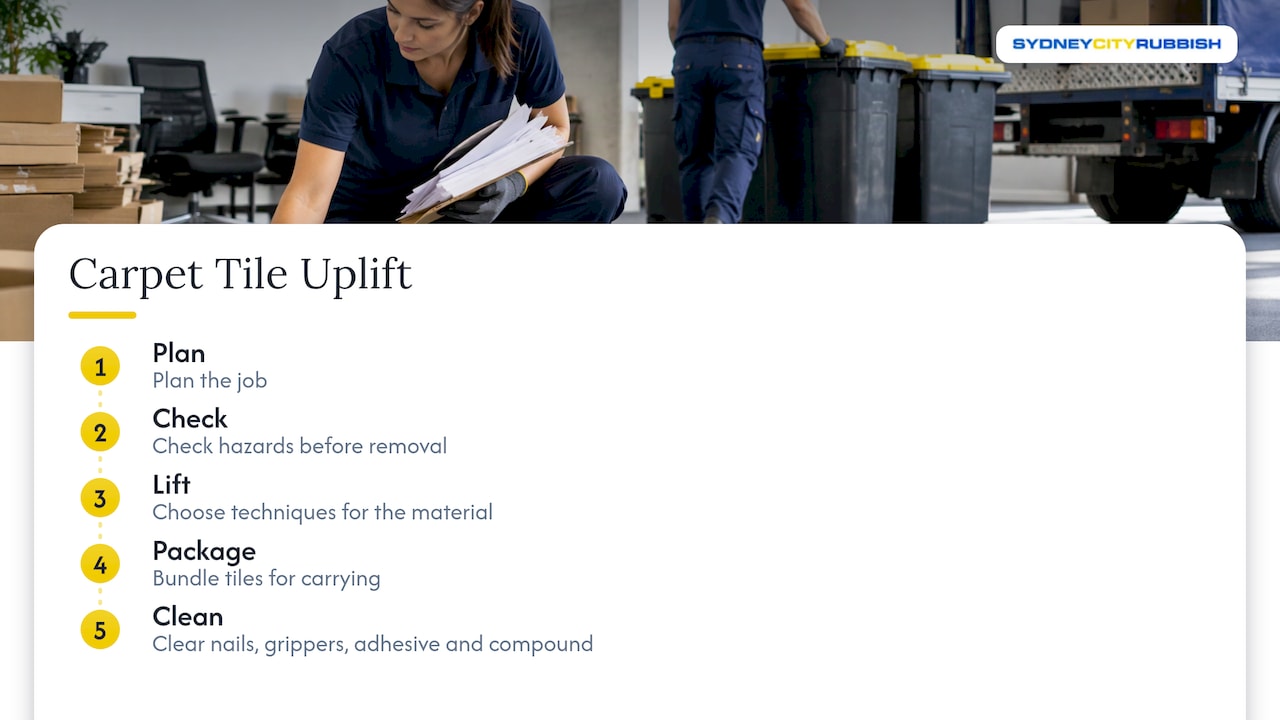
On a typical commercial floor the work goes like this. The crew starts at a doorway, transition strip or loose edge and slides a stiff scraper under the first tile. If it releases cleanly, the rest follow by hand and are stacked face to face in bundles that one person can carry. If tiles resist, a floor scraper held at a low angle with steady pressure does the work, and for large bonded areas a powered stripper is tested on a small hidden patch first. Removal is staged so that stacked tiles and bags never block corridors or fire exits, which matters in occupied buildings and shopping centres.
Check for asbestos before anything is lifted
This is the step where a job goes wrong most expensively. Older adhesives, particularly black cutback adhesive found under some vinyl and tile in buildings from earlier decades, and some older backings and underlays, can contain asbestos. Councils in NSW are blunt about the age range: Liverpool City Council notes that buildings built or renovated before 1990 have a good chance of containing asbestos, and that it can never go into skip bins or be left for council clean-ups.
For a commercial floor of that age, the practical routine is:
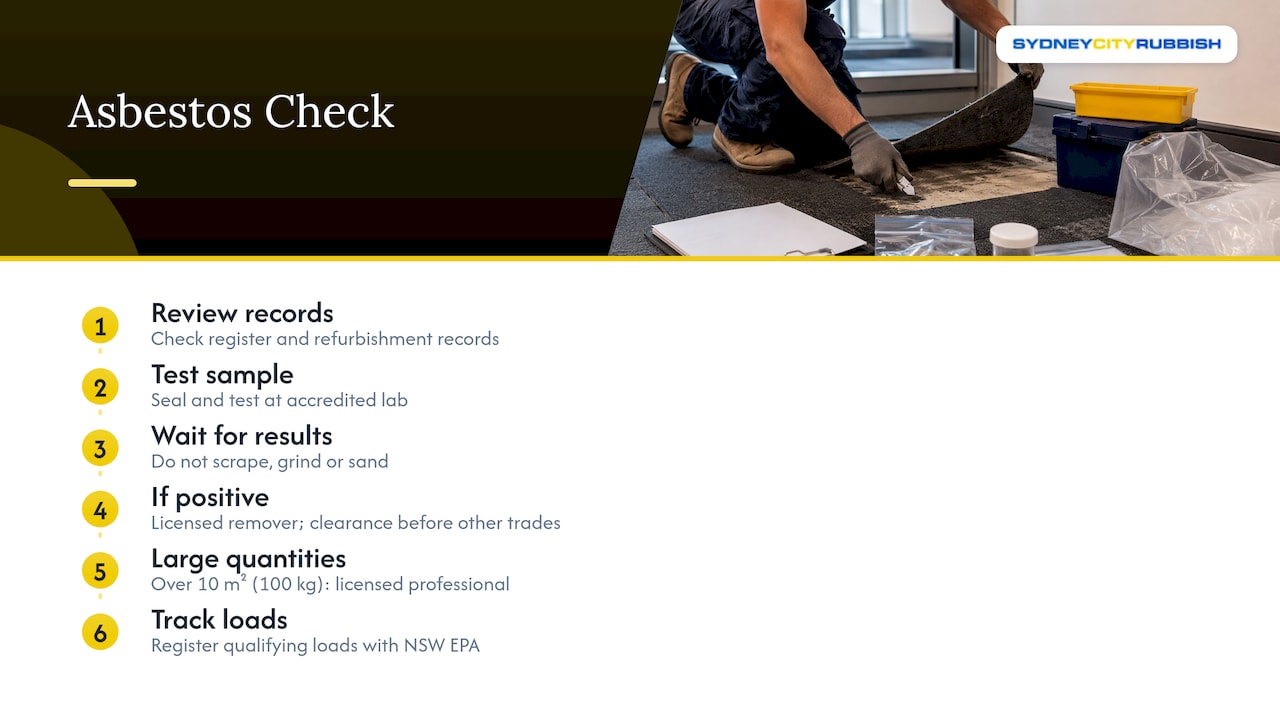
Check the building’s asbestos register and any previous refurbishment records first. Where the floor covering or adhesive is not covered, have a small sample of tile and attached adhesive taken, sealed and tested by an accredited laboratory before the floor is disturbed. Do not scrape, grind or sand suspect adhesive while waiting for results, because powered tools turn a contained material into airborne fibre.
If the result is positive, the removal is a job for a licensed asbestos remover, with clearance before other trades continue. Larger quantities also trigger tracking: Maitland City Council’s guide states that a licensed professional is required for more than 10 square metres (100 kg) of asbestos, and that loads of that size must be registered with the NSW EPA. Our own guide to waste tracking requirements in NSW explains how those records work in practice.
We build this check into the front of the job rather than leaving it to the day, so a crew never arrives at a floor that cannot be touched.
Adhesive, subfloor and what the next tenant needs
Once the tiles are gone, the slab tells you whether the job is finished. Tackifier usually leaves little behind. Pressure-sensitive adhesive and glued-down backings leave residue, and that residue has consequences for whatever goes down next.
Dunlop’s substrate preparation bulletin, DTB041, dated 28 May 2025, is clear on this: old adhesive residues are a common source of surface contamination and should be removed entirely by mechanical preparation, rather than relying on primers to bond over them. Building over old adhesive means relying on the bond and internal strength of a product laid years earlier, and the risk of it lifting or splitting can be high.
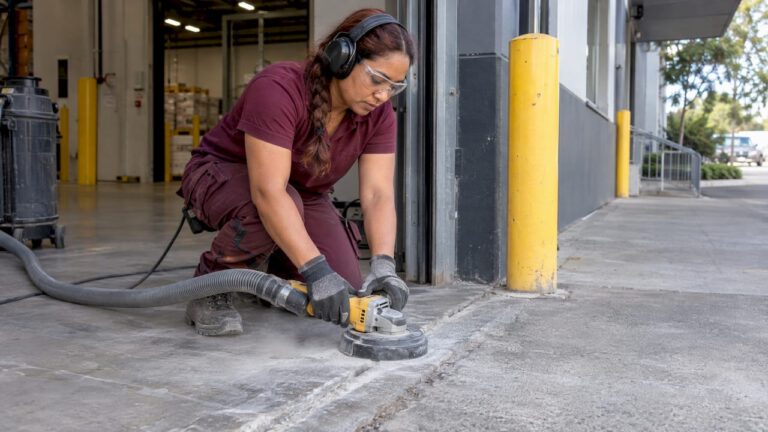
In practice, mechanical removal means scraping and, on larger floors, grinding. Grinding a concrete slab produces crystalline silica dust, which is why SafeWork NSW publishes guidance on controlling it. Its silica safety checklist for construction covers the hierarchy of controls for cutting, grinding and drilling. For a tenant or property manager this means grinding is planned work with extraction and containment, not a quick finish.
Our crews handle floor finish removal and concrete grinding as part of the same engagement, so the slab is left ready for the next fit-out rather than half-prepared. If the lease calls for a clean slab, that normally means adhesive off and the surface reasonably even, not polished. Over-grinding can damage a slab, so the brief should state the standard required.
Where floors are lifted back to the substrate, it is also the moment to check for tack strip remnants, staples, nails and any damage that was hidden, such as moisture. Any of these will show through or compromise new flooring if left.
Recycling carpet tiles in Australia
Carpet tile is one of the better candidates for recycling among floor coverings. Tiles lifted cleanly from a tackifier are often accepted by manufacturer take-back programmes, depending on the product and its condition. This reflects a wider shift: a Deakin University paper hosted by RMIT reports that Australian policy urges manufacturers to share responsibility for products at end of life through extended producer responsibility and take-back, and that carpet makers are among those who have developed voluntary schemes.
What decides whether a tile is recyclable is mostly how it was lifted and stored:
Tiles need to come up whole, with the backing intact. Wet, mouldy, oil-contaminated or adhesive-caked tiles are likely to be rejected by recyclers. Tiles stacked flat and kept dry stay in acceptable condition. Mixed loads, with tiles thrown in among plasterboard, timber and ceiling grid, lose their recycling value immediately.
This is the practical reason to have uplift and removal done by one team. We keep tiles separate from adhesive and debris during removal, and our disposal runs through registered recycling partners. Clients can also opt in to carbon-neutral disposal for corporate jobs. For a wider look at the topic, see our article on dealing with old carpet waste sustainably.
Where tiles cannot be recycled, UNSW’s Construction and Demolition Waste Management Guideline notes that carpet and underlay has no on-site reuse option under NSW rules: it is collected by a contractor for recycling if it meets the required quality, or otherwise goes to landfill. Sorting at the source is what keeps the first outcome available.
Disposal, dockets and who carries the risk
NSW EPA’s Better Practice Guidelines for Waste Management in Commercial and Industrial Facilities put the responsibility on the building side. Building managers and cleaners are expected to do due diligence that waste is deposited at a lawful, licensed facility, for instance by asking contractors for disposal and weighbridge dockets and checking where the waste went. The same guidelines note that flooring and other bulky waste typically arises during fit-outs and refurbishments, often when a tenant changes, and that the tenant or occupier generating it should be responsible for it.
In plain terms, if your contractor dumps a load illegally, the problem can come back to you. When you engage a contractor for carpet tile uplift, ask for:
A written description of how tiles, adhesive, timber and any hazardous items will be sorted and where each stream goes. Disposal or weighbridge dockets after the job. Evidence of insurance. For anything that could contain asbestos, licensed handling and the tracking records that go with it.
Sydney City Rubbish provides responsible disposal through registered recycling partners and a meticulous cleanup so that nothing is left in the tenancy. Our commercial waste removal service covers the rest of what comes out of a floor-out: office furniture, joinery, electronics, ceiling and wall debris.
Planning around the lease, the building and the clock
The first question on an end-of-lease carpet job is not how to lift the tiles but whether they must come up. Lease wording varies. A “remove tenant fitout and make good” clause often leaves a floor in place with damage repaired. A cold-shell or back-to-slab clause means everything, including adhesive, comes off. An original-condition clause means reinstating what the condition report records. Reading the clause before booking saves paying to remove something the landlord would have kept, or under-scoping a job that will fail the exit inspection.
The building then shapes the program. In strata buildings and shopping centres, noisy or dusty work is usually restricted to set hours, may need containment and extraction, and may require notice to neighbouring tenancies. Teams typically need to confirm in advance:
After-hours access and any permit. A loading dock booking and lift protection. Insurance certificates. A safe work method statement where grinding is involved. Fire detector isolation for dust-generating work. Site induction: access to construction sites also requires general construction induction training, as the national training register entry notes.
Our team coordinates directly with building management, which removes much of the back-and-forth over docks, lifts and hours. Carpet tile jobs in retail and office tenancies are well suited to an overnight or weekend window: tiles on tackifier can be lifted and removed quickly, while hard-set adhesive is the item that stretches a schedule and needs to be scoped before the date is fixed.
Office and warehouse end-of-lease
Office makegoods tend to combine carpet tile uplift with removal of workstations, partitions, ceilings and cabling. Warehouses more often involve a bonded floor finish or coating over a slab, together with racking and pallet waste. In both cases, bundling floor removal, rubbish removal and makegood works under one contractor means one point of contact, one program and one set of disposal records. We offer commercial strip out and demolition alongside makegood and de-fit, plus truck and driver hire for teams that only need the haul-away.
Timber and other floors in the same project
Mixed floors are common once a tenancy is opened up. Floating timber floors, held by interlocking joints and sometimes adhesive, usually lift in sections. Glued or nailed timber is slower, and nailed timber over a slab can mean the battens underneath come out as well. Clean untreated timber can often be reclaimed or reprocessed, which is another reason to keep it out of general skip loads. Each type goes into its own stream: see our guidance on handling construction and demolition wood waste.
Mouldy or water-damaged carpet is a separate case. It should be removed wet-free where possible, bagged to contain spores, and kept out of recycling streams. The cause of the moisture should be found before any new floor goes down.
Safe working basics
Even asbestos-free carpet removal disturbs rusty tacks, nails, dust and, in damp floors, mould spores. Crews wear eye protection, gloves, dust masks and knee protection as a baseline, and heavier controls apply where silica dust is involved. If you are a tenant considering handling a large floor yourself, the better investment is usually a single scoped job, because the hazards (asbestos, silica, manual handling of heavy stacks) sit exactly where a general cleaning crew has least experience.
What to ask for in a quote
Because carpet tile jobs differ so much, we quote per truckload or per project rather than from a rate card, and electronic quoting keeps the turnaround fast. To get an accurate figure, have these details ready: the floor area in square metres, whether tiles are loose, tackified or glued, the building’s age and any asbestos register, the access conditions (dock, lift, stairs, hours), whether adhesive removal or grinding is wanted, and what else is leaving the tenancy. For a view of how costs are built up for NSW property managers, read our carpet tile removal cost guide.
Book carpet tile uplift with Sydney City Rubbish
We remove carpet and vinyl from offices, shops, warehouses and strata buildings across Sydney, from the CBD to Parramatta and Macquarie Park. Our commitment is punctuality, with compensation if we are late, and a cleanup that leaves no waste behind. Details of the service are on our carpet removal in Sydney page, and the CBD-specific service is described at office carpet and vinyl removal in Sydney CBD. Request a quote through our commercial waste removal page and we will confirm the scope, the access arrangements and the disposal route.
FAQ
How do you remove carpet tiles from a commercial floor?
Start at a doorway or loose edge, slide a stiff scraper under a tile and lift gradually. Once tiles release, continue by hand and stack them face to face in manageable bundles. Test for asbestos first on older buildings, and keep tiles away from adhesive and debris so they can be recycled.
Can old carpet tiles be recycled in Australia?
Often, yes. Tiles that come up cleanly from a tackifier can be accepted by manufacturer take-back schemes, depending on the product and condition. Wet, contaminated or mixed loads are likely to be rejected, so sorting during removal matters. Our disposal goes through registered recycling partners.
Do I have to remove the adhesive after carpet tiles come up?
It depends on what goes down next and what the lease requires. Where new flooring is going in, the manufacturer’s preparation standard applies, and mechanical removal of old adhesive is the recommended approach over priming over it. Where the lease asks for a clean slab, adhesive is taken off and the surface left reasonably even.
Who is responsible for disposal when a tenant moves out?
The NSW EPA’s guidelines say the tenant or occupier generating bulky fit-out waste should be responsible for it, and that building managers should check that waste reaches a lawful, licensed facility. Asking for disposal dockets after the job is the standard way to document that.
How long does carpet tile removal take?
It depends on area, access and adhesive. Tiles laid on tackifier in a typical retail tenancy can often be lifted and taken out within a single overnight shutdown, while hard-set adhesive and grinding add time and require dust controls. We confirm the timeline in the quote.
Sources
- MSFFL2031 Remove existing floor coverings, National Training Register
- A-Z of Waste, Liverpool City Council
- Waste disposal guide, Maitland City Council
- Dunlop technical bulletin DTB041, substrate preparation
- SafeWork NSW silica safety checklist for construction
- The Circular Economy in the Australian Built Environment, RMIT
- Construction and Demolition Waste Management Guideline, UNSW
- Better Practice Guidelines for Waste Management in Commercial and Industrial Facilities, NSW EPA