Concrete Edge Grinding: Removing Trip Hazards on Commercial Slabs
Concrete edge grinding removes the raised lip where one slab, footpath panel or threshold sits higher than its neighbour. A diamond grinder takes the high side down in a gradual taper, so people and trolleys cross the joint without catching a foot or a wheel. For offices, retail frontages, warehouses and strata buildings in Sydney, it is usually the fastest way to deal with a trip hazard, because there is no pour and no cure time. Our team grinds concrete across Sydney as part of its commercial work, and we coordinate access directly with building management so the job runs without disrupting tenants.
This guide explains when grinding is the right fix, how a properly run job unfolds, what finish to expect, how dust is controlled and what moves the price.
TL;DR
- Grinding lowers the high side of a lipped joint into a smooth taper. It treats the surface, not the cause of the movement.
- It suits raised edges and joints. A sunken panel stays at its existing height, and a very large step may need partial slab replacement.
- Concrete contains crystalline silica, so dust extraction at the tool and a vacuum clean-up are part of the job, not extras.
- Quotes depend on the length of edge, the depth to be removed, the profile required and site access.
- Ask for the finished profile to be agreed in writing, and for photographs and a record of each treated joint.
Table of Contents
- What concrete edge grinding is
- When grinding works and when it does not
- How a well-run grinding job unfolds
- What finish to expect
- Dust, silica and keeping the site safe
- What drives the price of edge grinding
- Where edge grinding fits in commercial property work
- Booking a grind with Sydney City Rubbish
- FAQ
- Sources
What concrete edge grinding is
Slabs rarely stay level for ever. Tree roots lift panels, soil under a path settles, heavy vehicles load a driveway edge, and old joints open up so one side sits proud of the other. The result is a step, often only a few millimetres high, in exactly the place where people walk with their eyes up: a building entrance, a loading dock threshold, a path between car park and lobby.
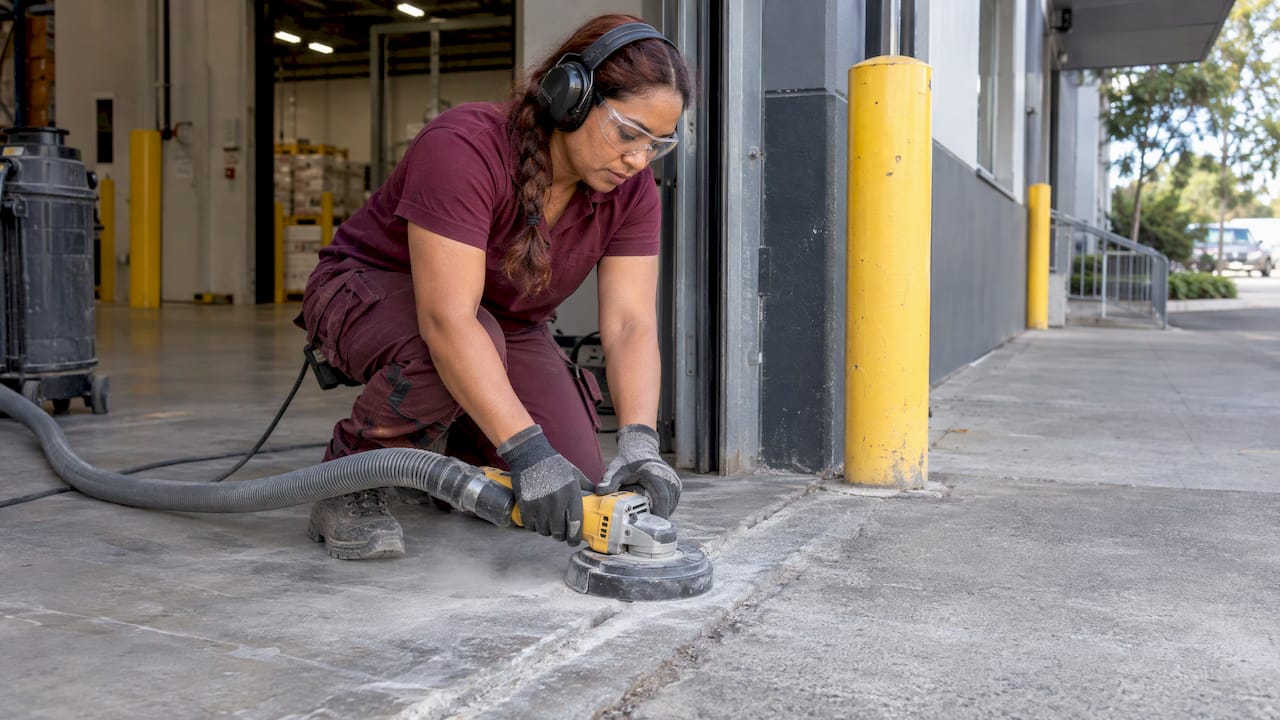
Edge grinding, sometimes called lippage grinding or trip hazard grinding, removes that step. An operator runs a grinder fitted with diamond tooling along the high side of the joint and takes the concrete down progressively, so the surface rises gently from the lower panel rather than ending in a sharp edge. Handheld grinders handle the awkward parts, such as walls, kerbs, thresholds and drainage grates, where a larger floor machine cannot reach.
For the manager who carries the liability for a path or floor, the appeal is practical. Grinding is far cheaper than replacing a section of slab, needs no cure time and, in most cases, the area can be walked on the same day, according to one Australian concrete finishing contractor’s guide to commercial and strata sites.
When grinding works and when it does not
Grinding takes material off the high side. That single fact explains both what it can fix and what it cannot.
It works well on a raised join between two panels, a lipped control joint, a raised edge at a threshold or a ridge left where a path has lifted. It reduces the high side and forms a transition towards the adjoining panel. The lower panel stays exactly where it is.
It does not lift a sunken slab, fill a depression or stop movement beneath the concrete. If a panel is dropping because the ground under it is moving, the grind removes today’s hazard and the step can reappear later. On sites with active subgrade movement, such as reactive clay or large tree roots near a path, plan for periodic re-inspection rather than treating the grind as permanent.
Size matters too. A step of a few millimetres to about a centimetre is the classic grinding job. As the step gets bigger, the grind has to run further along the high slab to keep the slope gentle, and it starts to cut deep into the slab surface. Past a certain point, partial slab replacement is the sounder repair. A good contractor will tell you on inspection which side of that line your joint falls.
The practical rule for a property or strata manager is simple. If the cause is a one-off lip, grind it. If the cause is ongoing movement, grind it as a safety measure and arrange for the underlying problem to be assessed.
How a well-run grinding job unfolds
The method below follows the sequence used by experienced concrete finishers, and it is the one we work to on commercial sites. It matters for a manager because each step is where a rushed job goes wrong.
Inspect and map every level change
The operator walks the whole site, not just the joint you reported. Hazards cluster: if one panel has lifted, its neighbours often have too. Each change in level is marked on a plan or photographed, so that you end up with a record of every location treated. Skipping this step is how a contractor fixes the joint you pointed at and leaves the one two metres along.
Measure each lip
Every lip is measured and recorded. This is the number that decides how much concrete comes off and how far the taper must run. It also gives you a before-and-after comparison, which is useful evidence for your insurer or your strata committee that the hazard was found and dealt with.
Mark the run and decide the taper
Before the grinder starts, the grind line is marked on the high slab. The length of the taper is chosen deliberately: a short, narrow grind strip can leave a steep change in slope that is itself a hazard for someone with a walking aid or a trolley. This is the step to question. Ask what the finished profile will be, not only whether the lip will be gone, and agree that profile with the contractor before work begins.
Grind progressively
The high side is ground back with diamond tooling in several passes across the marked run, rather than in one deep cut. Progressive grinding keeps the surface even and avoids gouging. The tooling is matched to the concrete, because a footpath slab and a hardened warehouse floor do not wear diamond segments the same way.
Feather the edges
The edges of the ground area are blended so the patch sits flush with the surrounding slab. Done properly, the ground area reads as a gentle slope. Done badly, it forms a shallow dish that holds water and is visible from across the lobby.
Use handheld tools for the details
Walls, kerbs, thresholds and drainage grates are finished with handheld grinders. These are the places a large machine cannot reach and where trip hazards are most common in a building: the junction between an entry slab and a door track, or the edge of a loading dock plate.
Re-check, clean down and document
Every treated joint is checked again, the area is cleaned down with vacuum extraction, and the work is documented. On our jobs, meticulous cleanup is a commitment: no slurry, dust or offcuts left for the building’s cleaners to deal with. Because we also handle the waste side of the work, ground material and debris leave the site with us, taken to registered recycling partners.
What finish to expect
A ground surface is not a new surface. Knowing that up front prevents disputes at handover.
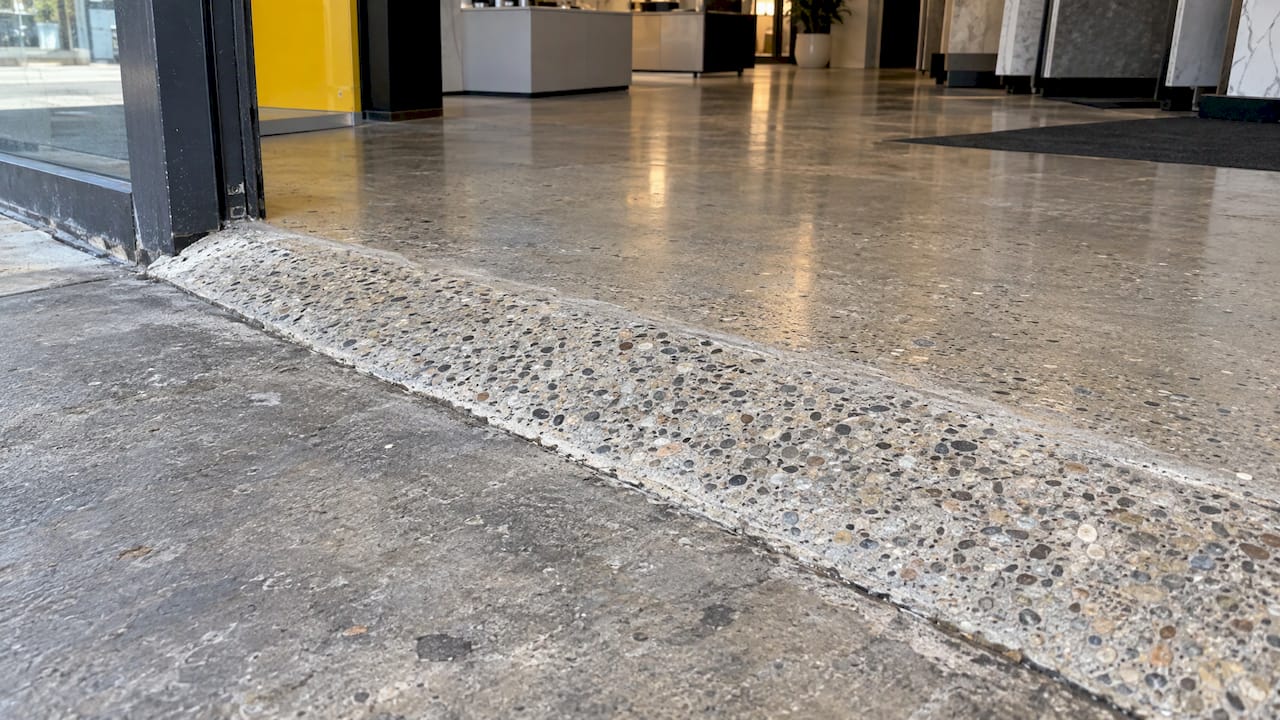
Grinding can expose the aggregate, the stones in the mix, and leave a patch that looks visibly different from the surrounding concrete. On a footpath or a loading bay that rarely matters. At a polished lobby entry or a showroom threshold it can, so mention the location when you request a quote. Where appearance matters, a sealer or a light blend of the surrounding area can be discussed at the quoting stage.
Slip resistance deserves a mention for any exterior or wet-area work. A surface that looks smooth in a photograph has not been assessed for grip when wet. If the slab is a public or tenant access route, ask what the contractor does to check the finished surface for slip.
Accessibility is the other limit. Grinding one joint does not by itself make a whole route meet an accessibility standard: crossfall, slope, width and adjoining features may each need separate consideration. If the route is part of a compliance upgrade, treat the grind as one component and have the full route reviewed.
Dust, silica and keeping the site safe
Concrete contains crystalline silica. Cutting, grinding or drilling it releases fine respirable dust, and breathing that dust over time causes serious lung disease. This is why dust control is the part of a grinding job a manager should look at most closely.
The exposure standard for respirable crystalline silica in Australian workplaces is 0.05 mg/m³ averaged over an eight-hour day, and we set out what that means for contractors on our guide to keeping silica under that limit during concrete grinding. Safe Work Australia’s work on silica has also widened in recent years: in March 2024 workplace health and safety ministers agreed to ban engineered stone and to develop a stronger framework for managing exposure to any material containing at least 1% crystalline silica, which includes ordinary concrete.
In practice, good dust control on an edge grinding job means:
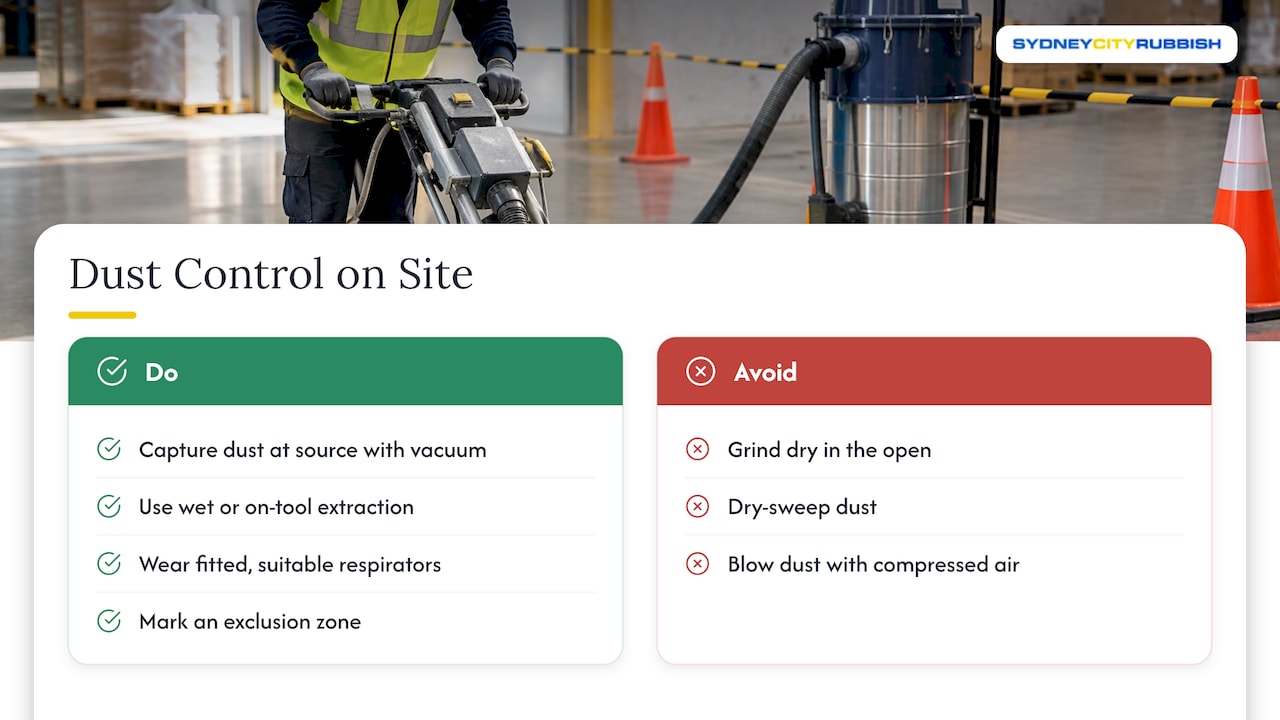
Shrouded tooling connected to an industrial vacuum extractor, so dust is captured where it is made rather than released into the air. Wet methods or on-tool extraction rather than dry grinding in the open. Vacuum clean-up rather than dry sweeping, and no compressed air to blow dust off the slab. Respirators, eye protection and hearing protection for the operators, with the respirator chosen for the dust and fitted properly. And a marked exclusion zone, so tenants, customers and passers-by are kept clear while work is under way.
The principle is the same one behind any good workshop extraction system, and the guide on effective dust collection for cleaner, safer workshops explains why capturing dust at source beats trying to clean the air afterwards.
For a building owner, the difference shows at the end of the shift. A well-extracted job leaves a clean walkway the moment the machine stops. A poorly controlled one leaves fine grey dust in lifts, air handling and carpets that someone else has to deal with. In NSW, silica and dust duties sit with whoever carries out the work and the person conducting the business or undertaking, and you can confirm the current requirements with SafeWork NSW before work starts. Our team keeps dust control inside the scope of the job, so you are not left to arrange it separately.
What drives the price of edge grinding
There is no single national price for grinding. Contractors quote on the work, and four things move the number.
Length of edge or number of joints. Trip hazard work is often priced per joint or per linear metre, while floor grinding is priced by area. A site with forty small lips costs differently from one long raised edge.
Depth to be removed. A 3 mm lip needs one or two passes. A 15 mm lip needs more passes, more tooling wear and a longer taper.
The profile you specify. A functional taper is quicker than a flush, blended finish for a visible entry.
Access and conditions. Tight spaces, work around tenants, after-hours access, building induction requirements and working over or near drainage all add time. So does dust control in an occupied building, which is not optional.
There is a fifth factor that managers tend to overlook: the number of separate visits and suppliers. If one contractor grinds, another removes the waste and a third coordinates with the building manager, you pay for each hand-off. Booking a single provider that handles the grind, the cleanup and the waste removal, and that coordinates directly with building management, keeps the job to one visit and one point of contact. We quote per project, and electronic quoting means you can have a figure quickly, so you can compare it with the cost of leaving a hazard in place.
If you want a broader view of how Sydney grinding is scoped for strata buildings, our Sydney concrete grinding cost guide sets out the factors in more detail.
Where edge grinding fits in commercial property work
Trip hazards rarely appear in isolation. They tend to surface during particular events, and each has its own timing.
End of lease. Make-good obligations often require floors and thresholds to be returned in safe, clean condition. Ground joints, removed floor finishes and a clean slab are common items in office and warehouse handbacks. We handle makegood and de-fit works alongside floor finish removal and grinding, with furniture, joinery and debris removed in the same program.
Strata and building management. Common property paths, driveways and lobby entries are the managers’ responsibility. A documented inspection and grind of every lip is a clear way to show that known hazards were addressed. Footpath and slab sections that are beyond a grind can be handled through professional concrete cutting and removal.
Strip-outs and refurbishments. When ceilings, walls and old floor coverings come out, level changes in the slab appear that were hidden under carpet or tiles. Grinding fits naturally into a building strip-out, where the same crew is already on site and the debris is already being removed.
Warehouses and retail. Trolleys, pallet jacks and customer footfall make a small lip a repeated risk. The grind is done out of hours, and the floor is back in service quickly.
Booking a grind with Sydney City Rubbish
We grind, cut and remove concrete for corporate offices, retail sites, construction companies, strata managers and property managers across Sydney. Our concrete grinding service covers edge and trip hazard work, and it sits alongside strip-out, makegood, concrete cutting, core drilling and waste removal, so one booking can cover the whole scope. We coordinate access with building management, we guarantee punctuality with compensation if we are late, and corporate clients can opt in to carbon-neutral waste disposal.
Send us your site address, a few photos of the lips and the access arrangements, and we will return an electronic quote. You can start from our what we do page or go straight to a quote on our site.
FAQ
Can you grind concrete smooth?
Yes, for the high side of a raised edge or joint. Grinding takes the concrete down into a smooth, gradual transition. It will not level a whole sunken panel, and the ground patch can look different from the surrounding surface because the aggregate may be exposed.
How long does trip hazard grinding take?
A single lip is often a short task, and most sites are walkable the same day because there is no cure time. The total time depends on how many joints there are, the depth of each, and the access arrangements. Mapping the site first gives a reliable estimate.
Will a ground trip hazard come back?
If the lip came from a one-off cause, the grind is a lasting fix. If the slab is still moving because of the ground beneath it, such as clay movement or tree roots, the step can return over time. In that case, grinding removes the immediate hazard and the cause should be assessed separately.
Is concrete grinding dust dangerous?
Concrete contains crystalline silica, and the dust must be controlled at the tool with extraction, vacuum clean-up and suitable respiratory protection. The Australian workplace exposure standard is 0.05 mg/m³ over an eight-hour day. Keep occupied areas clear of the work zone while grinding is under way.
What should I ask for in a quote?
Ask for the number of joints and lip heights, the finished profile, the dust control method, the access and hours, how debris will be removed, and what documentation you will receive at handover. A quote that covers those points removes most of the surprises on the day.
Sources
- Uneven Concrete Grinding: Fixing Trip Hazards on Commercial and Strata Sites
- Safe Work Australia, Quarterly News Update, Issue 7, May 2024