Net Zero vs Carbon Neutral: What Sydney Businesses Should Know
Updated November 2026 by the Sydney City Rubbish team
Carbon neutral means a defined activity, product or business has had its emissions measured, reduced and balanced by cancelling offsets. Net zero is a broader, longer-term target: cutting emissions across the whole organisation as far as possible, then balancing only what is left by removing carbon from the atmosphere. For an office, construction company, retailer or strata manager, the practical difference is scope. Carbon neutral is something you can apply to a service you buy this month, such as a clean-out or a strip-out. Net zero is the pathway your whole business follows over years. Our carbon-neutral opt-in for commercial waste removal in Sydney sits in the first category, and it feeds the second.
TL;DR
- Carbon neutral: emissions from a defined activity are measured, reduced and balanced with eligible offsets, usually reviewed every year.
- Net zero: emissions are cut across the organisation, usually including the value chain, and only the residual is balanced by removals.
- Net zero does not mean zero emissions. It means what remains is balanced by removals.
- In Australia, the ACCC expects any “carbon neutral” or “net zero” claim to be specific, backed by reasonable grounds and honest about offsets.
- For waste, you can choose a carbon-neutral removal on a booked job and record it in your reporting as one step towards a wider net zero plan.
Table of Contents
- What carbon neutral means
- What net zero means
- The practical differences side by side
- How the two fit together
- Net zero does not mean zero emissions
- Where carbon negative fits
- What the ACCC expects when you make a claim
- What makes offsets credible
- Supply chains, logistics and the boundary of a claim
- What this means for a Sydney office, site or building
- Carbon-neutral waste removal with Sydney City Rubbish
- Writing the claim in your own report
- FAQ
- Sources
What carbon neutral means
In plain terms, carbon neutral means balancing greenhouse gas emissions by offsetting, or removing from the atmosphere, an equivalent amount of carbon to what was produced. The UN Global Compact Network Australia’s 2023 guide uses that framing, and it is the one most Sydney facilities managers meet in tenders.
The key word is defined. A carbon-neutral claim can cover a single product, an event, a building or a service. CPA Australia’s guidance on net zero transition plans explains that carbon neutral can apply to a defined part of operations and typically accounts for carbon dioxide rather than every greenhouse gas. That is why one office tenancy or one waste contract can be carbon neutral while the wider business is still working on its plan.
In Australia the benchmark for the term is the government’s voluntary Climate Active Carbon Neutral Standard for Organisations. It asks the responsible entity to:
- calculate its emissions;
- put an emissions reduction strategy in place;
- buy offsets for what remains;
- have the result independently validated;
- publish a public statement of the claim.
Each stage except validation is repeated every year. Under the standard, net emissions equal zero because emissions have been reduced and offset units cancelled, which means retired so they cannot be used again.
What net zero means
Net zero is about the end state of an organisation’s whole emissions profile. The NSW Government’s Net Zero Business Guide, published in July 2025, defines it as human-caused residual greenhouse gas emissions balanced by human-led removals over a specified period and within specified boundaries, following the ISO Net Zero Guidelines. The guide also notes that getting there may require an overhaul of how a business makes, moves and sells its products.
Three features separate it from carbon neutral:
- Reduction comes first. Arup’s April 2023 analysis, summarised in the IPCC’s FAQ on the topic, describes net zero as cutting emissions along science-based pathways, then balancing the remainder with like-for-like removals, with minimal reliance on offsets on a 1.5°C trajectory.
- It covers all greenhouse gases and the supply chain. CPA Australia describes net zero as reducing absolute emissions across the whole supply chain to support the 1.5°C goal agreed at the 2015 Paris climate summit, and says a plan should incorporate Scope 1, 2 and 3 emissions.
- It has a boundary and a time frame. The target is set for a stated scope and a stated year, not as an open-ended slogan.
Scopes 1, 2 and 3 in one paragraph
Scope 1 is what your own operations emit directly, for example fuel in vehicles you own. Scope 2 is the emissions from the electricity you buy. Scope 3 is everything else in your value chain, including the waste contractors you hire, the materials you buy and the travel your staff take. A net zero plan has to deal with all three. Waste removal sits in Scope 3 for most offices and builders, which is why it is a sensible place to start.
The practical differences side by side
| Carbon neutral | Net zero | |
|---|---|---|
| What it covers | A defined activity, product, site or business | The whole organisation, usually with Scope 1, 2 and 3 |
| Gases | Often CO2 only in common use | All greenhouse gases, measured as CO2-equivalent |
| How you get there | Measure, reduce, then offset what remains | Cut emissions on a science-based pathway, then remove the residual |
| Role of offsets | Central to balancing the remainder | Limited to the residual after deep cuts |
| Time frame | Reviewed and cancelled every year | Target year, with interim milestones |
| Typical use | A claim about a service you buy or sell | A corporate strategy and transition plan |
The IPCC’s FAQ 1.3 makes a similar point. At sub-global scales, net zero CO2 typically applies to emissions under an entity’s direct control, while carbon neutrality also applies to firms, commodities and activities and generally includes value-chain emissions beyond direct control, with offsets permitted. The IPCC also notes that the term carbon neutral can be ambiguous in practice, so the boundary of any claim matters more than the label.
How the two fit together
The two terms are often presented as rivals. For a working business they are better read as steps on one path. 100% Renewables’ Australian guide notes that in common usage, carbon neutrality brings a net zero target forward to the present by balancing the footprint with purchased offsets, making it an interim target on the way to net zero.
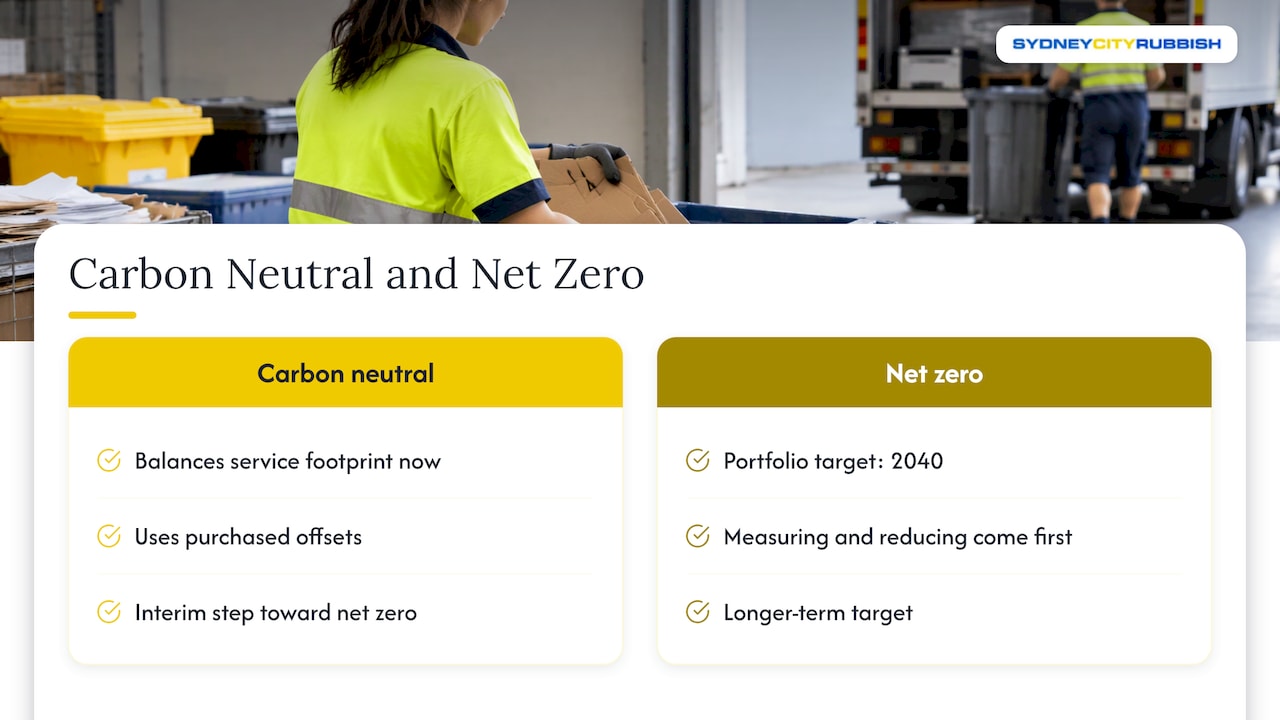
That is how many Sydney organisations use it. A property manager commits to net zero by a target year for the portfolio. In the meantime, each service the portfolio buys can be made carbon neutral, so the reported footprint of that service is balanced now rather than in 2040. Measuring and reducing come first, and the carbon-neutral service gives your reporting something concrete to record.
Net zero does not mean zero emissions
A common misreading is that a net zero business emits nothing. It does not. 100% Renewables separates net-zero emissions, where an organisation’s emissions of all greenhouse gases are balanced by removals, typically over one year, from absolute zero emissions, which is reached without offsetting. The ISO Net Zero Guidelines (IWA 42:2022), as quoted in the NSW guide above, likewise describe residual emissions balanced by removals, not their elimination.
Where carbon negative fits
Carbon negative, sometimes called climate positive, goes one step beyond. The UN Global Compact Network Australia defines it as removing or storing more carbon dioxide from the atmosphere than is emitted. Net zero is the balance point and carbon negative is past it. It is rarely a procurement requirement for offices, builders or strata schemes, so most commercial clients can treat it as context rather than a target.
What the ACCC expects when you make a claim
If you tell tenants, customers or investors that your business is carbon neutral or net zero, Australian Consumer Law applies. The ACCC’s December 2023 guide to making environmental claims sets out eight principles. For emissions claims it advises checking that the claimant:
- did a thorough emissions baseline using established Australian or internationally recognised methods;
- states which emissions are included and excluded;
- is open about reductions versus purchased offsets;
- verifies its offsets, including that the abatement has not already been claimed and the same benefit has not been issued under multiple registries.
The guide also expects up-to-date registry details of the offsets cancelled each year, and it warns against singling out CO2 while leaving out other gases.
On wording, the ACCC’s Prompt 2 on specificity says broad, unqualified claims such as “carbon neutral” or “net zero” in short-form marketing may create a misleading impression. It adds that a third-party certification or trust mark is not a guarantee a claim cannot mislead. The practical answer is to say precisely what is covered, for example “waste removal for our Parramatta office fit-out in 2026 was carbon neutral”, rather than “we are carbon neutral”.
Future targets carry their own duty. The ACCC’s supplementary submission to the greenwashing inquiry states that a representation about a future matter, such as a net zero target, must have reasonable grounds when it is made, or it is taken to be misleading. Enforcement is more likely where a business lacked reasonable grounds or had no plan to deliver. Carbon Market Watch’s August 2026 report notes the ACCC made greenwashing an enforcement priority in 2025, so documentation matters.
What makes offsets credible
Offsets are the part of a claim readers scrutinise most. Under Climate Active, certification requirements state that brands must offset residual emissions using eligible offset units and disclose the offset projects they choose, including the carbon abatement method and social, cultural and economic information. The Business Renewables Council of Australia’s May 2024 factsheet adds that the standard’s Appendix A lists currently eligible offset units, and that offsets are not recognised as renewable electricity under Climate Active.
For a buyer, that gives a simple question to ask any supplier: which units were cancelled, and where can I see the identifiers? Our page on verifying carbon neutral rubbish removal with ACCU IDs explains how Australian Carbon Credit Units are identified, so your sustainability report can point to something checkable.
Supply chains, logistics and the boundary of a claim
Waste is a good example of why the boundary matters. The truck, the driver, the sorting and the destination all sit in a chain, and a claim is only as clear as the boundary drawn around that chain. A discussion of supply-chain emissions and carbon-neutral claims for delivery and logistics shows the same principle: what a business can honestly declare depends on which parts of the chain are measured and compensated.
What this means for a Sydney office, site or building
The reader of this page usually has a job in front of them rather than a policy question: an office to clear at lease end, a retail fit-out to strip, a strata building with bulky waste, a site generating plasterboard and timber offcuts. Here is how the terms translate.
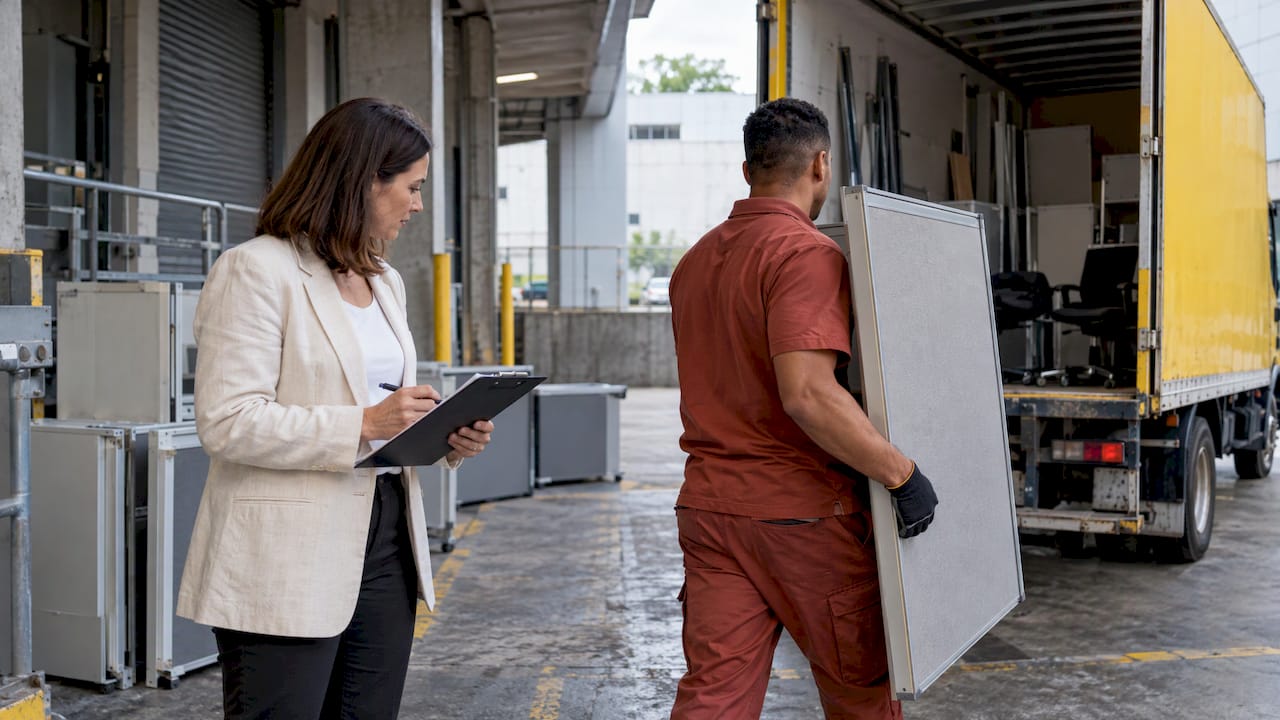
Offices and end-of-lease. Lease clauses increasingly ask for a makegood or de-fit that is documented. If your organisation has a net zero target, the furniture, partitions and electronics leaving the premises are Scope 3 emissions you can address with a carbon-neutral removal and records of where materials went.
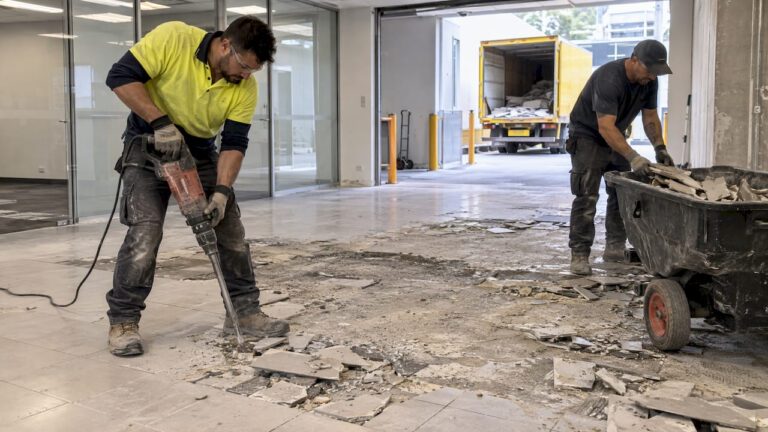
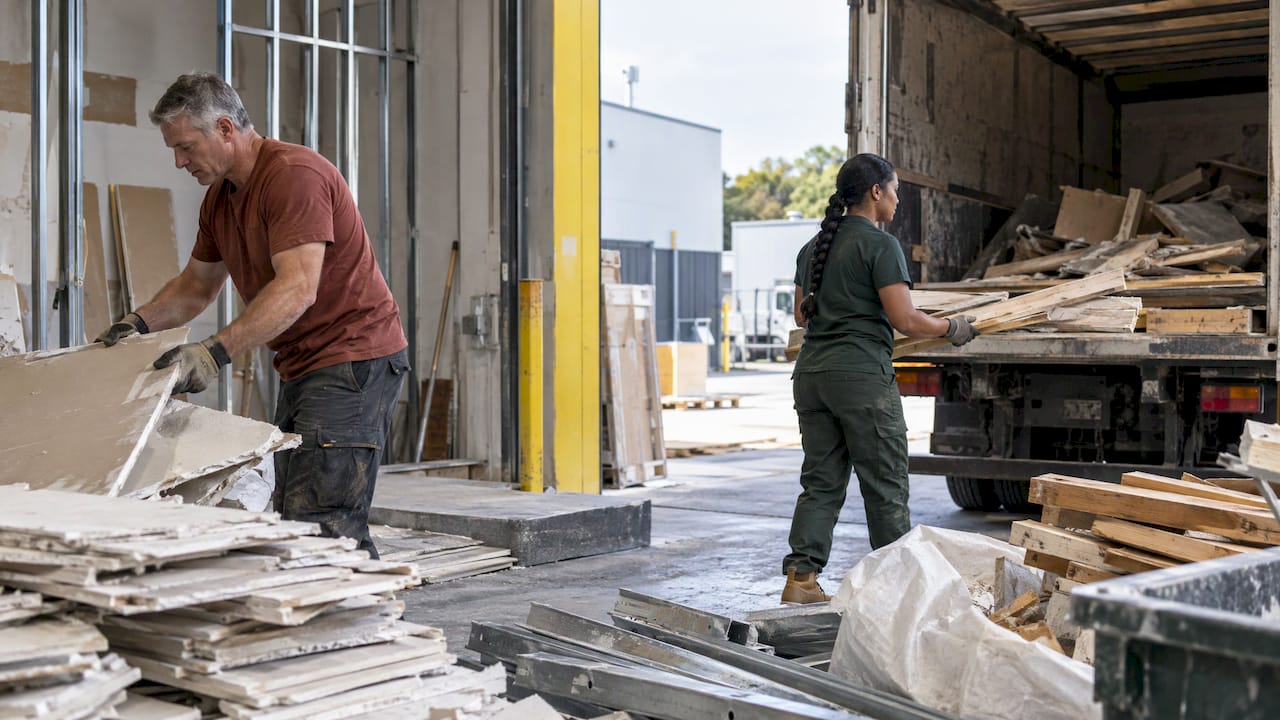
Construction and demolition. Builders carry heavy Scope 3 loads through materials and haulage. Separating concrete, timber, plaster and metals at source is the reduction step. Balancing what is left through a carbon-neutral removal is the interim balancing step. Our notes on waste separation in construction and demolition cover the first part.
Retail and strata. Property managers and strata committees are often asked by owners what the building’s waste footprint is. A service with a defined, carbon-neutral scope gives a clear, reportable answer. It also sits alongside the council and state rules for commercial waste, which we cover in our guide to Sydney commercial waste rules and FOGO.
Carbon-neutral waste removal with Sydney City Rubbish
Sydney City Rubbish removes commercial and corporate waste across Sydney, including offices, retail spaces, construction sites and strata-managed buildings. Clients can opt in to carbon-neutral removal, a service we deliver in partnership with Carbon Neutral. The opt-in applies to the job you book, so it is a defined, reportable scope and not a blanket statement about your whole business.
The same job includes the practical side: we coordinate directly with building management for access, quote electronically and use registered recycling partners for responsible disposal. We guarantee punctuality, with compensation if we are late. Furniture and joinery removal, building strip-outs, makegood and de-fit, structural demolition and truck and driver hire are all part of what we do, and the carbon-neutral opt-in is available for corporate clients. You can read how it works on our carbon-neutral waste disposal page or see commercial waste removal in Sydney and request a quote.
Writing the claim in your own report
A short, accurate sentence does more for a sustainability report than a headline. A useful pattern is the activity, the period, the standard or method, and the evidence: for example, “Waste removal for the level 4 office makegood, completed in 2026, was carbon neutral, with offset unit identifiers available on request.” Keep your net zero language for the target itself: the scope, the target year, the interim milestones and the plan to reach them. Keeping the two statements separate follows the ACCC’s emphasis on specificity, and it lets each be tested on its own terms.
FAQ
Is net zero better than carbon neutral?
They do different jobs. Net zero is the whole-of-organisation target, with deep reductions and removals for the residual. Carbon neutral is a claim about a defined activity, product or business, usually renewed each year. Most businesses use carbon-neutral services on the way to a net zero target.
Does carbon neutral mean no emissions were produced?
No. It means the emissions from the defined activity were measured, reduced where possible and balanced by cancelling eligible offset units. The Climate Active standard requires that calculation and cancellation to be repeated annually, with independent validation.
Can I say my business is carbon neutral if I buy a carbon-neutral service?
Say what you actually did. A carbon-neutral waste removal makes that service carbon neutral, so describe it as such, with the job and period. The ACCC advises against broad, unqualified claims, so avoid implying the whole business is covered unless it is.
What is the difference between net zero and carbon negative?
Net zero balances remaining emissions with removals. Carbon negative removes or stores more carbon dioxide than is emitted, going past that balance point, according to the UN Global Compact Network Australia.
How do I ask for a carbon-neutral rubbish removal in Sydney?
Select the carbon-neutral opt-in when you request your quote for office, retail, construction or end-of-lease waste removal. We can confirm the scope for your job and the details you need for your reporting.
Sources
- UN Global Compact Network Australia: Reducing Emissions and Respecting Human Rights (2023)
- NSW Government: Net Zero Business Guide (July 2025)
- IPCC AR6 WGIII FAQ 1.3: net zero and carbon neutrality
- CPA Australia: Net zero transition plans
- 100% Renewables: Carbon jargon guide
- ACCC: Making environmental claims, a guide for business
- ACCC: Prompt 2, Specificity
- ACCC: Supplementary submission to the Greenwashing Inquiry
- Climate Active Carbon Neutral Standard for Organisations
- Climate Active: Certification requirements
- Business Renewables Council of Australia: Meeting sustainability targets factsheet (May 2024)
- Carbon Market Watch: How litigation is challenging offsetting claims (August 2026)