Fluorescent Ballast Disposal for Sydney Businesses
Fluorescent ballasts should never go into a general waste skip. Older ballasts can contain a PCB-filled capacitor, so the safe default is to treat any ballast you cannot positively identify as PCB-containing, keep it out of landfill and have it removed by a licensed waste contractor. For a Sydney office, retail fit-out or warehouse, the practical answer is to bring ballast removal into the same booking as the lighting strip-out. Sydney City Rubbish removes hazardous materials from commercial sites and coordinates directly with building management for access.
This guide explains what a ballast is, how to tell which ones need special handling, how they are stored and removed, and how to deal with fixtures during a makegood, strip-out or end-of-lease job.
TL;DR
- A ballast is the control gear inside a fluorescent fitting. Old magnetic ballasts may contain PCBs in a small capacitor or in tar-like potting material.
- If a ballast has no “No PCBs” label and no readable manufacture date, treat it as PCB-containing.
- Fluorescent tubes contain mercury and must not go to landfill, so tubes, ballasts and fixture metal are three separate streams.
- Leaking or damaged ballasts need bagging, absorbent material and sealed drums, not a general skip.
- Booking removal with your strip-out or makegood contractor keeps the lighting waste documented and off your critical path.
Table of Contents
- What a ballast is and why it matters at clean-out time
- Is the ballast PCB-containing? How to tell
- Why you should not leave old ballasts in the ceiling
- Handling and storing ballasts safely before removal
- What the rules say about disposal in Australia
- Tubes, ballasts and fixtures: three streams, not one
- Where ballast removal fits in an office, retail or warehouse job
- Doing the removal as one job
- A practical checklist before the job
- FAQ
- Sources
What a ballast is and why it matters at clean-out time
A fluorescent fitting needs a ballast to start the lamp and limit the current through it. The ballast sits under a metal cover plate inside the fixture, usually behind the lamp holders. In a commercial ceiling you will find one or two per fitting, and a floor of an office building can easily hold hundreds.
The reason ballasts get special attention is a chemical called PCB (polychlorinated biphenyl), an industrial compound that persists in the environment and was once used as an insulating fluid in electrical components. US EPA guidance describes PCBs in ballasts as sitting in the small capacitor, which holds roughly 1 to 1½ ounces of PCB oil, or in the tar-like potting material packed inside the casing. Intact ballasts are a manageable risk. The problem starts when they are old, overheated or crushed during demolition.
That is why ballasts matter in commercial work specifically. A tenant handing back a floor, a landlord stripping a tenancy or a builder gutting a warehouse tends to pull ceiling grids, fixtures and cabling in a single pass. Ballasts then end up mixed with plasterboard, ceiling tile and general debris, which is exactly how a regulated waste ends up in the wrong bin.
Is the ballast PCB-containing? How to tell
The research on identification comes mostly from the United States, where the manufacturing history is best documented, but the logic is the same for any building with older lighting. US EPA says ballasts manufactured through 1979 may contain PCBs, that ballasts made between 1979 and 1998 without PCBs were labelled “No PCBs”, and that any unlabelled ballast should be assumed to contain PCBs.
Its building-materials guidance adds that premises built or renovated before 1979 are likely to have PCB-containing ballasts if the lighting was never fully retrofitted afterwards. The same guidance recommends inspecting a representative number of fixtures, looking at the ballasts and any manufacture dates, not only at the lamps.
In practice, a facilities or property manager can work through three questions:
First, is there a “No PCBs” statement on the ballast? If so, it can be handled as a non-PCB ballast.
Second, is there a legible date of manufacture? Dates are marked differently by each manufacturer and are often hard to read. University of Illinois guidelines for ballast removal take the cautious route: when in doubt, assume the ballast contains PCBs, so it goes into a separate waste stream and does not contaminate the non-PCB one.
Third, is it an electronic ballast? Those are lighter, with plastic casings, and sit in the non-PCB stream under the same guidelines. Most of the other, heavier magnetic ballasts go to the PCB stream unless clearly labelled otherwise.
Do not cut a ballast open to check what is inside. EPA’s fact sheet notes it generally does not recommend opening ballasts to sample the potting material because of the exposure risk. If the label and date do not settle it, the ballast is treated as PCB-containing and the decision is made.
A worked example
Take a 1990s office floor of 400 fittings that has had its lamps replaced over the years but never its ballasts. You inspect a sample of fixtures and find a mix: some ballasts with a “No PCBs” label, some with no label and an illegible date, and a few swapped for electronic units. The safe result is three batches: electronic and clearly labelled non-PCB units, and everything else bundled as presumed PCB. The second batch is the one that needs drums, labelling and a licensed destination.
Why you should not leave old ballasts in the ceiling
US EPA says PCB ballasts still in use have exceeded their designed life span, that sudden rupture may pose health hazards, and that it recommends removing them from buildings as soon as possible to prevent inhalation or skin exposure. A planned fit-out, strip-out or lighting upgrade is the natural moment to do it, because the ceiling is already open and the fixtures are coming down anyway.
Handling and storing ballasts safely before removal
Handling rules vary by regulator, so treat the following as the standard of care set out in published guidance, then confirm the requirements that apply to your site with the relevant authority. The most detailed Australian source is the Queensland Government’s guideline on PCB equipment, and it shows what a regulator expects.
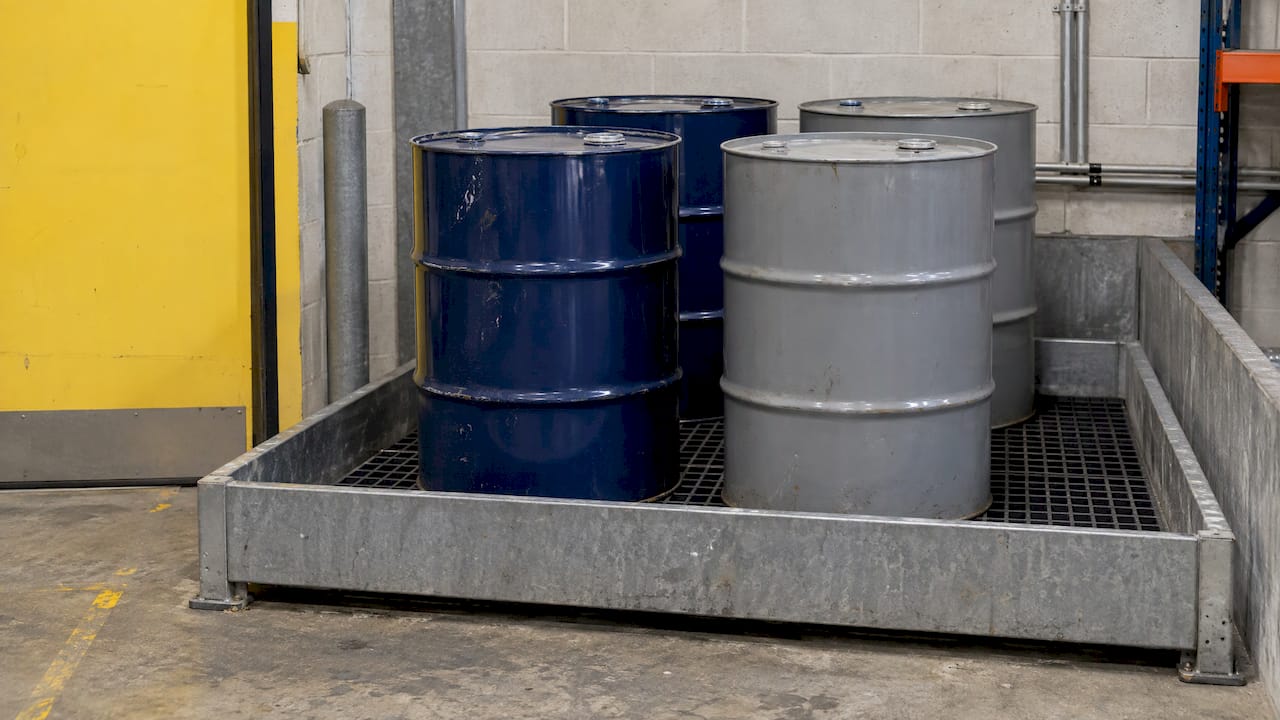
The Queensland guideline directs that PCB-containing equipment such as capacitors and ballasts be placed in a polyethylene bag and then in dangerous-goods-approved, sealable, epoxy-lined steel drums. Leaking components are bagged and placed in drums partly filled with absorbent material, such as commercial absorbent, kitty litter or diatomaceous earth. Drums carry a Class 9 PCB hazard label showing concentration, and are stored on an impermeable floor, away from heat, flammables, food, drainage and flooding, bunded and secured against unauthorised access.
The same document sets a notification trigger: storing more than 10 kg of scheduled PCB material requires notifying the Queensland department of quantity, location and type. That is a Queensland rule and does not automatically apply in New South Wales, but it gives a useful idea of the scale at which regulators begin paying attention.
Guidance from US institutions fills in the on-site routine. The industry training module from ALMR calls for chemical-resistant gloves, eye protection and safety boots when removing non-leaking PCB capacitors, double-bagging of leaking ballasts into drums with vermiculite, and a maximum 30-day storage period from the first accumulation. Those figures come from a US training programme, so use them as a benchmark for good practice and not as an Australian legal limit.
For a building manager the takeaway is simple. Do not let ballasts accumulate in a loading dock, plant room or car park bay while the job runs. Separate them as they come out, keep leaking units apart, and have the pick-up booked before the first fixture is unscrewed.
Damaged or leaking ballasts during a clean-out
A leaking ballast leaves an oily or tar-like residue. Treat that residue as the hazard: anything that has soaked up the oil, such as rags, ceiling tile or cardboard, joins the contaminated stream. The steps are to stop work around the fixture, avoid touching the residue, bag the ballast, place it in a separate container with absorbent material and report it to the contractor removing the waste before they arrive. Workers who suspect exposure should speak to a doctor. Leaking units should not be mixed with intact ones, and they should not be placed in a general waste skip under any circumstances.
What the rules say about disposal in Australia
There is no single national rulebook for ballasts. PCB waste is regulated by each state and territory, and so is mercury waste from lamps. DCCEEW notes that mercury waste rules differ by state and territory, with licensing and transport set by the relevant authorities, and that businesses must ensure safe recycling or disposal of mercury waste. For ballast disposal in NSW, confirm current requirements with the NSW EPA, and ask your waste contractor how they classify and document each load.
Two other states show the shape of the rules:
Queensland requires that, within one year of permanent removal, concentrated PCB equipment goes to a licensed treatment facility. Scheduled equipment must be treated by the owner or a licensed facility, and non-scheduled equipment must be made PCB-free or given to a licensed disposal facility. Metal from the casing can only be recycled if it is PCB-free.
Victoria requires waste PCB transport under its regulations and treatment or disposal at an EPA-licensed facility. Liquid PCBs cannot go to landfill.
In short, the common thread is that a PCB ballast is not a scrap-metal or landfill item until it has been established as PCB-free, and that a licensed facility sits at the end of the chain. The owner of the waste, which is usually the tenant, landlord or principal contractor, carries the responsibility for where it ends up, so the paperwork that follows the load matters as much as the pick-up.
Tubes, ballasts and fixtures: three streams, not one
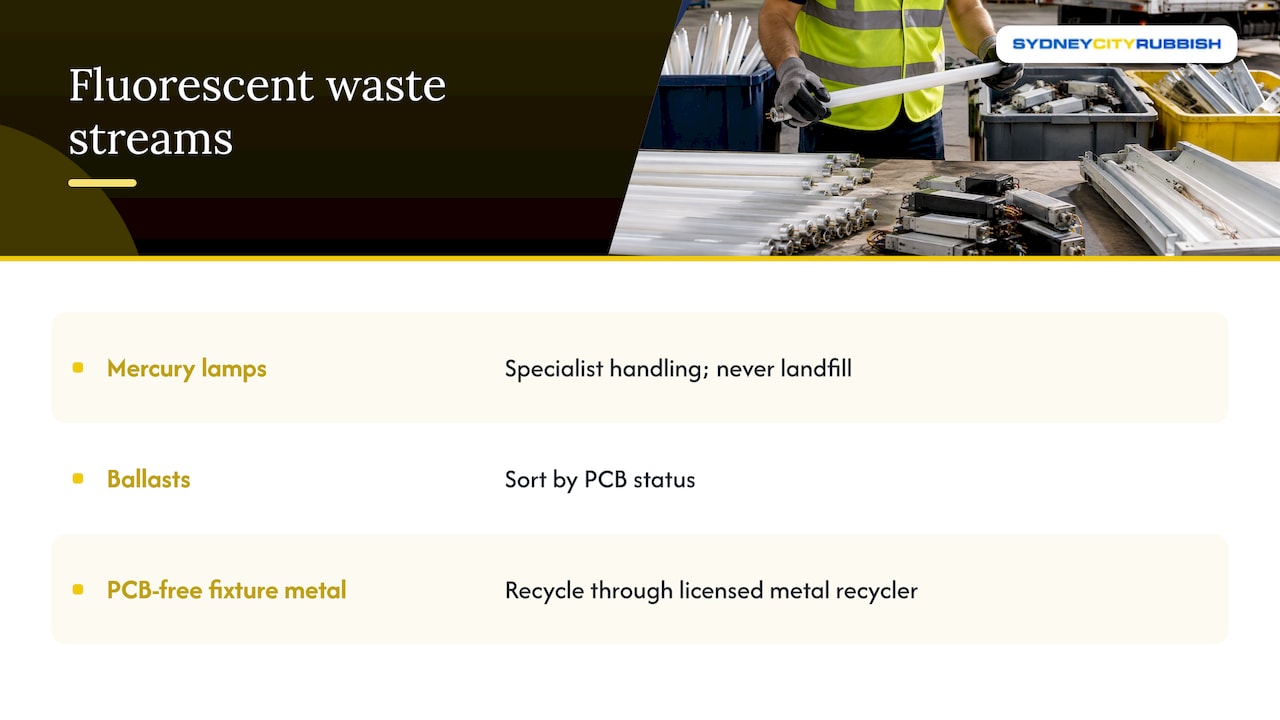
A fluorescent fitting is not one waste. When you strip a ceiling you generate at least three streams, and each goes somewhere different.
The lamps contain mercury. NSW EPA’s guidelines for commercial and industrial facilities note that fluorescent lights contain mercury and must not be disposed of to landfill. They also note that building management usually arranges replacement through a contractor when lamps fail. Phase-outs are also under way: DCCEEW says linear fluorescent lamps with triband phosphor of 60 watts or more phase out by 31 December 2027, and halophosphate lamps above 40 watts by 31 December 2026. Many Sydney buildings are therefore already moving to LED, which is the reason ballast and fitting removal is landing on so many building managers’ desks. Our page on fluorescent tube disposal for Sydney businesses covers the lamp side in detail.
The ballasts are the second stream, split into PCB and non-PCB as described above.
The fixture body is the third. Once the lamps and ballasts are out, the housing is largely sheet metal, plus wiring and plastic diffusers. Metal from electrical equipment can go to a licensed metal recycler only if it is considered PCB-free, which is why separating the ballast first is the step that unlocks recycling of the rest. Fixtures that still contain an unidentified ballast should not be handed to a scrap yard as is.
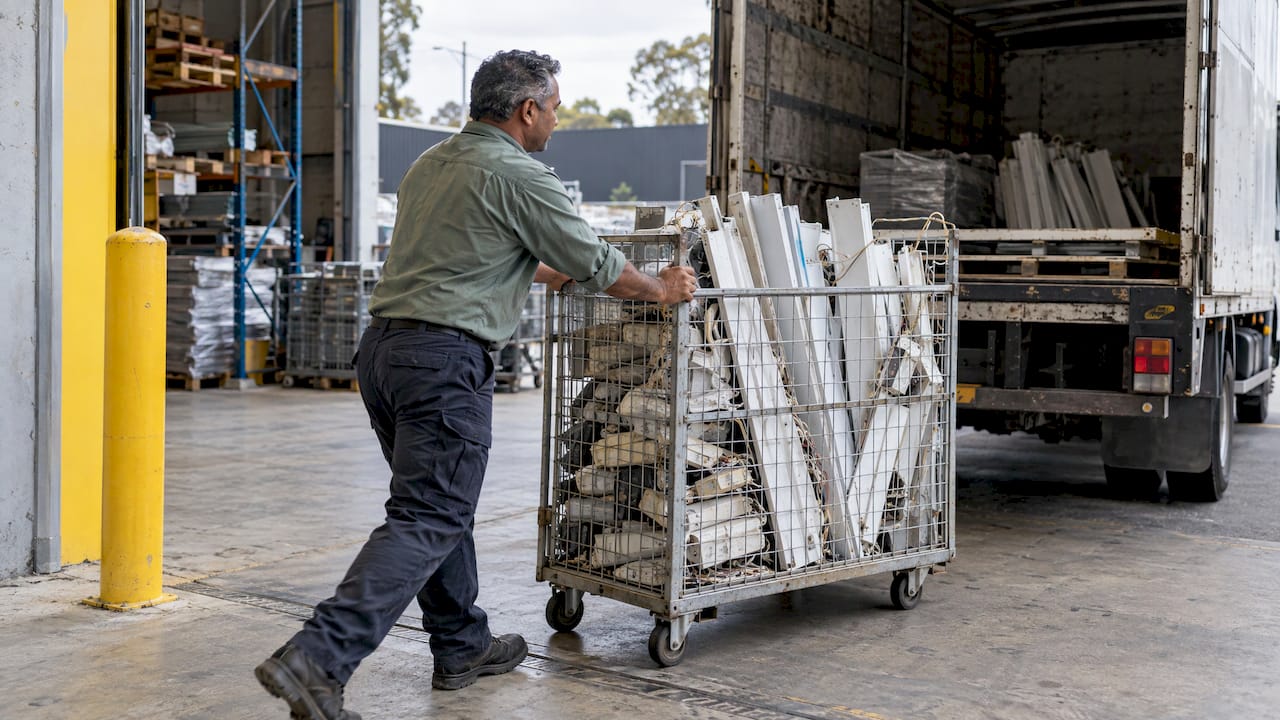
If you are replacing lighting in a tenancy, treat the job as lighting fixture removal with a waste plan attached: lamps out first and packed to avoid breakage, ballasts removed and sorted, fixtures stripped and metal separated, and every stream recorded against the site.
Where ballast removal fits in an office, retail or warehouse job
The situations where Sydney property and facilities managers run into ballasts are predictable.
End-of-lease and makegood: lease clauses often require the premises to be returned stripped of fit-out. Ceiling lighting installed by the tenant frequently comes out with the ceiling. Our guide to defit versus makegood explains how the two differ, and the office makegood page covers the scope.
Building strip-out: when a floor is gutted for a new fit-out, the lighting is among the first things to go. Planning the waste early avoids delay when a skip fills with ceiling tile and someone discovers ballasts at the bottom.
Warehouse and retail upgrades: high-bay and strip lighting upgrades to LED leave a large number of ballasts in a short window. A contractor with a truck and a hazardous-materials capability is far easier to coordinate than several separate pick-ups.
Strata and property management: common-area lighting replacements in older buildings generate ballasts in batches. The compliance burden sits with the manager arranging the work, so documentation and a clear chain of responsibility are worth as much as the removal itself. Our guide to hazardous waste pickup rules for Sydney managers explains how POEO fines come into it, and the hazardous waste rules guide for businesses goes further.
Doing the removal as one job
Separate trades each taking a piece of the lighting waste is where things go missing. An electrician unplugs the fittings, a demolition crew drops the ceiling, a general skip takes the rest, and nobody owns the ballasts. Combining the work under one contractor gives you a single point of accountability from the first fixture to the last drum.
Sydney City Rubbish handles rubbish removal for offices, retail locations, construction sites and strata-managed buildings across Sydney, including hazardous materials, and offers building strip-out, makegood and de-fit, ceilings, walls and doors, and truck and driver hire. We coordinate directly with building management for access, give quotes electronically, and work with registered recycling partners for responsible disposal. Corporate clients can opt in to carbon-neutral waste disposal. If ballasts are part of your strip-out or end-of-lease scope, get a quote through our commercial waste removal page and tell us how many fittings are coming down and whether any ballasts are leaking.
A practical checklist before the job
Write down how many fittings are in scope and the building’s age. Inspect a sample of ballasts for labels and dates, without opening them. Decide the default: anything unlabelled is treated as PCB-containing. Tell the removal contractor in advance about any leaking units so containers and absorbent are on the truck. Confirm access arrangements with building management, including loading dock and lift booking, so the pick-up is not held up on the day. Keep records of what was removed, when and by whom, in the project file for the lease handback or the building’s compliance record.
The e-waste and general commercial streams that often come out of the same site, such as monitors, cabling and furniture, are covered in our guides to safe electronics disposal and furniture disposal and recycling.
FAQ
Can I put fluorescent ballasts in a general skip?
No. Ballasts that may contain PCBs need to be separated and sent to a licensed destination, and fluorescent lamps contain mercury and must not go to landfill. Keep them out of the general waste skip and book a contractor who handles hazardous materials.
How do I know if a ballast contains PCBs?
Look for a “No PCBs” label and a readable manufacture date. US EPA guidance says ballasts made through 1979 may contain PCBs and that unlabelled ballasts should be assumed to contain them. If you cannot confirm it, treat the ballast as PCB-containing rather than opening it.
Can fluorescent light fixtures be recycled?
The metal housing can be recycled once the lamps and ballasts have been removed and the ballast is confirmed PCB-free or handled as PCB waste. Queensland’s guideline allows metal recycling only where the equipment is considered PCB-free. Separating the streams at the start is what makes recycling possible.
What do I do with a leaking ballast?
Do not touch the residue. Bag the ballast, place it in a separate sealed container with absorbent material, and keep it apart from intact units. Tell your removal contractor before collection so the right containers are brought, and see a doctor if anyone has been exposed.
Does ballast removal need to be a separate job from my strip-out?
No. Ballast and lighting removal can sit inside a strip-out, makegood or end-of-lease booking, which keeps access, timing and records in one place. Mention the number of fittings and any damaged units when you request your quote.
Sources
- Proper Maintenance, Removal and Disposal of PCB-Containing Fluorescent Light Ballasts, US EPA
- PCBs in Building Materials: Questions and Answers, US EPA
- PCBs in Fluorescent Light Ballasts fact sheet, US EPA
- Disposal of Fluorescent Light Ballasts, US EPA
- Guidelines for the Removal of Light Ballasts, University of Illinois
- Identifying and managing equipment containing PCBs, Queensland Government
- Handling and Disposal of Fluorescent Lamps, ALMR
- Managing Mercury in Australia, DCCEEW
- Better Practice Guidelines for Waste Management and Recycling in Commercial and Industrial Facilities, NSW EPA
- Waste PCB publication, EPA Victoria