Demolition Cost per sqm in Sydney: 2026 Guide
Updated November 2026 by the Sydney City Rubbish team
House demolition in Sydney has been reported at roughly $53 to $114 per square metre, and that range is a guide, not a rate card. The final figure moves with building size, construction material, access, hazardous materials, and removal and disposal costs. Commercial work such as strip-outs, makegood and partial demolition is priced on scope rather than a single rate, so the useful skill is knowing what sits inside a per-square-metre figure and what sits outside it.
This guide explains the benchmark, shows how to calculate it for your own building, and sets out the costs that most often arrive on top. It is written for property managers, strata managers, construction companies and business owners who need to budget before they ask for quotes.
TL;DR
- Sydney house demolition has been reported at about $53 to $114 per square metre. Treat it as a sanity check on a quote, not a price.
- Asbestos, tip fees, slabs, difficult access and services disconnection are the usual items priced separately from the base rate.
- Commercial strip-outs and makegood are quoted per project or per truckload, because scope matters more than floor area.
- Compare quotes on what is included (debris removal, licences, waste dockets, site handover), not on the headline number.
- Sydney City Rubbish handles strip-outs, demolition and waste removal for commercial clients, with electronic quoting.
Table of Contents
- What the per-square-metre figure means
- What pushes the rate up or down
- How to calculate the area and build a budget
- Disposal costs: the line that surprises people
- Approvals, services and asbestos rules in NSW
- Commercial demolition, strip-outs and makegood
- How to compare demolition quotes
- Reducing the cost without cutting corners
- Get a quote for your project
- FAQ
- Sources
What the per-square-metre figure means
A per-square-metre rate divides a demolition price by the floor area of the building. It gives you a quick way to compare jobs of different sizes, and it is the form in which most published guides present residential demolition.
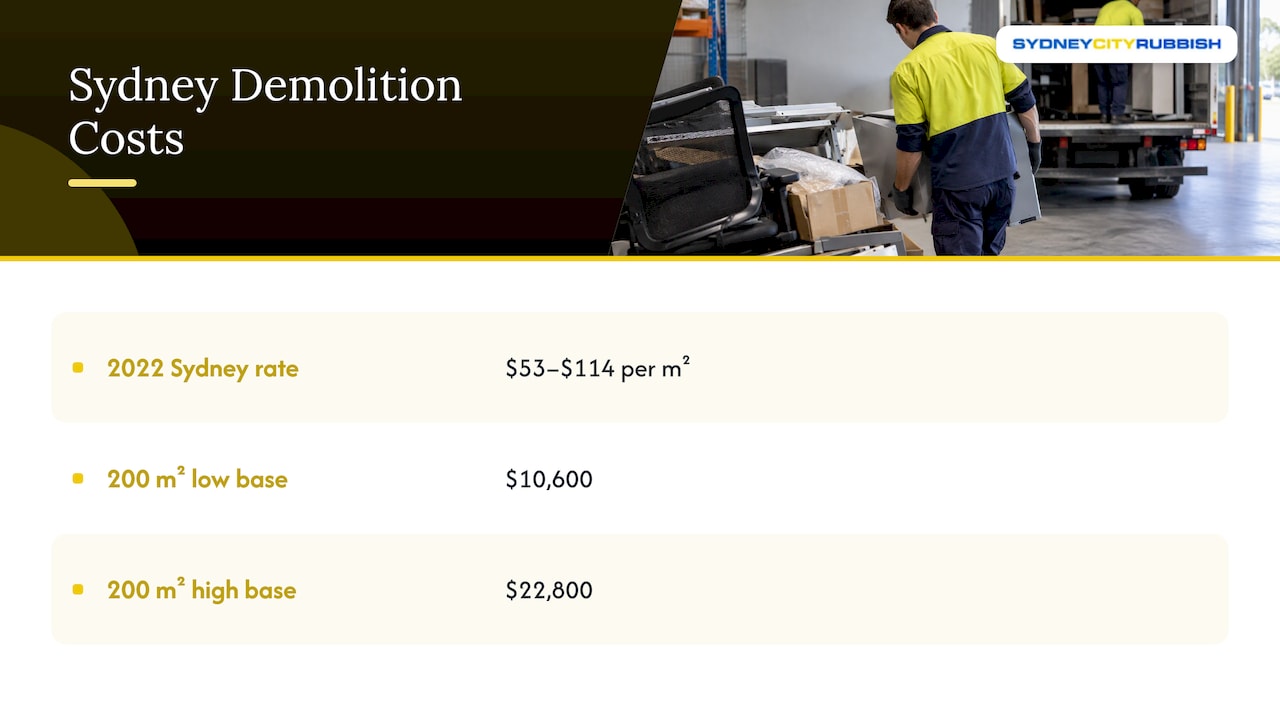
The Realestate.com.au guide to demolition costs reported a Sydney range of $53 to $114 per square metre in August 2022. The same article is clear that the amount depends on the size and construction of the building, site access, hazardous materials, and removal and disposal. Prices have moved since 2022, so use the range to orient yourself and ask for current written quotes before you commit a budget.
A worked example shows how wide the band is. For a 200 m² house, the 2022 range gives a base figure of $10,600 at the low end and $22,800 at the high end (200 × $53 and 200 × $114). That spread of more than $12,000 is not an error. It reflects the difference between a light timber-framed building on an open block and a heavy masonry building on a tight street.
The rate works best at the early budgeting stage. Once you have a quote, the lines inside it tell you far more than the rate does.
What pushes the rate up or down
Construction material and weight
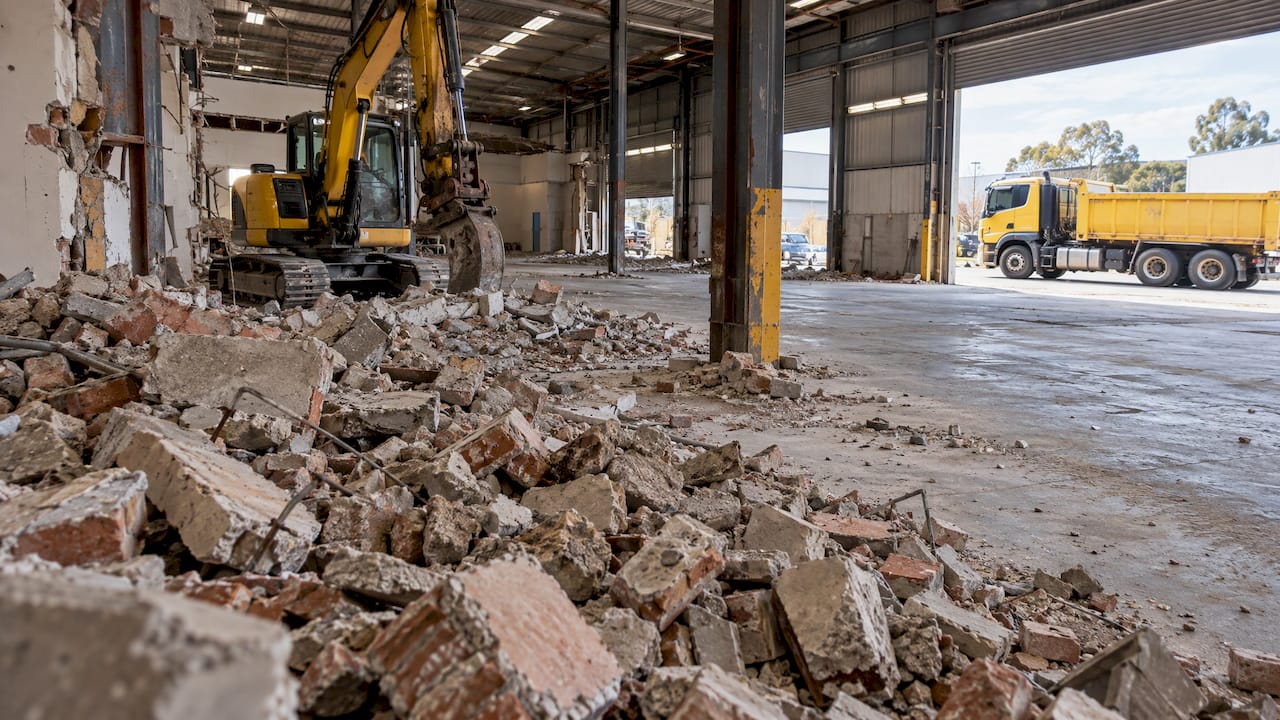
Brick, concrete and block buildings generally cost more to demolish than timber or aluminium-clad ones. The reason is bulk: heavier debris raises both the effort of breaking it down and the tipping and transport fees, as the Realestate.com.au guide explains through its industry expert. Dense rubble and jagged masonry fragments need more truck movements than a lightweight timber frame of the same floor area.
Size, storeys and additional structures
Larger buildings usually cost less per square metre than small ones, because machinery and crew are mobilised once. Double-storey buildings add working-at-height and labour complexity. Garages, sheds, retaining walls, pools and vegetation are often outside the main floor area, so check whether the quote counts them and how.
Access and location
Sydney sites are rarely generous. Narrow streets, steep driveways, shared laneways, strata basements and loading docks that limit truck height all push crews toward smaller machinery, more manual handling and extra truck trips. Distance to the nearest approved waste facility also changes transport costs.
In commercial buildings, access is often a question of building management rather than the street. Loading dock bookings, lift protection, after-hours work windows and noise restrictions all affect how many hours a crew can work in a day. We coordinate directly with building management so access is arranged before the crew arrives, and that planning is part of why scope is priced per project rather than per square metre.
Site logistics
Larger demolition and civil jobs depend on equipment running all day, which means fuel has to reach the site without interrupting work. Understanding how construction fuel logistics on job sites are managed helps project managers see why access, staging areas and delivery windows belong in the programme and not just the quote.
Hazardous materials
Asbestos is the item that can change a budget most. Homes built before the late 1980s may contain it, and SafeWork NSW recommends using a licensed professional to assess or remove it. Commercial fit-outs from the same era can also contain asbestos in ceiling tiles, floor adhesives, lagging and sheeting, so the same caution applies to older offices and shops.
How to calculate the area and build a budget
Start with the gross floor area of the building. Use the measurements from architectural plans or a survey where you have them, and measure each level separately for multi-storey buildings.
Then decide what counts. Garages, alfrescos, porches and outbuildings are the usual points of disagreement. Two contractors can quote on different areas and appear to be at different rates when they are really pricing different things. Ask each one to state the area it has used.
Next, apply a rate range to the base area, as in the 200 m² example above. This gives you a low and high base figure. Keep it separate from everything else, because the base rate typically does not cover the following items:
Asbestos assessment, removal and clearance, which are priced on what the assessment finds. Tip fees for the waste actually produced, which depend on weight and material type. Concrete slabs, footings and in-ground structures such as pools, which vary a great deal with size and access. Utility disconnection and make-safe work. Approvals and certificates. Site establishment such as fencing, hoarding and protection of neighbouring property.
Add a contingency for the items you cannot see yet. A pre-demolition assessment reduces the unknowns, which is why it belongs at the start of the budget and not at the end.
One caution on waste: floor area multiplied by storey height gives a volume for comparison, not a waste quantity. The tonnes that reach a tip depend on materials, and a contractor’s waste estimate or an audit is the sounder basis for that line.
Disposal costs: the line that surprises people
Tip fees are driven by weight, and in Sydney they include a state levy. The NSW EPA lists the 2026–27 waste levy at $180.20 per tonne in the Metropolitan Levy Area from 1 July 2026, and that is before the facility’s own gate fees and the cost of trucking.
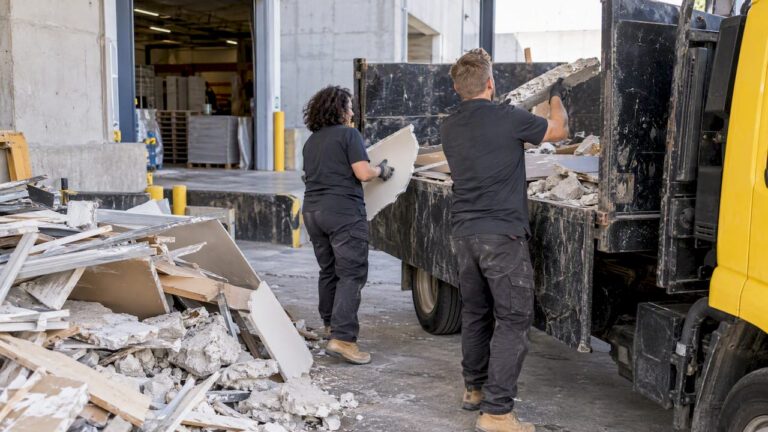
That is why heavy masonry and concrete cost more than the same floor area in timber, and why sorting matters. Waste that is separated into concrete, metal, timber and general debris can often be directed to recycling streams, while mixed loads cost more to handle. We use registered recycling partners for responsible disposal, and we can tie payment to waste dockets so you can see where the material went. Our guide to demolition waste handling in NSW explains the documentation commercial clients should expect, and our demolition waste plan page covers how dockets and payment connect.
Approvals, services and asbestos rules in NSW
Before any budget is final, the approvals pathway needs confirming. According to the NSW Planning Portal’s demolition guidance, a home may be demolished under a complying development certificate if it meets the Codes SEPP and the Section 10.7 certificate, or through a separate development application. The same page notes that licensed professionals must disconnect utilities. The Planning Portal also describes demolishing a building as an example of complying development when the proposal meets the relevant development standards.
The pathway depends on the property and the proposed work, so ask each contractor which applications and disconnections they coordinate and which fees are allowed for in the price.
On asbestos, SafeWork NSW states that a friable asbestos removal licence is required for any amount of friable asbestos, and a non-friable removal licence is required for more than 10 m² of non-friable asbestos. This is a safety and legal requirement, not an optional upgrade, and it is why an assessment comes before demolition and not after.
Commercial demolition, strip-outs and makegood
The per-square-metre benchmarks above describe house demolition. Commercial work behaves differently, and applying a residential rate to an office or shop will mislead you.
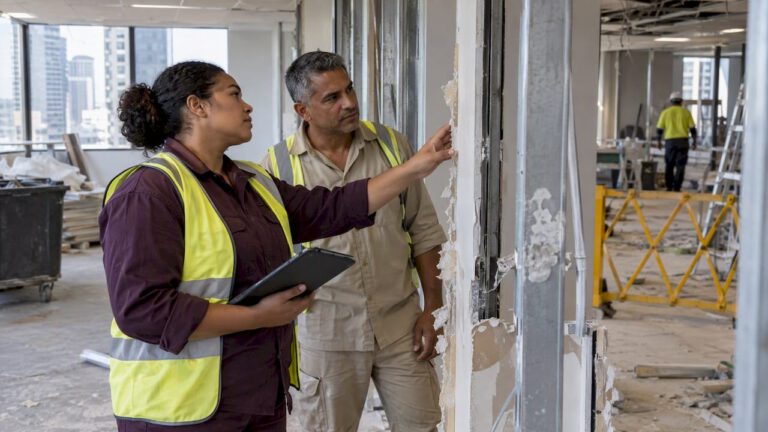
A commercial strip-out removes fixtures, partitions, ceilings, floor finishes and services from a tenancy. Makegood returns a leased space to the condition the lease requires. Structural demolition removes walls, slabs or whole sections of a building. Each has its own drivers: the density of partitions, the number of floors and lifts, the type of floor finish and adhesive, the amount of joinery and furniture, and the hours the building allows.
Because of that, scope drives the price. A fully open floor plate with carpet tiles is a very different job from a tenancy with plasterboard offices, glazing, bulkheads and a bonded floor, even at the same floor area. We quote commercial jobs per project or per truckload after we understand the scope, and our electronic quoting is designed to make that quick.
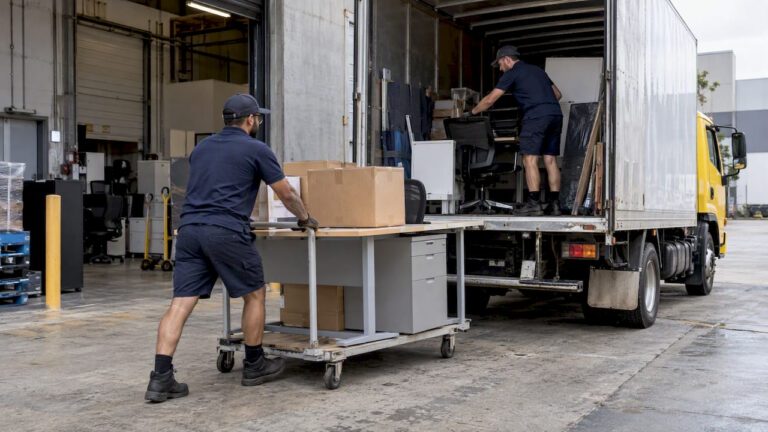
We carry out building strip-outs, makegood and de-fit work, structural demolition, floor finish removal, and concrete cutting and grinding, along with truck and driver hire. For leased premises, our page on defit versus makegood explains what tenants are usually asked to deliver, and our commercial demolition page describes how we approach larger scopes.
How to compare demolition quotes
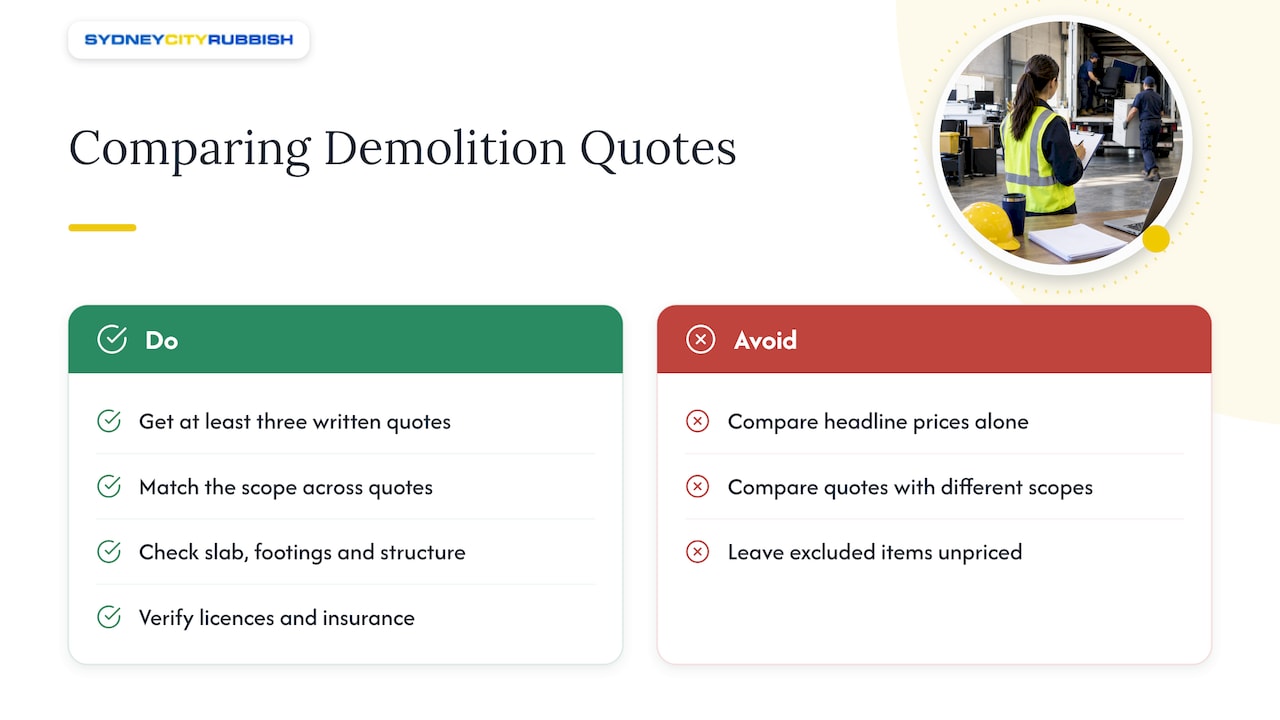
Get at least three written quotes for the same scope and make sure they are describing the same job. A low headline price is often a narrower scope.
Check each quote for the following. Whether it covers the structure, slab and footings or only the superstructure. How asbestos is handled: an assessment, licensed removal and clearance, or an exclusion with a provisional sum. Who pays tip fees and whether waste dockets are provided. Who arranges utility disconnections and approvals. What the site looks like at handover, including whether the site is left clean and safe. Insurance and licences held by the contractor.
If one quote leaves out items that the others include, price them in before you compare. A quote that excludes asbestos, tipping and disconnections is a base rate, and the real cost will arrive later as variations.
Punctuality matters on commercial jobs as well, because a delayed crew can hold up a handover, a lease deadline or the next trade. We guarantee punctuality with compensation if we are late, and we clean up meticulously so that no waste is left behind.
Reducing the cost without cutting corners
The best savings come from planning, not from skipping steps. Complete the asbestos assessment early, so the scope is fixed before the crew mobilises. Give the contractor accurate access details, including loading dock heights, lift sizes and parking restrictions. Remove or sell reusable items such as furniture and fittings before demolition starts. Separate recyclable materials where possible, and book work outside peak periods if the programme allows.
For corporate clients with sustainability targets, we offer an opt-in carbon-neutral waste removal option in partnership with Carbon Neutral. It is an addition you choose, and it lets your waste reporting reflect a lower-impact disposal pathway.
Get a quote for your project
If you manage an office, retail space, construction site or strata building in Sydney, send us your scope and we will price it properly: strip-out, demolition, makegood or waste removal. Start with our commercial rubbish removal service or our construction waste disposal page. Get a free quote now.
FAQ
How much does demolition cost per square metre in Sydney?
For houses, Realestate.com.au reported a range of $53 to $114 per square metre in 2022. Treat this as a guide only. Asbestos, tip fees and access can sit outside the base rate, so a current written quote is the only reliable figure.
Is there a per-square-metre rate for commercial strip-outs?
Commercial strip-outs are generally priced per project or per truckload, because partitions, ceilings, floor finishes, joinery and building access affect the work more than floor area does. Send us your plans or photos and we will quote against the actual scope.
Do I need a licence to remove asbestos before demolition?
In NSW, SafeWork NSW requires a friable asbestos removal licence for any amount of friable asbestos, and a non-friable licence for more than 10 m² of non-friable asbestos. Use a licensed professional to assess older buildings before work begins.
What is the cheapest safe way to demolish a building in Sydney?
The safest saving is a clear scope. Get several written quotes for the same work, complete the asbestos assessment first, confirm approvals and disconnections, and separate recyclable waste. Choosing a quote that leaves out licensed asbestos handling or disposal only moves the cost to later.
Sources
- How Much It Costs to Demolish a House, Realestate.com.au
- Demolish, MyHome Planner, NSW Planning Portal
- Complying Development, NSW Planning Portal
- Asbestos, SafeWork NSW
- Waste levy areas and levy rates, NSW EPA