Rubbish Removal Cost per m³ in Sydney: 2026 Commercial Guide
Published 31 October 2026 by the Sydney City Rubbish team.
There is no single rate per cubic metre for commercial rubbish removal in Australia. Published guides put general waste at roughly $80 to $150 per m³, but that figure is for light, mixed, easy-access loads. Heavy construction debris is charged by weight, small loads attract a minimum charge, and a CBD loading dock with a lift booking can cost more in labour than the tipping itself. This guide explains how the per-m³ figure is built, what pushes it up or down for offices, retail fit-outs, strata buildings and building sites, and how to compare quotes properly.
TL;DR
- Light, mixed commercial waste is commonly quoted between $80 and $150 per m³, but a minimum charge of about $150 to $250 means a small load works out far dearer per cubic metre.
- Heavy waste such as concrete, brick, tiles and plasterboard is charged by weight, and the NSW waste levy of $180.20 per tonne in the Sydney metropolitan area is a large part of that cost.
- Access, stairs, lift bookings, sorting and hazardous items change the price more than the volume alone.
- Ask every supplier for the same thing: volume or weight basis, labour, tipping, levy, and what is excluded.
Table of Contents
- What “per cubic metre” actually means
- Typical price ranges per m³
- Why a small load costs more per cubic metre
- The NSW waste levy and gate fees
- What changes your price on a commercial job
- How to estimate your own volume
- Rubbish removal or a skip bin?
- Quote checklist for commercial buyers
- Getting an accurate quote from us
- FAQ
- Sources
What “per cubic metre” actually means
A cubic metre is a space measure: one metre wide, one long and one high. Rubbish removal companies use it because it is the quickest way to size a job on site. A standard office desk with a return takes up around a cubic metre once it is loaded, and a full 6 m³ truck body holds about six of them with some packing.
The difficulty is that tipping facilities do not charge by space. They charge by the tonne, weighed at the gate. A cubic metre of polystyrene packaging weighs almost nothing, while a cubic metre of broken concrete is well over a tonne. So a removalist who quotes per m³ is making an assumption about how heavy your waste is. That is why a rate of $100 per m³ can be fair for a floor of old workstations and far too low for a bathroom demolition.
In practice, you will see three pricing methods in Sydney:
- Volume-based quotes, where the price is set by the estimated m³ plus crew time.
- Truckload quotes, where a truck and driver are priced for a set size of load.
- Weight-based quotes, mostly for heavy or construction waste, where the tip receipt drives the final figure.
Most commercial jobs blend two of them: a volume estimate for the labour and loading, and weight for anything dense.
Typical price ranges per m³
The ranges below combine one 2026 industry price guide with the factors that move a Sydney quote. Treat them as a way to check whether a quote is sensible, not as a price list. We do not publish fixed rates, because every commercial job is quoted on its own access and waste mix.
| Waste type | How it is usually charged | What drives the cost |
|---|---|---|
| Light office waste (cartons, paper, plastic, soft fit-out items) | Per m³ plus labour | Volume and number of crew |
| Office furniture and joinery | Per m³ plus labour | Disassembly, stairs, lift access |
| Mixed retail fit-out waste | Per m³ plus tipping | Mix of timber, metal, plasterboard |
| Construction and demolition debris | By weight | Levy, gate fee, density |
| Electronic waste | Often per item or per load | Recycling pathway |
| Hazardous or prescribed waste | Quoted separately | Licensed handling and tracking |
For general waste the guide cited above gives $80 to $150 per m³, and for end-of-lease clear-outs it describes jobs that can reach 20 to 30 m³, priced on estimated volume plus crew hours. For a job of that size, the per-m³ figure tends to fall as the volume rises, because travel and setup costs are spread over more cubic metres.
Why a small load costs more per cubic metre
The same guide reports a minimum charge of $150 to $250 that covers travel, fuel and standard tipping for up to about 1 m³. The truck, driver and tip run cost the same whether you send one cubic metre or three.
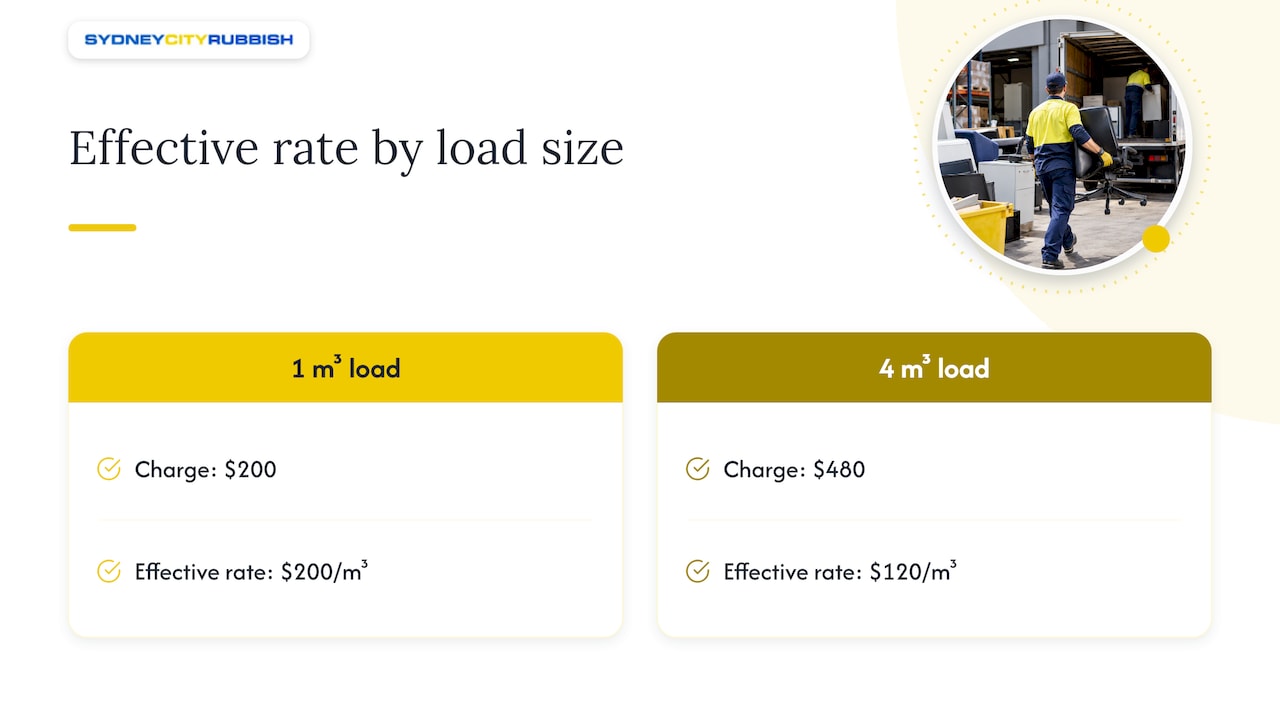
A quick illustration shows the effect. If a minimum charge of $200 covers a single cubic metre, your effective rate is $200 per m³. If the same crew arrives and takes 4 m³ for $480, the effective rate is $120 per m³. Neither quote is wrong. The second simply spreads the fixed cost over more waste.
The practical lesson for office managers is to batch. Clearing one meeting room this month and another next month costs more per cubic metre than a single visit that takes both. If a tenant is vacating in stages, ask for a single quote covering all stages and a pick-up schedule.
The NSW waste levy and gate fees
For heavy waste, the largest single component is often not the truck at all. Every tonne of waste that goes to landfill in the Sydney metropolitan levy area attracts the NSW waste levy. The EPA lists the 2026 to 27 rates from 1 July 2026 at $180.20 per tonne for the Metropolitan Levy Area and $103.80 per tonne for the Regional Levy Area. The rates rise with the Consumer Price Index each July, so any older guide will understate the cost. We cover the mechanics further in our explainer on Sydney’s waste levy and its implications.
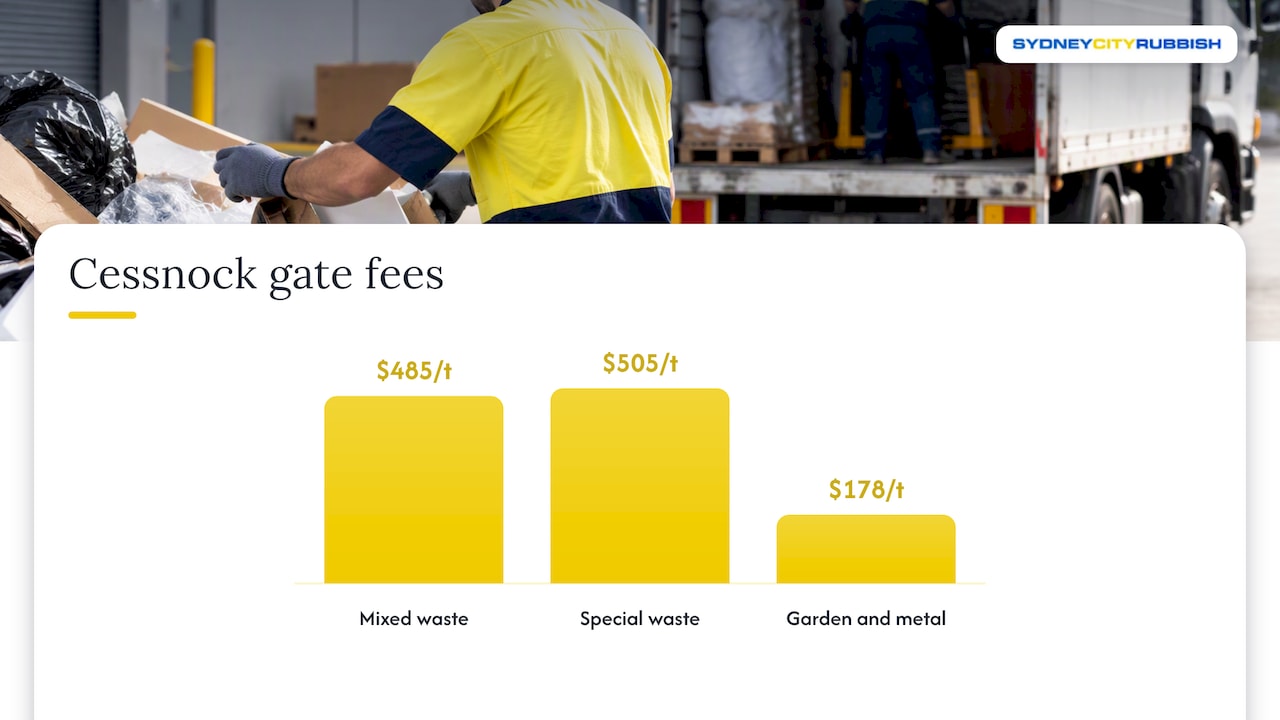
The levy is only one piece of the gate fee. Facilities add their own charges for handling and operation. Cessnock Council, for example, lists the State Waste Levy of $174.20 per tonne for 2025/26 and gate fees there of $485 per tonne for mixed waste and $505 for special waste, against $178 per tonne for garden organics and metal. Cessnock is outside Sydney, so those numbers are not Sydney prices, but they show the pattern clearly: a sorted stream can cost a third of what mixed waste does.
Here is why that matters for per-m³ pricing. Suppose a facility charges $400 per tonne for mixed waste and your load of dense debris weighs 1.5 tonnes. The tip cost alone is $600 before any labour or transport. If that debris occupied 2 m³, tipping is $300 per m³. This is a hypothetical to show the arithmetic, not a quote, but it explains why a flat rate of $100 per m³ cannot apply to heavy debris.
What changes your price on a commercial job
Access and building rules
A ground-floor shopfront with a roller door and a truck at the kerb is the cheapest kind of job. A fourth-floor office with a single goods lift, a loading dock booking window and a building manager who requires certificates of currency is slower. Crews carry more trips, and time on site is what you pay for. This is why we coordinate with building management before the day, so lift bookings, dock times and insurance requirements are settled and the crew is not waiting at the door.
In the Sydney CBD, Parramatta and Macquarie Park, loading dock restrictions and after-hours work rules are common. After-hours work can cost more in labour, but it also avoids tenant disruption and kerbside congestion. Ask for the in-hours and after-hours price side by side.
Sorting and separation
Sorting waste into distinct streams can reduce disposal costs, because metal and green waste often attract lower or zero gate fees compared with mixed waste. A council example makes this visible: Sunshine Coast facilities charge for commercial and construction and demolition waste, while scrap metal and e-waste are listed as free. That is Queensland, and Sydney facilities set their own schedules, but the principle is the same. If your fit-out strip-out produces a lot of steel framing, ducting or cabling, keeping it separate can lower the weight of mixed waste you pay the levy on.
Waste type and restricted items
Things that look like ordinary rubbish can change the quote. Fluorescent tubes, batteries, gas bottles, paint, asbestos-containing material and electronics each have their own handling. Tell the supplier before the quote, not on the day. Hidden hazardous items can cause a crew to stop work, and misdescribing waste is taken seriously by regulators. In Queensland, for instance, falsely identifying commercial waste is an offence with a penalty of up to $39,165. In NSW, the EPA regulates waste transport and disposal, so the safest approach is an accurate description and a supplier who takes waste only to facilities that are lawfully able to receive it.
Size categories and weighbridges
Some councils price commercial loads by category rather than exact weight. Logan City Council, for instance, bases commercial fees on small, medium or large loads and sends anything larger to a weighbridge site. The lesson for any state is to ask how your supplier’s tip is charged: by estimated load, or by the weighbridge ticket. A weighbridge ticket is the most transparent, and you can ask to see it.
How to estimate your own volume
A reasonable volume estimate helps you check any quote. Measure the piled or stacked waste by length, width and height in metres, then multiply. A pile 3 m long, 2 m wide and 1.5 m high is 9 m³ of loose space. Loose waste compacts or packs differently from how it sits, so treat the result as a rough guide. Furniture with voids, such as desks and filing cabinets, takes up more truck space than its material suggests, while flat-packed boards and cartons pack tight.
For offices, a workable approach is to count workstations, then add cabinets, meeting tables, kitchen items and any e-waste separately. A full floor of a typical open-plan tenancy can easily reach the 20 to 30 m³ range, which is why end-of-lease clearance is quoted on volume plus crew hours rather than a flat price. If you have photos and a floor plan, our team can usually give an electronic quote without a site visit, and larger or more complex jobs are inspected before the price is confirmed.
Rubbish removal or a skip bin?
A skip bin is a container you fill yourself and have collected. Rubbish removal means a crew attends, loads the waste and takes it away. For commercial clients the difference is labour and time, not just price. Published Sydney skip prices vary widely by size and waste type, and heavy waste is typically priced above general waste because of weight and levy costs. Skip bin quotes also tend to carry a weight allowance with excess charged per tonne, and a council permit may be needed if the bin sits on a public road.
A skip can suit a construction site that generates debris continuously and has space for a bin. Full-service removal tends to suit an office, retail tenancy or strata building where there is no space for a bin, no staff time to load it, or a lift and dock that restrict access. If you are weighing both, compare the total cost including your own labour hours, any permit, lift bookings, and the cost of delays. A bin that sits full on a loading dock waiting for collection can create its own problems with building management.
Quote checklist for commercial buyers
To compare quotes fairly, ask each supplier the same questions in writing.
First, ask what the price is based on: estimated m³, truck size, or weight. Second, ask whether labour, travel, tipping and the waste levy are included, and what happens if the load is heavier or larger than estimated. Third, ask whether the price assumes ground-level access, and what changes with stairs, a lift or a dock booking. Fourth, ask how hazardous items, electronics and mattresses are handled and whether they are extra. Fifth, ask for a disposal record or evidence of where the waste went, especially if your company reports on sustainability or recycling targets. Finally, ask what happens if the crew is late or leaves waste behind.
Our own approach is to quote on volume or load and the access conditions you describe, confirm anything unusual before the day, and clean up meticulously so no waste is left behind. We guarantee punctuality, with compensation if we are late, and we use registered recycling partners for responsible disposal. Clients can also opt in to carbon-neutral removal, in partnership with Carbon Neutral.
Getting an accurate quote from us
If you manage an office, a retail tenancy, a strata building or a construction site in Sydney, our commercial rubbish removal service covers furniture, appliances, electronics and general debris, and our construction waste disposal team handles heavy loads priced by weight. For larger projects such as strip-outs and makegood, see what we do. You can also read how we explain Sydney rubbish removal prices in more detail and what minimum charges and cubic-metre costs look like for permits and small jobs.
Send us your photos, the address and the access details, and we will come back with an electronic quote. Get a free quote now.
FAQ
What is the average cost of rubbish removal per cubic metre?
For general, light waste, 2026 industry guides put it at roughly $80 to $150 per m³. Heavy waste is charged by weight instead, so a per-m³ average does not apply. The access conditions on your site can change the figure significantly.
Why is a small load more expensive per cubic metre?
Because of the minimum charge. A truck, driver, fuel and tip run are needed even for a small load, and guides report minimums of about $150 to $250 covering up to roughly 1 m³. Combining several small clear-outs into one booking lowers the cost per cubic metre.
Does the NSW waste levy affect my quote?
Yes, for anything going to landfill. The levy for the Sydney metropolitan area is $180.20 per tonne from 1 July 2026, and it is built into tipping costs. Sorting out recyclable material such as metal reduces the weight that attracts the levy.
How much does an office end-of-lease clear-out cost?
It depends on volume, crew hours and access rather than a flat rate. Large clear-outs can reach 20 to 30 m³, and the per-m³ cost usually falls as volume rises. Send photos or a floor plan for a firm quote.
Sources
- How Much Does Rubbish Removal Cost in Australia 2026
- Waste levy areas and levy rates, NSW EPA
- Sunshine Coast Council waste fees document
- Commercial waste fee schedule, Logan City Council