Office Defit Cost in Sydney: 2026 Price Guide
Updated October 2026 by the Sydney City Rubbish team
Most Sydney office defits are priced per square metre, and the commonly quoted range for an office strip-out is roughly $50 to $150+ per square metre. Where your job lands depends on the size of the floor, what the lease obliges you to remove, how much ceiling and services work is involved, and how easy it is to get rubbish out of the building. The only reliable number is a quote based on a site inspection and a read of your lease.
This guide explains what a defit includes, what moves the price, which costs are often missed (removal, disposal and building access), and how to budget before you hand the premises back.
TL;DR
- Sydney office strip-outs are commonly quoted at around $50 to $150+ per square metre, but scope and lease terms decide the final figure.
- Services reinstatement, especially air conditioning (HVAC), is often the most underestimated line in a lease-end budget.
- Removal, disposal, loading dock bookings and after-hours access are frequently priced separately from the demolition itself.
- Read the make-good clause and the original condition report first, and get a scope assessed 3 to 6 months before expiry.
- Ask for quotes that separate labour, haulage, tipping and compliance paperwork so you can compare like for like.
Table of Contents
- What an office defit actually includes
- Typical office defit costs in Sydney
- What drives the price up or down
- Removal, disposal and recycling: the costs people miss
- How access and job size change the total
- Check the lease before you ask for quotes
- How to estimate and manage the cost before handback
- Why tenants choose Sydney City Rubbish
- FAQ
- Sources
What an office defit actually includes
A defit (also written de-fit) is the removal of the fitout a tenant installed during the lease: partitions, joinery, ceilings, carpet and other floor finishes, cabling, kitchenettes, signage and loose furniture. The aim is to return the floor to the condition the lease requires. In practice that is often a bare, stripped floor plate, though some leases ask for something closer to the original base-building condition and others allow certain items to stay.
Make good is the wider obligation. It is based on contract law, and the lease sets out what the tenant must do. A defit is usually the demolition and removal part of that obligation. Make good may also include reinstating ceilings, repairing walls and floors, restoring services and repainting. When people search for the cost of a defit they are often really asking about the cost of the whole handback, so it pays to confirm with each contractor exactly which of those items their price covers.
Our Makegood and De-fit service covers the removal side of this work: strip-out, ceilings, walls and doors, furniture and joinery removal, floor finish removal and the rubbish haulage that follows. If you want a plain-language walkthrough of the process, we have also described what a Sydney office strip-out involves.
Typical office defit costs in Sydney
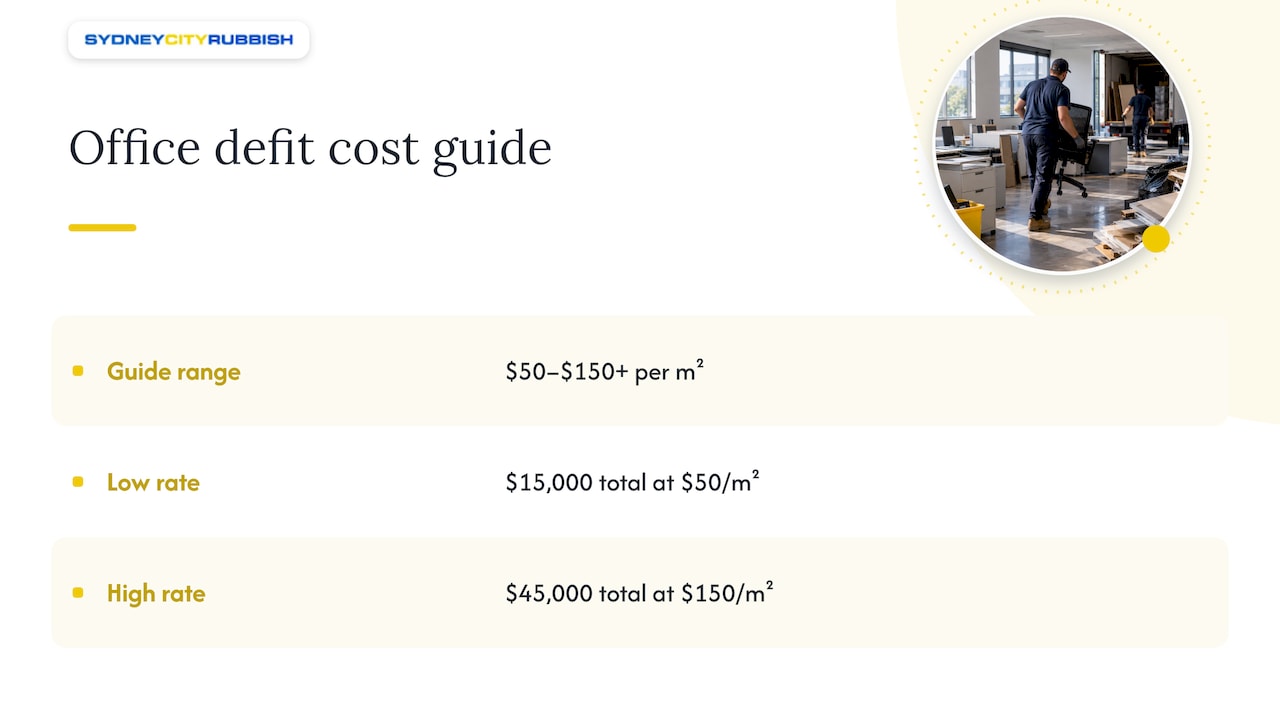
Treat any published figure as a guide. The range most often cited for Sydney office strip-outs is approximately $50 to $150+ per square metre, and that source is clear that the real cost depends on the premises and the scope of works. Prices can be lower for a simple open-plan floor and higher where there is heavy joinery, layered ceilings, concrete work or hazardous material.
To see what this means for a business, take a hypothetical 300 square metre floor. At $50 per square metre the strip-out comes to $15,000. At $150 per square metre it comes to $45,000. That is a threefold spread, and the gap is explained almost entirely by scope, access and services, which the sections below cover. This is an illustration of the arithmetic, not a quote.
It also helps to separate the defit from the cost of building a new fitout. Per-square-metre figures that appear in fitout cost guides, often many hundreds or thousands of dollars per square metre, describe construction, not removal. Do not use them to budget your handback.
What drives the price up or down
Several factors do most of the work in a defit quote, and they interact.
Size and layout
Floor area sets the baseline, but layout matters as much. A cellular floor with many full-height partitions, doors and ceilings takes more labour than an open-plan floor of the same size. Heavy glass partitions need careful dismantling and extra handling, and built-in joinery, reception desks and server rooms add hours.
Ceilings, services and reinstatement
Services are where budgets slip. Mechanical services, particularly HVAC, are frequently a major and underestimated lease-end expense, with reinstatement alone costing $30 to $80 per square metre according to one Sydney building services engineer. Electrical, data cabling and fire services can add further cost if the lease requires them to be returned to their original configuration. Removing a ceiling grid may also trigger the need to reinstate sprinkler heads or lighting.
Floor finishes and concrete work
Carpet tiles lift quickly. Glued vinyl, timber, epoxy coatings and screeds do not. If the lease requires a clean slab, floor finish removal and concrete grinding can become a major line item. We carry out floor finish removal and grinding in-house, along with concrete cutting, core drilling and jackhammering, which matters when you want one contractor accountable for the whole floor.
Hazardous materials
Older Sydney buildings can contain asbestos in ceiling tiles, adhesives, lagging or wall sheeting. Where it is suspected, testing and licensed removal come first and can change both cost and timing. If a building was constructed or refurbished before the use of asbestos was banned, ask the building manager for the asbestos register before anyone starts demolishing.
Building rules and access
Tower buildings in the CBD, North Sydney, Parramatta and Macquarie Park usually restrict when and how trades can work. Common conditions include after-hours or weekend work only, loading dock bookings, lift protection, certificates of currency for insurance and sometimes a bond. Each one costs money, either directly or through longer programs. A ground-floor suite with a street-level door is cheaper to clear than level 34 with a shared goods lift.
Removal, disposal and recycling: the costs people miss
A defit quote can be misleading if it covers demolition labour but leaves haulage and tipping to someone else. Removal is a real cost: the debris from a stripped office is bulky, mixed and heavy. Plasterboard, ceiling tiles, carpet, timber, metals, laminated joinery, electronics and old furniture all leave the building in different streams.
The items that tend to be charged separately, or hidden inside a single lump sum, are these:
| Cost item | What to ask |
|---|---|
| Labour to carry debris to the dock | Is it included in the demolition rate or priced per load? |
| Truck and driver time | Is pricing per truckload, per hour or per project? |
| Tipping and recycling fees | Are these passed through at cost, and with what paperwork? |
| Building access costs | Who pays for dock bookings, lift padding and after-hours supervision? |
| Electronic and hazardous waste | Is e-waste, lighting and anything regulated handled separately? |
Recycling affects cost as well as compliance. Sorted loads going to registered recycling facilities can be cheaper to process than a mixed skip, and they give you a paper trail for your sustainability reporting. We use registered recycling partners, and corporate clients can opt in to carbon-neutral disposal through our partnership with Carbon Neutral.
If the lease also requires you to clear furniture, our office furniture removal service is a straightforward way to take desks, chairs, filing and storage out before the strip-out crew arrives. Our office rubbish removal for the CBD is built around the dock and lift constraints that apply in large towers.
How access and job size change the total
Two offices of identical area can differ by tens of thousands of dollars purely on logistics. A job that needs three truck trips through a basement dock, with a 6 pm start, costs more than a job done in two daytime loads. Programming matters too: tasks run in the wrong order cause rework, such as removing a ceiling after the floor has been cleared of debris, or leaving loose furniture in the way of demolition.
It is also worth looking at what the stripped floor reveals. Once the space is bare, many tenants notice how much energy the old fitout was using, and if you are moving to a new tenancy, a few office energy saving tips can be worth applying in the next fitout. That is a decision for the new premises, though, not a factor in your handback cost.
Check the lease before you ask for quotes
The lease is the specification. Before you brief anyone, find the make-good clause, any schedule of works and the condition report from the start of the tenancy. Tenants should check the lease’s make-good provisions and refer to a signed condition report prepared before the lease begins. Retail leases cannot override the Retail Leases Act 1994 (NSW), so retail tenants have protections that office tenants may not.
Things to confirm in the documents include:
whether the landlord can require removal of fitout it approved or that was there when you moved in, whether ceilings, floor coverings and cabling must come out or can stay, what the lease says about restoring services, whether the landlord can take a cash settlement instead of works, and how long you have after expiry to complete the handback. If you are unsure how a clause applies, a property lawyer or a quantity surveyor is the right person to ask, not the contractor who will price the job.
Disputes are common. In retail leases, a certified quantity surveyor can often make a binding determination on make-good costs, and the NSW Small Business Commission offers mediation for eligible lease disputes, as set out in the NSW Retail Tenancy Guide. Office leases follow what they say on their own terms.
How to estimate and manage the cost before handback
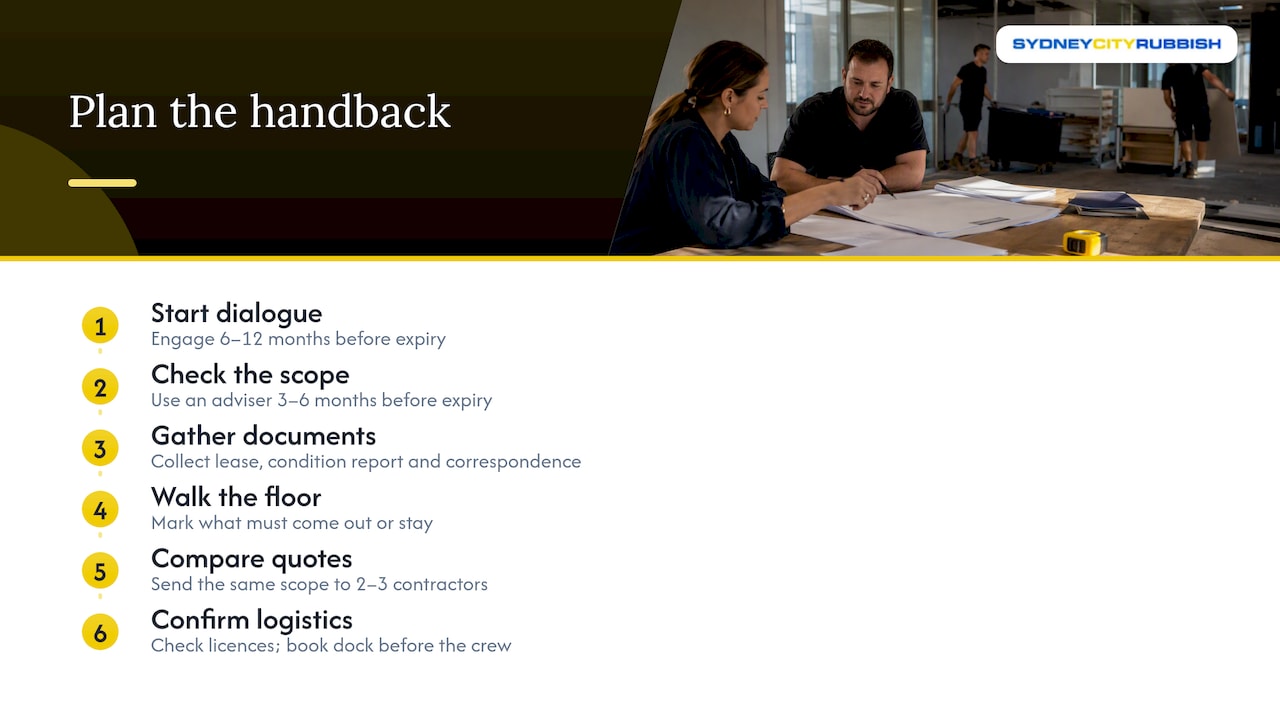
Start early. RICS recommends early dialogue, with engagement 6 to 12 months before lease expiry, and a fair and reasonable assessment of costs. Early contact with the landlord’s agent lets you agree the scope while there is still time to negotiate.
Then get the scope independently checked. Engaging a building services engineer or surveyor 3 to 6 months before expiry can help you scope the work accurately and potentially challenge excessive landlord claims. An independent scope also gives contractors the same brief, which makes quotes comparable.
A sensible sequence looks like this. First, collect the lease, condition report and any landlord correspondence. Second, walk the floor with an independent adviser and mark what must come out and what may stay. Third, send the same scope to two or three contractors, asking for separate lines for demolition, services, removal and tipping, and building access. Fourth, check insurance and licences, and ask how the contractor handles regulated waste. Fifth, book the building’s dock and lift before you book the crew, because the building slot often decides the date.
To keep costs down without cutting corners, remove furniture and loose items first, resell or donate what has value, and ask whether the landlord will accept some items staying, since leaving a usable ceiling or kitchenette can save a stripped-out line. Do not leave the job until the last month: rushed after-hours programs are the most expensive way to hand back a floor.
Why tenants choose Sydney City Rubbish
We handle the strip-out, the removal and the disposal as one coordinated job for offices, warehouses, retail space and strata-managed buildings across Sydney. We coordinate directly with building management for access, provide fast electronic quotes, and guarantee punctuality with compensation if we are late. Our cleanup is meticulous, and waste goes to registered recycling partners.
Have your lease, floor area and building details ready and request a quote for a commercial strip-out and demolition. Get a free quote now, and we will tell you what the job involves before you commit.
FAQ
How much does an office defit cost in Sydney?
Office strip-outs in Sydney are commonly quoted at around $50 to $150+ per square metre. The final figure depends on floor area, ceilings and services, floor finishes, hazardous materials and building access. A site inspection and a read of your lease are needed for a firm price.
Is a defit the same as make good?
Not exactly. A defit is the removal of the tenant’s fitout, while make good is the full obligation set out in the lease, which can also include repairs, reinstatement of services and repainting. Check your make-good clause to see which parts apply to you.
When should I start planning a defit?
Early. RICS recommends engaging 6 to 12 months before lease expiry, and an independent engineer or surveyor can scope the work 3 to 6 months out. That leaves time to negotiate with the landlord and book building access.
Are rubbish removal and disposal included in a defit price?
Not always. Some quotes cover demolition labour only, with haulage, tipping and recycling fees charged separately. Ask for removal, disposal and building access costs as separate lines so you can compare quotes properly.
Sources
- Make Good Clauses Explained – NSW Leases, Dettmanns
- Make good Australia, 3rd edition, RICS
- Make Good HVAC Obligations: Commercial Leases, CCC Engineering
- NSW Retail Tenancy Guide 2022, NSW Small Business Commission
- 7 Practical Office Energy Saving Tips