Hazardous Waste Rules in Sydney: A Guide for Businesses
If your business produces hazardous waste in Sydney, the NSW Environment Protection Authority (EPA) holds you responsible for it from the moment it is created until it reaches a facility that is lawfully allowed to take it. That means classifying it correctly, storing and labelling it safely, using an authorised transporter, tracking certain loads, and keeping records. Hiring a contractor does not hand the liability over. This guide sets out the rules that matter to offices, retail sites, construction projects and end-of-lease clear-outs, and what to do at each stage.
TL;DR
- Under NSW law the waste generator must classify its own waste, and hazardous waste is one of six classes.
- Hazardous waste is not accepted at council bins, Community Recycling Centres or Household Chemical CleanOut events, because businesses are not eligible to use them.
- Certain hazardous waste must be tracked, with authorisation before transport and a transport certificate travelling with the load.
- The owner of the waste, the vehicle owner and the transporter can each be guilty of an offence if waste goes to an unlawful place.
- Maximum penalties for the most serious offences reach $10,000,000 for corporations, so check every contractor’s authorisation before the truck arrives.
Table of Contents
- What counts as hazardous waste for a Sydney business
- The laws behind the rules
- Where hazardous waste cannot go
- Separating, labelling and storing hazardous waste
- Tracking and transporting hazardous waste
- Checking your transporter and disposal facility
- Penalties for getting it wrong
- Hazardous materials in common Sydney scenarios
- How to prepare for a hazardous waste pickup
- How Sydney City Rubbish can help
- FAQ
- Sources
What counts as hazardous waste for a Sydney business
NSW does not leave the definition to common sense. Waste generators must classify their waste into one of six classes: special, liquid, hazardous, restricted solid, general solid (putrescible) and general solid (non-putrescible). The class decides where the waste can go, how it is moved and what paperwork follows it.
Hazardous waste is defined in part by dangerous goods classes. The EPA lists explosives, gases, flammable solids, substances liable to spontaneous combustion, substances that emit flammable gases when wet, oxidising agents, toxic substances and corrosive substances among the categories that bring a waste into this class.
In practical terms, commercial sites in Sydney tend to meet the same items again and again:
- Solvents, paints, adhesives, degreasers and strong cleaning chemicals left behind by a tenant.
- Used oils, fuels and hydraulic fluids from workshops, loading docks and plant rooms.
- Batteries, fluorescent tubes, smoke detectors and gas cylinders.
- Fire extinguishers and pressurised containers.
- Asbestos-containing material found during strip-outs of older buildings.
- Pesticides and treatment chemicals from landscaping or pest control.
- Contaminated soil, sludge and liquid waste from construction and maintenance work.
Some of these, such as asbestos and liquid waste, have their own classification and handling rules. If you are unsure which class applies, the EPA’s Waste Classification Guidelines are the reference document, and the guidelines state that waste must be classified in accordance with them. A licensed waste contractor can also help with classification, but the legal duty remains with the generator.
The laws behind the rules
The Protection of the Environment Operations (POEO) Act is the principal environmental protection legislation in NSW. It sets waste management and licensing requirements, defines waste offences and penalties, and allows detailed requirements to be set through the Waste Regulation. When a Sydney contractor, strata manager or tenant talks about “POEO compliance”, this is the framework they mean.
Two other layers sit alongside it. Workplace health and safety law governs how hazardous chemicals are handled and labelled on site, and dangerous goods transport rules govern how they are packaged and moved on the road. Most of the confusion for businesses comes from these three layers applying to the same drum or pallet at different moments. We cover the wider picture in our guide to NSW commercial waste regulations, and the disposal side in what NSW businesses must do to dispose of hazardous waste legally.
Where hazardous waste cannot go
The first rule is a negative one. Chemical waste does not belong in sewers, stormwater gutters, waterways or bushland, and it does not belong in your general or recycling bins. Council collectors are entitled to reject bins that contain hazardous material, and a contaminated load can also create a safety problem for the driver and the facility.
The free drop-off options many Sydney residents rely on are not available to you. The EPA states that businesses are not eligible to use Community Recycling Centres and Household Chemical CleanOut events, which are designed for household problem waste. A business with a few leftover paint tins or old fire extinguishers therefore still needs a commercial pathway: an authorised collector, or a licensed facility that accepts the material from businesses.
Separating, labelling and storing hazardous waste
Compliance starts well before the truck turns up. The way you hold waste on site is where most avoidable incidents happen.
Keep waste streams apart
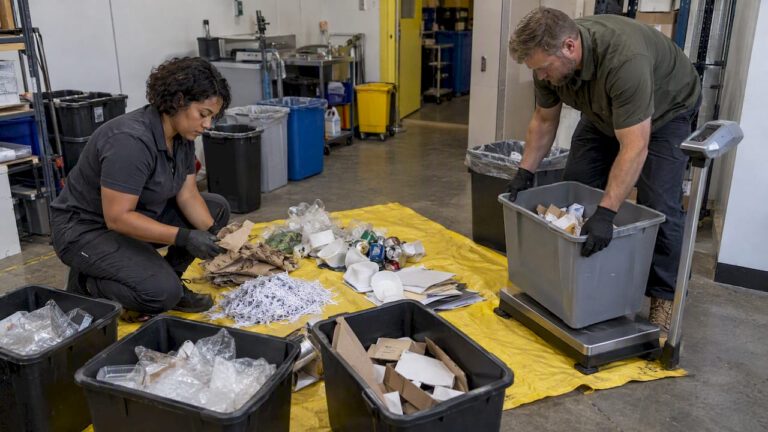
Do not mix incompatible materials. Solvents and oxidisers, acids and bases, or fuels and anything that can ignite are classic pairings that create fire, fumes or violent reactions. Mixing hazardous waste with general waste also turns the whole load into a more expensive and more tightly regulated problem. Separate at the source: one labelled container per stream, kept away from drains and out of public areas.
Labelling
Containers should be clearly and correctly labelled and made from material compatible with their contents. The EPA’s guidance for liquid waste facilities says that containers must be clearly labelled, well maintained and compatible with the stored waste, in line with the Australian Dangerous Goods Code. Although that guidance is written for liquid waste facilities, it is a sound benchmark for any business holding drums or tubs before collection.
For workplace chemicals, Safe Work Australia’s labelling code notes that codes of practice can be used as evidence in court to show what is reasonably practicable. In other words, following the code is the easiest way to show you took your duties seriously if something goes wrong.
Storage and spill control
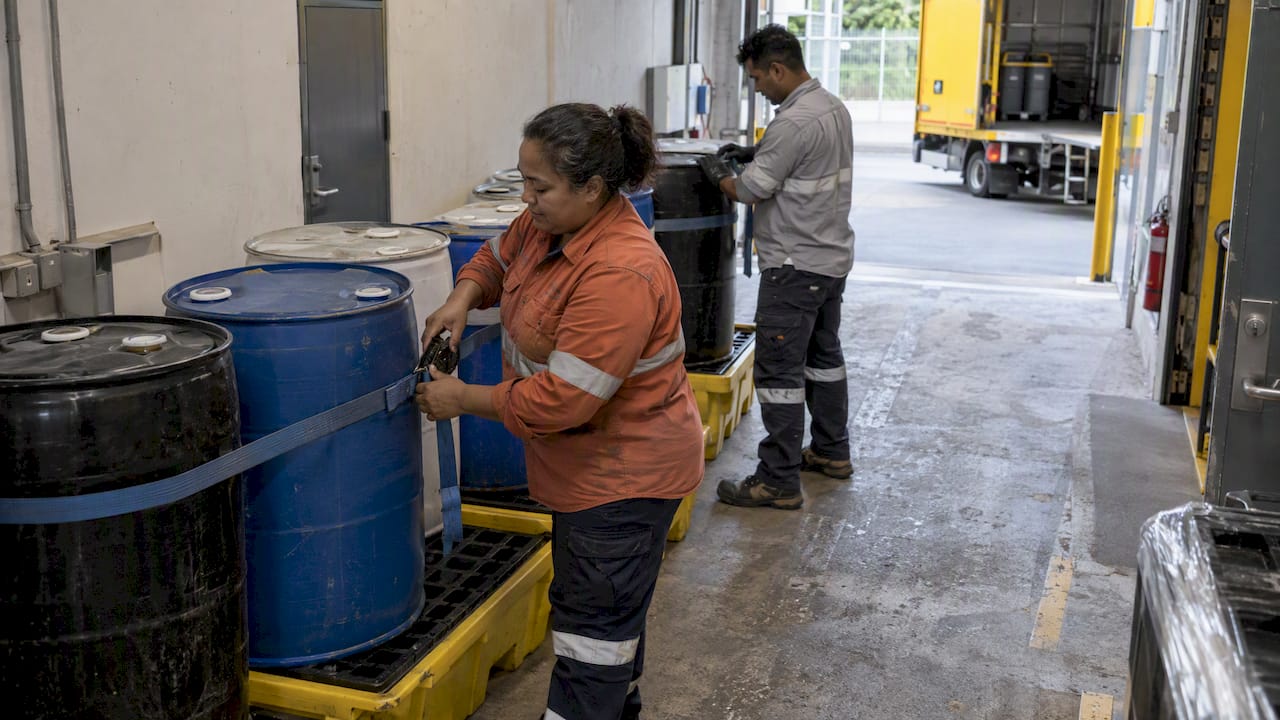
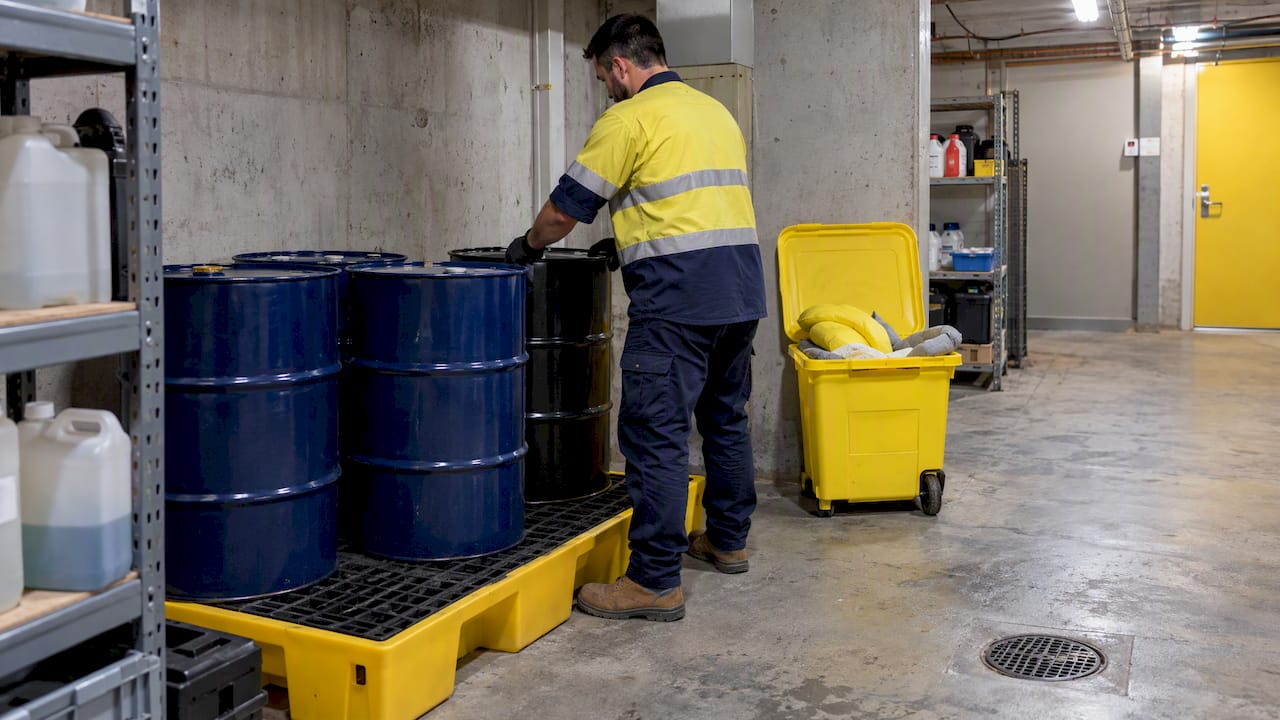
The same EPA guidance expects adequate secondary containment and spill containment procedures for tanks and drums. For a Sydney office basement, retail back-of-house or construction compound, the principle translates simply: keep liquids in a bunded area or on spill pallets, keep containers closed, store them undercover and away from stormwater drains, and keep a spill kit within reach. Our article on disposing of liquid waste responsibly goes further on liquids.
Tracking and transporting hazardous waste
Transport is where the rules become most formal. Hazardous waste listed in Schedule 1 of the Waste Regulation must be tracked when it moves into, within or out of NSW. According to the EPA, trackable waste needs a consignment authorisation before transport, a transport certificate with the load, and every party authorised to transport and receive the waste.
For a business, that has three consequences.
- Ask before you book. Before the pickup, confirm whether your waste is trackable and who will lodge the consignment details.
- Keep the paperwork. Retain the transport certificate and any receipt from the receiving facility. If the EPA asks where your waste went, these records are your answer.
- Check the destination. A load is only lawful if it ends at a place that can legally accept it.
The last point is not a technicality. Under section 143 of the POEO Act, the owner of the waste, the owner of the vehicle and the transporter are each guilty of an offence when waste is transported to a place that cannot lawfully be used as a waste facility. You can be liable even if someone else drove the truck.
Vehicles also have to be suitable. Waste must be moved in vehicles built and maintained to prevent spillage, and covered in transit unless it is only scrap metal or tyres. For a deeper walk-through of the tracking system, see our waste tracking requirements guide.
Asbestos is its own case
Older Sydney buildings regularly turn up asbestos-containing sheeting, lagging and flooring during strip-outs and makegood works. It can only go to a landfill licensed to accept it. NSW’s asbestos guidance adds that if a licensed contractor transports more than 100 kilograms or 10 square metres of asbestos waste, the movement must be notified to the EPA through the Integrated Waste Tracking Solution. If you suspect asbestos, stop work, do not break or drill the material, and bring in a licensed assessor and removalist before any demolition continues.
Checking your transporter and disposal facility
Because liability follows the waste, due diligence on your contractor is the most valuable step you can take. Three checks cover most of the risk.
First, confirm the receiving facility is authorised. The EPA says you can do this by verifying its environment protection licence on the POEO public register or confirming council development consent. Second, ask the contractor which facility your waste will go to, and ask for written confirmation that it accepts that class of waste. Third, ask for the documents at the end: the transport certificate where tracking applies, weighbridge dockets or receipts, and evidence of recycling where a recycling outcome was promised.
Be cautious of quotes that are far below the rest of the market for hazardous material, of providers who cannot name their disposal facility, and of any arrangement that offers to “just take it” with no paperwork. Those are the patterns that lead to illegal dumping, and the original waste owner is the party the EPA can trace.
Penalties for getting it wrong
NSW lifted its penalties significantly in 2024. The Environment Protection Legislation Amendment (Stronger Regulation and Penalties) Act 2024 means that Tier 1 wilful offences can carry fines of up to $10,000,000 for corporations and Tier 2 offences up to $2,000,000, with on-the-spot fines also increased. Those are maximums for serious cases, but they show how the regulator views hazardous waste, and the cost of an investigation, clean-up order or reputational damage can be considerable well before a court figure is reached.
For smaller incidents, such as a few drums left in a loading dock or a skip dumped on a street, on-the-spot fines and clean-up notices are the more common outcome. Our article on illegal dumping penalties in NSW covers those, and hazardous waste pickup rules for Sydney managers explains how to avoid them in practice.
Hazardous materials in common Sydney scenarios
The rules are the same everywhere. The way they bite differs by site type.
Offices and end-of-lease fitouts
Offices rarely produce industrial chemicals, but they accumulate batteries, toner and ink, fluorescent tubes, old electronics, cleaning chemicals and sometimes fire extinguishers and refrigerant-containing equipment. At end of lease, a landlord or building manager will expect the tenant to return the premises clear. Inventory these items early, separate them from furniture and general fitout waste, and arrange collection of the hazardous items separately from the bulk removal. Our teams coordinate access directly with building management, which matters in CBD towers with loading dock bookings and lift restrictions.
Retail and hospitality
Retail sites hold aerosols, paints, cleaning concentrates, batteries and display lighting. Commercial kitchens add used cooking oil and grease. Keep each stream in its own container, keep stock lists current, and do not tip liquids into floor drains or sinks, which connect to sewers or stormwater.
Construction and demolition
Builders deal with the widest mix: asbestos, treated timber, adhesives, solvents, fuel and oil from plant, contaminated soil and concrete slurry. Waste separation on site is more than good housekeeping, because a clean stream is cheaper to dispose of and easier to classify. Our notes on waste separation in construction and demolition and managing your construction waste set out how to organise it.
Strata and property management
Strata managers often inherit hazardous waste they did not create: chemicals abandoned in a storage cage, paint left in a car space, or a former tenant’s drums. The committee or manager can become the party responsible for getting it moved lawfully. Document what was found with photographs, restrict access, and engage an authorised contractor rather than disposing of it through the building’s general bins.
How to prepare for a hazardous waste pickup
A short checklist in sentence form keeps the job smooth. Identify what you have and where it sits. Read the labels and safety data sheets, and do not decant or combine products. Group items by type in sound, closed containers. Tell the contractor exactly what is on site, including anything you are unsure about, because a surprise at pickup can stop the job. Arrange site access, parking and lift or dock bookings. After collection, file the documents against the job or the lease. If you manage multiple sites, repeat the same process in each so records are consistent.
How Sydney City Rubbish can help
We remove commercial and corporate waste across Sydney, including electronic waste, construction debris and hazardous materials, and we handle office, retail, strata and end-of-lease clear-outs. We coordinate with building management, use registered recycling partners for responsible disposal, and offer a carbon-neutral opt-in for corporate clients. If your site holds anything that might be hazardous, tell us at the quote stage so the right pathway is planned from the start. See our commercial waste removal service or get a free quote now.
FAQ
Can a business use council hazardous waste drop-offs in Sydney?
No. The EPA says businesses are not eligible for Community Recycling Centres or Household Chemical CleanOut events. A business needs an authorised commercial collector or a licensed facility that accepts business waste.
Who is responsible if my contractor dumps hazardous waste illegally?
You can be. The POEO Act makes the owner of the waste, the vehicle owner and the transporter each guilty of an offence if waste goes to a place that cannot lawfully take it. Checking the facility’s licence and keeping your documents is your main protection.
Does all hazardous waste need to be tracked in NSW?
Not all of it. Hazardous waste listed in Schedule 1 of the Waste Regulation must be tracked, which means authorisation before transport and a transport certificate with the load. Asbestos loads over 100 kilograms or 10 square metres also need EPA notification. Ask your contractor whether your material is trackable before booking.
How do I dispose of fire extinguishers from a business premises?
They should not go into general bins. Households can use Community Recycling Centres, but businesses cannot, so arrange collection through a commercial waste contractor or the extinguisher service company that maintains your equipment. Ask for written confirmation of where they are taken.
Sources
- Classifying waste | EPA
- Hazardous and liquid wastes | EPA
- Waste classification guidelines Part 1: Classifying waste
- Waste regulations in NSW | EPA
- Find Community Recycling Centres and Household Chemical CleanOut events | EPA
- Guidance for the liquid waste industry | EPA
- Labelling of workplace hazardous chemicals | Safe Work Australia
- Tracking and transporting hazardous waste | EPA
- Transporting waste | EPA
- Disposal of asbestos waste | Asbestos in NSW
- Environment Protection Legislation Amendment (Stronger Regulation and Penalties) | EPA