NABERS Waste Rating Guide for Sydney Building Managers
By the Sydney City Rubbish team. Updated 28 October 2026.
A NABERS Waste rating is a six-star benchmark of how well a commercial office building separates its waste, diverts it from disposal and sends it to facilities that can recover it. To earn one, you collect 12 months of waste data, upload it to the NABERS Waste Platform and have an accredited assessor verify it. This guide explains each step in plain terms, what changed in 2026, and what a Sydney property or strata manager can do with their waste contractor to lift the result.
TL;DR
- The star rating is currently available only for commercial office buildings. Other building types can use the Waste Platform and may obtain a Verification.
- You need 12 months of operational waste data, usually supplied by your waste contractor, plus a NABERS-accredited Waste Assessor.
- Results are benchmarked against like-for-like buildings on a six-star scale, with a Materials Recovery Score rewarding higher-quality recovery.
- The 2026 update treats dry general waste as disposal rather than recycling and doubles the weighting of the Materials Recovery Score.
- Better ratings come from cleaner source separation, traceable recovery destinations and regular data uploads, all of which depend on your collection partner.
Table of Contents
- What a NABERS Waste rating measures
- The data you need: 12 months of waste records
- How the rating process works
- Reading the six-star scale
- What changed in 2026
- How to improve a NABERS Waste rating
- A practical 12-month timeline
- Where Sydney City Rubbish fits
- FAQ
- Sources
What a NABERS Waste rating measures
NABERS, the National Australian Built Environment Rating System, is run by the government and already known to most Sydney building managers for its energy ratings. The NABERS Waste rating looks at how effectively a building separates onsite waste into recoverable streams, diverts material from disposal and sends it to facilities able to recover it efficiently.
The Australian Government’s NABERS Policy Toolkit describes it as a performance-based benchmark for waste reduction and recycling, assessing the measured proportion of materials recovered from a waste stream and diverted from disposal. In practice, that means the rating is built on what actually left your building and where it went, not on what your waste policy says.
This is a different question from the one an energy rating answers. Energy ratings reward efficient equipment. A waste rating rewards behaviour and logistics: how tenants sort, how cleaners consolidate, how the loading dock is organised and what your contractor does with each stream after collection.
Who can get a star rating
NABERS currently says the star rating is available only for commercial office buildings. Other sectors can still use the Waste Platform to measure and monitor performance, and may obtain a Verification. If you manage a retail centre, a mixed-use building or an industrial site, the platform remains a useful tracking tool even without a star result.
Base building or whole building
NABERS offers two scopes. A base-building rating covers waste contracted by the building owner. A whole-building rating covers waste leaving the building wherever it can be reliably measured, which can include tenant-contracted streams. For most Sydney office towers, the base-building scope is the practical starting point, because the owner or manager already holds the contract and the data. Moving to whole-building scope later is a sensible step once tenants are engaged.
The data you need: 12 months of waste records
The central requirement is simple to state and harder to meet. NABERS says you must collect 12 months of operational waste data, collect building information through waste audits, and engage a NABERS-accredited Waste Assessor to complete the verification. The guidance on preparing for an office rating points to your waste contractor as the usual source of that data.
A full year matters because office waste is seasonal. December clear-outs, mid-year tenancy changes and fit-out activity all distort a single month. Twelve months smooths those peaks and exposes the real pattern.
Waste streams and measurement methods
Buildings on the platform record each stream separately. NABERS publishes a list of waste streams that includes general waste, paper and cardboard, mixed recycling, organics, glass and plastic, among others. For each, it sets a standard density and a standard contamination rate, and it states which measurement methods are allowed.
The two broad methods are the weight of the contents of bins collected by a contractor, or a count of the bins collected. Some streams allow either method, while others are restricted, so the way your contractor reports matters before the year starts, not after it ends. If your current provider only supplies invoices with lift counts and no stream breakdown, you will struggle to build a verifiable record.
The NABERS list gives general waste a standard density of 105 kg/m3 and paper and cardboard 50 kg/m3 with a 5% standard contamination rate. These figures are used to convert bin counts into weights, which is why bin-count reporting still needs to be accurate about bin size and fill.
How the rating process works
The sequence is the same for most Sydney offices.
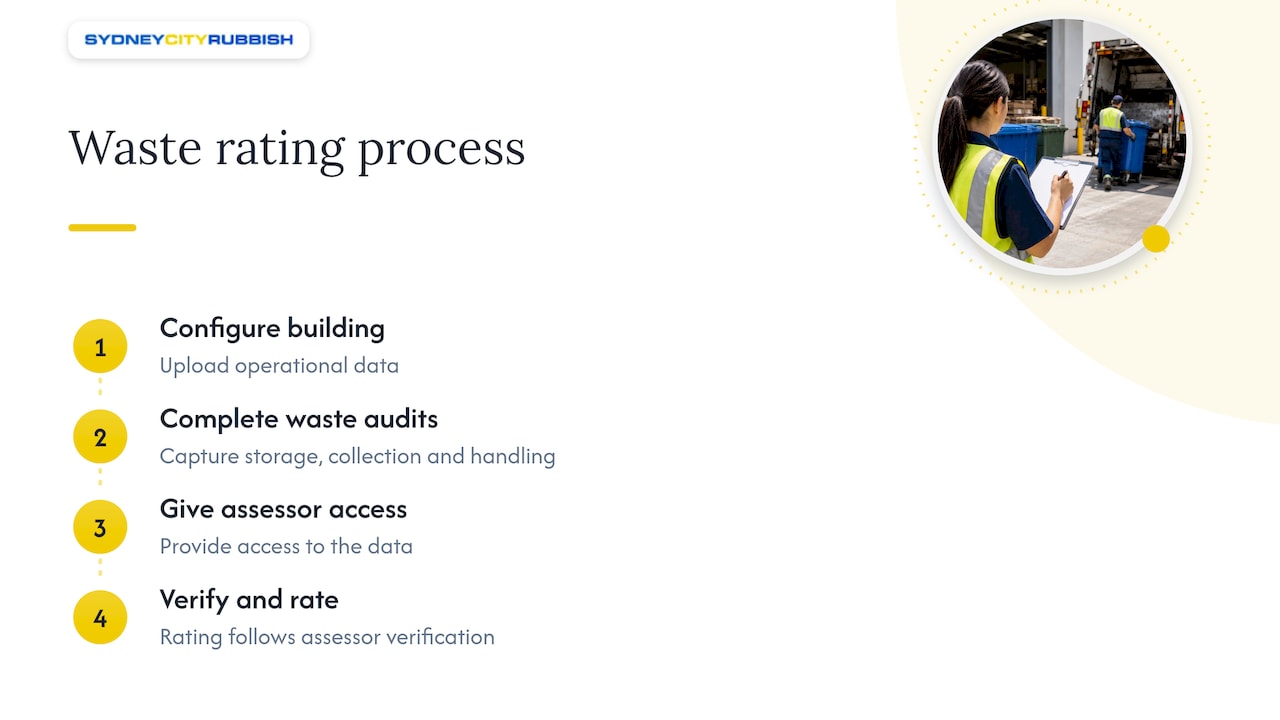
First, a Waste Platform Manager configures the building on the platform and begins uploading operational data. Next, the building completes waste audits to capture information about how waste is stored, collected and handled. The manager then gives an accredited assessor access to the data. NABERS provides a short guide for assigning an Accredited Assessor to a Waste Rating. Finally, the assessor completes the verification, and a Rating follows that verification process.
The NABERS Waste Rules state that a rating or verification must be performed by an assessor accredited in the NABERS Waste methodology. Assessor fees are separate from NABERS lodgement fees. NABERS’ pricing page has described a 50% discount on a building’s first waste verification and sets out FY26 administration-fee information that applies from 1 July 2026, so check that page for current amounts before you budget.
Uploads do not have to wait for the end of the year. NABERS recommends regular uploads so you can track and examine ongoing performance, and a contractor, platform administrator or assessor can manage them. Monthly uploads let you catch a problem, such as a contaminated recycling stream, while there is still time to fix it.
Reading the six-star scale
The result is benchmarked against like-for-like buildings and expressed on a six-star scale. NABERS’ 2020 case study describes the range as running from “making a start” at one star to “market leader” at six, and reported three stars as the market standard in the benchmark at that time. Benchmarks move as the market improves, so treat three stars as a historical reference rather than a permanent target.
The Materials Recovery Score
A star rating alone does not show the quality of recovery. The Policy Toolkit explains that the Materials Recovery Score is supplementary to the Waste rating and rewards higher-quality recovery. The highest score applies where material is recovered for perpetual reuse in a similar purpose, and the score is zero where the destination cannot be verified.
That distinction is the reason traceability matters. Recycling is not equally beneficial when material is downcycled, and a stream that disappears into an unverifiable destination earns nothing for quality, however diligent your tenants were at the bin.
What changed in 2026
On 2 July 2026, NABERS announced an update to the Waste rating tool, shaped by more than 100 industry stakeholders over six months of consultation. According to the NABERS announcement, the changes include a new approach to dry waste, a stronger focus on higher-quality recycling, a new Material Circularity Indicator and enhanced reporting. The update applies to ratings with rating periods starting on or after 1 July 2025.
Three changes matter most to building managers:
Dry general waste is no longer counted as recycling. It moves to the disposal category for calculation purposes and sits between landfill and recycling in the waste hierarchy. It remains a better outcome than landfill, but it no longer inflates a diversion figure.
The Materials Recovery Score carries double the weighting. Quality of recovery now counts for more than total diversion alone.
Certificates carry circularity metrics. The Material Circularity Indicator is a percentage that considers the circularity of recovery processes, the traceability of the value chain and the quality of the data. Rated buildings also receive an enhanced report aligned to Global Reporting Initiative standards.
The rules have moved too. Rules v2.1 stated that bag-based manual handling data is no longer suitable for extrapolating building-wide results, and that dry-waste recycling requires functional general-waste and organics streams where available. The NABERS rules page now lists later documentation, so always work from the version published there when you start your rating period.
If you rated a building before this update, expect your next result to look different even if nothing changed on site. Dry waste that previously counted as recycling will now count differently.
How to improve a NABERS Waste rating
The Waste Platform’s insights show which streams and recycling performance need attention. From there, NABERS recommends engaging contractors, cleaners, waste providers, tenants and building occupants, and appointing waste champions. Those recommendations reflect a simple reality: the building manager controls the infrastructure, but the result depends on dozens of people.
Start with separation at source
The Policy Toolkit frames the rating as a circular-economy instrument. Consistent measurement creates demand for recycling, encourages source separation, reduces contamination and keeps materials in use longer. For an office, that means clearly labelled, consistent bin sets on every floor, a working organics stream where it is available, and cleaners who do not tip separated streams into one trolley.
Contamination is the quiet failure. A recycling bin with food waste and soft plastics may be downgraded or rejected at the facility, and the benefit disappears. Short, regular feedback to tenants, using the platform data, does more than a single launch poster.
Plan for the bulky and one-off material
Routine bins are only part of an office’s waste. Tenancy changes, refits and end-of-lease clear-outs produce furniture, e-waste, partitions, carpet and ceiling tiles in volumes that routine services were never designed to handle. If that material goes into a general skip with no records, it can undermine the picture you have built over the year.
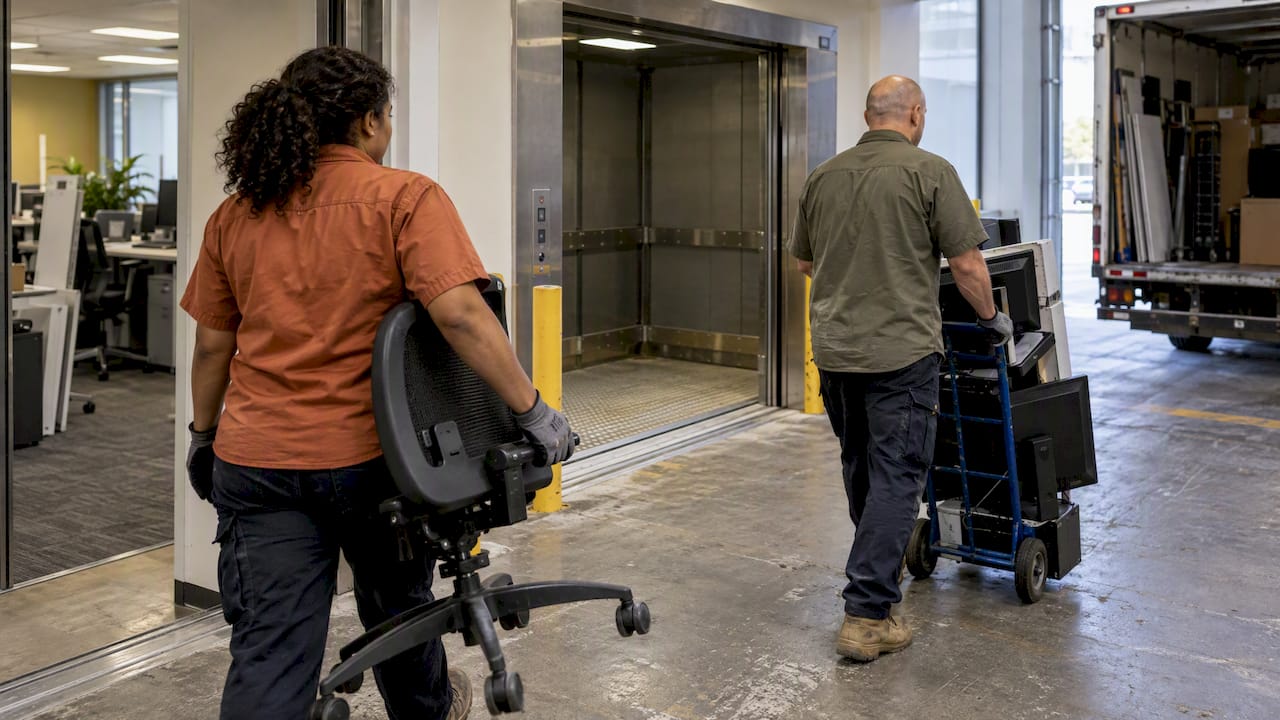
Our team has written separately about reusing and recycling office rubbish and about recycling office waste, and both cover the practical sorting steps. For a larger clear-out, an office cleanout and junk removal service that sorts material and documents where it goes keeps those one-off events from leaving gaps.
Choose and check your collection partner
The contractor is where most ratings are won or lost, because they hold the weights, the bin counts and the destination records. Before you commit, ask for stream-level reporting by bin size or weight, the names of the facilities that receive each stream and evidence that those facilities recover material rather than simply transfer it. Pre-qualification habits that are common in the trades, such as contractor prequalification checks on compliance paperwork, translate well to waste providers too. Ask for the licences, the records and the destination evidence in writing.
We also recommend setting the reporting format with your contractor at the start of the rating period. Data that arrives in a consistent monthly format is far easier for an assessor to verify than a year of invoices reassembled in the final month.
A practical 12-month timeline
The table below shows a sequence that works for most Sydney office buildings. Adjust it to your own rating period.
| Period | What to do | Who is involved |
|---|---|---|
| Before month 1 | Configure the building on the Waste Platform, agree reporting format and stream list with the contractor, check bin labelling | Platform Manager, contractor |
| Months 1 to 3 | Upload monthly data, run the first waste audit, brief cleaners and tenants | Manager, cleaners, tenants |
| Months 4 to 9 | Review platform insights, target contaminated or missing streams, appoint waste champions | Manager, waste champions |
| Months 10 to 12 | Confirm records are complete, give the assessor access, resolve gaps in destination evidence | Manager, assessor, contractor |
The most common delay is not the audit but the paperwork from the contractor. Raise missing records in the first quarter, not the last.
Where Sydney City Rubbish fits
We do not issue ratings: only an accredited assessor can do that. Our role is the collection and removal side that feeds a rating. We provide commercial waste removal in Sydney for offices, strata-managed buildings and retail premises, coordinate directly with building management for access, and use registered recycling partners for responsible disposal. Clients can also opt in to carbon-neutral waste disposal.
For property and strata managers working toward a rating, our page on NABERS waste rating improvement for Sydney managers sets out how collection, recovery and data work together over the 12-month period. When a tenancy ends or a fit-out begins, our strip-out, makegood and furniture removal services deal with the bulky material that routine contracts miss. Get a free quote now and tell us the building, the volumes and the timeline.
FAQ
Is a NABERS Waste rating mandatory?
Not on the sources we have reviewed. NABERS presents it as a voluntary benchmark that buildings use to measure, monitor and certify their waste performance. Check any lease, funding or green building requirement that applies to your property, because those can create their own expectations.
Can a retail or industrial building get a star rating?
NABERS currently says the star rating is available only for commercial office buildings. Other sectors can use the Waste Platform and may obtain a Verification. Confirm the current position with NABERS before you plan around it.
How long does it take to get a rating?
You need 12 months of operational waste data before the rating can be completed, so the data period is the main time requirement. An accredited assessor then completes the verification. Starting uploads early and keeping them regular avoids a rush at the end.
Who provides the waste data?
Usually your waste contractor. Agree the reporting format with them at the start, including stream-level weights or bin counts and the destinations of each stream. A contractor, platform administrator or assessor can manage the uploads.
Do the 2026 changes affect buildings that were already rated?
The update applies to NABERS Waste ratings with rating periods starting on or after 1 July 2025. Dry general waste is now treated as disposal rather than recycling, so a repeat rating may show a different result even with similar behaviour on site.
Sources
- NABERS Waste | NABERS
- NABERS Policy Toolkit (August 2024)
- NABERS Waste: List of Waste Streams
- NABERS Waste Rules and support documentation
- Pricing and offers | NABERS
- Case study: Winning the war against waste | NABERS
- Changes to NABERS Waste | NABERS