Demolition Waste Handling in NSW: A Guide for Commercial Clients
Updated 17 October 2026 by the Sydney City Rubbish team
Demolition waste handling in NSW comes down to four things: knowing what your project will generate, separating it at the source, sending it only to facilities that can lawfully accept it, and keeping paperwork that proves it. Under NSW law, responsibility does not end when a truck leaves your site. The owner of the waste can be held liable alongside the transporter if a load ends up in the wrong place. This guide explains how the process works for offices, retail fit-outs, construction sites and strata buildings in Sydney, what it costs you in levy terms, and what to ask a contractor before you sign.
TL;DR
- All demolition waste must go to a facility that can lawfully accept it under the Protection of the Environment Operations Act 1997, and the waste owner shares liability with the transporter.
- Many councils require a Waste Management Plan with the development application, often with a target of diverting 80% of material from landfill.
- The metropolitan waste levy is $180.20 per tonne from 1 July 2026, so mixed loads cost far more than sorted streams.
- Licensed asbestos work needs SafeWork NSW notification at least 5 calendar days ahead, and the waste has strict wrapping, transport and tracking rules.
- Ask for disposal dockets on every load and check the receiving facility’s licence before you pay.
Table of Contents
- What counts as demolition waste
- Your legal position as the waste owner
- Start with a Waste Management Plan
- Sort at the source, because the levy rewards it
- Asbestos: the material that changes everything
- Demolition, deconstruction and what can be reused
- A note on what does not belong in your bins
- How a compliant demolition waste job runs
- Questions to ask any contractor before you sign
- Demolition waste with Sydney City Rubbish
- FAQ
- Sources
What counts as demolition waste
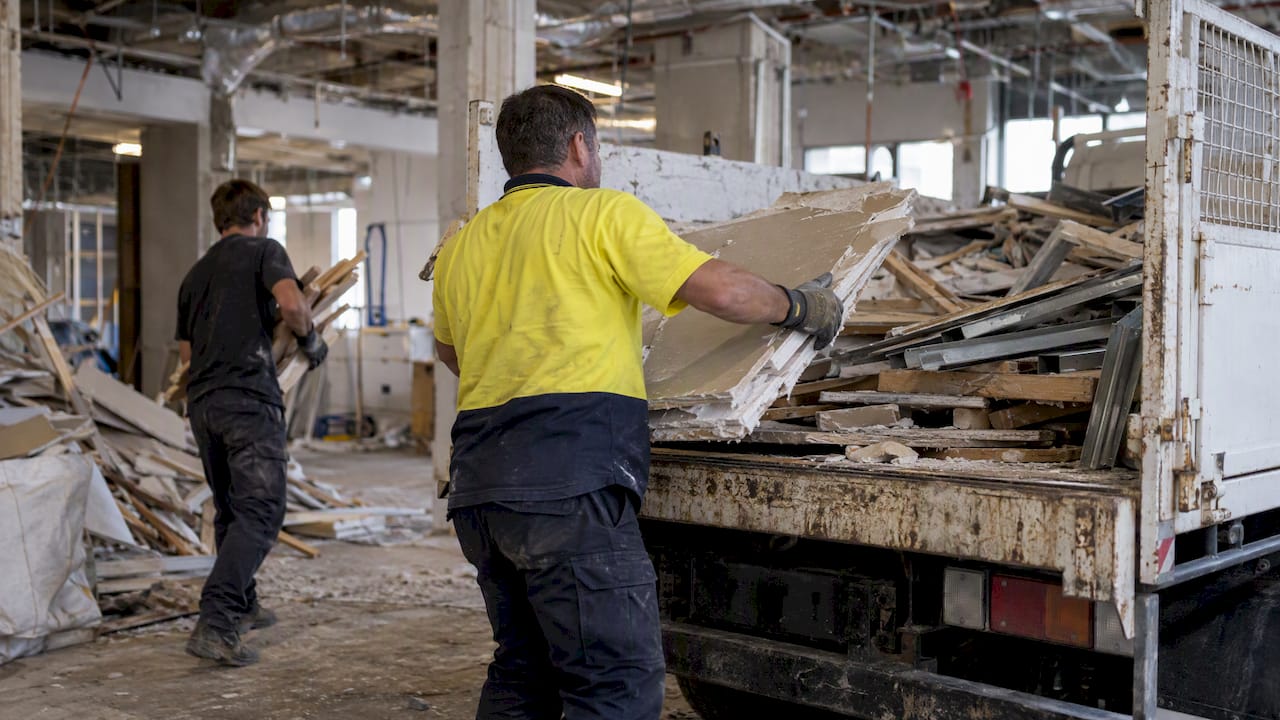
Demolition waste is everything that leaves a building when it is stripped, partly dismantled or taken down. In a commercial setting that usually means concrete and masonry, bricks, plasterboard, timber and joinery, metals, ceiling tiles and grids, carpet and floor finishes, glass, cabling, light fittings and old furniture. Some of it is heavy, dense rubble with jagged edges. Some is light but bulky, such as partition framing and insulation. A fair share of it needs special handling: asbestos-containing material in older buildings, treated timber, e-waste, fluorescent tubes and anything contaminated with oils or chemicals.
The NSW EPA’s construction and demolition waste page is written for demolition companies, builders, project managers and developers, and notes that these activities generate a wide range of materials, each with its own pathway. That range is the first reason demolition waste is harder to manage than general commercial rubbish. The second is that the same load can be a recyclable resource or an expensive landfill problem depending on how it was handled at the point of removal.
Your legal position as the waste owner
Property managers, strata managers and tenants often assume the contractor carries all the risk. The EPA’s position is different. All demolition waste must be managed in line with the Protection of the Environment Operations Act 1997, which requires waste to be taken only to places that can lawfully receive it. The EPA’s construction and demolition waste toolkit explains that transporting waste to a place that cannot lawfully accept it is an offence, and that both the owner of the waste and the transporter can be held liable.
In practice, that means a clause in the contract is not enough. The EPA guidance expects procurement and project managers to take an active role: check disposal dockets, confirm the receiving facility’s licence, and keep the records. Illegal dumping by a contractor you hired is a financial and reputational problem that lands on your desk too.
For a wider view of what your obligations look like across a commercial property, our guide to NSW commercial waste rules and compliance steps sets out the checks we recommend before any job starts.
Start with a Waste Management Plan
If your demolition needs development consent, the council will normally want a Waste Management Plan lodged with the application. The NSW Planning Portal template states that the relevant sections must be completed and submitted with the application, and that the plan helps you identify the types of demolition and construction waste a project will produce. A good plan covers four questions for each material: how much is expected, whether it will be reused on site, recycled off site or sent to landfill, and which facility will receive it.
Many NSW councils set a target of diverting 80% of construction and demolition waste from landfill, and that figure is often written into development consent conditions. Treat it as a design input, not a box to tick at the end. If your plan assumes 80% diversion but the site has no space for separate bins, the plan will fail in practice and the council may ask for evidence.
Three habits make a plan work:
First, walk the building before you write the plan. A pre-demolition audit that notes finishes, ceilings, services and any suspect materials gives you real quantities rather than guesses.
Second, match each material to a named destination. “Recycler” is not a destination. A facility name and its licence status is.
Third, build the plan into the contract. When payment is tied to dockets, the plan stops being paperwork. Our article on tying payment to dockets in a Sydney demolition waste plan walks through how that works.
Sort at the source, because the levy rewards it
The NSW waste levy is the reason separation matters so much commercially. The EPA’s levy page confirms that the 2026-27 rate for the Metropolitan Levy Area is $180.20 per tonne, applying from 1 July 2026, with the Regional Levy Area at $103.80 per tonne. Greater Sydney sits in the metropolitan area, so every tonne of mixed waste sent to landfill carries that levy before the facility adds its own operating charges.
The levy is designed to push businesses towards recycling. The EPA’s own material on levy and commercial recycling makes the point that source-separated streams can reduce disposal costs by avoiding mixed-waste landfill fees. Concrete, bricks, metals, clean timber and plasterboard each have recycling outlets. Once they are mixed in one skip, most of that value is lost and the whole load is treated as general waste.
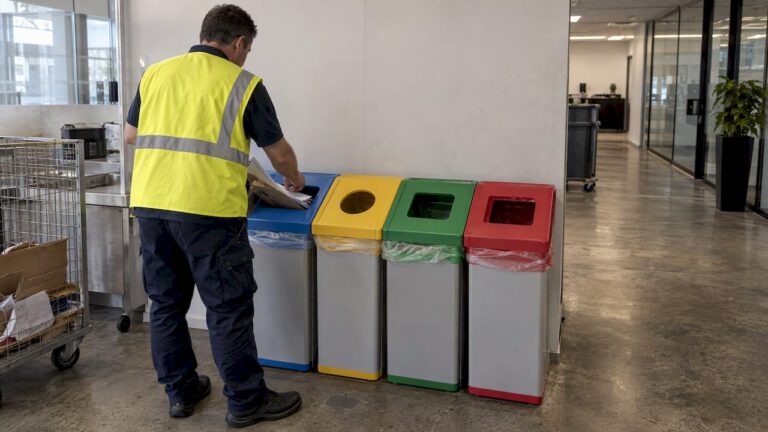
Separation does not have to be complicated. On a typical office strip-out, three or four streams cover most of the volume: metals (partition frames, ductwork, cable), timber and joinery, plasterboard and ceiling materials, and a residual stream for everything else. On a concrete-heavy site, a dedicated concrete and masonry stream usually makes the biggest difference. We cover the practicalities in our piece on the importance of waste separation in construction and demolition, and the levy’s wider implications in our Sydney waste levy explainer.
What disposal fees look like at the facility gate
The levy is only one line. Local waste facilities publish their own gate fees, and these vary. As one example from outside Sydney, Maitland City Council’s facility lists demolition and construction waste at $53.50 per 100 kg, with prices that include the $180.20 levy and GST, and requires a booking for asbestos. Another council’s published schedule shows a lower levy of $100.30 per tonne for its regional area in 2025-26. These are not Sydney prices, but they show how much the final figure depends on location, material and classification. Minimum charges, special handling and contamination surcharges all move the total.
This is also why a flat per-skip price can mislead. A skip of clean concrete and a skip of mixed demolition debris weigh and cost very differently at the weighbridge. When we quote per truckload or per project, we ask what is in the load, because the destination determines the cost.
Asbestos: the material that changes everything
In any building that predates the late 1980s, assume that asbestos-containing material could be present until a competent person has confirmed otherwise. It can sit in ceiling tiles, wall sheeting, floor tiles, lagging and adhesives. Finding it mid-demolition stops work, and it turns an ordinary waste stream into a regulated one.
The rules are strict. SafeWork NSW requires notification at least 5 calendar days before licensed asbestos removal begins, and the notification requirement applies to the removal of friable asbestos and to more than 10 square metres of non-friable asbestos. Work can start five calendar days after notification and not before. The waste itself must be wrapped or sealed, moved in leak-proof vehicles and delivered only to a facility licensed by the EPA to accept it.
Tracking is the other half. The EPA’s asbestos waste page sets out the state’s approach to asbestos waste, including use of the WasteLocate system for loads above 100 kilograms or 10 square metres. If you hire a contractor, ask to see the tracking record. The EPA’s Asbestos and Waste Tyres Guidelines lay out the obligations of consignors, transporters and receivers, and a property owner who commissions the work is often the consignor.
There is also a downstream risk. SafeWork NSW publishes a guide on managing asbestos in recycled construction and demolition waste, which notes that products containing asbestos cannot be sold or used as recycled material. One contaminated load in a recycling stream can cost the recycler dearly, which is why reputable facilities inspect what arrives. Our dedicated page on asbestos disposal regulations in NSW covers what property owners must know before engaging anyone.
Asbestos removal is licensed work and is separate from general demolition clearance. If you suspect it on your site, stop and speak to a licensed asbestos assessor or removalist before any strip-out continues.
Demolition, deconstruction and what can be reused
Traditional demolition reduces a structure to mixed debris quickly. Deconstruction takes more time: fit-out elements, doors, glazing, joinery, steel and fixtures are removed in an order that keeps them intact. The EPA’s model Waste Not DCP material points to demolition as a major opportunity for waste minimisation, and a deconstruction approach can help a project reach the 80% diversion targets often required in development applications.
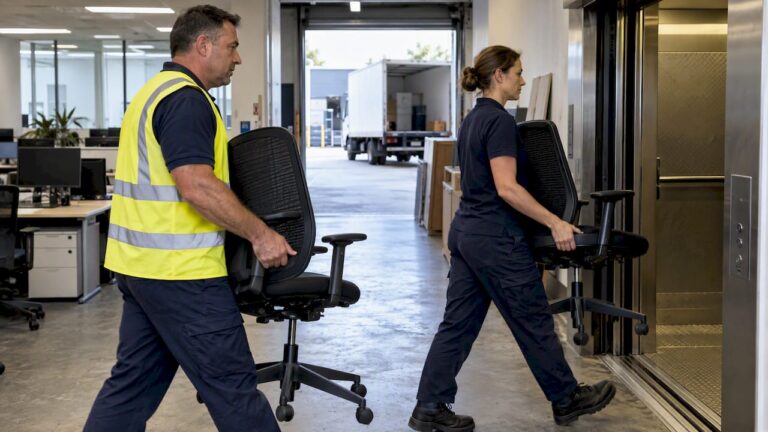
For commercial clients, the gains are most obvious in office makegoods. Workstations, partitions, glass, carpet tiles and joinery can often be reused, resold or recycled if they are removed carefully rather than smashed into a bin. If you are weighing how a separate contractor might handle bulky furniture alongside your strip-out, it helps to understand how a moving company approaches furniture disposal, because the sequencing of furniture removal before demolition affects how clean your remaining streams are.
The practical rule is simple: remove what has reuse or recycling value first, then demolish what is left. That order keeps the high-value streams out of the mixed pile.
A note on what does not belong in your bins
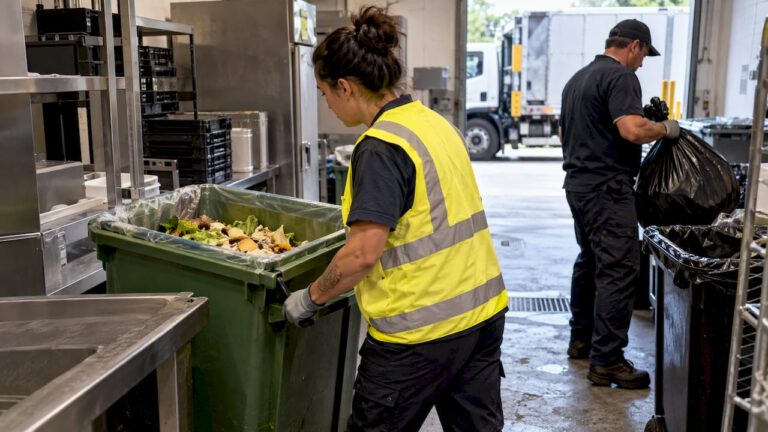
Strip-outs often generate everyday business waste at the same time: staff kitchens, pantries, break rooms. The City of Sydney’s business waste guidance points out that business council rates do not cover waste and recycling services, so you must arrange your own commercial collection. It also notes that items marketed as compostable or biodegradable are generally not accepted in commercial composting and should go to general waste. Plan for that in end-of-lease clearances so a pantry full of single-use packaging does not contaminate a recycling stream you have worked to keep clean.
How a compliant demolition waste job runs
Whether you manage a single floor or a whole site, a well-run job follows the same sequence.
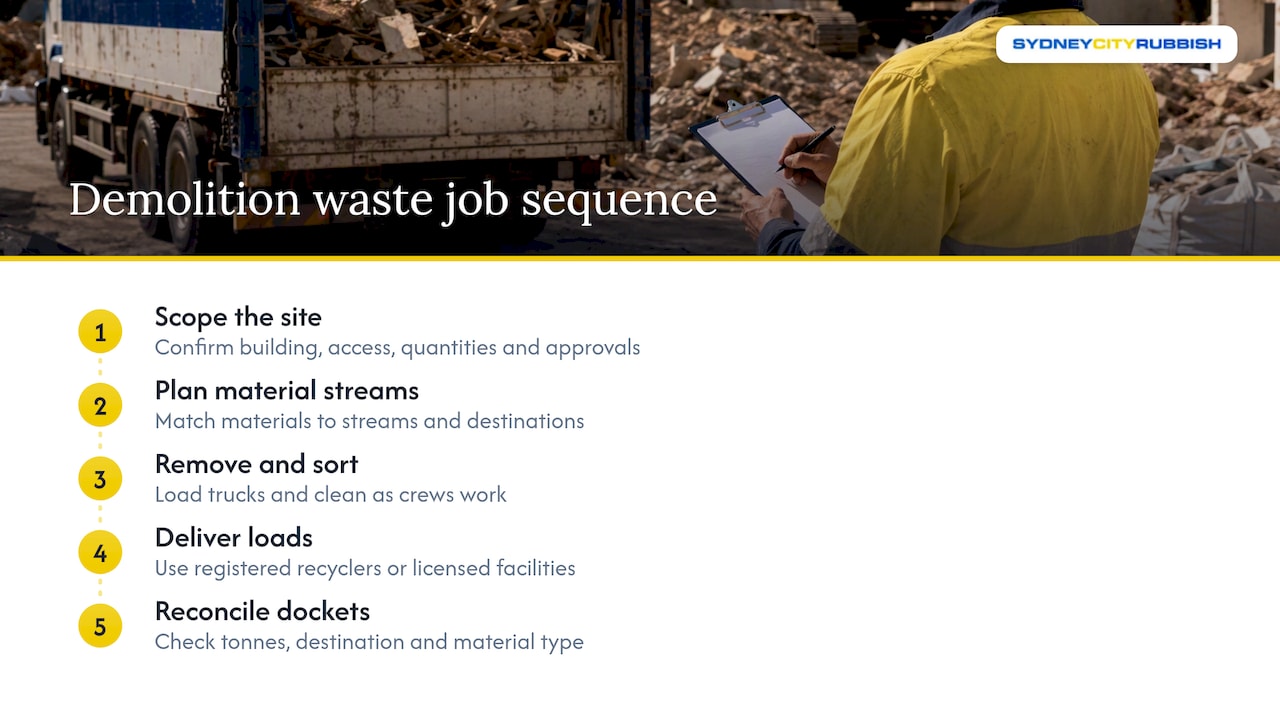
It starts with scoping. We establish the building type, age, access, quantities and any suspect materials, and confirm what approvals or notifications are needed. Where building management is involved, we coordinate directly on loading dock access, lift bookings and working hours, which removes a common source of delay for strata and property managers.
Next comes the plan. Materials are matched to streams and destinations, and the Waste Management Plan is aligned to what the site can physically separate. If the project needs more than waste removal, such as strip-out, makegood, floor finish removal or concrete cutting, the same team can handle those works so that waste is managed from the point it is created.
Then the work itself. Crews remove and sort material, load trucks and clean the area as they go, so no waste is left behind. Loads go to registered recycling partners and licensed facilities.
Finally, the paperwork. Disposal dockets or weighbridge records come back for each load. A project manager should reconcile them against the plan: tonnes out, destination, material type. Gaps are easier to resolve while the project is live than six months later when an auditor or council asks.
If you want a view of how the process applies to a broader commercial project, our commercial demolition in Sydney page and our guide to planning a successful commercial demolition are good next reads.
Questions to ask any contractor before you sign
A short set of questions separates a compliant operator from a risky one. Ask which facilities will receive each material and whether they hold the licence for that waste type. Ask whether disposal dockets are supplied for every load and when. Ask how asbestos, if found, is handled and who lodges the SafeWork NSW notification and tracking. Ask what happens if the crew is late or access is blocked. Ask how recycling outcomes are reported, and whether a diversion percentage is stated in writing.
Answers that are vague on facility names and dockets deserve caution. The EPA says that relying on a contract clause alone is not enough, so the paperwork is your protection as much as the contractor’s.
Demolition waste with Sydney City Rubbish
We handle rubbish removal, strip-outs, makegood and de-fit, structural demolition and concrete cutting and grinding for offices, retail spaces, construction sites and strata-managed buildings across Sydney. We coordinate directly with building management, provide fast electronic quotes, guarantee punctuality with compensation if we are late, and use registered recycling partners for responsible disposal. Corporate clients can also opt in to carbon-neutral waste removal. See our construction waste disposal service or get a free quote now for your project.
FAQ
Who is responsible if my contractor dumps demolition waste illegally?
Possibly you as well. NSW law makes it an offence to send waste to a place that cannot lawfully accept it, and both the waste owner and the transporter can be held liable. Check the receiving facility’s licence and keep disposal dockets for every load.
Do I need a Waste Management Plan for demolition in NSW?
If the work needs development consent, councils generally require one to be lodged with the application. The NSW Planning Portal template asks you to identify waste types and how each will be managed. Check your council’s conditions, as many set an 80% diversion target.
How much is the NSW waste levy in 2026-27?
The Metropolitan Levy Area rate is $180.20 per tonne from 1 July 2026, and the Regional Levy Area rate is $103.80 per tonne. Facilities then add their own charges, so the gate price is higher. Separating recyclable materials reduces the tonnage that attracts the levy.
What should I do if I find asbestos during a strip-out?
Stop work in the affected area and contact a licensed asbestos assessor or removalist. Licensed removal requires SafeWork NSW notification at least 5 calendar days beforehand, and the waste must be wrapped, transported in leak-proof vehicles and taken to an EPA-licensed facility.
Sources
- NSW EPA: Construction and demolition waste
- NSW EPA: Construction and demolition waste management toolkit
- NSW Planning Portal: Waste Management Plan template
- NSW EPA: Waste levy areas and levy rates
- NSW EPA: Waste levy and commercial recycling
- Maitland City Council: Using Maitland Waste Facility
- Richmond Valley Council: 2025-26 waste management fees and charges
- SafeWork NSW: Asbestos notifications
- NSW EPA: Asbestos waste
- NSW EPA: Asbestos and Waste Tyres Guidelines
- SafeWork NSW: Asbestos in recycled construction and demolition waste guide
- NSW EPA: Model Waste Not DCP
- City of Sydney: Businesses and waste services