Demolition vs deconstruction: what project owners should know

Choose selective deconstruction when your building contains high-value reusable materials, when landfill costs are a significant budget line, or when heritage or environmental obligations apply. Choose conventional demolition when the structure is unsafe, contaminated beyond safe entry, or when the programme simply cannot absorb the extra time. According to Australia’s national waste reporting, construction and demolition (C&D) waste is one of the largest waste streams in the country, which means the method you choose has real consequences for both your budget and the environment.
Three factors most often tip the decision:
- Landfill costs: Where disposal levies are high, the avoided gate fees from deconstruction can offset much of the extra labour cost.
- Building fabric: Timber-framed and unreinforced masonry buildings yield far more recoverable material than reinforced concrete structures, making deconstruction more viable.
- Programme constraints: Deconstruction typically takes 55–60% longer than conventional demolition, so a tight handover date often settles the question.
Key takeaways
The core decision is straightforward: deconstruction delivers superior environmental and often competitive net-cost outcomes for timber and masonry buildings where the programme allows the additional time; conventional demolition remains the practical choice for contaminated, unstable, or concrete-framed structures on tight schedules.
| Point | Details |
|---|---|
| Material recovery gap | Conventional demolition recovers 55–60% by weight; selective deconstruction reaches 70–90% in timber and masonry buildings. |
| Timeline premium | Deconstruction takes 55–60% longer than demolition; build this into programme planning from the outset. |
| Net cost, not gross cost | Avoided landfill fees and resale revenue can bring deconstruction’s net cost close to demolition where levies are high and the salvage market is active. |
| Building fabric is the key screen | Timber-framed and unreinforced masonry buildings are the strongest candidates; reinforced concrete structures rarely justify deconstruction on economic grounds. |
| Sydneycityrubbish | Provides salvage-aware rubbish removal, demolition support, and hazardous-material handling for Sydney commercial and construction projects. |
Table of Contents
- What demolition and deconstruction actually mean on site
- How demolition and deconstruction compare across the factors that matter
- Environmental and circular-economy implications of each approach
- Cost comparison: what to expect in Australia and how resale changes the equation
- Typical on-site process and how long each method takes
- Which buildings and project situations favour each method
- Practical decision checklist and the right questions to ask contractors
- Australia-specific evidence, policy context and a local example
- Sydney City Rubbish: local support for demolition, strip-out and salvage-aware removal
- Sources
What demolition and deconstruction actually mean on site
Conventional mechanical demolition is the systematic collapse and clearance of a structure using heavy plant, typically an excavator with a hydraulic attachment. The goal is speed and site clearance. Materials are broken down into mixed rubble, loaded into trucks, and transported to a processing facility or landfill. A small proportion of concrete and steel may be recycled, but the process is not designed for material recovery.
Deconstruction, by contrast, is construction in reverse: a sequential, planned disassembly that prioritises recovering materials in a reusable or recyclable condition. It is a skilled engineering discipline, not simply slower demolition. A competent deconstruction contractor prepares a disassembly plan that maintains structural integrity at every stage of removal, which is a distinct safety and planning requirement that conventional demolition does not share.
Within these two broad categories, several subtypes apply to Australian projects.
Soft-strip (also called selective strip-out) removes non-structural elements first: fixtures, fittings, joinery, ceilings, and services. It is often the first phase of either a full deconstruction or a conventional demolition, and it is where the highest-value salvage typically occurs. Full structural deconstruction extends the process to load-bearing elements, recovering framing, masonry, and roofing. Controlled implosion is a rare, specialist technique used on large concrete structures in urban settings; it produces mixed rubble and is not a deconstruction method in any meaningful sense.
Adaptive reuse sits alongside both: rather than removing the structure at all, it repurposes the existing building fabric for a new use. Where feasible, it preserves the most embodied carbon and avoids all disposal costs, though it requires a compatible new use and structural suitability.
From a regulatory standpoint, deconstruction requires a pre-demolition inspection and, in most Australian jurisdictions, a hazardous-materials assessment before any worker enters the structure. Asbestos identification and removal must be completed before soft-strip or structural deconstruction begins, and this requirement applies equally to conventional demolition.
How demolition and deconstruction compare across the factors that matter
The trade-offs between the two methods span environmental performance, cost, time, labour, and site suitability. The figures below draw on recovery-rate data from a 2026 comparative synthesis and EPA NSW guidance; local variables including landfill levy rates, resale market depth, and building type will shift individual project outcomes.
| Factor | Conventional demolition | Selective deconstruction |
|---|---|---|
| Material recovery (by weight) | 55–60% | much higher (timber and masonry buildings) |
| Embodied carbon preserved | Low: most materials lost to landfill or downcycling | High: reusable materials retain embodied energy |
| Gross cost | Lower upfront | Higher upfront (labour-intensive) |
| Net cost after resale and avoided disposal | Higher where landfill levies are significant | Can be cost-neutral or lower in favourable markets |
| Typical timeline premium | Baseline | 55–60% longer (EPA NSW) |
| Labour and skill requirements | Plant operators, traffic management | Skilled salvage workers, structural engineers, hazmat specialists |
| Best-suited building types | Reinforced concrete, severely contaminated, structurally unstable | Timber-framed, unreinforced masonry, intact joinery and fixtures |
| Regulatory constraints | Asbestos removal, demolition permit | All demolition requirements plus pre-deconstruction inspection, salvage inventory |
| Local reclaimed-materials market | Not relevant | Critical: storage, transport, and buyer access determine net return |
The recovery-rate gap is the single most important figure in this table. That difference translates directly into avoided landfill fees and potential resale revenue.
Environmental and circular-economy implications of each approach
The environmental case for deconstruction rests on two distinct arguments: landfill diversion and embodied-carbon preservation.
Landfill diversion is straightforward. Conventional demolition sends the majority of mixed rubble to landfill or, at best, to a crushing facility that produces low-grade aggregate. The national waste report identifies C&D waste as one of Australia’s largest waste streams, and the recovery gap between the two methods is a direct contributor to that volume.
The embodied-carbon argument is less familiar but increasingly important. Every material in a building carries the carbon cost of its original extraction, manufacture, and transport. When demolition destroys that material, the carbon is effectively wasted and the replacement material must be manufactured again, generating a second round of emissions. As embodied carbon becomes a larger share of whole-life building emissions, keeping materials in use through deconstruction or adaptive reuse is one of the highest-leverage interventions available to project owners.
Not all materials are equally recoverable. Timber framing, hardwood flooring, face brick, roof tiles, and intact joinery are the highest-value targets. Reinforced and post-tensioned concrete present the opposite challenge: separating steel reinforcement from concrete is labour-intensive and energy-intensive, and the practical recovery rate drops sharply. For a concrete-framed building, the environmental benefit of deconstruction narrows considerably.
Policy is beginning to reflect this. EPA NSW’s resource-recovery framework sets out the orders and exemptions that govern how C&D materials must be managed and disposed of in New South Wales. At the municipal level, C40 Knowledge Hub guidance documents how cities internationally are using permit conditions, landfill-tax regimes, and procurement mandates to shift the economics of deconstruction in favour of project owners who choose it. Australian councils are at varying stages of adopting similar tools.
The circular-economy framing positions deconstruction as the mechanism that feeds salvaged materials back into the construction supply chain, reducing demand for virgin resources. The practical plumbing for that loop, storage facilities, transport logistics, and active resale platforms, determines whether the environmental benefit is realised or remains theoretical.
Cost comparison: what to expect in Australia and how resale changes the equation
Gross cost comparisons between demolition and deconstruction consistently show deconstruction running higher upfront. The labour intensity of sequential disassembly, the need for specialist salvage workers, and the additional time on site all contribute. For a typical Sydney residential project, you should obtain site-specific quotes, as costs vary significantly with building size, access, hazardous-material content, and the local salvage market. No published Australian benchmark covers all project types, so treat any figure as a starting point for a conversation with contractors rather than a budget line.
The more useful framing is net cost, which accounts for three offsets that conventional demolition does not generate:
- Avoided landfill disposal fees. NSW levies a waste-disposal fee on C&D material sent to landfill. The higher the levy and the greater the material volume, the larger the avoided cost from deconstruction.
- Resale revenue from salvaged materials. Reclaimed hardwood flooring, face brick, roof tiles, and period joinery can attract genuine market prices through architectural salvage dealers, online platforms, and community reuse organisations. Revenue depends entirely on material condition, local demand, and your ability to store and transport items to buyers.
- Reduced transport costs. Fewer truckloads of mixed rubble leaving the site means lower haulage costs, particularly relevant for inner-Sydney projects where traffic management and truck-movement restrictions add to per-load costs.
A simplified net-cost model works as follows: take the gross deconstruction quote, subtract avoided landfill fees (volume of diverted material multiplied by the applicable levy rate), subtract estimated resale revenue (assessed by a salvage appraiser before work begins), and add any additional storage or transport costs the salvage operation requires. Where landfill levies are high and the resale market is active, the net cost of deconstruction can approach or match that of demolition.
The local signals that make deconstruction most likely to be cost-competitive in Sydney and NSW include: a building with significant timber or masonry content in good condition; proximity to architectural salvage dealers or active online resale platforms; a project timeline that can absorb the additional weeks on site; and a contractor with an established salvage network rather than one treating recovery as an afterthought.
Pro Tip: Before accepting any deconstruction quote, ask the contractor to provide a written salvage inventory and an estimated resale value for each material category. This document serves two purposes: it lets you verify the net-cost calculation, and it creates the audit trail you may need for council permit conditions or environmental reporting.
Typical on-site process and how long each method takes
Understanding the sequencing of each method helps you plan logistics, manage neighbours, and avoid the delays that most commonly push deconstruction projects over budget.
Conventional demolition: process and duration
A standard residential demolition in Sydney follows a predictable sequence. The contractor completes a pre-demolition hazardous-materials survey, removes any asbestos under a licensed contractor, disconnects services, and then brings in the excavator. For a single-storey dwelling, mechanical demolition and site clearance typically takes two to five working days once the machine is on site. A two-storey commercial fit-out or small commercial building may take one to three weeks depending on access and the volume of material to be removed.
Traffic management, dust suppression, and neighbour notification are standard requirements. Mixed rubble is loaded directly into trucks and removed progressively, so the site is clear and ready for the next phase relatively quickly.
Deconstruction: process and duration
Deconstruction follows a more deliberate sequence. The pre-work phase is longer: in addition to the hazardous-materials survey and service disconnection, the contractor prepares a disassembly plan and a salvage inventory. Soft-strip comes first, removing fixtures, fittings, joinery, flooring, and services while the structure remains intact. Structural disassembly follows, working from the top down to maintain stability. Recovered materials are sorted, labelled, and either stored on site or transported directly to buyers.
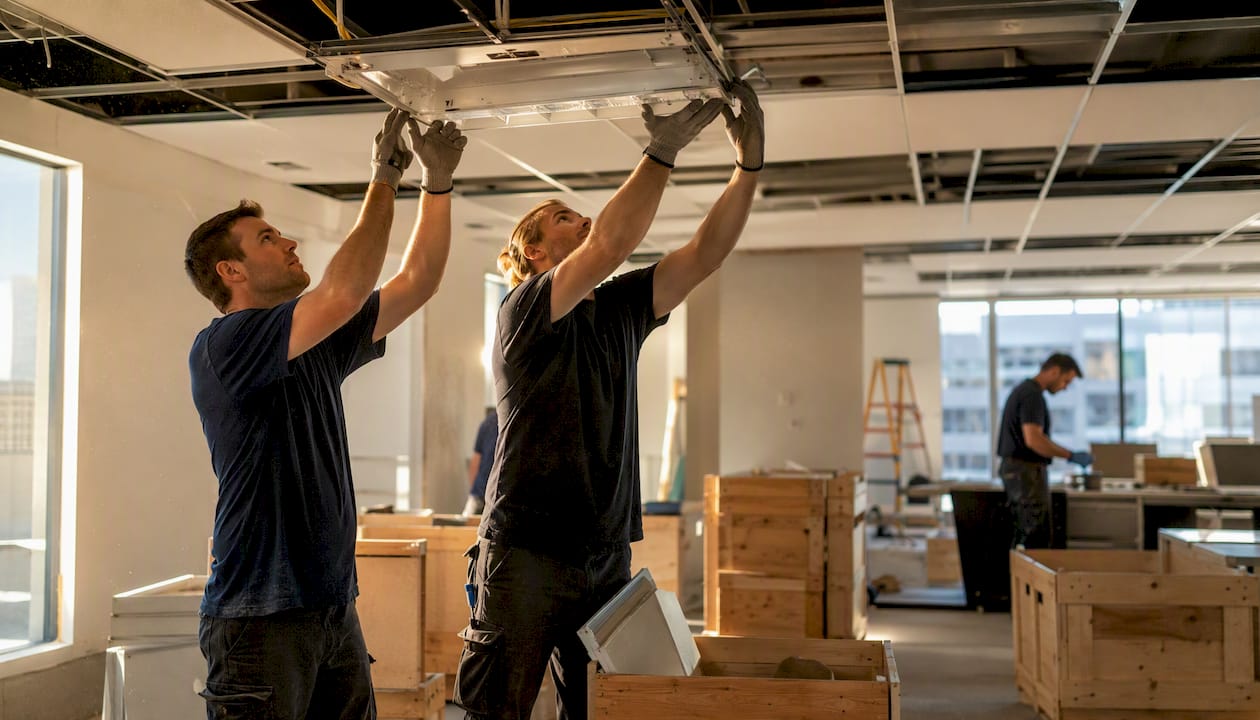
EPA NSW guidance states that deconstruction typically takes around 55–60% longer than conventional demolition because recyclable materials require additional handling and processing. For a project that would take two weeks to demolish, expect three to three-and-a-half weeks for full deconstruction. Storage space on or near the site is a practical necessity; without it, the salvage operation stalls while waiting for buyers to collect.
Pro Tip: Engage salvage buyers before work begins, not after. Knowing which materials have confirmed buyers, and at what price, lets the contractor prioritise those items during soft-strip and avoids the cost of storing material that ultimately cannot be sold.
Which buildings and project situations favour each method
The single most reliable predictor of deconstruction viability is building fabric. Timber-framed residential buildings, particularly pre-1980 construction with hardwood framing, flooring, and weatherboards, are the strongest candidates. Unreinforced brick or sandstone masonry buildings with intact face brick are similarly well-suited. Period joinery, leadlight windows, cast-iron hardware, and original tiling all carry salvage value that a demolition contractor will simply crush.
Reinforced concrete structures present the opposite case. The energy and labour required to separate steel from concrete, combined with the low resale value of the resulting aggregate, means deconstruction rarely makes economic sense for concrete-framed buildings. The environmental benefit also narrows, because the recovered material is typically downcycled rather than reused.
Buildings with severe contamination, including widespread friable asbestos, chemical contamination, or biological hazards, generally require demolition under controlled conditions. Safe entry for the sequential work of deconstruction may not be achievable, and the contamination remediation cost can dwarf any salvage revenue. Similarly, a structure that is structurally unstable or at risk of partial collapse cannot be safely deconstructed; the sequential disassembly plan depends on the building remaining stable throughout.
Site logistics matter as much as building fabric. Deconstruction requires space to sort and store recovered materials, ideally on site. An inner-city project with no laydown area and strict truck-movement restrictions faces a harder path to cost-effective deconstruction than a suburban site with a large footprint. Heritage listings can cut both ways: a listed building may be ineligible for demolition at all, making deconstruction the only lawful option, but the heritage constraints may also limit how aggressively materials can be removed.
Asbestos is the most common regulatory red flag in Australian residential stock. Any building constructed before 1990 should be treated as potentially containing asbestos until a licensed assessor confirms otherwise. Asbestos removal must be completed before soft-strip or structural deconstruction begins, and the cost of that work needs to be included in the net-cost comparison.
Practical decision checklist and the right questions to ask contractors
A structured decision flow prevents the most common mistake: choosing a method based on a single factor (usually gross cost) without accounting for the others.
Work through these checks in sequence:
- Safety and contamination first. Is the structure stable enough for safe entry? Does it contain friable asbestos, chemical contamination, or biological hazards that preclude sequential disassembly? If yes to either, conventional demolition under controlled conditions is the default.
- Reuse value second. What is the building fabric? Timber, face brick, period joinery, and intact roofing materials all carry salvage value. If the building is predominantly reinforced concrete or has been heavily modified with non-original materials, the reuse case weakens.
- Timeline third. Can the programme absorb 55–60% additional time on site? If the site must be cleared by a fixed date that does not allow for this, deconstruction is likely not viable.
- Net-cost modelling fourth. Once you have a salvage appraisal and a deconstruction quote, calculate the net cost using avoided landfill fees and estimated resale revenue. If the net cost is within 10–15% of the demolition quote, deconstruction is worth commissioning.
When tendering or requesting quotes, ask contractors the following:
- Do you hold a current demolition licence and, if applicable, an asbestos removal licence for this jurisdiction?
- Will you provide a written salvage inventory and estimated resale value before work begins?
- How do you handle materials that cannot be sold? Do you provide waste disposal manifests for all material leaving the site?
- Who are your salvage buyers, and do you have confirmed relationships with local architectural salvage dealers or reuse platforms?
- What insurance do you carry for structural incidents during deconstruction?
- Can you provide references from comparable projects completed in the past two years?
- Will you supply a disassembly plan and a hazardous-materials report before work commences?
Red flags in contractor responses include: refusal to allow a site visit before quoting; vague or verbal-only salvage accounting; inability to name specific salvage buyers; and reluctance to provide waste disposal manifests. A contractor who cannot account for where every material stream goes is a liability, not a saving.
Request the following documents before signing any contract: a pre-demolition hazardous-materials report (including asbestos survey), a salvage inventory with estimated values, a disassembly plan (for deconstruction), and a waste management plan that identifies the destination of each material stream.
Australia-specific evidence, policy context and a local example
Australia generates substantial volumes of C&D waste annually, and the national waste report identifies this stream as one of the largest by mass in the national waste inventory. Recovery rates vary by state and by material type, with concrete and steel achieving relatively high recycling rates through crushing and metal recovery, but timber and mixed materials performing less well.
In NSW, the regulatory framework for C&D material management is anchored by EPA NSW’s resource-recovery orders and exemptions, which specify how recovered materials must be classified, tested, and managed before they can be reused or sold. These orders directly affect what a deconstruction contractor can legally do with recovered material and what documentation is required. Project owners in NSW should confirm with their contractor that the salvage plan complies with the applicable resource-recovery order for each material type.
At the council level, requirements vary. Some Sydney councils include waste management plan conditions in development consents for demolition, requiring applicants to identify material streams and demonstrate diversion from landfill. The C40 Knowledge Hub documents how leading cities internationally have gone further, embedding deconstruction requirements into permit conditions for buildings above a certain age or size. Australian councils are beginning to adopt similar approaches, and it is worth checking current DA conditions with your local council before assuming demolition is the straightforward path.
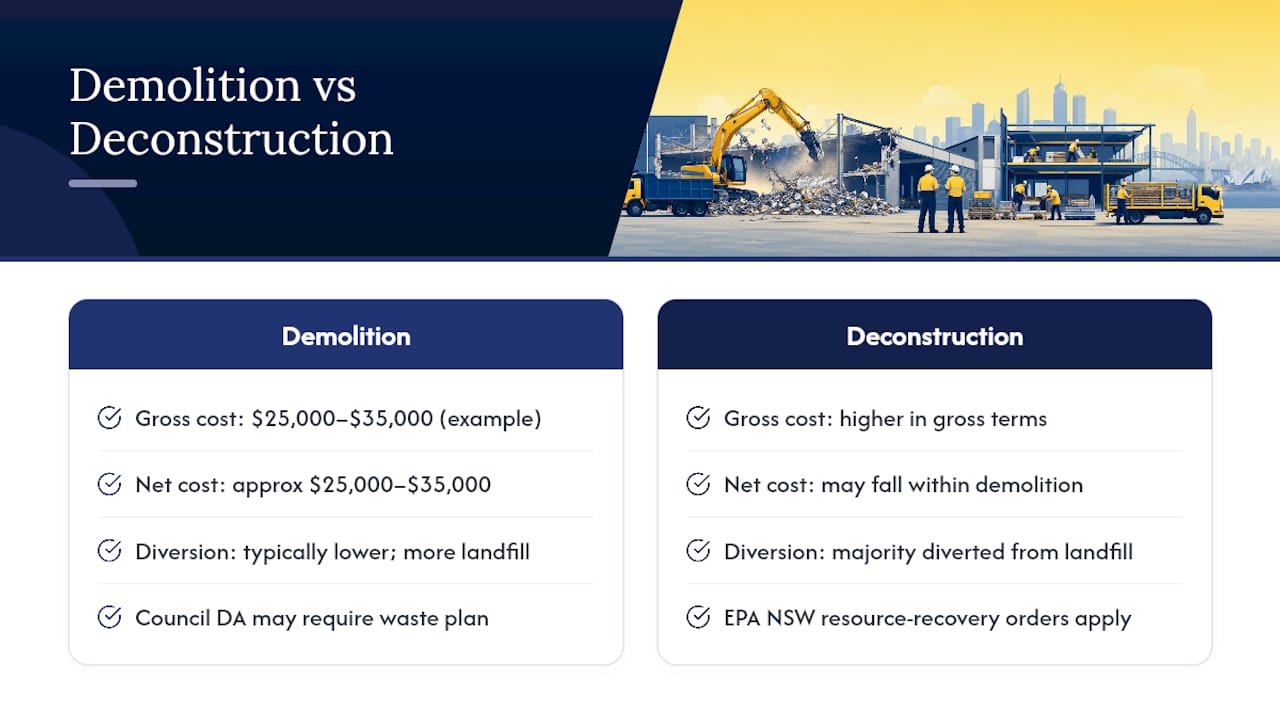
A useful illustrative scenario: a pre-1960 timber-framed dwelling in inner western Sydney, scheduled for redevelopment. A conventional demolition quote comes in at approximately $25,000–$35,000 (site-specific; obtain your own quotes). A deconstruction quote for the same building runs higher in gross terms, but the contractor identifies hardwood flooring, original face brick, period joinery, and roof tiles as saleable. Avoided landfill fees and resale revenue, once modelled, bring the net deconstruction cost within range of the demolition quote, and the project diverts the majority of material from landfill. The critical variable is whether the contractor has active buyer relationships; without them, the salvage sits in storage and the economics deteriorate.
For Sydney-based projects, practical local action steps include contacting your council’s development assessment team to confirm waste management plan requirements, and reaching out to architectural salvage dealers in the inner west and western Sydney for pre-work appraisals. Online platforms and community reuse organisations also provide channels for smaller salvage volumes that do not meet the minimum quantities required by commercial dealers.
Sydney City Rubbish: local support for demolition, strip-out and salvage-aware removal
For Sydney commercial and construction projects, the gap between a good deconstruction plan and a well-executed one often comes down to who handles the material once it leaves the building. Sydneycityrubbish works with property managers, strata managers, developers, and construction companies across Sydney, providing salvage-aware rubbish removal, demolition support, soft-strip and makegood services, and hazardous-material handling, including the documentation and disposal manifests that NSW regulatory requirements demand.
Where a project qualifies, Sydneycityrubbish offers a carbon-neutral disposal opt-in through its partnership with Carbon Neutral, which gives commercial clients a verifiable environmental credential alongside the practical service. The team handles construction debris, electronic waste, and mixed C&D material, with truck and driver hire available for projects that need flexible logistics rather than a full managed service.
If your project is at the planning stage and you need a site appraisal, a quote for demolition or strip-out work, or guidance on salvage-aware removal options, contact Sydneycityrubbish to discuss your project requirements and get a quote.
Sources
The following primary sources are recommended for deeper technical, regulatory, or data enquiries.
Australian and NSW sources:
- Deconstruction (Designing Buildings wiki)
- How to start deconstructing and stop demolishing your city’s buildings (C40 Knowledge Hub)
International references for recovery-rate and cost context: