Wet vs Dry Hire: Which Suits a Sydney Commercial Job?
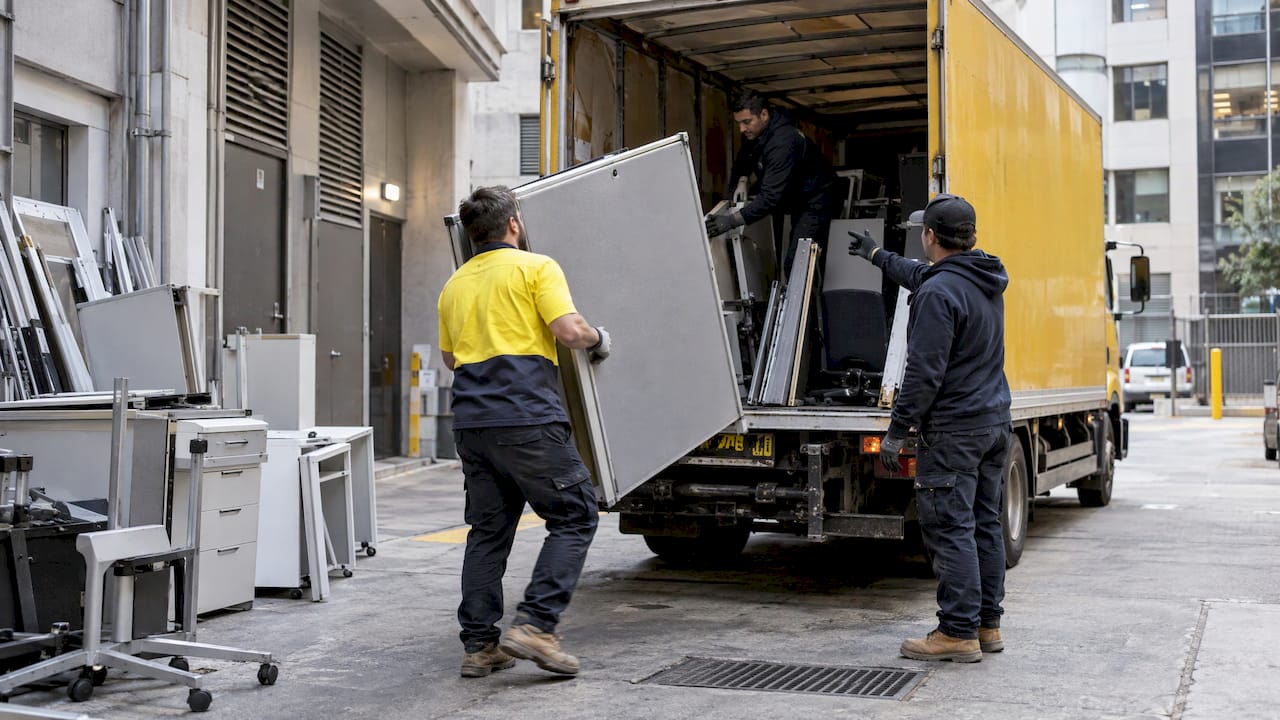
Dry hire means you hire the equipment and supply the operator yourself. Wet hire means the equipment arrives with a qualified operator supplied by the hire company. For most office, retail, strata and end-of-lease clearouts in Sydney, wet hire is the better fit: you book an outcome, the driver or operator belongs to the supplier, and the licensing, fatigue and day-to-day operating duties stay with people who do the work for a living. Sydney City Rubbish runs its truck and driver hire on that wet basis, with the driver and truck booked together.
TL;DR
- Dry hire is the machine only. You provide a trained, licensed operator, fuel, daily checks and the insurance that goes with running it.
- Wet hire is the machine plus operator. The supplier manages the operator’s hours, tickets and, usually, the routine upkeep of the machine.
- Work health and safety duties cannot be contracted out under either model. Wet hire simply places more of the operating duties with the supplier.
- Dry hire suits businesses with their own experienced operators and long programs. Wet hire suits short, one-off jobs such as a strip-out, a makegood or a lease-end clearout.
- Compare the two on total cost for the job, not the headline hourly rate.
Table of Contents
- What dry hire and wet hire actually mean
- Who carries the risk when something goes wrong
- Safety law applies either way
- What each option costs once you count everything
- Which model fits which Sydney job
- A short checklist before you sign
- How we run wet hire at Sydney City Rubbish
- FAQ
- Sources
What dry hire and wet hire actually mean
The terms come from plant and equipment hire, but they apply to anything that moves waste: trucks, tippers, bobcats, forklifts, scissor lifts and the like.
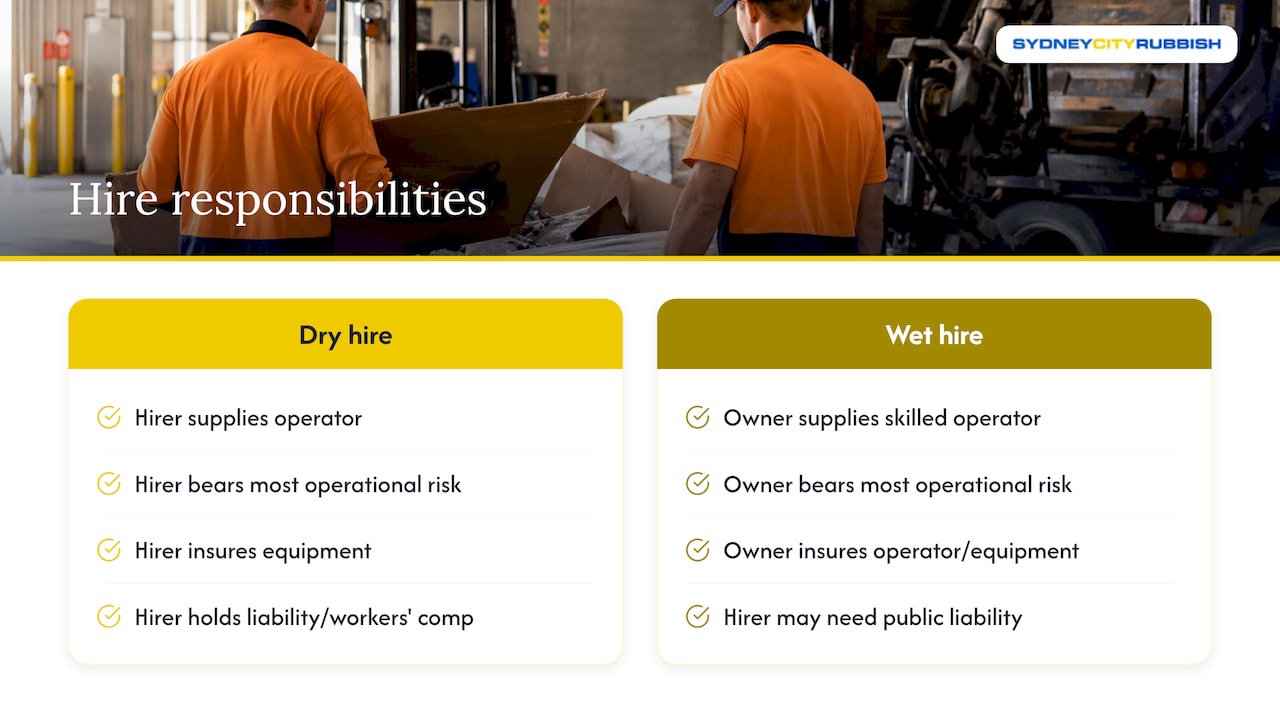
In a dry hire, the hire company hands over the machine and steps back. Your business becomes responsible for who runs it, how it is used, fuelling, pre-start checks, reporting faults and returning it in the condition it left. A comparison of the two models by Prosper Law puts it plainly: in dry hire the hirer provides the operator, carries most of the operational risk, insures the equipment and holds public liability and workers compensation cover, and handles maintenance as set out in the agreement.
In a wet hire, the machine and a skilled operator come as one booking. In the same comparison, the owner supplies the operator, bears most of the operational risk, insures the operator and equipment, and the operator handles day-to-day maintenance. The hirer may still need public liability cover of its own.
Two practical points follow. First, the hire company usually bills wet hire by the hour or by the job, and dry hire by the day, week or month. Second, the labels are not perfectly standardised across suppliers. Some use “wet hire” to mean only that fuel is included. Whatever the label, get the inclusions in writing before the job starts.
Who carries the risk when something goes wrong
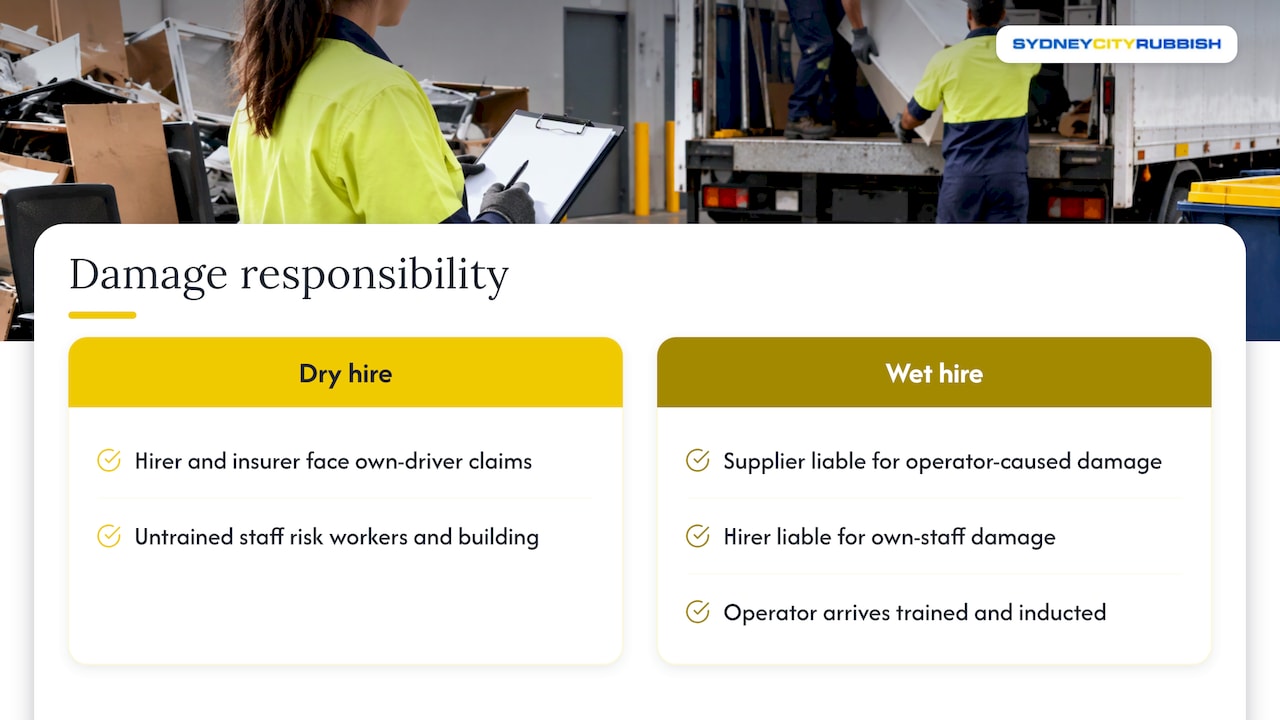
This is where the choice stops being a pricing question. Lawyers writing in Cranes & Lifting explain that wet-hire agreements typically make the supplier liable for damage caused by the operator’s actions, and the hirer liable for damage caused by the hirer’s own staff. They add that wet hire often provides significant risk and liability benefits over dry hire.
Consider what that means on a typical commercial job.
A strata manager books a skip truck for a basement clearout. If the driver reverses into a roller door, the damage traces to the supplier’s operator. If your own caretaker had been driving a dry-hired vehicle, the damage and the claim would sit with you and your insurer.
A corporate tenant strips out two floors before handback. A dry-hired scissor lift operated by a facilities officer without the right training puts a worker, the building and the tenant’s lease position at risk at once. A wet-hired operator arrives already trained, inducted and covered by their employer.
Neither model removes your own obligations. It only changes where most of them sit.
Safety law applies either way
No hire agreement can write the law out of the picture. Under the Work Health and Safety Act 2011, section 25, a supplier of plant must ensure, so far as is reasonably practicable, that it is without risks to health and safety, and must give each person supplied adequate information about its purpose and safe use. These duties apply to hiring as well as selling. In NSW, the Work Health and Safety Regulation 2025 sets out the duties of a business that manages or controls plant, including risk management, guarding, emergency stops, and maintenance and inspection of the plant.
In practice, more than one business can hold duties over the same machine on the same site. The supplier owes duties for the machine it supplied. The business running it owes duties for how it is operated. The head contractor or building manager owes duties for the site as a whole. They need to consult and coordinate with each other.
High risk work licences
Some plant can only be operated by a person holding a licence. Under regulation 81 of the Work Health and Safety Regulations 2011 (Commonwealth compilation of 25 March 2025), a person must not carry out a class of high risk work unless they hold a high risk work licence for that class. Regulation 85 requires the business directing or allowing the work to see written evidence of the licence first. NSW’s own regulation covers licensing of high risk work in regulations 81 to 85.
This matters most in dry hire. If you supply the operator, you are the one who must see the licence and confirm competency. With wet hire, the supplier has put a qualified operator in the seat before the machine reaches your site. You should still ask for the licence details your site induction needs, but you are not building the competency from scratch.
Waste systems in commercial buildings
The NSW EPA’s Better Practice Guidelines for Waste Management in Commercial and Industrial Facilities state that waste collection methods and systems in commercial buildings must comply with the Work Health and Safety Act 2011 and associated regulations. They also stress that systems should be designed and operated to prevent injury risk to tenants, building staff, collection staff and others. For a property manager, that is a reason to put heavy loading and truck movements in the hands of crews who do them every day.
What each option costs once you count everything
The hourly rate for dry hire is lower. That is why it looks attractive on a quote. The comparison changes when you add what dry hire leaves with you:
- the wages, oncosts and time of whoever operates the machine
- supervision, inductions and any training or licence required
- fuel, transport to and from site, and cleaning
- idle time while the machine waits for the next task
- exposure to damage, theft or loss while it is in your care, plus the insurance or damage waiver that covers it
- the administration of off-hire notices, inspections and reports
Wet hire typically bundles the operator’s wage, insurance and overheads into the rate, and often fuel and routine servicing. Travel time, minimum call-out hours, overtime and weekend rates are commonly charged separately, so ask about each of them. Items worth checking in any hire agreement include the rate basis, minimum hire period, delivery and collection, fuel, cleaning, damage waiver, operator inclusion, overtime and the off-hire process.
The sensible measure is total cost per productive hour, or better, total cost for the whole clearout. A fast one-off job rarely justifies hiring a machine dry, then finding and covering someone to run it. For a worked example, picture a retail tenant clearing a shopfront in a weekend. Dry-hiring a tipper means a licensed driver, fuel, tip runs, and your own risk exposure. Booking a truck and driver means one quote for the load and the haul. Our own page on truck and driver costs in Sydney sets out what to check on a freight and cartage quote.
Which model fits which Sydney job
The right answer depends on who you are, how long you need the equipment and what skills you already employ.
Office and retail clearouts
Office furniture, partitions, e-waste and fit-out leftovers are one-off tasks with a clear finish. Wet hire fits because nobody in your business should need a truck licence or loading experience for something that happens once. The same applies to a makegood or defit at lease end, where the deadline is fixed by the lease and delays cost money. If you are weighing the two lease-end routes, our page on defit versus make good explains what Sydney tenants need to know.
Strata and building management
Strata managers deal with committees, residents and loading dock bookings. A supplier who arranges access directly with building management, with a driver who knows how to work inside a managed building, removes a layer of coordination. That is the practical benefit of wet hire for strata: fewer parties for you to supervise, and a single point of accountability when a bin chute, lift or dock is involved.
Construction and demolition sites
Builders with their own plant operators and a long program can make dry hire work, particularly for smaller plant on changing work fronts. Many sites mix the two: dry hire for the simple machines their crew already runs, and wet hire where the task is specialised or the licence is not held in-house. For heavy debris, construction waste disposal with a supplied truck and driver keeps haulage off your crew’s workload. Tipper work is covered on our tipper truck hire page.
Warehouses and larger commercial properties
End-of-lease warehouse clearouts often involve racking, pallets, concrete floor finishes and mixed waste. These jobs are heavier and riskier than office work, and the cleanup has to meet the lease standard. A single supplier handling removal, haulage and floor finish work reduces the number of contracts, insurers and induction processes you need to manage.
A short checklist before you sign
Whichever model you choose, settle these in writing before the truck arrives.
First, confirm exactly what the rate includes: operator, fuel, tipping or disposal, travel, and any minimum hours. Second, confirm who supplies and who verifies licences and site inductions. Third, check which insurance each party holds and ask for certificates of currency before handover. Fourth, agree what happens to standby time, delays from weather or building access, and extensions. Fifth, confirm how the waste will be handled, including where it goes after it leaves your building.
That last point matters for your own compliance and reporting. A job that ends with an unmarked load and no record leaves the building owner exposed.
How we run wet hire at Sydney City Rubbish
Our truck and driver hire puts a driver with the truck, so the operating task is ours, not yours. We coordinate directly with building management for access, quote electronically so you can compare quickly, and guarantee punctuality, with compensation if we are late. Disposal goes through registered recycling partners, and corporate clients can opt in to carbon-neutral removal. Quotes are per truckload or per project, and you can book and pay online.
If your job is a clearout rather than an equipment rental, the closest fits are our commercial waste removal and commercial rubbish removal services. For strip-outs, makegood, demolition, concrete cutting and the rest of the range, see what we do. Send us the address, the access conditions and a rough idea of the volume, and get a free quote.
FAQ
What is the difference between wet hire and dry hire?
Dry hire supplies the equipment only, and you provide the licensed or trained operator. Wet hire supplies the equipment with a qualified operator from the hire company. The split affects who carries the operating risk, who insures what, and who handles fuel and maintenance.
Is wet hire more expensive than dry hire?
The hourly rate is usually higher because it covers the operator. Once you add your own operator’s wages, supervision, fuel, transport, idle time and damage exposure, the gap often narrows or closes on short jobs. Compare the total cost for the whole job.
Do I need a licence to run hired equipment?
For high risk work classes, the operator must hold the matching high risk work licence, and the business directing the work must see written evidence of it. Other equipment still needs a trained, competent operator. With wet hire, the supplier provides that operator.
Can a hire agreement transfer all safety responsibility to the other party?
No. Work health and safety duties cannot be contracted out. Suppliers, hirers and site managers can each hold duties over the same machine, and they must consult and coordinate with each other.
Which is better for an end-of-lease clearout?
Wet hire is the practical choice. The task is short, has a fixed deadline and usually involves loading and haulage skills your staff do not need to hold. One supplier with a driver and truck keeps it simple.
Sources
- Key Terms in Equipment Hire Agreements, Prosper Law
- Understanding Wet and Dry hire, Cranes & Lifting
- Work Health and Safety Act 2011
- Work Health and Safety Regulations 2011 (25 March 2025 compilation)
- Work Health and Safety Regulation 2025 (NSW)
- Better Practice Guidelines for Waste Management in Commercial and Industrial Facilities, NSW EPA