Anchor Bolt Removal from Concrete: Methods for Sydney Commercial Sites
Anchor bolt removal in a commercial space is rarely about pulling a bolt out. The anchor type decides whether it unscrews, gets driven below the surface, is cut flush or has to be cored out with the concrete around it, and the lease or the next fit-out decides which of those results is acceptable. For offices, warehouses and retail tenancies heading into makegood, the safest approach is to settle the method with the property owner first, then have it done under silica controls. Our team at Sydney City Rubbish handles core drilling, concrete cutting and makegood work across Sydney, so the whole job sits with one crew.
TL;DR
- Identify the anchor first: Dynabolt (sleeve), wedge, drop-in, chemical or screw anchors all behave differently when you try to remove them.
- Pulling a set anchor hard enough usually fails the concrete, leaving a cone-shaped crater that costs more to repair than the anchor ever did.
- Cutting flush or tapping below the surface is quick, but it leaves steel in the slab. Coring removes the anchor completely and leaves a clean cavity to fill.
- Drilling, coring and grinding concrete creates respirable crystalline silica dust, and NSW sets an exposure limit of 0.05 mg/m3 over eight hours.
- Confirm with the building owner or makegood manager whether retained metal is acceptable before any work starts.
Table of Contents
- Why the anchor type decides everything
- Four outcomes, and what each leaves in the slab
- When the lease decides the method
- How a Dynabolt comes out, step by step
- Wedge, drop-in and chemical anchors
- Silica: the part that cannot be skipped
- A small job and a site job are different things
- How we handle anchor removal on commercial sites
- Planning the work: a short checklist in prose
- FAQ
- Sources
Why the anchor type decides everything
Concrete anchors are designed to hold, not to come out. Once an expansion anchor is set, its grip comes from a sleeve or wedge pressed hard against the walls of the drilled hole. Force the bolt out and the concrete tends to give way before the anchor does.
Four types turn up on commercial floors and walls:
- Sleeve anchors, including Dynabolts. A bolt with an expanding sleeve, common for racking, machinery bases, partitions and fixtures. The nut comes off easily and the sleeve is the problem.
- Wedge anchors. A threaded stud with a clip that bites into the concrete. These are built to stay put.
- Drop-in (female) anchors. Set flush with the surface and expanded with a setting tool. The internal thread can be unscrewed of its bolt, but the body stays in the slab.
- Chemical (resin) anchors. A threaded rod bonded with resin. They are very strong and the hardest to deal with.
- Concrete screws. Threaded straight into a pilot hole, these are the only type designed to come back out.
Manufacturers say as much. Ramset describes the DynaBolt as a permanent anchoring solution and recommends its AnkaScrew for installations where removal may be needed later. For a facilities team that sees racking or equipment moved around, that is worth remembering at the next install, but most tenants are dealing with what the previous occupant left behind.
Four outcomes, and what each leaves in the slab
Before choosing a tool, choose the outcome. There are four, and they are not equivalent.
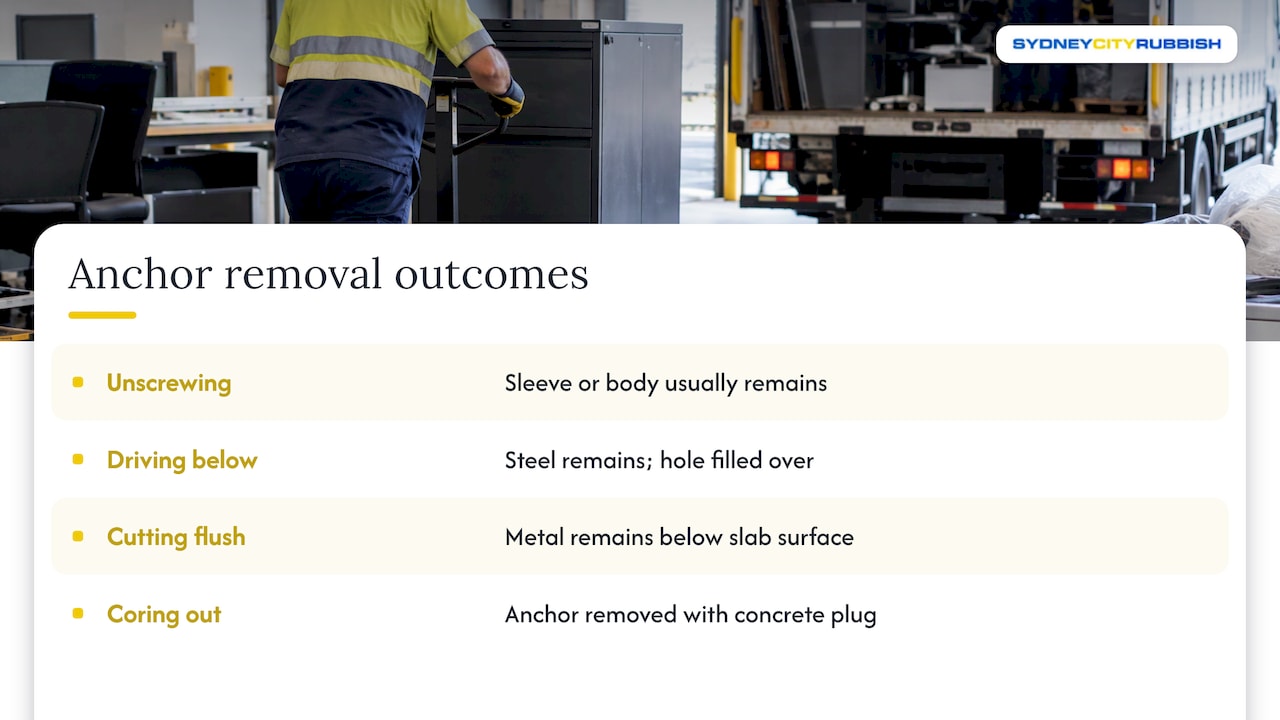
Unscrewing. Works for concrete screws and for the bolt of a drop-in or sleeve anchor in good condition. Turn the nut or head anticlockwise with a spanner or socket. The sleeve or body usually stays behind.
Driving below the surface. Ramset’s guidance for a DynaBolt is to remove the nut, then hammer the threaded stud into the drill hole. Where the hole is not deep enough, the stud is cut off at the surface with a grinder and punched down. The hole is then filled over. It is fast, but the steel stays in the slab.
Cutting flush. An angle grinder takes the stud off at the surface, then the edge is ground slightly below the slab so nothing catches a boot, a pallet jack or a floor coating. Again, the metal remains.
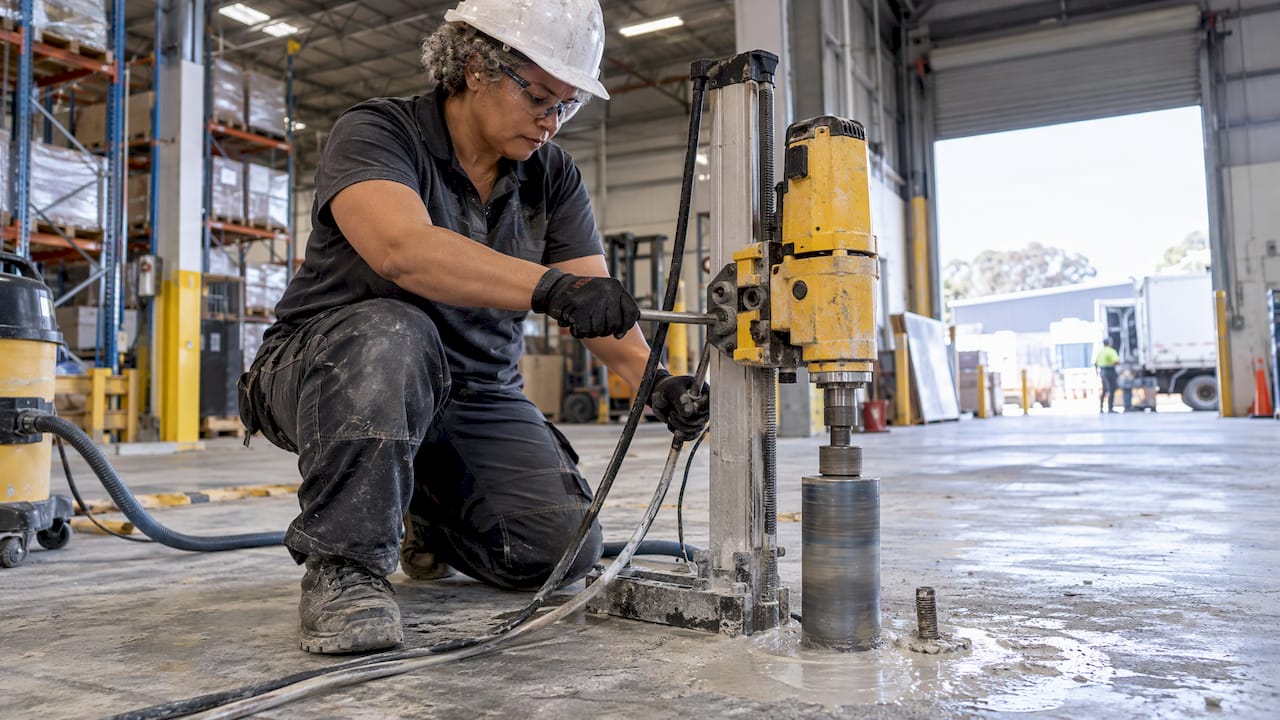
Coring out. A diamond core bit is drilled around the anchor, below its embedded depth, and the anchor comes out with a plug of surrounding concrete. The cavity is clean and the anchor is gone entirely. It takes longer and needs a repair, but it is the only outcome that proves the anchor has been removed.
A level surface and a complete removal are different results. Retained steel can obstruct future drilling in the same spot, which matters when the next tenant or the owner wants to install new fixings, scan the slab, or lay a new floor system. That is why the method should be agreed before work begins, not discovered at the handback inspection.
When the lease decides the method
For most of our clients, anchor removal is a line in a makegood or de-fit schedule. A warehouse tenant leaving pallet racking, an office tenant removing a server cage or workstation partitions, a retailer stripping out shopfit fixtures: each leaves anchors in the floor.
The lease usually says the premises must be returned to base-building condition, and the owner’s representative decides what that means for the slab. Some are satisfied with flush-cut anchors and a patched surface. Others, particularly for warehouses where new racking will go in, want anchors cored out and the holes filled with high-strength epoxy. Property and strata managers can save a dispute by asking three questions early:
- Does the handback standard require full removal or is flush acceptable?
- Will the slab be coated, polished or loaded with new equipment after handback?
- Who signs off the repair method and the finished floor?
Those answers also set the price. Per-anchor coring and filling costs more than cutting and patching, and a site with hundreds of anchors multiplies the difference. We quote per project or per truckload, so send us the schedule of works or the lease clause and we price against the real requirement. Our core drilling and epoxy filling for warehouses page explains the approach for larger floors, and our Dynabolt removal guide goes further into that specific anchor.
How a Dynabolt comes out, step by step
The Dynabolt is the anchor most Sydney tenants meet, so it is worth walking through properly. This is what the work involves, and where it commonly goes wrong.
1. Identify the anchor and scan the slab. Confirm what you are dealing with before you pick a tool. Skipping this step is the usual cause of force-extracting an anchor that was never going to release. Before cutting or coring, scan for reinforcement, conduit and services. Hitting rebar or a post-tension cable is the costly mistake, and it is why anchors near cables or in load-bearing slabs belong with a professional crew.
2. Remove the nut and washer. If the nut is rusted or rounded, a nut splitter or a bolt extractor socket grips what a spanner cannot.
3. Release the sleeve. Tap the bolt down with a hammer and steel punch. This relieves the pressure that forces the sleeve against the hole wall. If the sleeve then comes free with locking pliers, the anchor is out. If it stays, gripping the sleeve and bolt together and levering both out is more reliable than pulling the bolt alone, which simply re-wedges the sleeve.
4. Decide between burying, cutting or coring. If the bolt will go below the surface, it can be filled over. If it will not move, cut it level with the slab using a grinder. If the specification calls for complete removal, core around it.
5. Clean and repair the hole. Vacuum out dust and debris so the repair material bonds, then fill with a high-strength non-shrink grout or two-part epoxy mortar, in stages if the hole is deep, and finish flush. Let it cure before the floor is loaded.
Where the work goes wrong is predictable: a flush cut left rough enough to catch dirt or trip someone, a hole that was not cleaned before patching, or a repair finished before the owner’s inspector has agreed that retained metal is acceptable. Our crews coordinate directly with building management for access, which keeps lift bookings, after-hours entry and loading dock times from holding up the job.
Wedge, drop-in and chemical anchors
Wedge anchors are made not to come out. Pulled to ultimate tension, the concrete fails and a cone of concrete leaves with the anchor, which is why a wedge anchor guide points to cutting the stud off at the surface with a cut-off saw or grinding wheel instead. For a commercial floor, the choice is the same as above: flush cut and patch, or core and fill.
Drop-in anchors cannot be removed without breaking the concrete. The male bolt unscrews, but the sleeve stays in the slab. The practical options are to leave the body and fill over it, or core it out where the specification requires.
Chemical anchors are the hardest. The rod is bonded along its length by resin, so tapping it down is not an option. Coring is the realistic way to deal with them, and the repair needs thought. Hilti’s engineering team notes that used chemical anchor holes must be cored out and roughened, leaving a larger-diameter hole, and that under AS 5216 the options are to fill with non-shrink mortar and anchor in a new hole or to use a larger rod, with on-site testing recommended. If a new structural fixing is going back into the repaired area, that decision belongs with the engineer.
Silica: the part that cannot be skipped
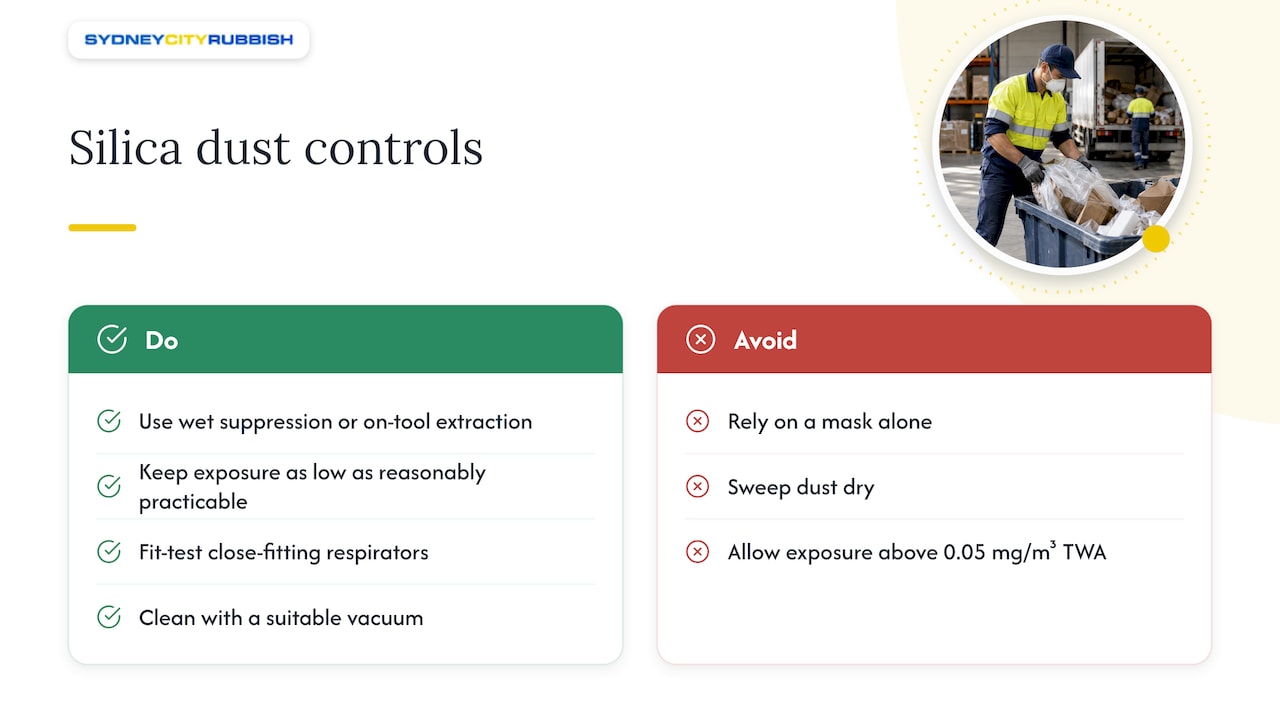
Every method that cuts, drills or grinds concrete releases respirable crystalline silica, the fine dust that causes silicosis and other lung disease when breathed in over time. In NSW, a business must ensure exposure does not exceed 0.05 mg/m3 as an eight-hour time-weighted average, and must keep exposure as low as reasonably practicable.
The same SafeWork NSW code of practice requires concrete processing, including drilling and coring, to be controlled by at least one of isolation, an enclosed operator cabin with high-efficiency filtration, effective wet dust suppression, on-tool extraction or local exhaust ventilation. Respiratory protective equipment is provided to anyone still at risk, and it must meet AS/NZS 1716:2012 and AS/NZS 1715:2009. Relying on a mask alone is rarely appropriate.
SafeWork NSW’s separate guidance on cutting, drilling and grinding concrete lists on-tool dust capture and wet cutting with RCD-protected equipment among the controls, and standard protective equipment of a respirator, helmet, eye and hearing protection and suitable footwear. Close-fitting respirators must be fit-tested.
In an occupied office, a shared warehouse or a strata building, this has practical consequences. Dust travels to other tenants, into air-handling systems and across common areas. Wet coring and on-tool extraction keep it at the source, and the area needs to be cleaned with a suitable vacuum rather than swept dry. Strata managers and property managers should expect the contractor to explain its dust controls before the job starts. Our pages on silica dust compliance for commercial sites and concrete cutting safety set out the controls we apply.
A small job and a site job are different things
A single light fixing in an accessible spot is one thing. A commercial floor is another. The work should go to a specialist crew when:
- the anchors are structural or in a load-bearing slab
- there are many of them across a large floor
- they sit near rebar or post-tension cables
- access equipment is needed for work at height
- the floor must be left visually clean for handback or will take new machinery
That last point is where makegood goes wrong most often. A tenant removes racking, patches each hole with whatever filler is at hand and then finds the owner wants a coated, level slab with no retained steel. Redoing the repair costs more than doing it once, and it can push the handback date past the end of the lease.
How we handle anchor removal on commercial sites
Sydney City Rubbish removes anchors as part of makegood, de-fit and building strip-out projects for offices, warehouses, retail tenancies and strata buildings. Our services include concrete cutting, concrete grinding, core drilling, floor finish removal and jackhammering, so the anchor removal, the floor preparation and the waste removal sit under one booking. The steel, concrete plugs, racking, furniture and joinery that come out of the space are taken away with the rest of the job, using registered recycling partners for responsible disposal. Clients can opt in to carbon-neutral waste disposal.
We guarantee punctuality, with compensation if we are late, and quoting is done electronically so you can have a figure against your handback schedule quickly. If you manage a lease exit or a strata cleanout, tell us about the job and get a quote.
Planning the work: a short checklist in prose
Start with the lease or handback schedule and find the clause on slab condition. Then walk the space and photograph the anchors, noting type, spacing and whether any are rusted or sheared. Ask the owner or their makegood representative which of the four outcomes they will accept. Book building access, noting any lift, noise or after-hours restrictions, and confirm that the contractor will scan for services and apply wet or extracted dust control. Finally, agree who inspects the repaired floor and when, so there is a sign-off before the lease end rather than after it.
If demolition, strip-out or furniture removal is part of the same exit, scheduling it together avoids anchors being exposed on a floor that crews are still walking heavy equipment across. Our page on safe practices on office demolition projects covers sequencing in an occupied building.
FAQ
Can you remove an anchor bolt from concrete?
Yes, but the way depends on the type. Concrete screws unscrew fully, while sleeve anchors such as Dynabolts can often be loosened by removing the nut and tapping the stud down. Wedge, drop-in and chemical anchors generally need to be cut flush or cored out, because pulling them tears a cone of concrete from the slab.
How do you remove a Dynabolt?
Remove the nut and washer, then tap the bolt down with a hammer and punch to release the sleeve. Grip the sleeve and bolt with locking pliers and lever them out. If it will not move, drive it below the surface or cut it flush, then clean and fill the hole. For a full removal, core around it.
Is it better to cut an anchor flush or core it out?
Flush cutting is quicker and cheaper but leaves steel in the slab, which can obstruct future drilling at that point. Coring removes the whole anchor and leaves a clean cavity to fill with epoxy or grout. Confirm with the property owner which one the lease requires before work begins.
Does anchor removal create dust that needs controlling?
Yes. Drilling, coring and grinding concrete release respirable crystalline silica. NSW codes of practice require controls such as wet dust suppression or on-tool extraction, with approved respirators for anyone still at risk.
How do you fill the hole afterwards?
Vacuum out all dust and debris, dampen the hole, then pack it with non-shrink grout or two-part epoxy mortar, in stages if deep. Finish flush and let it cure before loading the floor.
Sources
- Ramset: FAQs on DynaBolt and AnkaScrew
- The Spruce: How to Install Concrete Anchors
- Wedge anchor removal guide
- Hilti Australia: re-using a chemical anchor hole
- SafeWork NSW: Managing risks of respirable crystalline silica in the workplace
- SafeWork NSW: Working safely when cutting, drilling and grinding concrete