Waste Tracking Requirements in Australia: A NSW Guide
Published 19 October 2026 by the Sydney City Rubbish team
There is no single national waste tracking law in Australia. Each state and territory sets its own rules, its own list of trackable waste and its own online system. For a Sydney business, the rules that apply are NSW rules, and they sit in Part 4 of the Protection of the Environment Operations (Waste) Regulation 2014. If your waste crosses a border, the rules of other states can apply as well. This guide explains what NSW requires, who carries the responsibility, what changes in Queensland and Victoria, and what to settle with your contractor before a truck arrives.
TL;DR
- Waste tracking is regulated state by state. Compliance in Sydney does not cover a movement that starts or ends in Queensland or Victoria.
- In NSW, hazardous waste listed in Schedule 1 of the Waste Regulation must be tracked when it moves into, within or out of the state. Asbestos and waste tyres have their own thresholds.
- The producer, any authorised agent, the transporter and the receiving facility each carry duties. Handing the job to a contractor does not hand over your accountability.
- NSW tracking now runs through the Integrated Waste Tracking Solution (IWTS), which replaced the older Online Waste Tracking and WasteLocate systems.
- Before any strip-out, makegood or clean-out starts, ask your contractor how each trackable waste stream will be classified, recorded and disposed of.
Table of Contents
- Why waste tracking exists
- One country, several rule sets
- What NSW requires you to track
- The IWTS in practice
- Who is responsible: producer, transporter or receiver
- How Queensland and Victoria differ
- Waste tracking on common commercial jobs
- What a defensible record file contains
- Questions to ask before you book a contractor
- How we handle this at Sydney City Rubbish
- FAQ
- Sources
Why waste tracking exists
Waste tracking follows a load from the site where it is produced to the facility that accepts it. The NSW EPA says that tracking helps stamp out illegal dumping and stops waste going to the wrong facility. It also protects operators who do the right thing from being undercut by those who dump.
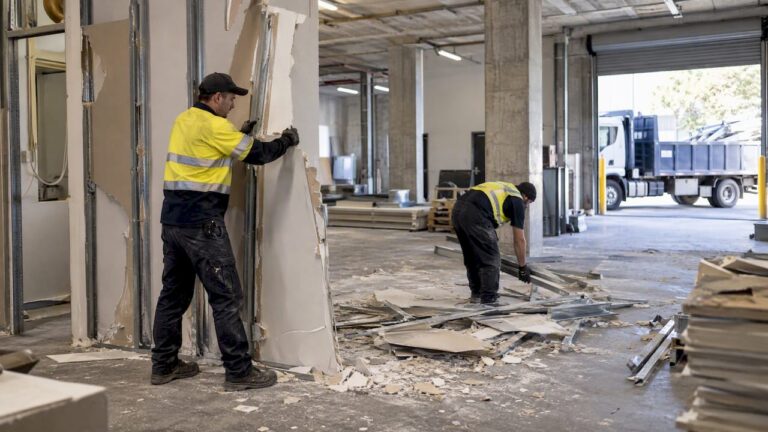
For a commercial client, the practical meaning is simple. Every trackable load leaves a record, and that record names you. A office fit-out that produces contaminated materials, a demolition that exposes asbestos sheeting, or a warehouse clean-out that turns up drums of unknown liquid can all create trackable waste, even when the job was booked as ordinary rubbish removal.
One country, several rule sets
The National Waste Policy sets a shared direction, but jurisdictions implement their own levies, tracking systems and bans. Businesses therefore have to follow the rules of the jurisdiction where the waste movement starts or ends. The same applies to the waste hierarchy, which ranks avoiding, reducing, reusing, recycling, recovering, treating and disposing in that order. It guides state strategies, but it is not a tracking rule.
Three systems matter most for Sydney businesses that also operate elsewhere:
| Jurisdiction | Main system | Key legal basis |
|---|---|---|
| NSW | Integrated Waste Tracking Solution (IWTS) | Protection of the Environment Operations (Waste) Regulation 2014, Part 4 |
| Queensland | Online Services platform or paper waste transport certificates | Environmental Protection Regulation 2019 |
| Victoria | Waste Tracker | Environment Protection Act 2017 and Environment Protection Regulations 2021 |
The NSW and Queensland environment agencies built the IWTS together, and it is part of a push towards a nationally consistent hazardous waste tracking and data system. Consistency is a goal, not yet a reality, so you still need to check the state rules for every movement.
What NSW requires you to track
Under Part 4 of the Waste Regulation, the transport and disposal of hazardous waste listed in Schedule 1 must be tracked when it is moved into, within or out of NSW. The EPA publishes a table of waste descriptions and codes on its page about waste that needs to be tracked. The consignor, meaning the producer or their authorised agent, has to work out whether the waste is on that list. There are exemptions for some waste types, so the classification step matters.
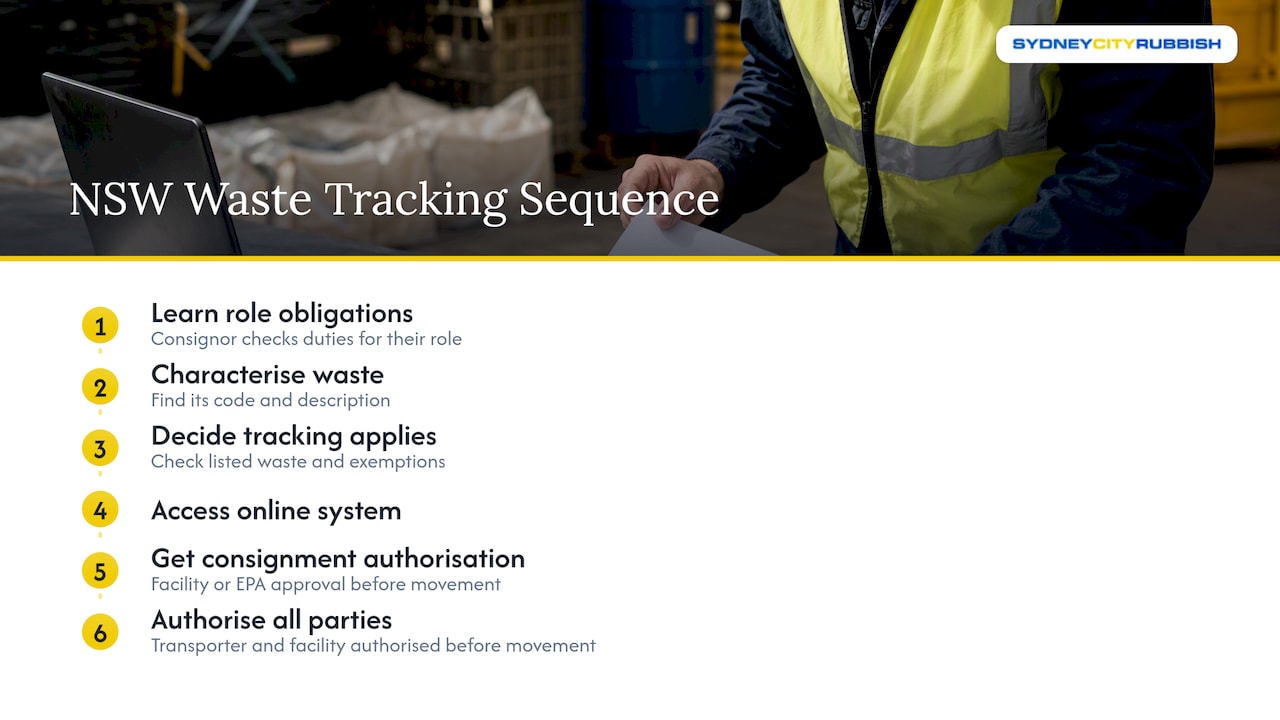
The EPA describes the sequence in practical terms. The consignor first learns the obligations for their role, then characterises the waste to find its code and description, then decides whether it must be tracked, then gets access to the online system. A consignment authorisation, which is the approval from the receiving facility or the EPA for the waste to be transported, has to be in place before the load moves. Every party must also be authorised: the transporter to carry the waste and the facility to receive it.
The requirements are the same whether or not your business holds an environment protection licence.
Asbestos and waste tyres
Two waste streams carry their own thresholds, and both turn up regularly on commercial sites in Sydney.
For asbestos, transporters and facilities handling loads inside NSW must track and report the waste in the IWTS when a load weighs 100 kilograms or more, or includes 10 square metres or more of asbestos sheeting. The EPA notes that heavy penalties may apply for not using the IWTS or for tracking movements incorrectly. Older fibro ceilings, wall cladding and roofing in pre-1990 buildings are the usual source, so any strip-out of an older building should begin with a hazardous materials assessment, not with a skip bin.
For waste tyres, the EPA applies tracking to loads of 200 kilograms or more moved within NSW, with a separate count threshold for tyres by number. Warehouse and fleet clean-outs are where this is most likely to come up.
Waste leaving the state
Interstate movements bring extra rules. The EPA states that all waste generated in the Metropolitan Levy Area must be tracked when it is transported out of NSW. Sydney sits inside that area, so a Sydney business whose general waste is trucked to a facility over the border still has a tracking obligation. Movements of listed waste between states also fall under a national environment protection measure for controlled waste, so check both ends of the journey.
The IWTS in practice
The IWTS replaced WasteLocate for waste tyres from 19 September 2023. It replaced WasteLocate for asbestos from 28 February 2024, and on the same date replaced the Online Waste Tracking system for other trackable waste, according to the EPA’s rollout table. If a supplier or a procedure manual still refers to WasteLocate or Online Waste Tracking, treat that as a warning sign. Those processes are out of date.
The system records the key dates in the life of a load: pick-up from the consignor’s premises, the intended delivery date, the facility’s acceptance or rejection, and the final disposal, treatment or storage. If the facility rejects a load, it is sent back or sent on to a facility that can lawfully accept it, and the record shows it.
Each party needs its own account, and the EPA directs businesses to its help pages for registration. A producer that never registers has no view of what is being recorded in its name, which leads to the next point.
Who is responsible: producer, transporter or receiver
The EPA is clear that the waste producer, their authorised agent if appropriate, the transporter and the receiving facility manager are all responsible for ensuring that the waste is properly tracked. Its industry responsibilities page sets out the duties for each role.
The producer and any authorised agent are together called the consignor. In a commercial setting, that may be a tenant, a landlord, a builder or a strata manager, depending on who controls the site and who engaged the contractor. This is where disputes begin, so settle it in writing before work starts:
- Who is the consignor for each waste stream?
- Is the contractor acting as your authorised agent, and has that been agreed in writing?
- Who checks the electronic record after each load?
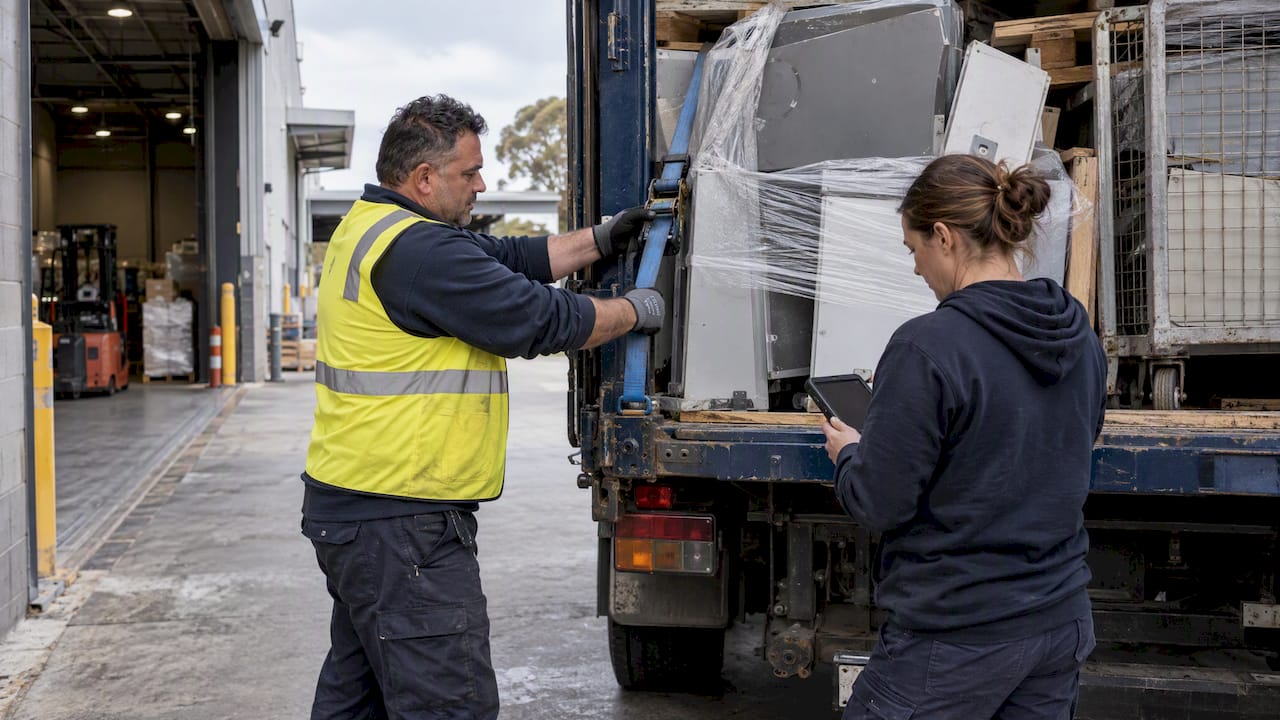
Victoria’s regulator makes a related point from its own system: Waste Tracker records must be accurate for every party that touches the waste. In our experience, the most common mistake is assuming the transporter will manage everything, then discovering that a wrong waste code or weight on a record is still the producer’s problem. Ask to see the record, and check the description against what was actually removed from your site.
How Queensland and Victoria differ
If your business operates beyond NSW, or if waste from a Sydney job is heading north or south, the neighbouring systems work differently.
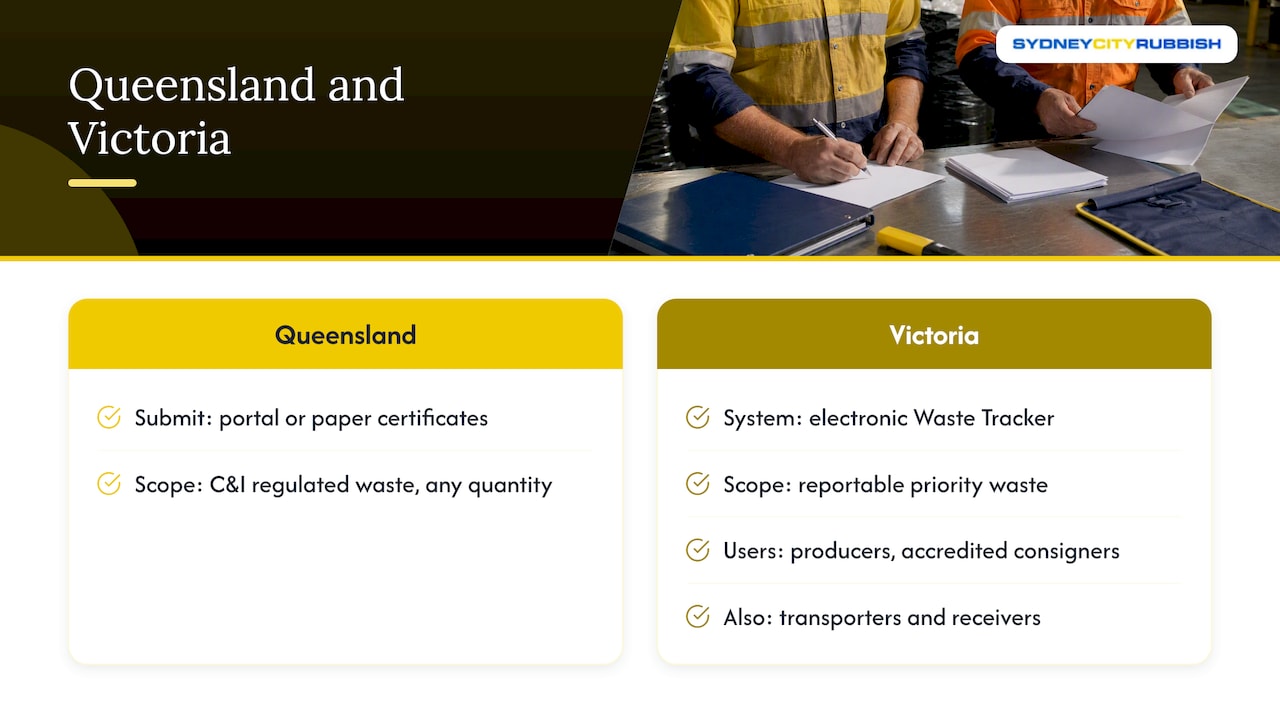
Queensland. Waste handlers can submit the prescribed information through the department’s Online Services platform or on paper waste transport certificates, as set out on Business Queensland’s page on submitting waste tracking information. The threshold for transporters is low: anyone transporting commercial and industrial regulated waste in any quantity has tracking obligations. A generator is the person from whom the trackable waste is transported, and you also become a generator if you store, treat or otherwise process trackable waste before it moves. Queensland’s generator obligations page covers record keeping, and Queensland businesses should read it for the retention period that applies to them. Do not assume the same period applies in NSW without checking the NSW regulation.
Victoria. Victoria tracks reportable priority waste in Waste Tracker, an electronic system that producers, accredited consigners, transporters and receivers use to record each transfer. Drivers update the record at pick-up and drop-off through the portal or the mobile app. The duty to notify of transactions comes from the Environment Protection Regulations 2021.
The point for a Sydney manager is not to learn three systems. It is to recognise that a compliant NSW process does not automatically cover a Queensland or Victorian movement, and to ask your contractor, before the job, which state’s rules apply at each end.
Waste tracking on common commercial jobs
Most commercial rubbish is not tracked waste. General office waste, timber offcuts, clean plasterboard and ordinary bulk furniture are normally outside the hazardous waste tracking scheme, though they remain subject to the NSW waste rules on lawful disposal. Tracking becomes relevant when a job contains something more.
Office makegood and de-fit. Removal of ceilings, partitions, carpet and joinery is routine. The question is what is hidden behind them. In older buildings, fibro or bonded asbestos materials, or old fluorescent fittings and electronic items, can change how a load must be handled. Our guide to hazardous waste disposal in NSW explains what businesses must do to dispose of hazardous material legally.
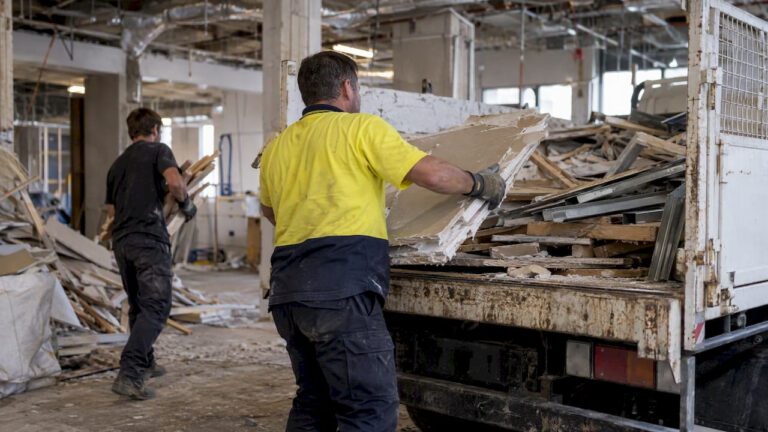
Construction and demolition. Mixed demolition waste often combines clean concrete and brick with contaminated or hazardous fractions. Separating the streams on site keeps the trackable portion small and the recyclable portion clean. Our article on managing mixed demolition waste on construction sites covers the compliance side, and the importance of waste separation in construction and demolition explains why it saves money as well as paperwork.
Warehouse end-of-lease. Left-behind stock, pallets, batteries, chemicals, tyres and oils are the usual surprises. A walk-through before the lease ends, with an inventory of anything unidentified, lets you classify materials before a truck is booked rather than after.
Strata and property managers. When a building generates waste from common areas, the consignor is not always obvious. Agree it with the owners corporation or landlord in writing, and keep the records where the next manager can find them.
What a defensible record file contains
Regulators audit tracking data to look for illegal dumping and improper disposal, so keep a file that tells the story of each trackable load on its own. For every job, we suggest keeping the waste classification and code, the consignment authorisation or reference, a copy of the electronic record after the load was delivered, the receiving facility’s confirmation, and any assessment report that justified the classification. Add the contract or work order showing who was the authorised agent.
How long to keep the file depends on the rule that applies. Queensland publishes its own retention requirements, and NSW’s regulation and EPA guidance should be your reference for NSW movements. Where you are unsure, keep records longer rather than shorter, and confirm the period with the EPA or your legal adviser. For questions about whether a specific waste is trackable, the NSW EPA’s contact details are on its tracking page.
Two cautions apply where people act on this. If you suspect asbestos, stop work and have it assessed by a licensed asbestos assessor before anything is removed, because disturbing it creates a health risk and a legal one. If you find unlabelled chemicals or drums, do not move or mix them. Get them identified by a qualified hazardous materials professional first.
For wider context on the obligations that sit alongside tracking, see our overview of commercial waste regulations in NSW and five compliance steps and the national picture in commercial waste regulations across Australia.
Questions to ask before you book a contractor
A reliable contractor will welcome these questions, and a vague answer tells you something. Ask who will act as the consignor on each waste stream and whether that is documented. Ask how unknown materials found mid-job will be handled and who authorises the extra cost. Ask which facilities receive each stream and whether they are registered and licensed to take it. Ask whether you will receive copies of the electronic records and the disposal confirmation. And ask what happens if the job produces something that needs tracking and the paperwork is not ready, because a truck waiting on a missing consignment authorisation is a cost that someone has to carry.
The answers matter most on tight timelines. An end-of-lease handover date or a building access window does not move when a waste code turns out to be wrong.
How we handle this at Sydney City Rubbish
Sydney City Rubbish removes waste for offices, retail sites, construction projects, strata-managed buildings and end-of-lease clean-outs across Sydney, including furniture, appliances, electronics, construction debris and hazardous materials. We coordinate directly with building management for access, and we dispose of material through registered recycling partners. Clients can also opt in to carbon-neutral waste disposal, in partnership with Carbon Neutral.
Where a job involves strip-out, makegood, demolition or flooring removal, tell us early what you know about the building and its fit-out. That lets us flag likely trackable streams while you can still plan around them, and confirm in writing how each stream will be classified and recorded. Our quoting is electronic and fast, and we guarantee punctuality, with compensation if we are late.
For general commercial clearances, see our commercial waste removal service. For building sites, our construction waste disposal service covers debris removal, and the full list of strip-out, makegood and demolition work is on our what we do page. Get a free quote now, and tell us what you think is on site so we can plan the job around the rules.
FAQ
Do I need to track all commercial waste in NSW?
No. Tracking applies to hazardous waste listed in Schedule 1 of the Waste Regulation, plus asbestos and waste tyres above set quantities. Waste generated in the Metropolitan Levy Area must also be tracked when it leaves NSW. Work out which category your waste falls into before it moves.
Is the waste producer still responsible if the transporter makes the record?
Yes. The EPA says the producer, any authorised agent, the transporter and the receiving facility manager all share responsibility for proper tracking. A contractor can create the records for you, but you should check the details against what was removed.
Is waste tracking the same in every state?
No. NSW uses the IWTS, Victoria uses Waste Tracker, and Queensland uses its Online Services platform or paper certificates. The lists of trackable waste and the thresholds also differ, so check the rules for the state where the waste starts and where it ends up.
What should I do if I find asbestos during a strip-out?
Stop the affected work and have the material assessed by a licensed asbestos assessor before anyone disturbs it. In NSW, loads of 100 kilograms or more, or 10 square metres or more of sheeting, must be tracked in the IWTS. Use a contractor authorised to transport it.
Sources
- Tracking and transporting hazardous waste, NSW EPA
- Waste that needs to be tracked, NSW EPA
- Industry responsibilities when waste tracking, NSW EPA
- Integrated waste tracking solution, NSW EPA
- Tracking asbestos waste using the IWTS, NSW EPA
- Tracking waste tyres using the IWTS, NSW EPA
- Tracking waste out of NSW, NSW EPA
- Submitting waste tracking information, Business Queensland
- Waste transporter tracking obligations, Business Queensland
- Waste generator tracking obligations, Business Queensland
- Waste Tracker, EPA Victoria