Gyprock Removal and Disposal in Sydney: A Commercial Guide
By the Sydney City Rubbish team, 30 October 2026
Gyprock is a brand name, but on Sydney sites it means plasterboard: gypsum sandwiched between paper. To dispose of it properly, keep it dry and separate from other waste, confirm the building is free of asbestos, and send it with a transporter who takes it to a facility that can lawfully accept it. In NSW the waste owner shares legal responsibility for that last step, so the paperwork matters as much as the truck.
This guide is for office managers, builders, strata and property managers who have walls, ceilings or bulkheads to strip and need to know where the sheeting goes afterwards.
TL;DR
- Plasterboard is recoverable, but it is lost to landfill mainly because it ends up in mixed loads. Keep it separate from the first day of the strip-out.
- Under NSW law, waste must go to a place that can lawfully accept it, and both the waste owner and the transporter must be able to prove it did.
- Before any wall comes down in an older building, identify whether asbestos is present. Never assume sheeting is clean without checking.
- Keep weighbridge dockets, invoices and your waste management plan on file. Regulators can ask to see them.
- We remove plasterboard from offices, retail fit-outs, construction sites and strata buildings across Sydney, and you can request a free quote online.
Table of Contents
- What counts as Gyprock waste on a commercial job
- Why plasterboard should not go to landfill
- Check for asbestos before you strip
- Your legal duty in NSW
- How to sort and prepare plasterboard before collection
- Where the plasterboard goes
- What affects the cost of plasterboard removal
- Records to keep after the job
- How we handle Gyprock and plasterboard removal
- A practical checklist in paragraph form
- FAQ
- Sources
What counts as Gyprock waste on a commercial job
On a commercial project, plasterboard waste is rarely one tidy pile. It arrives as full sheets from partition walls, jagged offcuts from new fit-outs, ceiling tiles and bulkhead linings, and dusty fragments left after demolition. Each form behaves differently when you load it, store it and send it away.
Full sheets from a careful strip-out are the easiest to recycle because they stay dry and clean. Offcuts from new work are usually clean too, provided they are not thrown in with timber, metal studs, insulation and general site rubbish. Painted, wet, mouldy or glued sheeting is a harder case, and so is anything stuck to tiles, adhesives or other finishes. Facilities set their own acceptance rules for these, so ask before you book.
The distinction matters because of how Sydney businesses currently dispose of waste. The NSW EPA’s 2023 Commercial and Industrial Waste Audit Report found that 82.5% of commercial and industrial waste by weight reaches disposal facilities in mixed loads. The same report classes plasterboard as recoverable now, with more than 41,000 tonnes a year still sent to landfill in the regulated areas. That is the gap a well-run job can close.
Why plasterboard should not go to landfill
Plasterboard is highly recyclable. A Commonwealth guide to construction and demolition waste notes that it is challenging to recover from mixed loads, and that most recovery comes from construction sites, often through manufacturer or supplier arrangements for clean product. In practice, that means the quality of your site separation decides whether the sheeting becomes a feedstock or a landfill cost.
There is also an operational reason. Gypsum in a landfill can release hydrogen sulfide gas as it breaks down, which is one reason recovery is promoted over burial, as set out in this plasterboard recycling guide from the recycling sector. Even without that, a tonne of plasterboard sent to landfill is a tonne that carries disposal charges, while a clean, separated load has a recycling pathway.
The practical takeaway for a commercial client: separation is not a green gesture, it is how you keep disposal predictable.
Check for asbestos before you strip
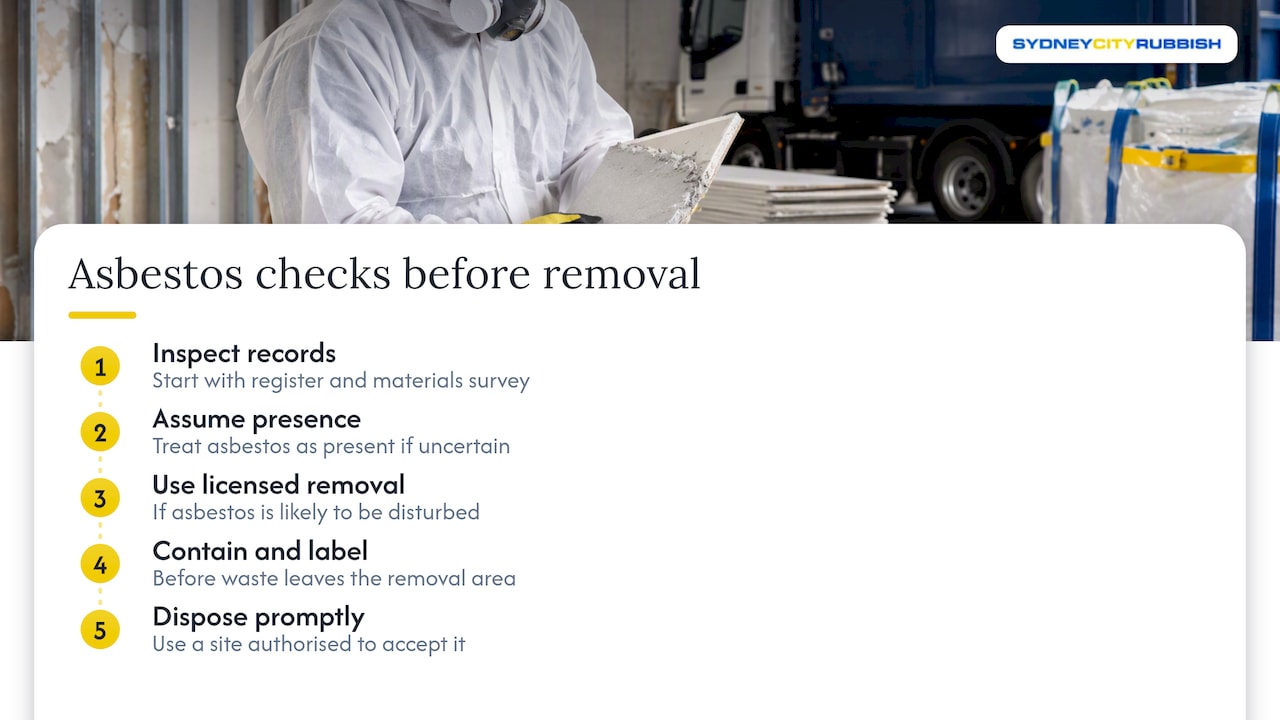
This step comes before removal, not after. In buildings of a certain age, wall and ceiling linings, textured coatings, adhesives and sheeting behind fixtures can contain asbestos. Sheeting that looks like ordinary plasterboard is not proof that it is.
WorkSafe Queensland’s Demolition work Code of Practice 2021 states that the person conducting the business or undertaking must identify whether asbestos is present before demolition begins, and must assume it is present if there is uncertainty. If it is likely to be disturbed, a licensed professional must remove it. That code applies in Queensland, and NSW has its own work health and safety regulations and SafeWork NSW guidance. The principle is the same across Australian jurisdictions, and your site’s asbestos register and hazardous materials survey are where you should start.
If asbestos is found, it cannot travel with ordinary plasterboard. WorkSafe Queensland’s guidance on asbestos and demolition says asbestos waste must be contained and labelled before it leaves the removal area, then disposed of as soon as reasonably practicable at a site authorised to accept it. The same page explains that where asbestos cannot reasonably practicably be removed before demolition, methods such as wet spraying must be used to minimise airborne fibres and water run-off must be controlled.
If you are unsure whether a ceiling or wall lining is safe to disturb, stop work and have it tested by a qualified assessor before anyone cuts or breaks it.
Your legal duty in NSW
NSW places the burden of proof on the people who generate and move the waste. Under section 143 of the Protection of the Environment Operations Act 1997, as explained by the EPA’s construction and demolition waste page, waste must be transported to a place that can lawfully accept it. The waste owner and the transporter are both legally responsible for proving that it was.
The penalties are not minor. The EPA’s transporting waste guidance lists maximum penalties of $1,000,000 for a corporation and $250,000 for an individual for taking waste to a place that cannot lawfully accept it.
For a property manager or head contractor, the sensible response is simple. Choose a removalist who can name the receiving facility, and ask for evidence after the job. The EPA’s guidance also recommends preparing a waste management plan and keeping accurate records of transport and facility use. A plan for demolition and construction waste is often required with a development application too: councils ask applicants to document how materials such as plasterboard will be reused, recycled or disposed of, and to retain weighbridge dockets and invoices for inspection, as one NSW waste management plan template sets out.
How to sort and prepare plasterboard before collection
Good preparation costs very little and changes what a facility will accept. Start by deciding, before demolition begins, where plasterboard will be stored. A dedicated bay or bin near the loading point keeps the sheeting out of the general skip. Keep it covered and off the ground, because wet plasterboard is heavier, harder to handle and less likely to be accepted for recycling.
Remove screws, metal framing, insulation batts and timber battens as you go. Do not mix plasterboard with tiles, concrete, carpet or office furniture. Offcuts should go into the same bay as full sheets rather than the general rubbish bin.
Facilities enforce this. The Blue Mountains’ Katoomba Resource Recovery and Waste Management Facility is one example: it accepts plasterboard and Gyprock only when it is uncontaminated and source-separated, requires recyclable construction and demolition loads to be sorted by material type, and says unsorted loads may not be accepted. It also takes only waste generated in its own area, and does not accept commercial or industrial chemicals. Sydney facilities each have their own rules, but the same logic applies. For an explanation of why this discipline pays off across a whole project, see our piece on the importance of waste separation in construction and demolition.
Preparing a strip-out in an occupied building
Office and strata jobs add access constraints. Lifts, loading docks and after-hours windows all affect how plasterboard leaves the building. We coordinate directly with building management so access, lift protection and timing are agreed before the crew arrives, and a separate plasterboard container or dedicated truck run can be planned into the schedule rather than improvised on the day.
Where the plasterboard goes
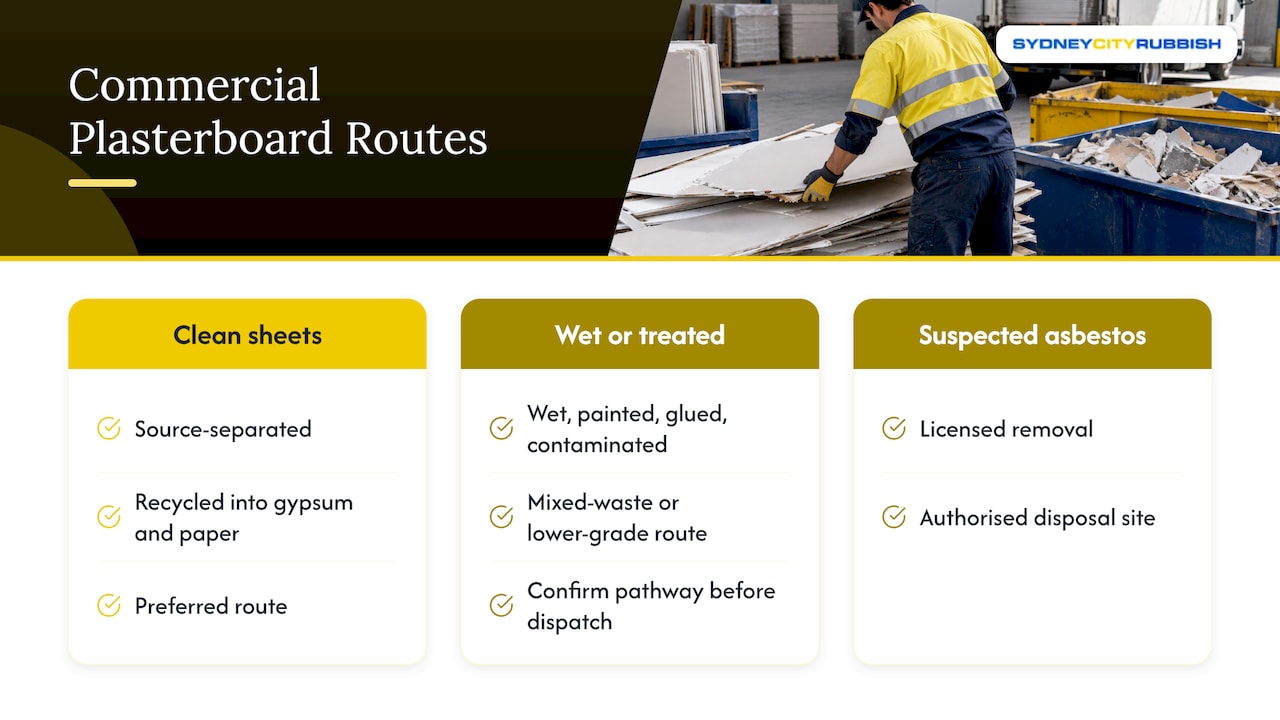
There are three broad routes for commercial plasterboard in Sydney.
The first is recycling. Clean, source-separated plasterboard can go to a facility that processes it into gypsum and paper products. This is the preferred route and the one the EPA’s audit identifies as an opportunity.
The second is a mixed-waste or lower-grade route for sheeting that is wet, painted, glued or contaminated. Some facilities accept it at a different rate or under different conditions, so confirm the pathway before the load leaves site.
The third is the special-handling route for anything with suspected asbestos, which is not a plasterboard decision at all and must go through licensed removal and an authorised disposal site.
Do not assume that a local council depot is an option. The City of Wollongong’s problem waste page, for instance, says its Whytes Gully depot does not accept building waste, including Gyprock and plaster sheeting, and notes that some private businesses in the area do. Council facilities are generally set up for residents, which is why commercial loads usually go through a contracted removalist with access to the right receiving sites.
What affects the cost of plasterboard removal
Plasterboard jobs are quoted per truckload or per project, and several factors move the figure. We do not publish a flat rate because every job differs.
Volume and weight come first. Wet sheeting weighs considerably more than dry, and disposal is typically charged by weight at the receiving facility. Access is next: a ground-floor retail unit with a roller door is a different job from a fifteenth-floor office with a single goods lift. Separation also matters, because a clean, source-separated load has a recycling route, while a mixed load may need to be sorted or sent elsewhere. Finally, scope: if plasterboard is part of a wider makegood or strip-out, bundling the removal into one program usually runs more smoothly than booking separate crews.
Our rubbish removal prices page explains how we approach quoting, and electronic quotes are quick once we know the job.
Records to keep after the job
After the truck leaves, the job is not finished. Under the EPA’s guidance, the waste owner needs to be able to prove lawful transport. In practice, a head contractor, property manager or tenant should file the following with the project documents: the waste management plan, the removalist’s invoice, weighbridge dockets from the receiving facility, and any asbestos clearance or register entries where relevant.
The same documents help at lease end. A landlord’s agent inspecting a makegood will want to see that the fit-out was stripped and the waste handled responsibly, and a tidy file saves an argument later. For a wider look at how commercial demolition waste is documented and moved in this state, our guide to demolition waste handling in NSW covers the process from site setup to final records.
How we handle Gyprock and plasterboard removal
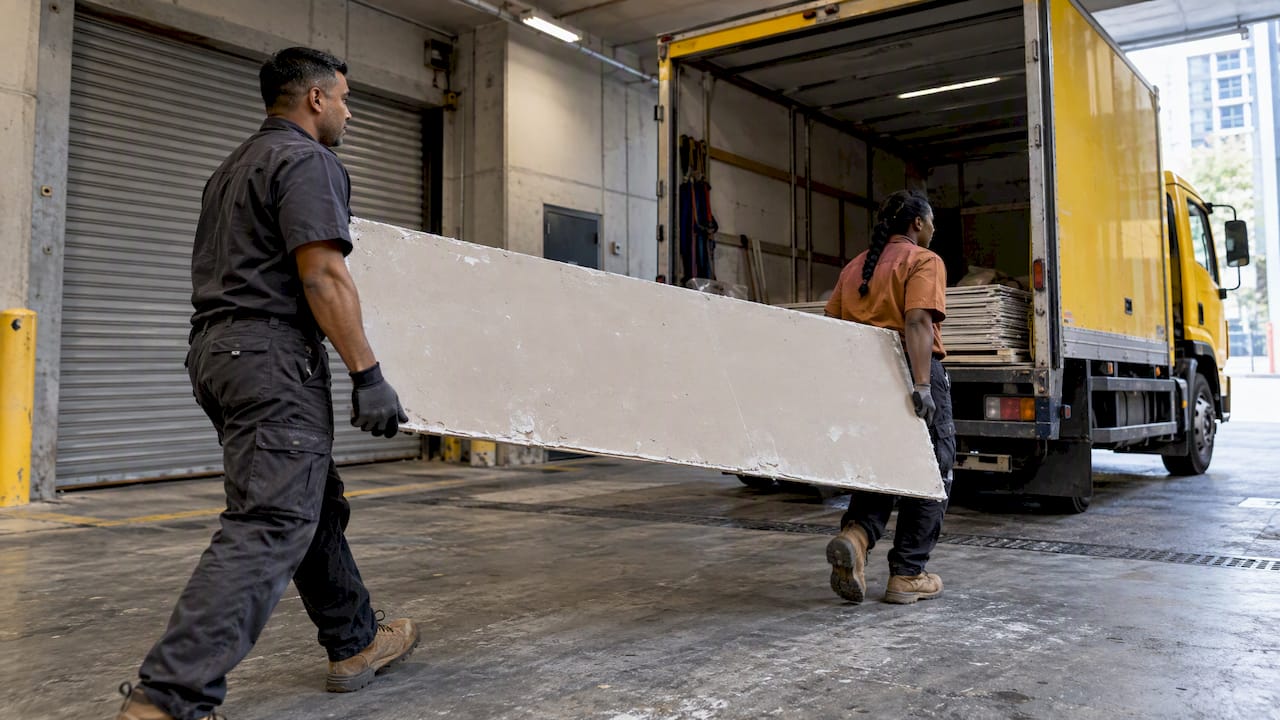
Sydney City Rubbish removes plasterboard as part of commercial waste removal, building strip-outs, makegood and de-fit work, and construction clean-ups across the Sydney CBD, Parramatta, Ryde, Macquarie Park, Sydney Olympic Park and Greater Western Sydney. Our approach is to take the sheeting away with the rest of the strip-out debris, with the loads separated so the material has a lawful pathway, and to leave the space meticulously clean.
We use registered recycling partners for responsible disposal. We guarantee punctuality, with compensation if we are late. Clients can also opt in to carbon-neutral removal in partnership with Carbon Neutral. If your project involves partition walls, ceilings, bulkheads or doors, the Construction Waste Disposal Sydney service is the page to start from, and you can see the full range, including strip-outs and makegood, on our what we do page. For more on the material itself, read our note on disposing of plaster products.
Ready to book? Get a free quote now.
A practical checklist in paragraph form
Before the job, confirm the building’s age and asbestos status, and obtain the register or a test result if there is any doubt. Agree access times with building management and decide where the plasterboard bay will sit. During the job, strip sheets carefully, keep them dry, separate offcuts from other debris and remove fixings where you can. On collection day, make sure the removalist names the receiving facility and that the load is sorted as agreed. Afterwards, file the invoice and dockets with your waste management plan.
That sequence takes little extra time. It is also what turns a pile of dusty sheeting into a documented, defensible disposal.
FAQ
Is Gyprock the same as plasterboard?
Yes, for practical purposes. Gyprock is a well-known brand of plasterboard, and in Australia the name is used for gypsum wall and ceiling sheeting generally. Disposal rules apply to the material, not the brand, so treat any plasterboard the same way.
Can Gyprock go in a general skip?
It can physically, but it is better not to. Plasterboard mixed into general waste is a major reason it is lost to landfill, and mixed loads are harder to route to recycling. Keeping it separate preserves a lawful recycling pathway and avoids facility rejection.
Can I take commercial plasterboard to the council tip?
Usually not. Council facilities often restrict commercial loads, and some do not accept building waste at all, as the City of Wollongong states for its Whytes Gully depot. Ask the facility first, or use a removalist with access to approved receiving sites.
What if the plasterboard might contain asbestos?
Stop and have it assessed by a qualified person before disturbing it. Asbestos waste must be contained, labelled and taken to an authorised site, and licensed professionals must remove it where it is likely to be disturbed. It must never be mixed with ordinary plasterboard.
Do I need to keep records of where it went?
Yes. In NSW the waste owner and transporter are both responsible for proving lawful transport, so keep invoices, weighbridge dockets and your waste management plan where they can be produced on request.
Sources
- 2023 C&I Waste Audit Report, NSW EPA
- Construction and Demolition Waste Guide, DCCEEW
- Demolition work Code of Practice 2021, WorkSafe Queensland
- Asbestos and demolition, WorkSafe Queensland
- Construction and demolition waste, NSW EPA
- Transporting waste, NSW EPA
- Waste Management Plan, Demolition and Construction
- Katoomba Resource Recovery and Waste Management Facility
- Problem Waste, City of Wollongong