Epoxy Floor Removal in Sydney: Methods, Safety and Waste
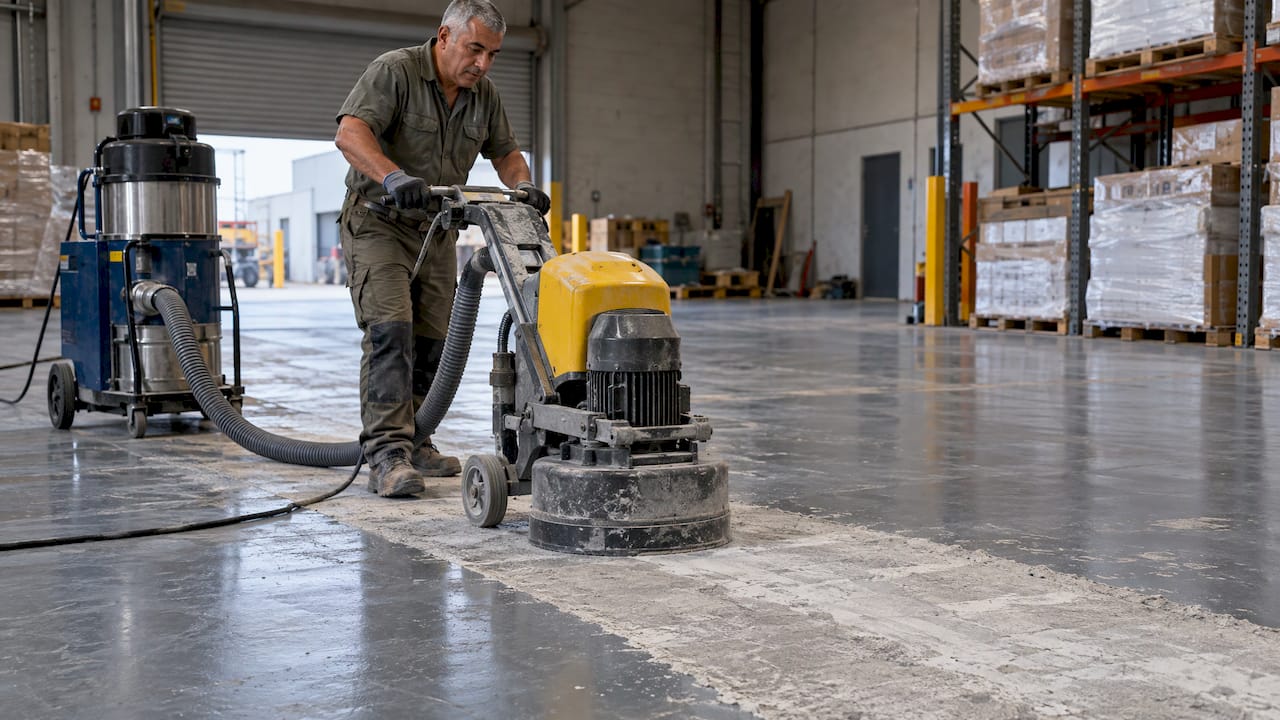
For most commercial floors, epoxy removal means diamond grinding with dust extraction, followed by cleanup of the slab and lawful disposal of the waste. Chemical stripping, scarifying and shot blasting have their place, but they suit particular coatings, areas and access conditions. This guide is for property managers, strata managers, tenants and builders who need an epoxy coating gone before a makegood handover, a new floor system or a tenancy change. It covers how each method works, what the dust risk means for your site, how the waste must be handled, and when self-levelling is part of the answer.
Updated November 2026 by the Sydney City Rubbish team.
TL;DR
- Diamond grinding is the standard method for bonded epoxy on concrete, because it removes the coating and prepares the slab in one pass.
- Chemical strippers suit small areas, edges and tight corners. They are slower on cured two-pack epoxy, and leftover residue can affect the next floor.
- Grinding epoxy and concrete creates respirable crystalline silica dust, so extraction, respirators and containment are part of the job, not extras.
- Self-levelling compound fills dips but does not remove epoxy. Whether it can go over an existing coating depends on the product manufacturer.
- Removal waste needs a lawful destination and a paper trail. A contractor who handles removal and disposal together keeps that trail in one place.
Table of Contents
- What epoxy floor removal involves on a commercial slab
- Method 1: Diamond grinding
- Method 2: Scarifying and shot blasting
- Method 3: Chemical stripping
- Heat and other methods
- Choosing the method: a practical comparison
- Dust, silica and site safety
- Waste from epoxy removal and how to handle it in NSW
- Self-levelling versus grinding
- What does epoxy floor removal cost in Sydney?
- When an epoxy floor needs to come out
- Related work: filling, coring and cutting
- Epoxy floor removal with Sydney City Rubbish
- FAQ
- Sources
What epoxy floor removal involves on a commercial slab
Epoxy bonds to concrete far more tightly than paint. It is a cured resin that locks into the pores of the slab, which is why it lasts in warehouses, workshops, car parks and kitchens. It is also why a scraper and a weekend rarely work. A floor-prep manufacturer notes that epoxy, polyurethane and tile mastics bond tenaciously to concrete and need aggressive removal, with the material lifting in chunks rather than fine dust when a scarifier is used.
The work usually arises in one of four situations:
- End of lease. A lease or make good clause requires the premises to be returned bare or to base-building condition.
- Failed coating. The epoxy is peeling, bubbling or delaminating and a patch repair will not hold.
- Change of use. A new tenant needs a different floor finish, such as polished concrete, vinyl, carpet tile or a new resin system.
- Refurbishment. A strip-out, de-fit or renovation exposes a coated slab that has to be cleared before the next trade starts.
In each case the slab, not the coating, is what you are really delivering to the next trade. The standard is a clean, sound surface that adhesives, levelling compounds and new coatings can bond to. That standard shapes every decision below.
Method 1: Diamond grinding
Grinding is the first choice for bonded epoxy on concrete. A planetary floor grinder fitted with diamond tooling cuts through the coating and opens the surface of the slab beneath. The same machine can then take the slab to the profile the next system needs. This is why it is the default for end-of-lease warehouse floors, where the client wants the coating gone and the concrete left in a presentable, uniform state.
A well-run grinding job follows a sequence:
- Remove floor coverings, fixtures and raised items such as non-slip strips and line markings, so the surface is clear and level.
- Test a small, less visible patch to confirm tooling and speed before committing to long runs.
- Work in controlled, overlapping parallel passes across the floor. Going too fast leaves coating behind, and going too slow risks cutting deeper than needed.
- Finish edges and corners with hand grinders, because the large machine cannot reach them.
- Collect all flakes and dust, then inspect the slab before anything else is laid.
Tooling choice matters. For most coatings a medium-coarse diamond grit does the work. For thicker build-ups, a coarser grit or a scraper-style disc that tears the coating off instead of grinding it can be more effective. This is why a contractor will usually ask for the original specification, the approximate thickness and any photographs of the floor before quoting.
Swirl marks, low spots and exposed aggregate are the usual signs of an over-aggressive pass. Leaving epoxy residue is the opposite error, and it creates weak points under the next floor. A measured approach avoids both, which is the main argument for using an operator who grinds commercial slabs every week.
We provide this as part of our concrete work. If your warehouse needs the floor returned bare, our page on concrete grinding at the end of a warehouse lease explains how it fits into a lease exit.
Method 2: Scarifying and shot blasting
Where the coating is thick, multi-layered or combined with old mastic, a scarifier can be faster than a grinder. Its spinning cutters attack the coating at depth and break the bond. Manufacturer guidance for heavy epoxy or mastic is to use several passes at controlled depths rather than one deep pass, because one aggressive pass risks damaging the substrate. A scarified surface is rougher than a ground one, so it often needs a follow-up grind before a thin-film finish.
Shot blasting fires steel shot at the floor and recovers it with the debris in a closed loop. It suits large, open, uninterrupted areas, and the enclosed system captures dust at the source. It is less suited to tight tenancies, mezzanine undersides, or floors broken up by plant and racking.
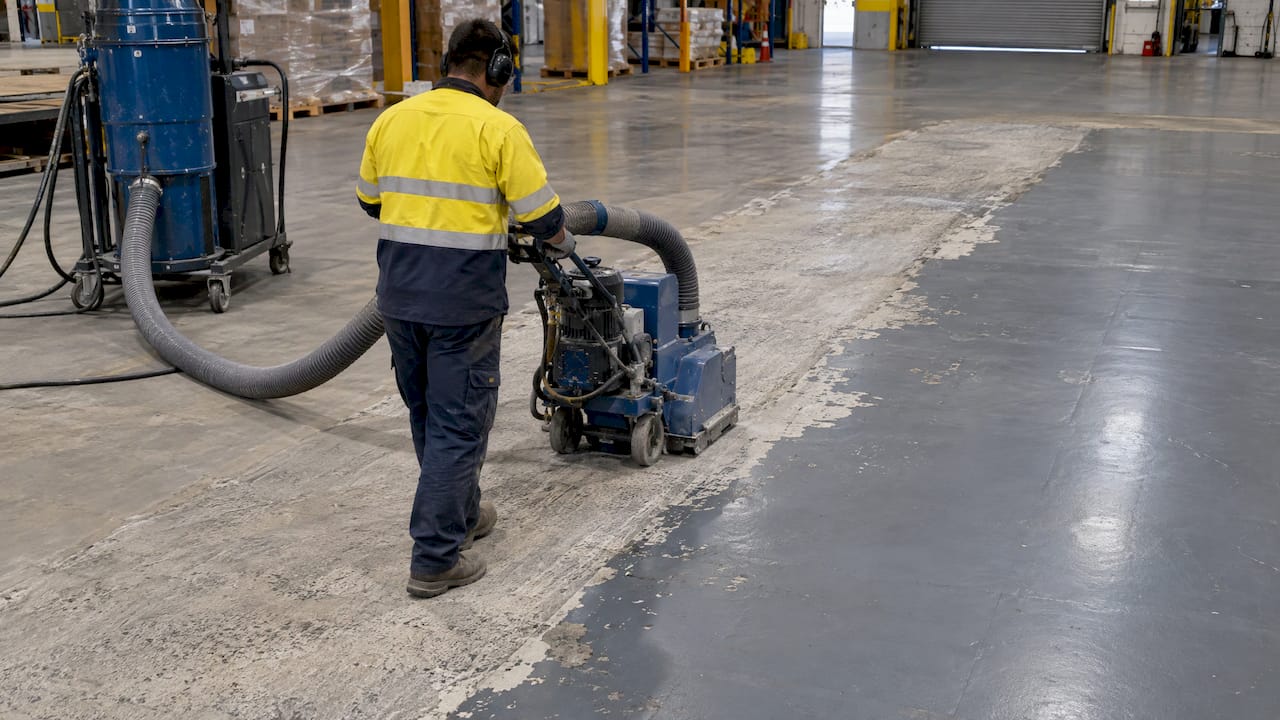
In practice, large Sydney warehouse floors are often handled with a combination: scarifying or blasting for bulk, grinding for finishing and edges. Method choice is a site decision, and it comes down to coating thickness, floor area, access, noise limits and what goes on the slab next.
Method 3: Chemical stripping
Chemical removal uses epoxy strippers or solvents to soften the coating so it can be scraped away. It has genuine uses on small areas, detailed edges, and spots where a grinder cannot reach. It is rarely the primary method on a fully cured commercial two-pack epoxy, where it tends to be slow and messy.
There are two things to manage if chemicals are used. First, solvents such as isopropyl alcohol, denatured alcohol and acetone are flammable and give off fumes, so ventilation and ignition control matter in an enclosed tenancy. Second, any residue left in the pores of the slab can interfere with the adhesion of tiles, vinyl, levelling compounds and new coatings. A rinse and neutralise step, followed by a check of the surface, is part of finishing the job properly.
The slurry from chemical removal is waste. It does not go to a drain or stormwater pit, and it is handled as described in the waste section below.
Heat and other methods
Heat guns and infrared heaters can soften epoxy so it can be scraped, and they are sometimes used on small patches. They are slow over any real area and are not practical on a commercial floor. Hand tools such as long-handled scrapers have a place on thin coatings and small repairs but not on bonded industrial epoxy.
The principle across every method is the same: take off the bonded layer without harming what lies beneath it. The same thinking applies to other hard coatings, and a guide on removing ceramic coating safely shows how the approach of matching the method to the coating protects the surface underneath.
Choosing the method: a practical comparison
| Situation | Usual method | Why |
|---|---|---|
| Bonded epoxy on a warehouse or workshop slab | Diamond grinding with extraction | Removes coating and prepares the slab in one operation |
| Thick, multi-layer coating or mastic | Scarifying, then grinding | Faster bulk removal, then a finer finish |
| Large, open, uninterrupted floor | Shot blasting or grinding | Enclosed dust capture over big areas |
| Edges, corners, small patches | Hand grinders, sometimes chemical | The large machine cannot reach them |
| Thin paint-like coating on a small area | Chemical stripping or hand grinding | Lower disturbance on light coatings |
If you are unsure which row describes your floor, send photographs, the floor area and the lease or project requirement. That is enough for a contractor to propose a method and quote it.
Dust, silica and site safety
This is the part of epoxy floor removal that a property manager needs to take seriously. Grinding reduces epoxy, adhesives and concrete to fine dust. Concrete contains crystalline silica, and the fine fraction of that dust is hazardous when inhaled. Safe Work Australia sets the eight-hour workplace exposure standard for respirable crystalline silica at 0.05 mg/m³, and describes mechanical processes such as cutting, drilling and grinding as sources of that dust.
In practical terms, a compliant job on an occupied or shared building includes:
- Grinders connected to high-quality dust extraction, with edge and corner tools also extracted.
- Respiratory protection suited to fine dust, together with eye, skin and hearing protection.
- Sealing of doors, cabinets, windows, vents and ceiling penetrations so dust does not travel into neighbouring tenancies.
- Ventilation or air movement plans for enclosed floors, particularly where solvents are also in use.
- Clear communication with building management about hours, lift use, loading dock access and fire system isolation.
A household grinder without proper extraction can turn a floor removal into a major cleanup and a health risk. For a commercial site, the practical point is that dust control is what protects your workers, your neighbours and your building. If you are a PCBU, such as a head contractor or a tenant engaging trades, ask any contractor how they control silica on the job and who is responsible for air monitoring on larger works. Your state work health and safety regulator, SafeWork NSW, and a qualified occupational hygienist are the right contacts for exposure monitoring questions specific to your site.
Older coatings and adhesives deserve a check before disturbance. If a building predates the 1990s, flooring adhesives, bitumen and underlays below the epoxy may need testing for asbestos before grinding starts. A licensed assessor can sample and confirm, and that result decides whether the job proceeds as a standard removal.
Waste from epoxy removal and how to handle it in NSW
A ground floor generates a surprising volume of material: coating flakes, concrete dust, slurry if wet methods are used, spent tooling, PPE, and any chemical residue. A quick sweep is not enough. The slab should be visibly clean and free of loose material, particularly if a new system has to bond to it.
Two principles govern disposal. First, the waste goes only to facilities lawfully permitted to accept it for its classification. Second, you keep the records. Large property developers publish this in their own construction and demolition waste plans, which typically require retained details of what was removed, the date, the waste type and classification, the volume, the transporter and the receiving facility.
The NSW EPA keeps a list of waste that must be tracked when it is moved within the state, and its descriptions include wastes from the use of resins, adhesives, paints and lacquers. Whether a given load needs tracking depends on how it is classified, so confirm classification before it leaves site, particularly when solvents or chemical strippers have been used. Do not wash coating slurry into drains, garden beds or stormwater.
This is where combining removal and disposal pays off. Our team handles the cleanup, loads out and delivers waste to registered recycling and disposal partners, so the paperwork follows the material. For wider project context, see our guides on waste management for commercial renovations and new builds and renovation waste removal.
Self-levelling versus grinding
This comparison comes up often, and the two are not alternatives. They do different jobs.
Grinding removes. It takes off epoxy, paint, adhesive and old levelling compounds, and at the same time it can even out the slab surface and create the profile for what follows. Self-levelling adds. It is a cementitious compound poured to fill low spots and bring a floor to a flat plane before a covering is laid.
So self-levelling does not remove an existing epoxy coating. The real question is whether the epoxy needs to come off before levelling, and the answer sits with the manufacturer of the product you plan to use. Some systems permit specified preparation over a compatible, firmly bonded epoxy. Others require complete removal. Obtain the technical data sheet and written confirmation from the supplier before deciding, because a bond failure under a new floor is expensive.
There is a practical sequence that works well in commercial fit-outs:
- Grind off the epoxy and any residual adhesive.
- Repair cracks, joints and damaged areas.
- Measure the slab for dips and falls against the flatness the new finish requires.
- Level only where the measured variation justifies it.
Step 4 matters because levelling adds cost and time, and a ground slab is often flat enough for the next covering. Where levelling is needed, a smooth cured levelling surface also typically needs preparation or a primer before a coating is applied over it, so follow the product system from start to finish.
What does epoxy floor removal cost in Sydney?
We quote commercial removal per project or per truckload, because price depends on area, coating thickness, floor condition, access, dust containment requirements, working hours and waste volume. A single figure per square metre would mislead more than it helps, and we do not publish one.
There are a few cost drivers you can control. Send accurate floor area and photographs. Tell us whether the building is occupied and whether work must happen after hours. Confirm whether the lease requires a bare slab or a prepared slab. Combine removal with other makegood tasks such as ceilings, partitions and joinery, so one team and one mobilisation covers the whole scope.
For context on equipment alone, a hire company lists hand-held and walk-behind concrete grinders from $231 to $572 per day, and scarifiers at $418 to $451 per day. These are dry hire rates for the machine. They exclude the operator, dust extraction, tooling, PPE, labour, loading out and disposal, which together make up much of a professional job’s cost.
When an epoxy floor needs to come out
Epoxy floors are durable, but they do age. Commercial and industrial floors take more punishment than residential ones, and wear shows in familiar ways: peeling or delamination, bubbles or blisters, deep cracks with exposed concrete, severe yellowing or chalking, wear-through in traffic lanes, permanent chemical staining, and repairs that keep failing. Moisture in the slab is a frequent root cause, as is inadequate preparation at the original install.
Patching suits isolated damage. When the failure spreads across a large share of the floor, or the concrete below is damaged, replacing the system is generally the more sustainable decision, and that begins with removal. A floor that is releasing from the slab will not hold a new coating on top, so the old layer has to be taken back to sound concrete.
For tenants, the trigger is usually the lease. Your make good obligations define what condition the floor must be in at handover, and our guides on defit versus make good and office makegood explain how those obligations work in Sydney.
Related work: filling, coring and cutting
Epoxy appears on floors in more ways than a coating. Warehouses use epoxy to anchor and fill after cores are drilled, for example when racking or services are removed. If you are dealing with core holes, slab penetrations or anchor points as well as a coated surface, our page on core drilling and epoxy filling for warehouses covers that scope. We also cut and grind concrete and remove other floor finishes, which helps when the epoxy sits on top of tiles, screed or old adhesive.
For larger warehouse exits that involve racking, mezzanines and bulk waste as well as the floor, see our guide to managing warehouse waste in Sydney.
Epoxy floor removal with Sydney City Rubbish
We work with property managers, strata managers, corporate offices, construction companies and retailers across Sydney, including the CBD, North Sydney, Parramatta, Ryde, Macquarie Park, Sydney Olympic Park and Greater Western Sydney. Our services cover floor finish removal and grinding, concrete grinding, cutting and core drilling, strip-outs, makegood and de-fit, and rubbish removal, so the floor, the demolition debris and the disposal can be handled by one team. We coordinate directly with building management for access, offer fast electronic quoting, and guarantee punctuality with compensation if we are late. Carbon-neutral waste disposal is available as an opt-in for corporate clients.
See everything on our services page, or for waste and debris, our construction waste disposal service. Get a free quote now through Sydney City Rubbish with your floor area, photographs and handover requirements.
FAQ
Can you grind epoxy off a floor without damaging the concrete?
Yes, when the operator uses a measured approach and the right tooling. Too aggressive a pass can leave swirl marks, low spots or exposed aggregate, while too light a pass leaves residue. A test patch before full runs confirms the settings. A common tip for hand grinding is to tape around the spot so you notice immediately if the grinder tilts into the surrounding surface.
How long does an epoxy floor last before it needs removing?
It depends on traffic, chemical exposure, moisture in the slab and how well the surface was prepared before coating. Commercial and industrial floors generally wear out sooner than residential ones. Peeling, blistering, deep cracking and repairs that keep failing are the signs that removal and recoating make more sense than patching.
Is chemical stripping better than grinding?
For most bonded commercial epoxy, grinding is the more predictable method, because it removes the coating and prepares the slab together. Chemical stripping is useful on small areas, edges and places a grinder cannot reach. Any residue must be fully cleaned off so later adhesives and coatings can bond.
Does self-levelling cover up epoxy?
Self-levelling compound fills low spots but does not remove the coating beneath. Some manufacturers permit specified preparation over compatible, firmly bonded epoxy, and others require full removal. Check the technical data sheet for your product before you decide.
Sources
- Safe Work Australia: workplace exposure standard for respirable crystalline silica
- NSW EPA: waste that needs to be tracked
- Tyrolit Australia: floor scarifier considerations
- Mega Hire: surface preparation equipment
- Loctite: how to remove epoxy from concrete
- Diamondbrite: removing ceramic coating safely