Carbon Neutral Waste Disposal for Sydney Businesses
By the Sydney City Rubbish team, November 2026
Carbon neutral waste disposal means the emissions created by collecting, transporting, processing and disposing of your waste have been measured, reduced where possible, and the remainder balanced with verified offsets. For a Sydney business, the practical route is to cut and separate waste first, choose a provider that can show how its figures were calculated, and keep records of what left your site and where it went.
This guide explains the term in plain language, how the waste hierarchy fits in, what to ask a provider, and what to prepare for an office clear-out, retail fit-out or construction job.
TL;DR
- Carbon neutral disposal is not zero emissions. It combines measured emissions, reductions and offsets, and a trustworthy claim keeps those three apart.
- Avoiding, reusing and recycling waste before it is collected reduces emissions more reliably than offsetting after the fact.
- Ask any provider for its emissions baseline, its method, what is included and excluded, and how its offsets are verified.
- In NSW, the waste owner and the transporter can both be liable if waste goes to an unlawful facility, so keep records.
- At Sydney City Rubbish, carbon neutral removal is an opt-in for corporate clients, working with Carbon Neutral.
Table of Contents
- What carbon neutral waste disposal actually means
- Start with the waste hierarchy
- What can be reused, recycled or needs specialised disposal
- How emissions are measured, and how residual emissions are addressed
- How to verify a carbon neutral waste provider
- Rules that apply to commercial waste in NSW
- A practical plan for an office, retail or site clear-out
- Carbon neutral removal with Sydney City Rubbish
- FAQ
- Sources
What carbon neutral waste disposal actually means
Every waste job produces emissions. Trucks burn fuel, sorting and processing use energy, and anything that ends up in landfill can release methane as organic material breaks down without oxygen. The IPCC waste guidance explains that methane is emitted during the anaerobic decomposition of organic waste in solid-waste disposal sites, which is why food, paper and timber that reach landfill carry a bigger climate cost than inert material such as concrete.
A service described as carbon neutral has tried to account for that footprint. The business works out its emissions, reduces what it can, then purchases offsets to cover what remains. The word neutral describes the balance. It does not mean the trucks run on nothing or that no waste reaches a disposal site.
The ACCC’s guide to environmental claims, published in December 2023, sets out how Australian businesses should make such statements. A carbon neutral claim should rest on a thorough emissions baseline, built with established Australian or internationally recognised methodologies, with the included and excluded emissions clearly stated. The same guide says businesses should distinguish emissions reductions from purchased offsets, and explain how emissions, including electricity-related emissions, were accounted for.
That gives you a useful test. A credible provider can tell you what it counted, how it counted it, and how much of the result comes from real reductions rather than offsets.
Carbon neutral versus low-carbon waste management
The two terms are often mixed up. Low-carbon waste management reduces emissions at the source: less waste produced, more material recovered, organics kept out of landfill, shorter and fuller truck runs. Carbon neutral is an accounting outcome that includes offsetting the emissions that remain.
The ACT’s waste strategy shows how the two connect. The ACT Waste Management Strategy identifies organic waste sent to landfill as the main source of waste-sector emissions because of methane, and lists methane capture, organic diversion, energy recovery, recycling and efficient collection and transport among the measures that move the sector toward carbon neutrality. Offsets sit alongside those measures. They do not replace them.
An Australian academic study by Rossetto, published in Carbon Neutrality in 2023, found that a large share of waste-sector carbon credits came from landfill-to-electricity projects. It argued for greater emphasis on circular solutions that reduce, recover and use waste before disposal. For a business, the lesson is practical: the cleanest tonne is the one you never send for disposal.
Start with the waste hierarchy
Before a truck arrives, the biggest gains come from what happens on your premises. The waste hierarchy is the standard order of preference: avoid waste, then reuse and recycle, and only then dispose. Sustainability Victoria’s guide for commercial and industrial facilities, published in April 2023, recommends maximising source separation and recovery, and preparing construction-site plans that divert waste to recovery and increase recycled content. It is a Victorian document, but the principle applies equally to a Sydney site.
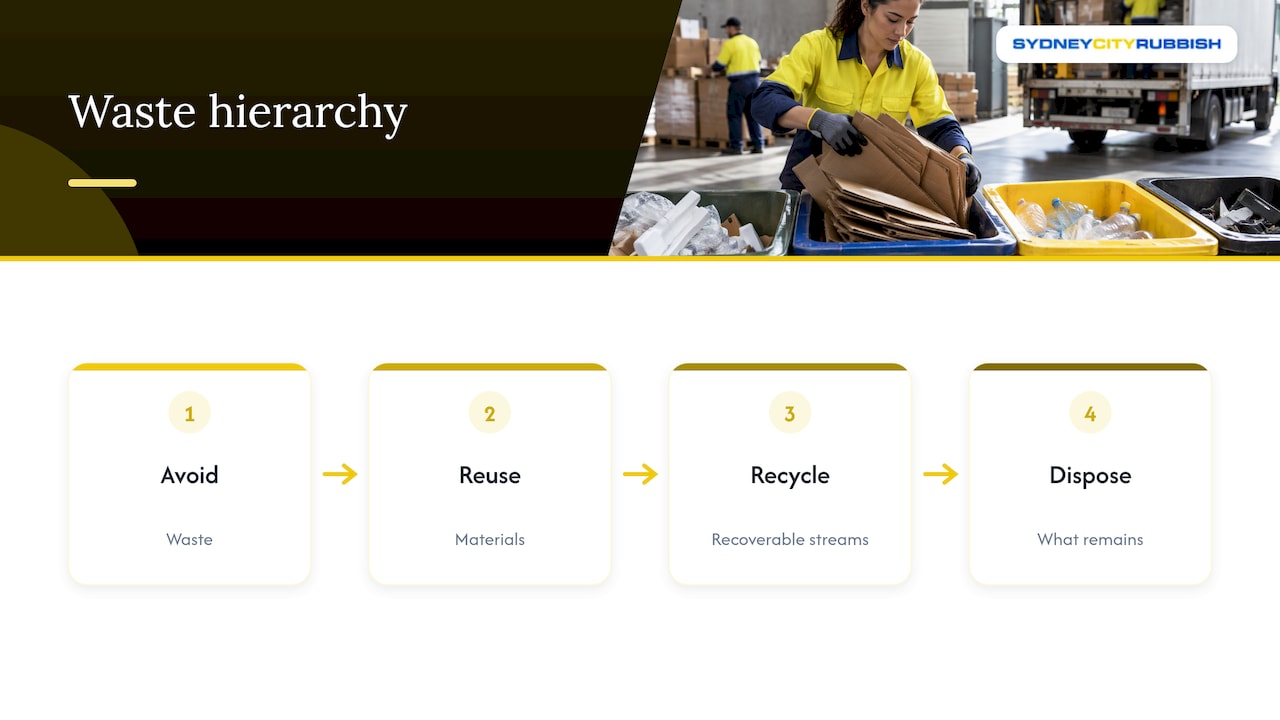
The NSW EPA’s better practice guidelines for commercial and industrial buildings say a good waste system should improve waste minimisation, source separation, recycling convenience, recovery yield and contamination control. They also make a point property managers will recognise: good outcomes depend on design, convenient infrastructure, tenant behaviour, monitoring and corrective action, not merely on arranging a collection.
Offices
The CitySwitch waste guide for offices offers a clear set of steps. It recommends removing personal bins, installing simple central bin stations with current signage, setting realistic targets, appointing waste champions and regularly using a waste assessment tool. It also suggests consulting building managers and contractors, using clear bags to spot contamination and hazardous items, and writing waste KPIs into cleaner and contractor contracts.
One point worth acting on: the guide recommends assessing how remote work and one-off events change your waste mix. An office that has downsized its desk count, or is clearing a floor after a restructure, produces very different waste from the same office in a normal week. Bulky furniture, cabling and old screens then dominate, and they need a different plan from paper and cardboard.
Retail and hospitality
Retail waste is steadier but more varied: cardboard and plastic film from deliveries, shopfit offcuts, display fixtures and, for food businesses, organics. The NSW EPA guide covers offices, non-food retail, food retail, shopping centres, hospitality and industrial buildings, and recommends consulting councils, planners and waste managers about local service requirements. In practice that means checking what your landlord’s loading dock, bin room and building management rules allow before you book any removal.
Construction and demolition
Building sites generate dense, mixed loads: plasterboard, timber, metal, concrete, tiles and packaging. Mixed skips are harder to recover from than separated streams, so separating on site at the point of demolition usually pays off. Our own guides cover the importance of waste separation in construction and demolition and managing mixed demolition waste on site, which are useful starting points for site managers planning a stage-by-stage strip-out.
What can be reused, recycled or needs specialised disposal
The NSW EPA guide groups typical commercial waste into three bands. Everyday streams include paper, cardboard, plastic film, metals, recyclable containers and organics. Bulky items include furniture and fit-out materials. Special waste includes toner cartridges, batteries, fluorescent lights, mobile phones and chemicals.
That grouping is a handy way to sort an end-of-lease clear-out. Desks, chairs, filing cabinets and partitions are bulky items that can often be reused or recovered if they are removed intact. Electronic equipment, batteries and lighting tubes need to be kept out of general loads and handled as special waste. Chemicals, paints and other hazardous materials need to be identified before the removal crew arrives, so they are packed and transported correctly.
For offices and warehouses at the end of a lease, the same guide advises planning bulky waste services for furniture and fit-out materials, and consulting councils and waste managers about local requirements. A walk-through with your property manager or building management a couple of weeks before handover will tell you what the lease requires, what must be removed, and what access rules apply for trucks and lifts.
How emissions are measured, and how residual emissions are addressed
Measuring comes before offsetting. The Australian National Pollutant Inventory manual for landfills lists four estimation techniques: direct measurement, mass balance, fuel analysis or engineering calculations, and emission factors. The NPI landfill emission estimation manual, published in 2002, notes that landfill emissions can include methane, landfill-gas treatment, machinery fuel and leachate-related impacts. The IPCC recommends the First Order Decay method where possible, because it represents emissions over time better than assuming all the potential methane is released in the year of disposal.
For a business buying waste removal, you will not run these calculations yourself. What matters is that your provider uses an accepted method and can describe it. NABERS gives a useful example of structured measurement: its Waste rating includes a carbon-emission value based on waste directed to landfill, which can feed into a Carbon Neutral rating for a building.
Transport is the other major source. Truck movements, route planning and load size all affect the fuel burned per tonne removed. If you want a broader view of how transport emissions are cut across freight and logistics, this overview of eco-friendly shipping options covers practical reduction strategies that translate well to waste collection: consolidating loads, choosing efficient routes and reducing unnecessary trips.
Once emissions have been reduced as far as practical, the residual amount is balanced with offsets. This is the step where scrutiny matters most, and the next section explains what to ask.
How to verify a carbon neutral waste provider
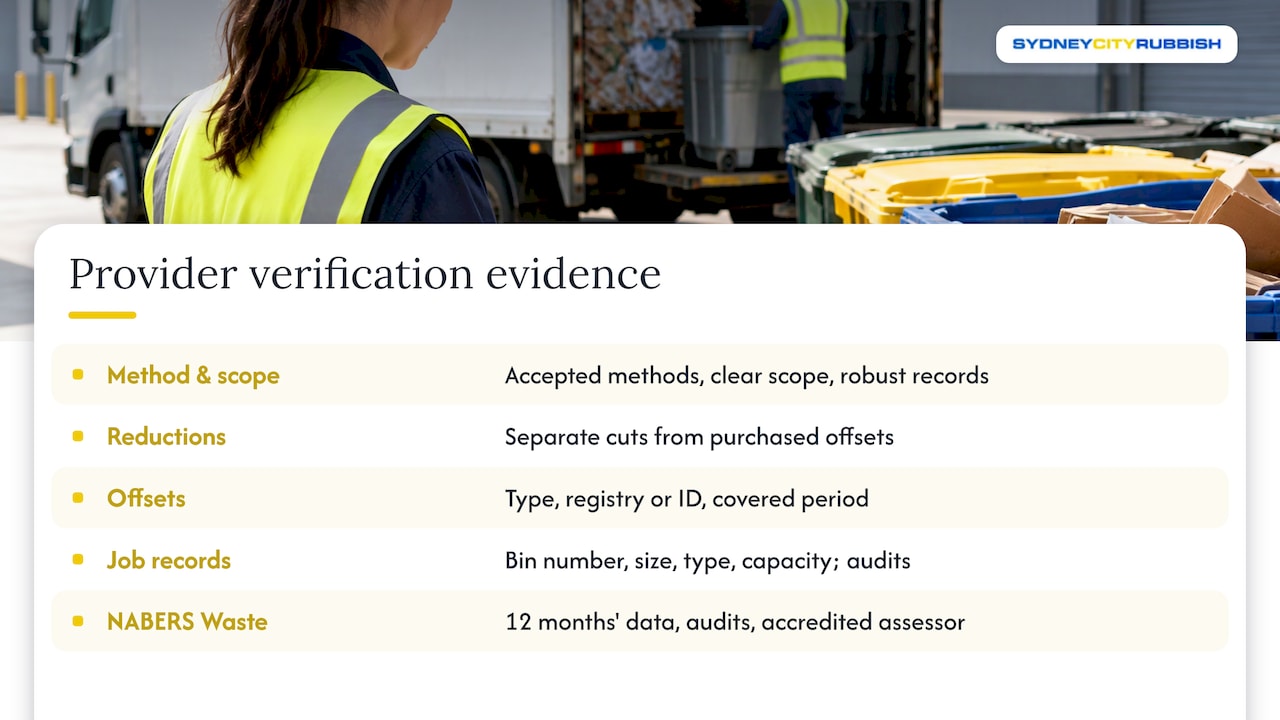
The ACCC says evidence for environmental claims may come from internal records or from third parties, but businesses should take reasonable steps to verify supplier information, and use accepted methodologies with robust records for emissions-reduction claims. You are a customer, and you may repeat the claim in your own sustainability reporting, so it is reasonable to ask for the following.
Start with the baseline. Ask what emissions the provider counted: fuel, electricity, processing, disposal. Ask what was excluded, and why. The ACCC expects included and excluded emissions to be stated clearly.
Next, ask how reductions and offsets are separated. A provider that can tell you how much of its footprint was cut through fleet, routing and recovery, and how much was offset, is giving you the picture the ACCC guide describes.
Then ask about the offsets themselves: the type, the registry or identifier, and the period covered. We explain what to look for in our guide on how Sydney businesses can verify carbon neutral rubbish removal with ACCU IDs.
Finally, ask for job-level records. The NSW EPA guide says waste systems should be monitored rather than treated as set-and-forget. At a minimum, businesses should record the number, size, type and capacity of bins emptied daily or weekly, and periodically audit those records. For one-off jobs such as a strip-out, the equivalent is a record of loads removed, the material types, and the facilities that received them.
If your building pursues a NABERS Waste rating, the bar is higher again. A NABERS Waste Verification requires 12 months of operational waste data, waste audits and a NABERS-accredited Waste Assessor, and the report covers total generation, landfill, diversion, recycling, waste intensity, data quality and material recovery results. Good provider records make that process much easier.
Rules that apply to commercial waste in NSW
Carbon claims sit on top of legal obligations. Service NSW’s guide to waste management for businesses, updated in August 2024, notes that NSW businesses may need council or other authority approval for some activities, including placing commercial waste in a public place. It also warns that both the waste owner and the transporter may commit an offence if waste is taken to an unlawful facility.
That second point is why records matter. When you hire a removal provider, you remain connected to where the waste ends up. Ask which facilities receive your loads, and confirm that your provider uses registered recycling partners. We describe our own approach as responsible disposal through registered recycling partners, and we are happy to talk through the destination of each stream on your job.
Requirements differ by state, so avoid assuming that another state’s rules apply to your Sydney site. Queensland, for example, regulates waste generation, transport, receival, storage, treatment and disposal under its own Regulation, with a levy framework covering commercial, industrial, construction and demolition waste. For Sydney sites, your local council, building management and the NSW EPA are the right first contacts. Our guide to waste management for commercial renovations and new builds covers the practical side for projects in the city.
A practical plan for an office, retail or site clear-out
A well-run clear-out tends to follow the same order, whatever the size.
First, audit what you have. Walk the space with building management and list furniture, electronics, fit-out elements, hazardous items and general waste. Clear bags and a quick count of items will tell you far more than an estimate from memory.
Second, remove what can be reused. Furniture in good condition, intact joinery and working equipment are candidates for reuse or resale before they become waste. This reduces both disposal volume and cost.
Third, separate the rest. Keep electronics, batteries, lighting and chemicals apart from bulky and general loads. On construction jobs, keep concrete, metal, timber and plasterboard in separate streams where the site allows.
Fourth, agree access with building management. Loading dock bookings, lift protection, after-hours windows and parking all affect how quickly a crew can work. Our team coordinates directly with building management for access, which keeps handover timelines intact.
Fifth, decide on the carbon neutral option at the quoting stage, not afterwards. If you want your removal job recorded as carbon neutral, say so when you request the quote, so the paperwork and records are set up from the start.
Finally, file your records. Keep the removal confirmation, the material types, and any carbon neutral documentation with your project or lease files. They support your reporting and your answers if a client or auditor asks.
Carbon neutral removal with Sydney City Rubbish
We remove rubbish for offices, retail locations, construction sites, strata-managed buildings and end-of-lease cleanouts across Sydney, from the CBD to Parramatta, Ryde, Macquarie Park and Greater Western Sydney. Our work includes furniture and electronics removal, construction debris, strip-outs, makegood and de-fit, and floor finish removal, along with truck and driver hire.
Carbon neutral disposal is an opt-in for our corporate clients, delivered in partnership with Carbon Neutral. You can read how we describe it in what carbon neutral rubbish removal is and why we chose to go carbon neutral. We aim for fast electronic quoting and meticulous cleanup, and we guarantee punctuality, with compensation if we are late.
For office and retail jobs, see our commercial rubbish removal service. For sites with demolition or fit-out waste, see construction waste disposal in Sydney. Get a free quote now, and tell us at the start if you want the carbon neutral option included.
FAQ
Is carbon neutral waste disposal the same as zero waste?
No. Zero waste aims to send nothing to disposal. Carbon neutral means the emissions from the service have been measured, reduced where possible and balanced with offsets. A business can pursue both, and reducing waste first makes the carbon accounting simpler.
Can a carbon neutral claim be checked?
Yes. The ACCC says claims should rest on a clear baseline and accepted methodologies, with reductions and offsets distinguished. Ask your provider for its method, what it included and excluded, and how its offsets are verified, then keep that information on file.
Who is responsible if waste goes to an unlawful facility in NSW?
Service NSW says both the waste owner and the transporter may commit an offence if waste is transported to an unlawful facility. Ask your provider where each stream goes, and keep removal records for your own files.
What should I separate before a commercial clear-out?
Keep electronics, batteries, fluorescent lights, toner cartridges and chemicals apart from general and bulky waste, as the NSW EPA guide treats them as special waste. Furniture and fit-out items that are still usable are worth setting aside for reuse before the removal crew arrives.
Sources
- Making environmental claims: a guide for business, ACCC
- ACT Waste Management Strategy
- The relative importance of carbon markets to the waste sector, Carbon Neutrality
- Waste and recycling for commercial and industrial land use, Sustainability Victoria
- Better Practice Guidelines for Waste Management, NSW EPA
- Waste guide for offices, CitySwitch
- NABERS Waste
- IPCC waste guidance
- NPI landfill emission estimation manual
- Waste management for businesses, Service NSW