Avoid Fines: NSW Commercial Waste Rules and 5 Compliance Steps
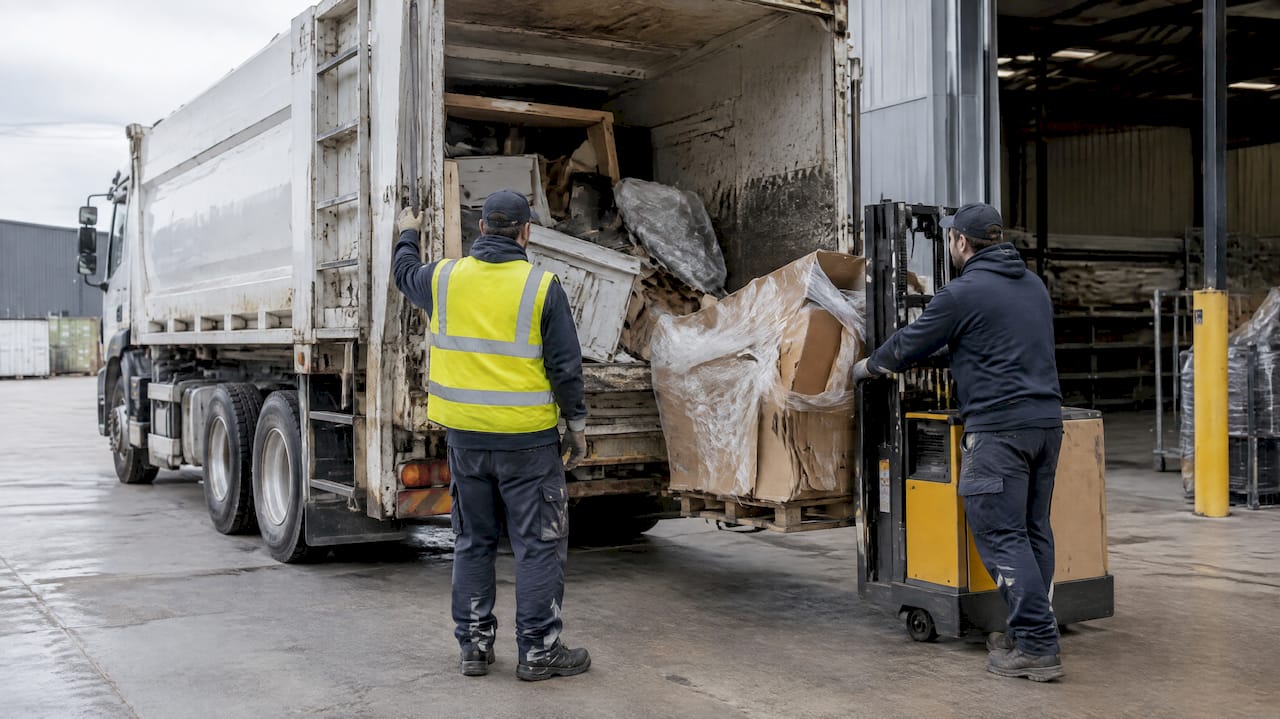
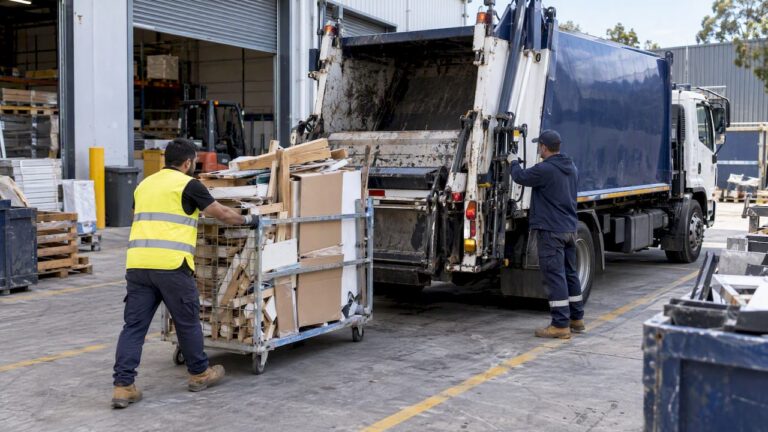
Most businesses placing or transporting commercial waste in a NSW public place need some form of approval or tracking registration before they start. Local council approval, usually under Section 68 of the Local Government Act 1993, covers placing bins or containers on public land, while the NSW EPA’s Integrated Waste Tracking Solution applies to asbestos, tyres and other hazardous or trackable waste. Check your bin meets local size, lid and labelling rules, and keep transport paperwork on hand.
TL;DR:
- Routine commercial bins under size limits with lids and labels usually do not require separate approval if placed during designated collection times.
- Moving or placing waste containers in public places generally necessitates a Section 68 approval, especially for larger containers or outside specified conditions.
- Hazardous and trackable waste must be registered with IWTS, with consignors and transporters carrying proper authorizations and certificates.
- The NSW waste levy applies to almost all waste sent to licensed facilities in Sydney, increasing disposal costs based on waste origins rather than volume alone.
- Using a knowledgeable contractor reduces compliance risks by managing paperwork, labels, and scheduled waste documentation effectively.
Table of Contents
- When do you need approval to place waste in a public place?
- Moving waste through public places: Section 68 and transport approvals
- Hazardous and trackable waste: IWTS and consignment paperwork
- The waste levy and what it means for your disposal costs
- How to apply and what evidence to have ready
- Compliance checklist: reducing your enforcement risk
- How a compliant contractor supports your obligations
- How Sydney City Rubbish supports compliant commercial waste removal
- FAQ
- Sources
When do you need approval to place waste in a public place?
Councils generally exempt routine commercial bin placement from formal approval, provided the bin meets set standards and sits out for a limited window around collection. The City of Sydney’s local approvals policy sets out the practical criteria that most inner Sydney businesses rely on, and similar thresholds appear across other metropolitan councils.
- Bins under the standard local size limit with closed lids and clear business labelling generally do not need separate approval.
- Bins must be placed out only within set collection time windows and removed promptly afterwards.
- Overflowing, unlabelled or permanently kerbside bins are commonly treated as illegal dumping rather than exempt storage.
- Larger containers, skips or anything stored in a public place outside these conditions usually triggers a Section 68 application.
If your bin, skip or storage arrangement falls outside these conditions, assume you need to apply rather than wait for a council officer to tell you. Contacting your local council’s waste or compliance team before collection day avoids a fine notice later.
Moving waste through public places: Section 68 and transport approvals
Section 68 of the Local Government Act 1993 is the mechanism most NSW councils use to regulate waste activity on public land, and the NSW Planning Portal lists the relevant activity categories. Businesses and contractors transporting or placing waste need to check which category applies before a job starts.
- Placing a waste storage container, skip or bin in a public place typically needs approval.
- Transporting waste over or under a public place, such as running a chute or conveyor across a footpath, falls under Section 68.
- Waste that is simply being carried through on a truck, with no placement or storage on public land, generally does not need this approval.
- Any fee-based collection service operating from public land usually needs council sign-off separate from the waste approval itself.
Transporters carrying hazardous or trackable waste also need an EPA environment protection licence or registration on top of any council approval, since the two schemes cover different parts of the chain.
Hazardous and trackable waste: IWTS and consignment paperwork
Asbestos, tyres and other regulated wastes fall under the Protection of the Environment Operations (Waste) Regulation and must be tracked through the NSW EPA’s Integrated Waste Tracking Solution, which replaced earlier systems including a shift for asbestos tracking that took effect from 28 February 2024. In practice, this means every consignor, transporter and receiver in the chain carries a non-delegable obligation to record the movement correctly.
- Register with IWTS before you need to move trackable waste, since account setup takes time.
- Obtain a consignment authorisation and a printed transport certificate to accompany the load.
- Confirm the receiving facility is licensed to accept that waste type before the truck leaves site.
Our guide to hazardous waste disposal rules and asbestos-specific compliance guidance walk through these steps in more detail for property owners and managers.
The waste levy and what it means for your disposal costs
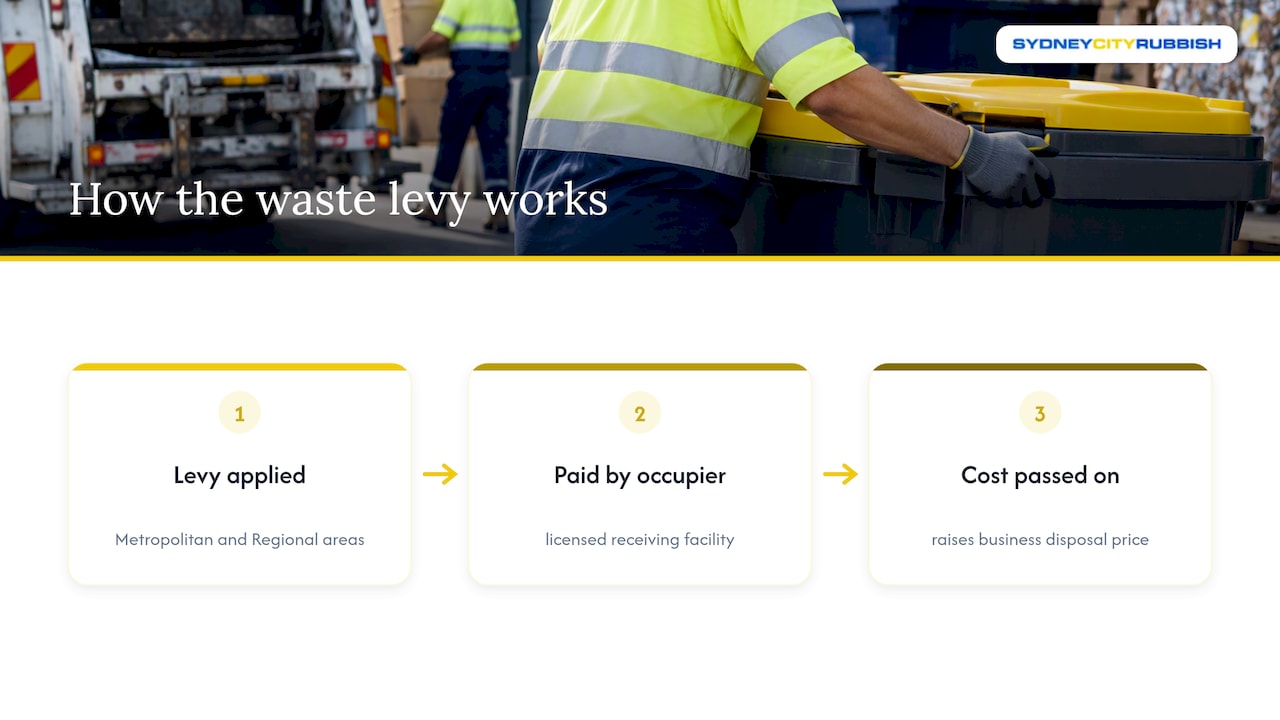
NSW applies a waste levy across the Metropolitan Levy Area and the Regional Levy Area, with rates published and updated by the NSW EPA. Sydney sits within the Metropolitan Levy Area, so almost every commercial waste load generated by a city or suburban business attracts the levy once it reaches a scheduled facility.
The levy is generally paid by the occupier of the licensed facility receiving the waste, but it flows through to the price a business pays for disposal. That cost difference is one reason that where you send waste, not just how much you generate, matters when planning a commercial waste contract.
How to apply and what evidence to have ready
Applications for placing or transporting waste in a public place go through your local council, often via an online form referencing Section 68 approvals on the NSW Planning Portal. Trackable or hazardous waste registrations go through the EPA’s eConnect and IWTS portals instead.
- Keep a copy of your commercial waste collection contract, since councils often ask for it during inspections.
- Have bin labelling and signage ready to show compliance at a glance.
- For trackable waste, carry your consignment authorisation and transport certificate with the load.
- Call your council’s waste compliance line or the EPA’s IWTS support team early if you’re unsure which approval applies.
Processing times vary by council, so lodge applications well before your planned collection or works start date.
Compliance checklist: reducing your enforcement risk
A short pre-collection check avoids most of the fines businesses encounter around commercial waste in NSW.
- Classify the waste and confirm whether it falls under IWTS tracking.
- Obtain a consignment authorisation and printed transport certificate if the load is trackable.
- Check bins meet local standards: lids closed, reflectors and brakes fitted on larger bins, and clear business labelling.
- Keep a current contract with your commercial waste contractor accessible for inspection.
- Watch for red flags such as overflowing bins, missing labels or bins left out beyond the permitted collection window.
Pro Tip: Photograph your bin setup and collection area once it meets council standards, so you have ready evidence if a compliance officer raises a query later.
How a compliant contractor supports your obligations
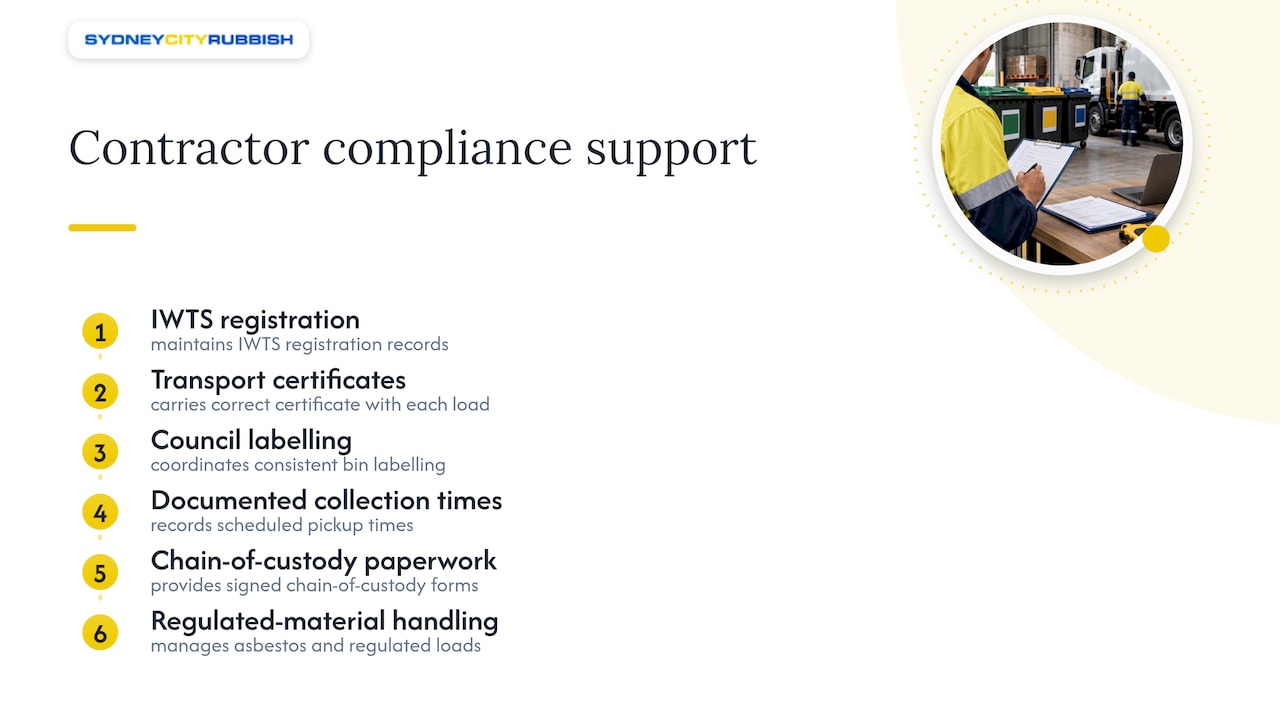
A contractor who already understands IWTS registration, transport certificates and council labelling rules removes a lot of the administrative load from a busy office, retail site or construction project. Coordinated bin labelling, documented collection times and chain-of-custody paperwork for scheduled waste all reduce the chance of a compliance officer flagging your site. For businesses handling asbestos or other regulated material, having a contractor who carries the correct transport certificate with every load is the difference between a routine pickup and a potential penalty.
How Sydney City Rubbish supports compliant commercial waste removal
We handle the practical side of NSW commercial waste compliance so your team doesn’t have to chase paperwork between meetings. Our services cover the situations businesses most often need help with:
- Commercial waste removal for offices, retail sites and strata-managed buildings, coordinated directly with building management.
- Construction waste disposal for sites generating mixed or scheduled waste streams.
- Scheduled and trackable waste handling through our scheduled waste removal service, supporting IWTS documentation where it applies.
We offer carbon-neutral disposal as an opt-in for clients who want it, and we guarantee punctual collections. If storage space is tight between collections, a commercial storage option from our partner, which can bridge the gap on larger projects. Get in touch through our commercial waste removal page for a quote tailored to your site.
FAQ
What are the waste management standards in Australia?
Australia’s waste standards sit under state and territory regulations rather than one national rulebook, with NSW setting its own requirements through the EPA and local councils. Businesses in NSW follow the Protection of the Environment Operations (Waste) Regulation alongside council-level approvals such as Section 68.
What is Australia’s national waste policy?
The national policy sets shared goals and targets that states then implement through their own laws, which is why NSW has its own waste levy, tracking system and council approval rules rather than a single uniform scheme. Businesses operating in NSW need to follow the state-specific requirements, including IWTS for trackable waste.
Who is responsible for waste management in Australia?
Responsibility is shared between state environment agencies, local councils and the businesses generating or transporting the waste. In NSW, the EPA regulates licensing and tracking, councils manage public place approvals, and the waste producer, transporter and receiver each carry obligations under the Waste Regulation.
Do I need council approval to put a skip bin on the street?
Yes, in most cases. Placing a skip or storage container in a public place usually requires a Section 68 approval from your local council, separate from any arrangement with your waste contractor.
What happens if I don’t track asbestos or hazardous waste correctly?
Failing to register trackable waste through IWTS or carry the required transport certificate can lead to significant penalties under NSW law. Consignors, transporters and receivers each hold responsibility for making sure the paperwork accompanies the load.
Sources
- Integrated Waste Tracking Solution – NSW EPA
- Managing waste in public places – local approvals policy (City of Sydney)
- Section 68 approvals | NSW Planning Portal