Mattress Removal for Strata Buildings in Sydney
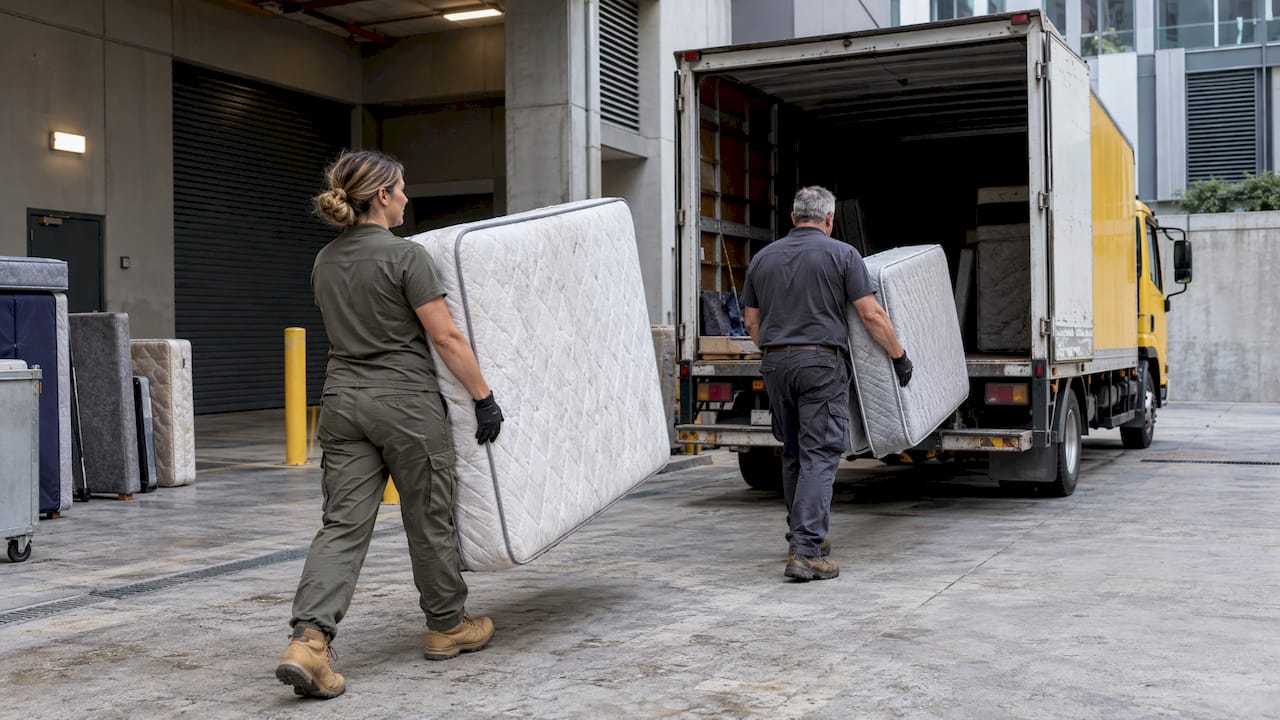
The simplest way for a strata manager to deal with mattresses is to book one commercial collection for the whole building, with a set time, a nominated pick-up point and a record of where the mattresses went. Sydney City Rubbish removes mattresses and other bulky items from strata-managed buildings across Sydney, and we coordinate directly with building management for access. This guide covers who is responsible, how to prepare the building, what recycling involves and what to put in writing.
TL;DR
- The owners corporation carries the first cost of mattresses left on common property, so a single planned collection is cheaper than repeated clean-ups.
- Book one collection for the building, name a pick-up point, and tell residents the date, location and what is accepted.
- Keep mattresses together and dry, separate from other bulky waste, and out of fire exits, driveways and lift lobbies.
- Ask for a record of responsible disposal. Mattresses can be broken down into steel, foam, timber and textiles for recycling.
- Sydney City Rubbish offers carbon-neutral removal as an opt-in, fast electronic quoting and a punctuality guarantee with compensation if we are late.
Table of Contents
- Why mattresses are a strata problem
- Who is responsible for arranging removal
- Planning a building-wide mattress collection
- What a commercial collection takes off your hands
- What happens to the mattresses
- A simple routine for the year
- End-of-lease and commercial buildings
- Ready to book a building collection
- FAQ
- Sources
Why mattresses are a strata problem
A mattress is bulky, awkward to carry and impossible to hide. When a resident moves out or replaces a bed, the easiest option for them is the car park, the bin room or the footpath out the front. Once a mattress sits on common property, it belongs to the building’s problem list.
The cost lands on the scheme first. A strata software provider explains that dumped waste is first a by-law problem and then a cost-recovery problem: the owners corporation pays the after-hours collection, cleaner or skip, and can only recover that from a lot owner if a by-law makes owners liable for what they or their occupiers leave behind, and if there is evidence tying the item to the lot. A mattress with no story becomes a building cost.
There is also a scale problem. Australia disposes of roughly 1.8 million mattresses a year, and each one takes up a lot of landfill space. A building with a few hundred apartments and regular tenant turnover will generate a steady flow of them. Treating mattress removal as a planned routine, rather than a reaction to whatever has appeared downstairs, keeps the cost predictable and the building tidy.
Who is responsible for arranging removal
In a strata scheme, the common property is the owners corporation’s responsibility, and in practice the strata manager or building manager acts for it. Councils that offer communal collections for apartment blocks follow the same logic. The City of Canterbury Bankstown, for example, requires bookings for properties with six or more dwellings to be made as a communal booking by an authorised property representative, such as the strata manager, building manager or committee member, who must tell all residents the collection date, location and acceptable items. Northern Beaches Council says communal collection through the strata manager or owners corporation gives one consistent point of contact and reduces confusion among residents.
The point carries over to any collection, whoever runs it. One person books, one person communicates, and one place is nominated. That structure is what stops mattresses appearing in random corners of the building.
If you manage a building, our strata bulky waste contractor pack sets out what to have in place before any contractor attends, and our NSW strata bulk waste checklist covers the paperwork side.
Mattresses that are already abandoned
When a mattress has been left on common property and nobody claims it, NSW has rules. The NSW Government explains that abandoned goods still belong to their owner, so the owners corporation must follow set steps before disposing of them. A disposal notice should name someone on the owners corporation, describe the goods, give an address where the owner can collect them, state any removal or storage costs, and say that the goods will be sold, kept or destroyed after a given date unless collected. The owners corporation should also make a reasonable effort to find the owner.
For a manager, the practical lesson is to photograph the item and its location, record the date, display the notice, and only then book removal. If the building’s by-laws allow cost recovery, that file is also the evidence you need to bill the lot responsible. Where the situation is unclear, confirm the steps with the scheme’s strata lawyer before disposal.
Planning a building-wide mattress collection
A good collection is mostly preparation. These are the decisions that determine whether the day runs smoothly.
Choose the pick-up point
Pick a spot that a truck can reach without blocking fire access, a driveway used by residents or a loading dock needed for deliveries. Ground-level common areas, a visitor car space or a spot beside the bin room usually work. Basements and tight ramps cause delays. Our crews coordinate with building management for access, so if the pick-up point is inside the building, tell us about lift bookings, loading dock rules and key or fob arrangements when you request a quote.
Set the window and tell residents
Residents need three facts: the date, the place and what is accepted. Put them on the noticeboard and in an email or the building’s app, and repeat them a few days before. Northern Beaches Council advises managers to notify residents by noticeboard or email and to make sure items are put out correctly, at the right time and within the volume allowed. Those habits help for a private collection too.
A short notice might say: mattresses and bases only, placed at the nominated point from 5pm the day before, nothing left in the lift lobby, no wet or soiled items left uncovered. Setting a placement window keeps mattresses off the street and out of the weather for as long as possible.
Keep mattresses separate
Mattresses are recycled as their own stream, so they should sit in their own pile. City of Newcastle’s bulk waste rules, for example, require mattresses to be placed separately from other bulk waste with nothing on top, because they are collected by a separate truck. The same principle makes sorting quicker on any job: a dry mattress pile is easier to load and easier to send for recycling than a mixed heap of furniture, e-waste and timber.
Count the items
Get a rough count before you ask for a quote. Note whether bases and ensembles are included, and whether any are wet, mouldy or stained. Provide the count, the location and the access details, and our electronic quoting lets you receive a quote fast, without waiting on a site inspection for a simple job.
What a commercial collection takes off your hands
A council-style booking works around fixed schedules and per-booking limits, and the manager does the remaining work. With a commercial removal, the manager chooses the timing and a single contractor deals with the rest.
Here is how that looks with Sydney City Rubbish.
First, we quote per truckload or per project, so you see one figure for the job. We do not publish prices, because they depend on volume, access and what else is being removed.
Second, we coordinate directly with building management. Access, lift use, loading dock times and parking approvals are arranged with the people who control them, not left to the manager to chase.
Third, we guarantee punctuality, with compensation if we are late. In a strata building, a truck that turns up late can block a driveway at peak hour or miss the loading dock booking, so being on time is part of the service.
Fourth, we clean up. Our service is meticulous cleanup, so that no waste is left behind at the pick-up point.
Fifth, disposal is responsible. We use registered recycling partners, and corporate clients can opt in to carbon-neutral removal through our partnership with Carbon Neutral.
Mattresses rarely travel alone. A building clear-out usually includes bed bases, sofas, desks, whitegoods and electronics left in storage cages or the bin room. We can take bulky furniture, appliances and e-waste on the same visit. See our mattress removal service for the dedicated page, or furniture disposal and recycling for the wider range.

What happens to the mattresses
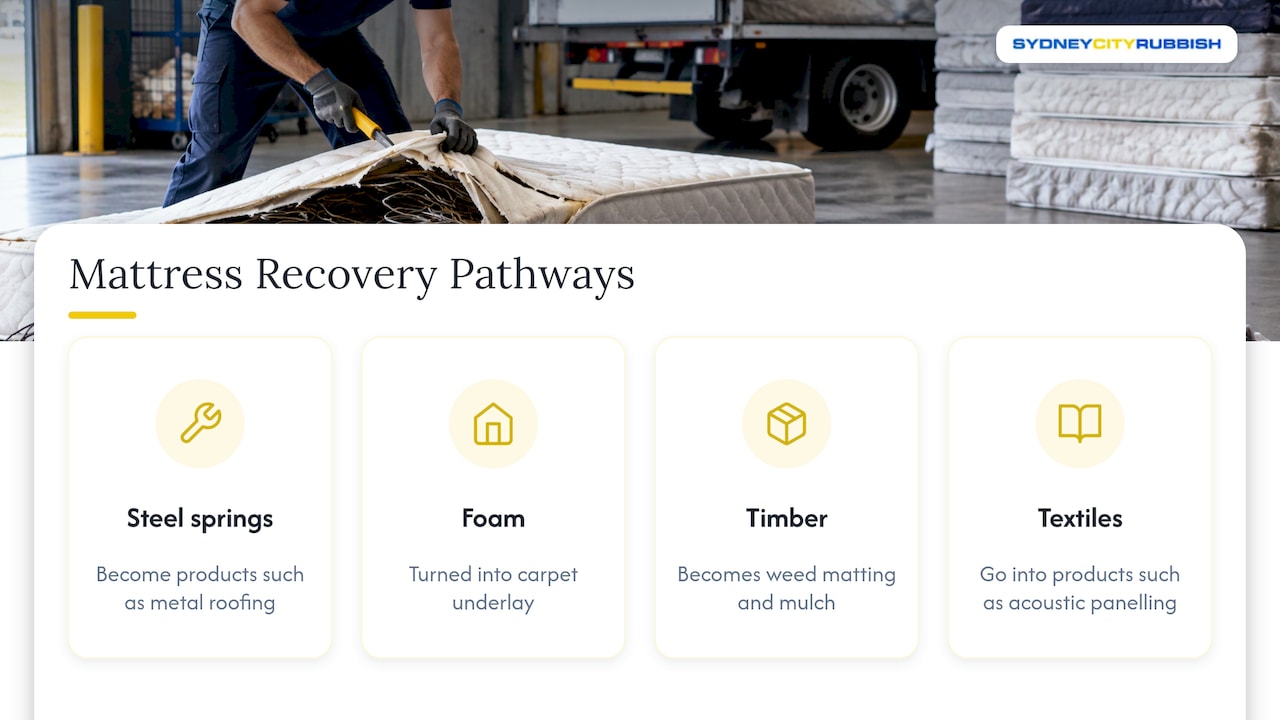
A mattress is a mix of materials, and each one needs a different process. The City of Sydney says its contractor works with specialised recyclers who collect mattresses separately, and that up to 75% of mattress parts are recycled. Steel springs become products such as metal roofing, foam is turned into carpet underlay, timber becomes weed matting and mulch, and textiles go into products such as acoustic panelling.
Those outcomes only happen when a mattress is dry, intact and kept apart from general rubbish. A mattress that has been rained on, or crushed in a compactor with other waste, usually ends up in landfill. This is why the pick-up point rules above matter: they protect the recycling value before the truck arrives.
For your records, ask your contractor to confirm that mattresses go to a registered recycling partner. Sydney City Rubbish uses registered recycling partners for responsible disposal, and you can keep that confirmation with the job file for the committee or the next audit. If your owners corporation reports on sustainability, the carbon-neutral opt-in is available for corporate clients.
A simple routine for the year
The cheapest way to handle mattresses is to schedule rather than react. A routine that suits most buildings has four parts.
- Plan around turnover. Tenant and owner moves cluster around the end of the month, the end of a lease and the start of the school year. Book a collection shortly after those peaks.
- Publish a standing rule. Add a line to the move-out guide and the by-laws page: mattresses are not to be left on common property, and the owner or tenant is responsible for removal.
- Keep a log. When an item appears, record the date, the location and, if known, the lot. That is the evidence needed for cost recovery under a by-law.
- Combine jobs. Pair mattress collection with other building tasks, such as clearing a storage cage, a refurbishment of a common area or an end-of-lease makegood, so the building pays for fewer truck visits.
For wider building programs, our guide to strata waste management in Sydney covers how bulky waste fits into the overall plan, and the strata waste management plan page is useful when development applications are involved.
End-of-lease and commercial buildings
Strata is not only residential. Commercial strata, serviced offices and mixed-use buildings often have mattresses too: staff rest rooms, hotel-style serviced apartments, student accommodation and furnished corporate lets. When a tenant leaves, the property manager wants the premises cleared quickly so the next occupant or the makegood works can start.
We handle furniture and joinery removal, strip-outs, makegood and de-fit work, and rubbish removal for offices, retail and warehouses, so a mattress clear-out can be part of a larger end-of-lease job instead of a separate booking. See our commercial rubbish removal page for what is covered.
Ready to book a building collection
If you manage a strata building in the Sydney CBD, Parramatta, Ryde, Macquarie Park, Sydney Olympic Park or the wider Sydney region, send us the number of mattresses, the pick-up point and the access details. We will return an electronic quote and arrange the time with building management. Start with our commercial waste removal page and get a free quote.
FAQ
Who pays for mattress removal in a strata building?
For mattresses left on common property, the owners corporation pays first, because the scheme is invoiced for the collection or skip. The cost can be recovered from a lot owner only where a by-law makes owners liable for waste left by them or their occupiers, and where there is evidence linking the item to that lot. Keeping a dated log and photographs makes recovery realistic.
Can a resident book mattress removal themselves?
In buildings with shared waste, councils commonly require the strata manager, building manager or another authorised representative to book on behalf of all residents. Canterbury Bankstown, for example, requires communal bookings for properties with six or more dwellings. A private commercial collection avoids those limits, because the manager books one job for the whole building.
How should mattresses be presented for collection?
Place them at the nominated pick-up point, dry, in their own pile, with nothing stacked on top. Keep them clear of fire exits, driveways and lift lobbies. Tell residents the date, location and placement window so mattresses are not left out for days.
What happens to mattresses after they are collected?
They are taken to a recycler that separates the steel springs, foam, timber and textiles. The City of Sydney reports that up to 75% of mattress parts can be recycled this way. We use registered recycling partners and offer a carbon-neutral opt-in for corporate clients.
What if a mattress has been abandoned and nobody claims it?
In NSW the item still belongs to its owner, so the owners corporation should make a reasonable effort to find them and display a disposal notice before removal. Record the item, photograph it and keep the notice on file. Your strata lawyer can confirm the steps for your scheme.
Sources
- Illegal Dumping and Bulky Waste in Apartment Buildings
- Australian Bedding Stewardship Council
- Bulky waste clean-up terms and conditions, City of Canterbury Bankstown
- Information for strata and property managers, Northern Beaches Council
- Strata abandoned goods, NSW Government
- Bulk Waste Collection, City of Newcastle
- Free council pick-up for residents, City of Sydney