Ceramic Tile Removal for Commercial Sites in Sydney
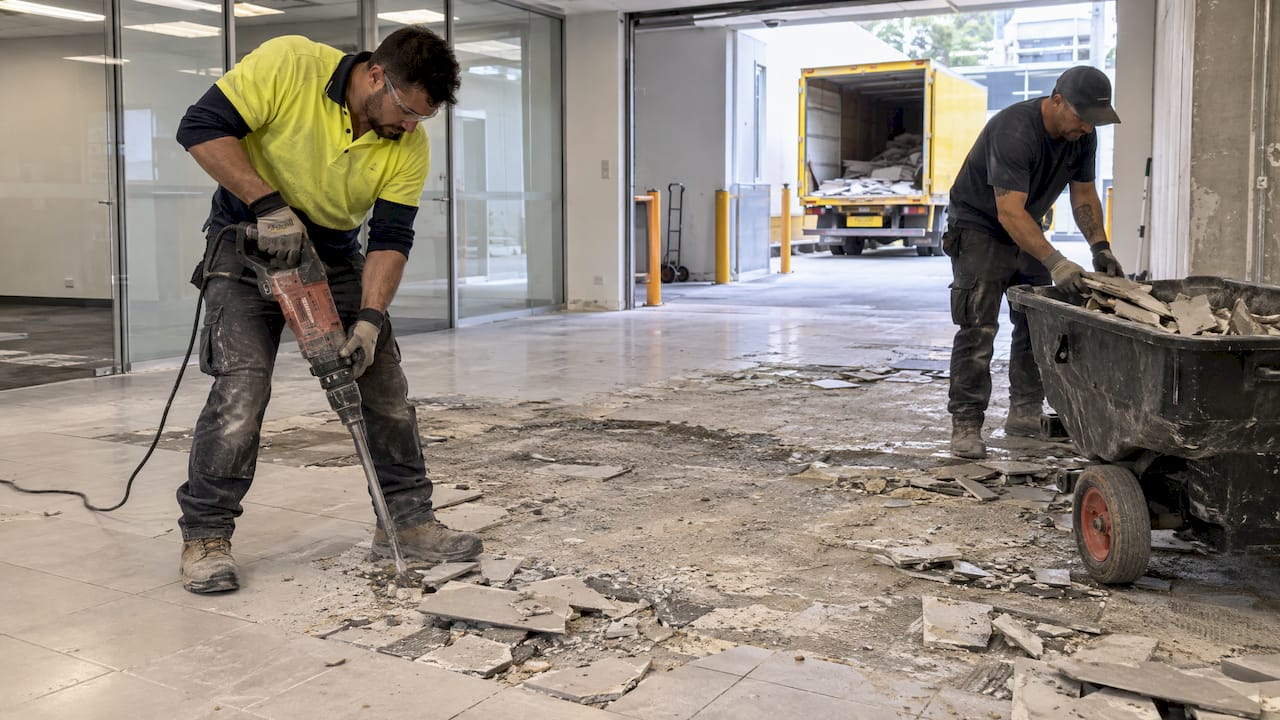
Ceramic tile removal on a commercial site is a sequence of five jobs: checking what is under the tile, containing dust, lifting the tile, clearing the adhesive from the slab, and getting the rubble out of the building legally. Lifting the tile is the quickest part. Silica dust, possible asbestos in older buildings, stubborn adhesive and heavy rubble are what stretch a program. Sydney City Rubbish handles strip-outs, makegood and de-fit work, floor finish removal and grinding, and the waste removal that follows, so the tiles, adhesive and debris leave your site in one coordinated job.
This guide is written for property managers, strata managers, office and retail tenants, and construction contractors who need tiled floors out before a handback, a refit or a new finish. It covers what to check first, how the work is done, what the safety rules require and what to expect when the rubble is removed.
TL;DR
- Identify the tile, the adhesive, the slab and the next finish before choosing a method. Ceramic is usually quicker to lift than porcelain or stone, but the adhesive underneath sets the pace.
- Tile and slab grinding creates respirable crystalline silica dust. Work needs dust control at the tool, a sealed work area and the right respirator, and in many cases a Safe Work Method Statement.
- In buildings with pre-1990 floor coverings, backing or adhesive, stop and have suspected asbestos assessed before any tile is disturbed.
- Wet-area tiles sit on a waterproof membrane, which removal usually damages, so plan re-waterproofing before the new floor.
- Tile rubble is heavy and must be declared and sorted. Book removal, access and recycling together so the floor is ready for the next trade or the lease handback.
Table of Contents
- Why commercial tile removal is not a bigger version of a home job
- Assess the site before choosing a method
- How ceramic tile removal is done, step by step
- Silica dust: the hazard that sets the controls
- Asbestos in older buildings
- Wet areas and waterproofing
- Where the rubble goes
- What drives the cost
- How Sydney City Rubbish fits into a tile removal program
- Scheduling for lease handbacks and strata works
- FAQ
- Sources
Why commercial tile removal is not a bigger version of a home job
A bathroom floor in a house is a weekend job for one person. A tiled office foyer, a retail tenancy, a warehouse amenities block or a strata common area is different in four ways.
First, the area is larger, so the quantity of rubble is large. Ceramic floor tile on a concrete slab produces dense, jagged fragments that add up to tonnes quickly, and a bin or truck that was sized by volume can hit its weight limit before it is full.
Second, the building is often occupied. Neighbouring tenants, residents and shoppers are exposed to noise, vibration and dust. Strata buildings and managed commercial towers set work hours, lift bookings, loading dock windows and protection requirements for common property.
Third, the work is a regulated workplace activity. Employers and contractors have duties under the model Work Health and Safety laws, and removing tile can involve silica dust, manual handling and, in older buildings, asbestos.
Fourth, there is a deadline. End-of-lease makegood, a fit-out start date and a re-tenanting date all sit on the other side of the tile removal, so a floor that is lifted but not cleaned back to a flat slab does not count as finished.
Assess the site before choosing a method
The method follows from four facts, and the cheapest time to learn them is before anyone picks up a tool.
The tile. Ceramic tile is generally the easiest to lift. Porcelain is denser and harder, and natural stone is heavier and often more firmly bonded. Check the tile thickness, the size and whether any tiles are already drummy (hollow when tapped), because loose tiles give a clean starting point.
The adhesive and bedding. Tiles may be fixed with a thin-set mortar or tile adhesive, a flexible adhesive, or a thicker sand and cement bed. Each behaves differently under a chisel. Thin adhesive often stays bonded to the slab in patches, while a thick bed can come away in slabs of its own and add to the weight.
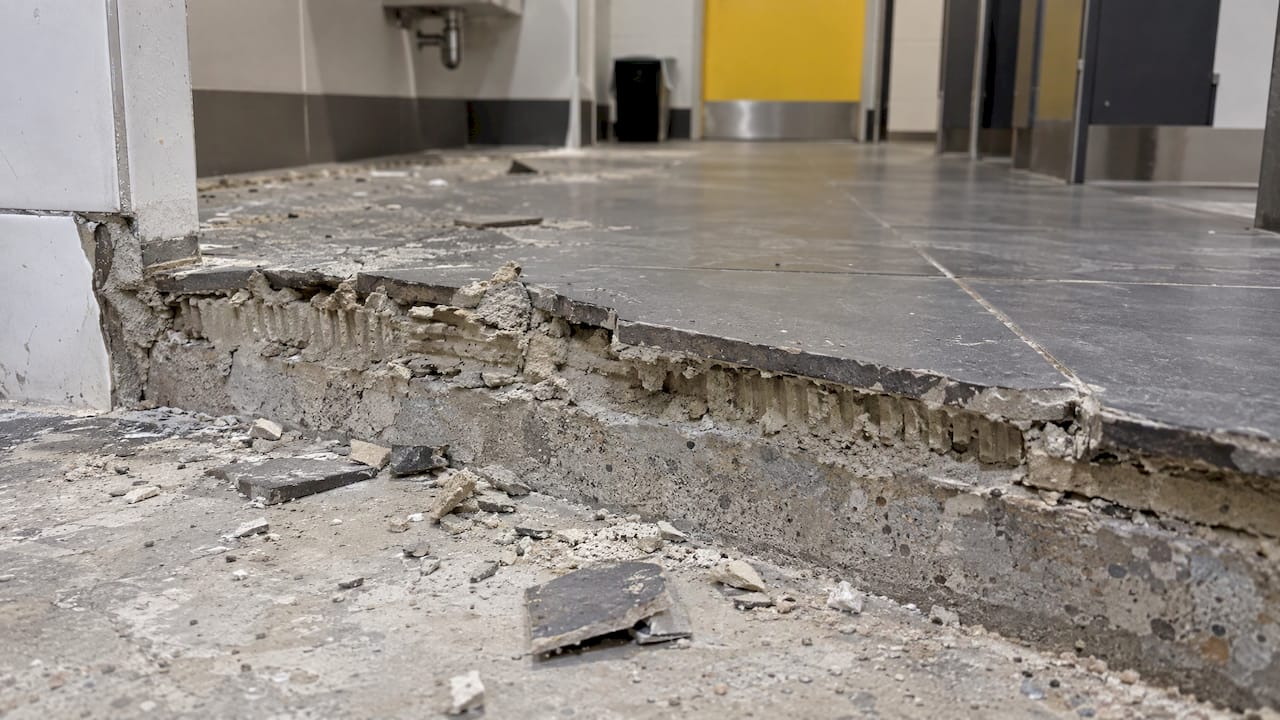
The slab and the age of the building. Look for cracks, level changes, drains and any evidence of a levelling compound. Ask for the building’s age and any asbestos register. Materials installed before 1990 may contain asbestos in the backing, the adhesive or the underlay, which changes the whole job.
The next finish. Polished concrete, carpet tiles, vinyl and new tiles all demand different slab conditions. Vinyl and adhesives, for example, need a clean, flat surface, and leftover residue is a common reason a new floor fails to bond. If the lease requires a bare slab at handback, the target is even clearer: clean concrete with no ghosting of old glue.
With these four answers, you can specify the scope: the area in square metres, the method (hand tools, a rotary hammer with a chisel bit, or a ride-on or walk-behind scraper), whether grinding is needed and how much waste will leave the building. If you give your contractor photos, floor plans and the building’s access rules at the quote stage, the price is far more accurate. Sydney City Rubbish quotes electronically and coordinates directly with building management for access, which takes the booking of lifts, docks and hours off your plate.
How ceramic tile removal is done, step by step
1. Prepare and contain the area
Clear furniture, fixtures and anything that can collect dust. Protect adjoining joinery, walls and floors that are not being worked on. Remove skirting boards, scotia and door trims where they sit over the tile edge. Seal doorways with plastic sheeting and tape, cover vents and isolate or switch off air-conditioning that would carry dust through the floor plate, where the building manager permits it. Cover floor drains so rubble and slurry cannot enter them. Plan the waste route too: where the buckets, wheelie bins or trolleys travel, which lift or dock they use and where the truck stands.
2. Find a starting point
Begin at a loose, cracked or already missing tile, or at a doorway edge. If there is no obvious starting tile, break one in the middle of the area with a hammer and chisel and work from the opening. Wet the surface lightly with a mist of water before breaking ceramic to limit dust, which is the simplest first control.
3. Lift with the chisel low
Hold the chisel at a shallow angle, roughly 30 degrees, and drive it under the tile edge so the tile lifts rather than the blade digging into the slab. A steep angle gouges concrete, and gouges become repair and levelling work later. On large areas, a rotary hammer with a chisel bit or a floor scraper speeds the work, with dust extraction fitted to the tool or a water mist at the point of impact.
Work systematically in rows. Lift tiles into bins as you go, because loose fragments underfoot are a slip and cut hazard. Operators should wear safety glasses, task gloves, steel-cap boots, hearing protection when using power tools and knee pads. The Job Safety Analysis published by GSR Australia lists the relevant Australian Standards for each item of protective equipment, such as AS/NZS 1337.1 for safety glasses and AS/NZS 2210.3 for safety footwear.
4. Remove the adhesive and prepare the slab
Once the tile is up, the job is only half done. Thin-set mortar, tile glue and levelling compound remain on the slab, and a new finish will not bond properly to that residue. A power scraper takes off the bulk, then a diamond grinder brings the concrete back to a clean, flat surface at the profile the next finish needs. Grinding is where most silica is created, so it must be done with on-tool extraction connected to an industrial vacuum. Sydney City Rubbish lists floor finish removal, grinding, concrete grinding and concrete cutting among its services, so removal and preparation are quoted as one scope.
5. Clean down and inspect
Vacuum with an industrial-class machine, never sweep dry, and then inspect the slab under good light. This is when hidden problems show up: cracks, low spots, old membranes, moisture or patched areas. Record them with photos before the next trade arrives, because it protects you in a makegood dispute.
Silica dust: the hazard that sets the controls
Ceramic tile, grout, mortar and concrete all contain crystalline silica, and cutting, grinding or breaking them releases respirable dust fine enough to reach deep into the lungs. Regulators across Australia have been tightening the rules. In May 2024, the Work Health and Safety and Workers Compensation Ministers agreed on model WHS Regulations for a stronger framework on respirable crystalline silica, including a prohibition on uncontrolled silica-generating work. Each state and territory adopts the model laws on its own timetable, so confirm the position with SafeWork NSW for a Sydney job.
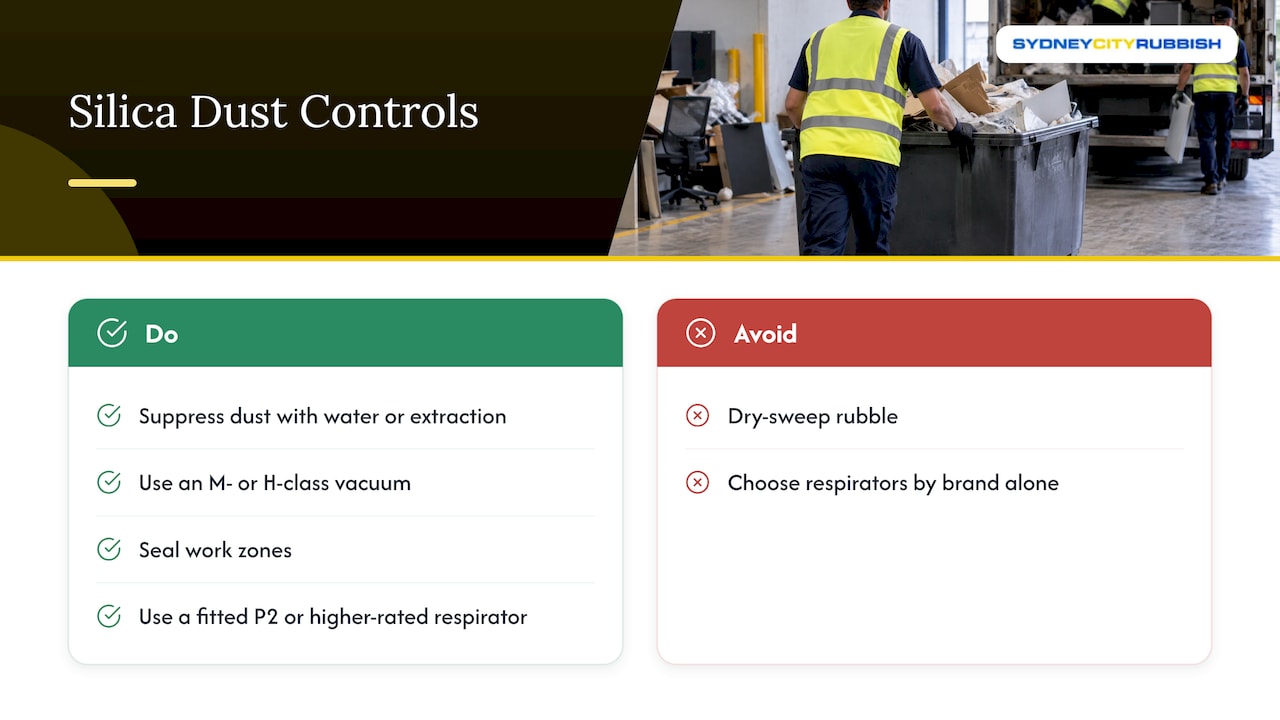
In practice, controlling silica on a tile floor means water suppression or on-tool extraction, an M or H class industrial vacuum, sealed work zones, no dry sweeping, damp handling of bagged rubble, and a properly fitted P2 respirator for light work or a higher-rated one for heavy grinding. Many overseas guides mention N95 masks, but Australian respiratory protection is selected under AS/NZS 1716, so check the rating of the mask rather than the brand.
It also helps to know what is outside the engineered stone ban. Safe Work Australia’s December 2025 review of the prohibition lists ceramic wall and floor tiles and grout among the materials it addresses, and they are outside the ban as it is defined. They still release silica when worked, so the dust controls above apply.
Safe Work Method Statements
Tile removal on a construction or fit-out project can fall under high-risk construction work, which needs a Safe Work Method Statement (SWMS), a written document setting out the hazards, the controls and who is responsible. GSR Australia notes that a Job Safety Analysis is a useful daily tool for pre-start meetings but does not replace a SWMS where the work is classed as high-risk. If you are the principal contractor or the property manager engaging a contractor, ask for the SWMS before work begins.
Asbestos in older buildings
If the building was constructed or refurbished before 1990, assume that floor coverings, backing sheets and adhesives could contain asbestos until a licensed assessor says otherwise. This is a safety and legal requirement, and tile removal does not start until it is resolved. Disturbing asbestos-containing material by chiselling or grinding releases fibres.
The Queensland Government’s asbestos guide for minor renovation is a clear statement of the general rules, though state legislation differs and SafeWork NSW and the NSW EPA govern a Sydney job. It states that asbestos waste can only be disposed of at council-approved sites, must be double-wrapped in plastic and labelled, and that it is illegal to put it in domestic garbage bins, or to re-use, recycle, sell or give it away. It also specifies an H-class industrial vacuum to AS/NZS 60335.2.69 with a HEPA filter for clean-up, and says domestic vacuums are never suitable.
In short: for any pre-1990 floor, get a sample tested, keep the result on file, and use a licensed asbestos removalist if asbestos is found. Do not allow tile or adhesive removal to start on the assumption that it is clear. Sydney City Rubbish lists hazardous materials among the waste it removes, so tell the team about any asbestos register or test result at the quote stage so the program and disposal are planned around it.
Wet areas and waterproofing
Tiled bathrooms, kitchens, amenities and wet-room floors have a waterproof membrane beneath the tile. Removing the tile and its bed almost always damages the membrane, so the new floor needs the waterproofing redone before it goes down, and that is work for a licensed waterproofer. Advance Floors makes the same point in its guide. For a property manager running a makegood program, this means wet-area floors need a second line in the schedule, with the waterproofing and its curing time ahead of the finish. Sydney City Rubbish also offers Makegood and De-fit work and building strip-outs, which cover the stripping stage of those programs.
Where the rubble goes
Tile and adhesive rubble is classed as construction and demolition waste. It is dense, and bins and trucks have weight limits, so it must be declared as heavy rubble rather than general waste. Mixed loads create their own problems: plaster, timber, metal and general rubbish should be kept apart from tile, because clean, sorted rubble is far easier to recycle than a contaminated load. Sydney City Rubbish has written on handling tile waste in Sydney and the benefits of recycling tile waste, and its broader guidance on waste separation in construction and demolition is worth reading before a large job.
Three points matter on commercial jobs.
Suspected asbestos is never mixed with the load. It is kept separate, wrapped and labelled and goes only to an approved facility.
Verge collection does not take rubble, and a general skip may not either unless you have declared the material. Check the declaration before you book.
Clean, sorted ceramic rubble can be taken to recycling facilities. Sydney City Rubbish disposes of waste through registered recycling partners, and corporate clients can opt in to carbon-neutral waste removal in partnership with Carbon Neutral, which is useful if your organisation reports on waste or emissions. For brick and concrete from the same job, see brick and concrete removal and disposal.
What drives the cost
There is no single price per square metre, because the quote depends on the quantity of tile, the type of tile, the adhesive underneath, how much grinding the next finish needs, the access conditions and the amount of waste. As one reference point from outside Sydney, a Brisbane cost guide for 2026 lists removal of old tile from a concrete slab at $30 to $65 per square metre and standard levelling at $20 to $40 per square metre. Use it to see how removal and preparation are priced as separate items, not as a Sydney rate.
The items that most often move a commercial quote are:
Access and hours. After-hours or weekend work, long carry distances, lift restrictions and loading dock bookings all add time.
The slab. A floor with thick bedding or a hard flexible adhesive needs more grinding passes.
Waste weight. Heavy rubble is priced by weight and truck loads.
Sydney City Rubbish quotes per truckload or per project, with online booking and payment. The fastest way to a firm number is to send the floor area, photos, the building address and the target finish. See the rubbish removal prices page for how quoting works.
How Sydney City Rubbish fits into a tile removal program
For an office handback, a retail refit or a strata common-area upgrade, the tile is rarely the only thing leaving. Furniture, joinery, ceilings, partitions and carpet usually go with it. Sydney City Rubbish handles building strip-outs, makegood and de-fit work, floor finish removal and grinding, truck and driver hire, and the removal of the resulting commercial waste, across Sydney CBD, North Sydney, Parramatta, Ryde, Macquarie Park and Greater Western Sydney. The team coordinates directly with building management for access, guarantees punctuality with compensation if it is late, and aims for a meticulous clean-up so no waste is left behind.
If you want a quote for tile removal, grinding and waste removal on a Sydney site, send the details through the commercial rubbish removal page.
Scheduling for lease handbacks and strata works
Tile removal should be sequenced, not squeezed in. For an end-of-lease handback, read the make-good clause first to see whether the landlord wants the floor returned as a bare slab or with a specified finish, then work back from the handback date. Allow time for any asbestos testing, for the removal itself, for grinding and for inspection, with a buffer for any waterproofing and curing.
In strata buildings, noise and vibration from chiselling and grinding are the main sources of complaints, and the body corporate or owners corporation may restrict hours. Give the strata manager the SWMS, the contractor’s insurance and the dust and noise plan early, and book lifts and loading areas in advance. Warehouses and industrial units have different constraints: heavy floor loads, forklift access and large areas where a ride-on scraper is more efficient than hand tools. Each makes a site inspection before quoting worthwhile.
FAQ
How long does ceramic tile removal take?
It depends on the area, the adhesive and the method. A small tenancy can be stripped and ground in a day or two, while larger floors with bonded adhesive take longer because grinding is the slow part. Allow extra time for any asbestos testing and, in wet areas, waterproofing.
Do I need to test for asbestos before removing floor tiles?
If the building, or the floor covering, dates from before 1990, yes. Get a licensed assessor to test the tile backing and adhesive before work starts, and use a licensed asbestos removalist if it is found. Tell your contractor about any register or test result when you ask for a quote.
Can the tiles be recycled?
Clean, sorted ceramic rubble can often be accepted by recycling facilities, usually for a fee, while asbestos-containing material cannot be recycled. Keeping tile apart from plaster, timber and general waste makes recycling more likely. Sydney City Rubbish uses registered recycling partners for the waste it collects.
What is the difference between tile removal and floor preparation?
Tile removal takes the tiles off the slab. Floor preparation removes the adhesive and levels or grinds the concrete so the next finish will bond. Both should be in the scope and the quote, because a floor with glue residue is not ready for carpet, vinyl or new tile.
Does ceramic tile removal need a Safe Work Method Statement?
Often, yes, where the work is high-risk construction work under the WHS Regulations, and a SWMS should be in place before work begins. Ask your contractor for it at the start, and confirm the requirements for your project with SafeWork NSW.
Sources
- GSR Australia: Existing Tile Removal and Substrate Preparation Job Safety Analysis
- DEWR: Work Health and Safety and Workers Compensation Ministers’ Meeting communiqué, 10 May 2024
- Safe Work Australia: Review of the engineered stone prohibition, December 2025
- Queensland Government: Asbestos, a guide for minor renovation
- Advance Floors: What to know about the process of tile removal
- Brisbane floor tiling costs, 2026