UPS Battery Disposal for Sydney Businesses: A Compliance Guide
Sydney City Rubbish team, updated November 2026
A used UPS battery must never go in a general waste bin, a skip or a bulky waste pile. It belongs with a battery recycler, either through a drop-off point for small quantities or through a licensed collection for the sealed lead-acid blocks that most office and server-room UPS units contain. For a business, the practical steps are to identify the battery chemistry, make the terminals and casing safe, choose a pathway that suits the quantity, and keep a record of where the battery went.
This guide walks through each step for Sydney offices, retail sites, strata buildings and construction projects, and explains where our own service fits when you have more than a single unit to move.
TL;DR
- UPS batteries are regulated waste. Sealed lead-acid and lithium units cannot go to landfill or into any bin or bulky waste pile.
- Check the chemistry first: lead-acid batteries are stored upright and strapped, while damaged lithium batteries need individual protection because of fire risk.
- Small, loose batteries can go to free drop-off points, but sealed lead-acid UPS blocks usually need a specialist recycler or a business collection.
- In NSW, loads of waste lead-acid batteries above 200 kg need a licensed transporter, and interstate movements must be tracked.
- Keep a disposal record for your compliance file. We can collect, coordinate building access and remove old UPS units and batteries from your site.
Table of Contents
- Why UPS batteries are not ordinary rubbish
- Lead-acid or lithium: identify the battery before you move it
- What the rules mean in NSW
- Your disposal options, by quantity and battery type
- Preparing UPS batteries for collection
- What happens to UPS batteries after recycling
- Records, responsibility and your compliance file
- Get UPS batteries removed from your Sydney site
- FAQ
- Sources
Why UPS batteries are not ordinary rubbish
An uninterruptible power supply is only as good as the battery inside it, and that battery has a working life measured in years rather than decades. When it fails, the unit is often left sitting in a comms cupboard, a server room or a store room until someone needs the space. That is usually the moment a facilities manager or property manager has to decide what to do with it.
The risk is real. Willoughby City Council states that e-waste and batteries are not allowed in any bin or bulky waste pile, because they can cause fires if crushed in waste trucks or at waste facilities. The same page advises that leaking or damaged batteries be placed in a clear plastic bag or container and taken to a Community Recycling Centre or a Household Chemical CleanOut event. That guidance is written for households, but the fire mechanism is identical for a commercial bin or a mixed skip on a fit-out.
On the compliance side, Natural Power Solutions, an Australian UPS service provider, notes that lead-acid and lithium batteries are regulated waste in Australia and cannot go to landfill, and that disposal through approved recycling channels should come with a record for the business’s compliance file. For anyone who answers to a building owner, an auditor or a lease, that record matters as much as the removal itself.
Lead-acid or lithium: identify the battery before you move it
Most UPS units in offices and server rooms use sealed lead-acid batteries. Newer or higher-end systems increasingly use lithium-ion. The label on the battery, or the model number on the UPS, will tell you which you have. The distinction changes how you store and package it.
EPA Victoria’s guideline on waste batteries is the most detailed public document on this, and it is a sound reference for good practice anywhere in Australia, even though it is a Victorian regulatory document. It classifies lead-acid batteries as Class 8 dangerous goods and lithium-ion batteries as Class 9, and notes the greater fire risk of lithium, including storage at least 10 m from other dangerous goods or combustible materials as a consideration.
Handling sealed lead-acid UPS batteries
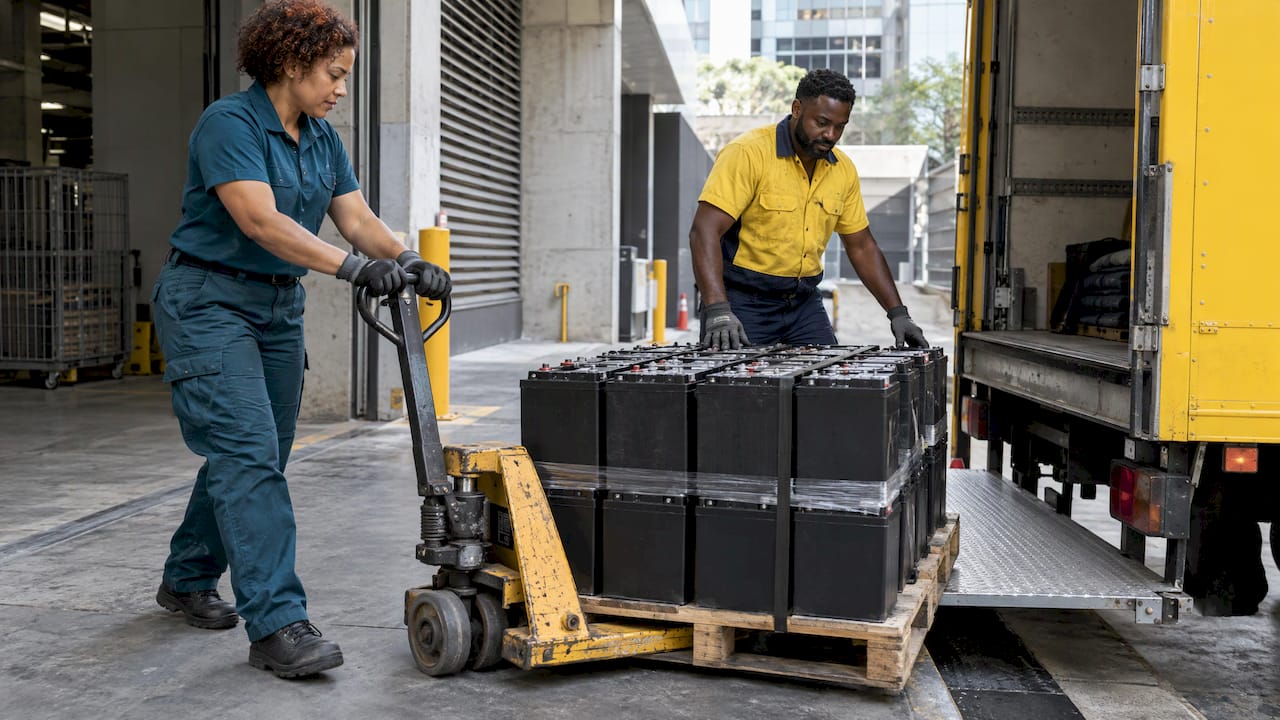
The same EPA Victoria guideline says used lead-acid batteries should be stored upright on a plastic pallet or container, stacked no more than two layers high, then wrapped in clear plastic stretch wrap and secured with non-conductive strapping for transport. People handling them should wear acid-resistant gloves, safety glasses and safety boots.
In practice, this means you should not leave heavy battery blocks loose on a shelf or stack them in a corridor. Pull the pack from the UPS cabinet with two people if it is a rack-mount unit, because these packs are dense and awkward. Keep them away from foot traffic until the collection arrives.
Handling lithium UPS batteries
For lithium, the guideline specifies that the total weight of containers holding smaller packaged lithium-ion waste batteries should not exceed 30 kg. It also says that damaged, defective or leaking lithium batteries must be individually protected and packaged under ADG Code packing instruction P908 Part 4. A swollen, hot or leaking lithium pack is not something to carry to a car. Isolate it, keep it away from combustibles and speak to a specialist hazardous waste contractor before it moves.
Small batteries and terminals
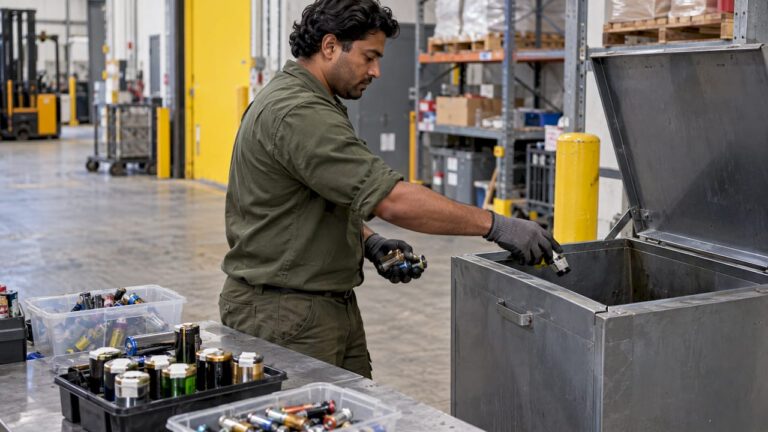
If a UPS contains or sits alongside small loose batteries such as AA cells or button cells, the national battery stewardship scheme B-cycle advises taping the end terminals with clear sticky tape and placing them in a glass container. It also says not to cover the brand name or battery chemistry information, and not to use paper bags, which create a fire hazard.
What the rules mean in NSW
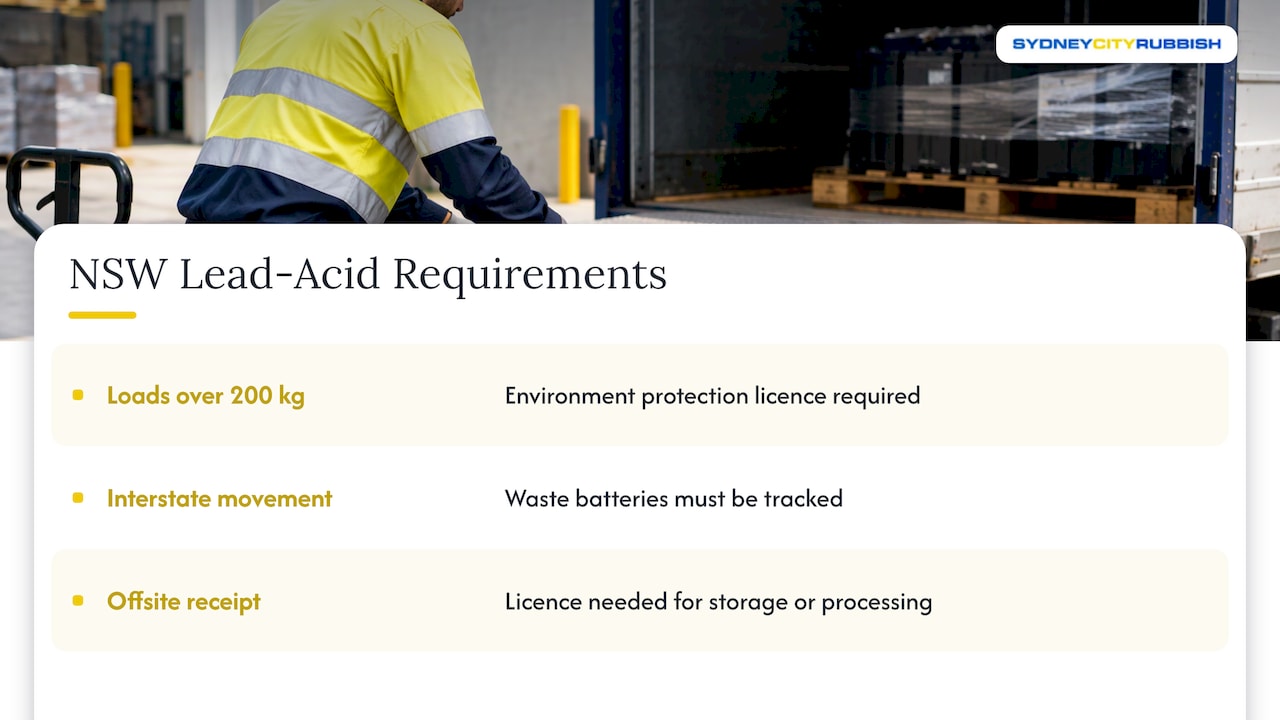
Rules differ by state, and the most detailed guideline in the research comes from Victoria, where lead-acid batteries are reportable priority waste and need a waste transaction record in EPA’s online Waste Tracker when consigned for transport. In NSW, the EPA’s page on waste lead-acid batteries sets out its own requirements. It states that an environment protection licence is required to transport loads exceeding 200 kg of waste lead-acid batteries, and that waste lead-acid batteries moved between NSW and another state or territory must be tracked. It also says an environment protection licence is needed to store or process such batteries received from offsite.
For a business, the takeaway is simple. A couple of UPS batteries from one office are a very different proposition from a data-centre refresh or a building strip-out that produces dozens of battery blocks. Once quantities grow, the transporter and the receiving facility both need to be properly licensed, and you need paperwork to show it. Our guide to waste tracking requirements in NSW explains how tracking works in practice.
Your disposal options, by quantity and battery type
There is no single answer, because the right pathway depends on how many batteries you have, their chemistry and their condition.
Free drop-off for small, loose batteries
B-cycle states that it is 100% free for Australians and businesses to take used batteries to a B-cycle drop-off point, and that if you have more than 1 kg you should call ahead to confirm the point can accept the quantity and type. The scheme accepts small, loose and easily removable batteries, including AA and AAA cells, button batteries, rechargeables, power banks and e-bike and e-scooter batteries. It does not accept batteries from solar panels, home energy storage systems or caravans, or batteries embedded in devices.
That last exclusion matters. A battery sealed inside a UPS, or a large lead-acid block, is not what this scheme is designed for. For lead-acid, B-cycle’s battery types accepted page points people to the Australian Battery Recycling Initiative to find a used lead-acid battery recycler.
Retail and council drop-off for lead-acid
nbn’s battery back-up information explains that once used, sealed lead-acid batteries are classified as hazardous waste. It says they should go to a recycling facility such as a specialist battery recycler, a selected battery retailer or a local council drop-off centre, and advises confirming terms and conditions before visiting. In Sydney, Willoughby City Council lists the Northern Sydney Community Recycling Centre and the Kimbriki Recycling and Resource Centre as accepting household and lead-acid batteries, with examples such as car and motorbike batteries.
These options suit a single small UPS battery carried by one person in a ute. They are less suited to a commercial tenant clearing a comms room, where the weight, the handling risk and the need for a documented record all point toward a collection service. Some facilities also charge businesses: the City of Greater Geraldton, for example, accepts UPS systems as e-waste at its waste facility, free for residents but with fees for commercial users. Councils differ, so always confirm commercial acceptance and fees before you load a vehicle.
Supplier take-back and replacement programs
Some UPS manufacturers and resellers run take-back or recycling arrangements, often tied to buying a replacement unit. These are worth asking about when you are replacing equipment, because the old unit and batteries may be collected as part of the purchase. They are conditional, so check the terms with your supplier before you assume they apply.
Commercial collection from your site
When you have several UPS units, a rack of battery packs, or batteries mixed into a larger clearance, a collection service removes the handling risk from your team. Our batteries service is built for this, and we handle electronics alongside batteries through our safe electronics disposal service. Where the batteries are one part of a wider IT refresh, our business computer recycling service covers the rest of the equipment with asset-level certificates.
Vehicle batteries are a separate stream with their own handling. If your fleet includes hybrid vehicles, the maintenance side is covered in this overview of hybrid fleet vehicle maintenance, and for conventional vehicle batteries we have a page on car battery disposal in Sydney.
Preparing UPS batteries for collection
A tidy, safe handover makes collection faster and reduces risk for everyone involved. Before the truck arrives, work through the following in sequence.
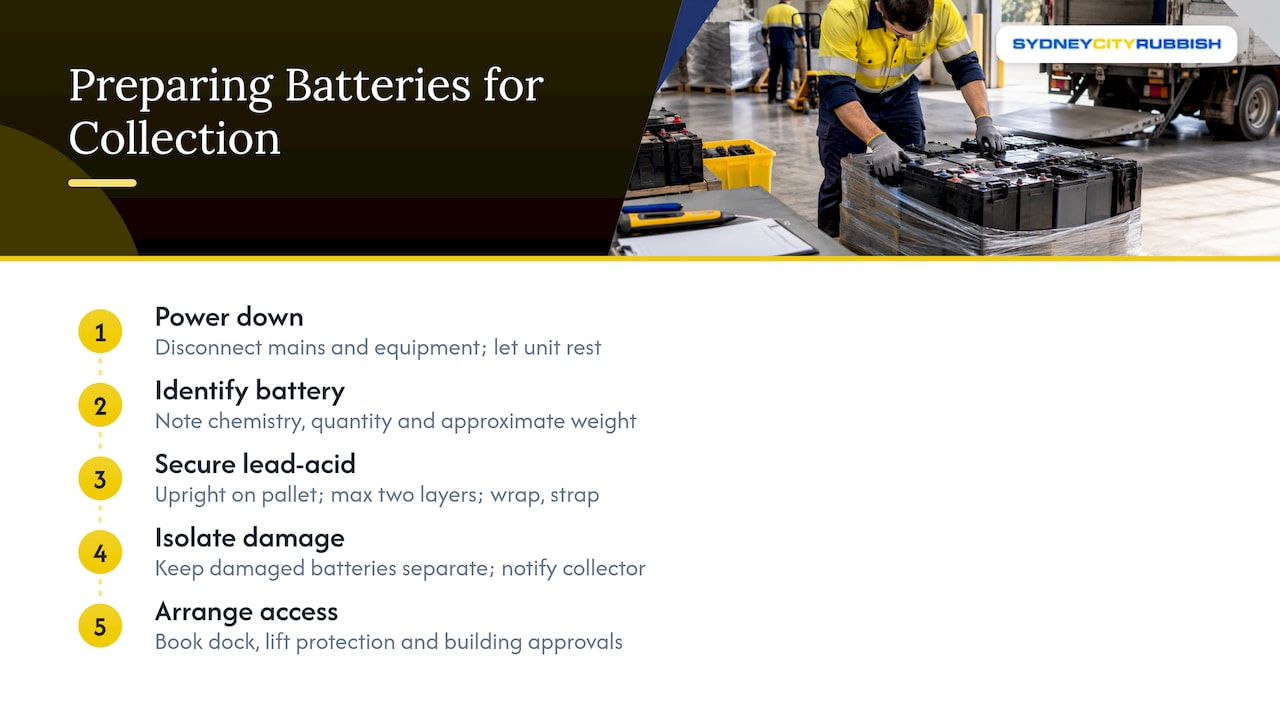
First, power the UPS down and disconnect it from the mains and from connected equipment. Let the unit rest so that nothing is live or warm. Second, identify the battery chemistry from the label and note the quantity and approximate weight. This information helps your collector plan the right vehicle and handling.
Third, for lead-acid blocks, stand them upright on a pallet, keep to two layers at most, and wrap and strap them as described in the EPA Victoria guideline. Fourth, if any battery is cracked, leaking or swollen, keep it separate from the others. The Geraldton guidance also advises not to mix leaking batteries with others, and Willoughby’s advice to use a clear plastic bag or container for damaged batteries applies equally. Tell your collector in advance, because a damaged lithium pack needs the specialist packaging described earlier.
Finally, arrange access. In a multi-tenant tower or strata building, loading dock bookings, lift protection and building management approvals often take longer than the removal itself. We coordinate directly with building management so that access is arranged before we arrive.
What happens to UPS batteries after recycling
For lead-acid batteries, the outcome is a good one. Battery Rescue reports that nearly 97% of a lead-acid battery is recycled, with only about 3% going to landfill, and that most are processed at one of Australia’s four battery recycling facilities. The lead is recovered for reuse, the plastic casing is recycled, and the sulfuric acid can be converted into products such as sodium sulfate, which is used in fertilisers and laundry detergents. The same page notes that recycled sources meet about 60% of global lead demand.
This is why proper disposal matters beyond compliance. A battery that goes through an approved channel feeds back into new batteries and other products. A battery that goes into a skip risks a truck fire and sends recoverable material to landfill.
Lithium recycling follows different processing routes and is less standardised, which is one more reason to keep lithium UPS batteries separate and documented, and to use a collector that works with registered recycling partners.
Records, responsibility and your compliance file
Whoever generates the waste carries responsibility for where it ends up. For a business, a disposal record is the proof that the batteries reached an approved recycler rather than an unknown destination. A good record names the collector, the date, the quantity and type of batteries, and the receiving facility.
Keep that record with your asset register and, where the UPS formed part of a leased fit-out, with your lease documents. At the end of a lease, landlords and property managers expect a clean handover, and electrical and IT equipment is often the first thing inspected. Our makegood and de-fit work regularly includes comms rooms, so the battery question is one we meet often. For the wider picture, see our advice on avoiding improper e-waste disposal and our explainer on how large batteries are recycled.
Get UPS batteries removed from your Sydney site
If you manage an office, a retail space, a strata building or a construction site in Sydney, we remove old UPS units and batteries as part of our commercial waste removal service. We coordinate directly with building management for access, provide fast electronic quotes, guarantee punctuality with compensation if we are late, and use registered recycling partners for responsible disposal. Clients can also opt in to carbon-neutral removal through our partnership with Carbon Neutral.
If the batteries are part of a larger strip-out, we can remove them together with furniture, ceilings and fit-out materials in a single visit. Get a free quote now through our website, and tell us the battery type, quantity and building access details so we can plan the job properly.
FAQ
Can a business put a UPS battery in the general waste bin?
No. Batteries are not allowed in any bin or bulky waste pile, because they can ignite when crushed in trucks or at waste facilities. Lead-acid and lithium batteries are regulated waste in Australia. Use a recycling drop-off for small quantities or a collection service for larger ones.
Are UPS batteries accepted at free drop-off points?
Small, loose and easily removable batteries are accepted free at B-cycle drop-off points, and you should call ahead if you have more than 1 kg. Batteries embedded in devices are not accepted. Sealed lead-acid UPS blocks usually go to a specialist lead-acid recycler, a selected retailer or a council facility, so confirm acceptance and any commercial fees first.
Do I need a licence to move old UPS batteries in NSW?
The NSW EPA requires an environment protection licence to transport loads of waste lead-acid batteries above 200 kg, and interstate movements must be tracked. Dangerous goods rules also apply to transport. If you are unsure whether your load qualifies, use a collector that handles the compliance side for you.
How should I store UPS batteries while waiting for collection?
Keep lead-acid batteries upright on a plastic pallet, no more than two layers high, wrapped and strapped. Keep lithium batteries away from combustible materials, and isolate any damaged or leaking unit in a clear plastic container. Wear gloves and safety glasses when handling them.
What happens to the battery once it is recycled?
For lead-acid, the lead, plastic and acid are recovered and reused, with nearly 97% of the battery recycled according to industry reporting. That material goes back into new batteries and other products, which is why approved recycling is the right outcome.
Sources
- EPA Victoria: Storage and management of waste batteries guideline
- NSW EPA: Waste lead acid batteries
- Willoughby City Council: E-waste and batteries
- B-cycle: Resource FAQs
- B-cycle: Battery types accepted
- nbn: Battery back-up information
- City of Greater Geraldton: Recycling ABCs
- Natural Power Solutions: UPS battery replacement and maintenance
- Battery Rescue: Where do your used lead acid batteries go?
- Hybrid vehicle maintenance for commercial fleets