Battery Recycling at Work: A Guide for Australian Businesses
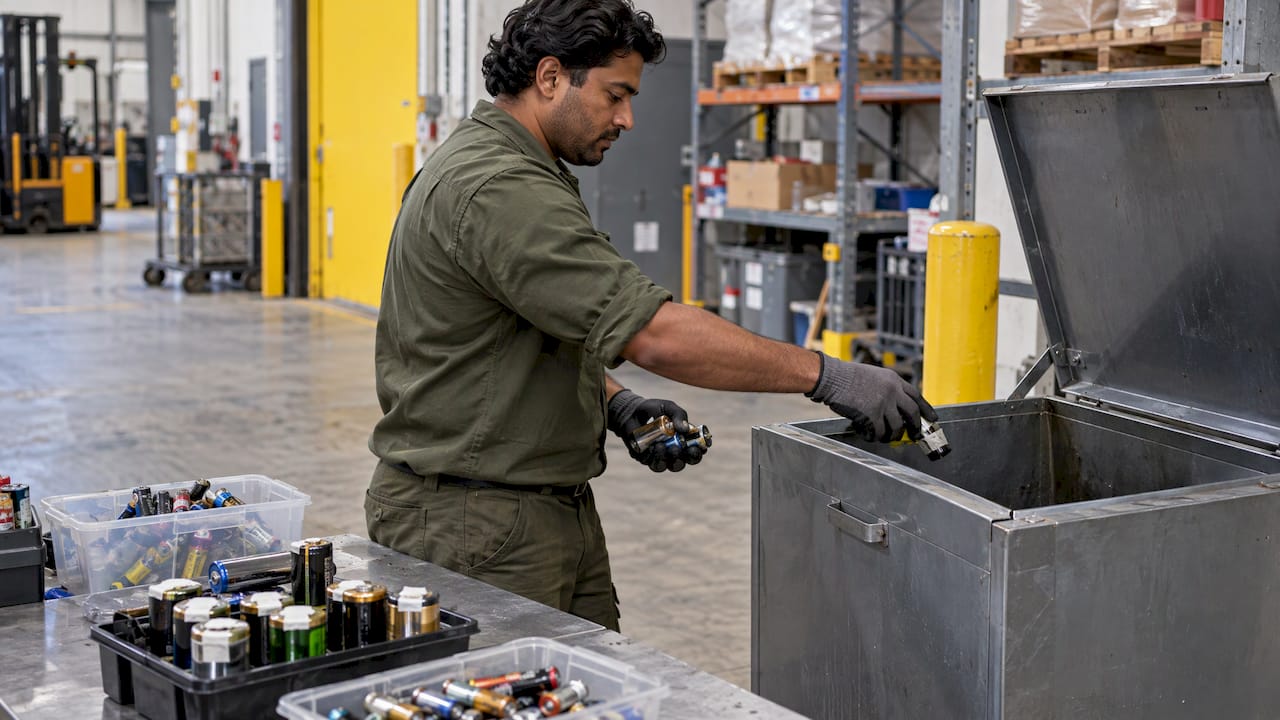
To recycle batteries at work in Australia, keep every used battery out of general waste and recycling bins. Tape the terminals, store the batteries in a cool, dry, fire-resistant container, and send them to a drop-off point or a collector under the national B-cycle scheme. Larger lead-acid, vehicle and industrial batteries need separate handling and a licensed transporter. This guide covers what each route accepts, how to store batteries before collection, which NSW and Victorian rules matter, and what to do when a battery fails.
Published 6 November 2026 by the Sydney City Rubbish team.
TL;DR
- Small batteries (AA, AAA, button, power banks, removable power tool and e-bike batteries) can go to a B-cycle drop-off point. Drop-off is free up to 5 kg.
- Tape the terminals, use a fire-resistant container, and never use paper bags. Keep the container away from heat and sunlight.
- Lead-acid and large lithium-ion batteries are regulated dangerous goods. They need correct storage, packaging and, in some cases, licensed transport.
- If a battery swells, smokes or overheats, evacuate and call Triple Zero (000). Do not try to put out a lithium-ion fire.
- Sydney businesses with mixed commercial waste can have batteries removed alongside a clean-out or strip-out.
Table of Contents
- Why batteries do not belong in the bin
- Which workplace batteries can be recycled
- How to collect, sort and store used batteries
- Ways to get batteries recycled
- Larger batteries and the rules that apply
- What to do when a battery fails
- A simple workplace battery plan
- Have batteries removed with your next clear-out
- FAQ
- Sources
Why batteries do not belong in the bin
Most workplaces hold more batteries than anyone realises. They sit in remote controls, scanners, torches, wireless headsets, power banks, cordless tools and the e-bikes and e-scooters staff ride to work. When they die, they often end up in a desk drawer or, worse, the general waste bin.
The problem is physical as well as environmental. B-cycle explains that used batteries can be crushed or damaged during collection and processing, which causes sparks and fires. In landfill they can corrode and release hazardous materials into soil and waterways. Many battery types contain toxic metals such as cadmium, mercury and lead, while others hold valuable materials such as zinc and manganese. Recycling keeps the toxic metals out of landfill and recovers the useful ones.
Lithium-ion batteries carry the highest fire risk. A battery that looks dead can still hold charge. When damaged, it can overheat quickly and set off a chain reaction known as thermal runaway. For a commercial site, one fire in a bin room or a waste truck can mean an evacuation, damaged stock and a call to the insurer.
Which workplace batteries can be recycled
The answer depends on size, chemistry and whether the battery can be removed from the device.
Small and handheld batteries
The national scheme accepts standard-size handheld batteries including AA, AAA, C, D, 9V, 6V and button batteries. It also takes rechargeable handheld batteries of all chemistries up to 5 kg, batteries that a person can remove from power tools and digital cameras, and e-micromobility batteries from e-bikes and e-scooters. Power banks and removable hearing aid batteries are covered too.
For offices, retail stores and warehouses, this covers the bulk of what accumulates: alkaline cells from equipment, rechargeable packs from tools and scanners, and button cells from keyfobs and small electronics.
What the scheme does not take
Drop-off points do not accept batteries from vapes, solar panels, home energy storage systems or caravans. They also refuse batteries embedded in devices. B-cycle directs people to their local council or transfer station for those items. Embedded batteries are a particular concern. The NSW EPA warns that e-cigarettes and disposable vapes contain a heating element and a lithium battery that can readily ignite during collection or processing.
The NSW EPA’s guidance also notes that large removable household batteries of 5 to 20 kg, such as e-scooter, e-bike, vacuum cleaner and large power tool batteries, can go to a Community Recycling Centre or Household Chemical CleanOut event. Check the EPA page for how that applies to your situation, as those services are designed with households in mind.
Car, lead-acid and industrial batteries
Lead-acid batteries from vehicles, forklifts, backup power systems and alarms sit outside the handheld scheme. They are dangerous goods and are regulated for storage and transport, which the sections below explain. If your business runs vehicles or equipment, see our guide to safe car battery disposal in Sydney.
How to collect, sort and store used batteries
A good battery process is simple and set up once. Put a labelled container in the places where batteries are swapped out: the IT cupboard, the maintenance room, the stockroom and the kitchen. Give one person responsibility for emptying it into the central storage container.
Prepare each battery
B-cycle advises staff to tape the terminals of used batteries with clear sticky tape to prevent short circuits. This applies to AA, AAA, button, 9V and lithium or rechargeable batteries. Store them in a fire-resistant container such as a glass jar, in a cool, dry place. Do not put them in paper bags, which create a fire hazard.
For larger volumes, the Victorian EPA’s storage guideline recommends plastic or cardboard UN-approved containers, non-conductive tape over terminals, and containers with adequate ventilation. It says to avoid metal containers and to fill empty space with non-conductive, non-combustible cushioning such as sand or vermiculite. Sort batteries by chemistry rather than mixing them in one bin.
Choose the storage location
The same guideline sets out what a battery storage area should have: ventilation, signage, impermeable floor and wall surfaces, weatherproof cover, containment such as a bunded area, fire detection and unobstructed access to dry powder fire extinguishers. It also recommends an emergency management plan that is reviewed and tested with staff. The guideline was written for Victoria, but the practices are sensible for any Australian workplace.
B-cycle’s own code of practice for drop-off points is a useful benchmark. Bins must be in a safe, visible, well-ventilated area, indoors or undercover, away from direct sunlight or heat, in a fixed spot that is easy for collectors to reach. That rules out loading docks in full sun, car park corners and the back of a hot storeroom.
Facilities that handle many batteries, such as logistics and fleet depots, will find practical detail in this guide to battery storage and fire prevention for fleets, including approved collection bins.
Reduce charging risk
WorkSafe Victoria issued a safety alert after a lithium-ion battery fire. It recommends employers install smart chargers or software that monitor battery status and disconnect power if a fault is detected. It also advises storing and charging equipment in a dedicated fire-resistant area separated from people, and setting up a system to inspect and remove damaged batteries.
In practice, that means not charging e-bikes or scooters under desks or in exit paths, and not leaving chargers running overnight in a storeroom full of cardboard.
Ways to get batteries recycled
There are three practical routes for a business. Pick based on volume and how much handling you want to do.
Drop off at a B-cycle point
B-cycle is Australia’s official product stewardship scheme for batteries, authorised by the ACCC. It lists more than 6,000 drop-off locations, and 95% of Australians live within a 15-minute drive of one. Drop-off is free up to 5 kg, which suits a small office that collects a jar of batteries over a few months.
This route suits small volumes, but it does need someone to do the trip. Add it to the office manager’s routine rather than leaving it to chance.
Become a drop-off point with a collector
Businesses that go through a lot of batteries can become accredited drop-off points and work with an accredited collector. Collectors transport batteries in bulk to a recycler, and their fee is substantially subsidised by B-cycle rebates.
The scheme sets safety conditions. Batteries must be collected at least every 12 weeks, and more frequent collection can be agreed with the collector. Drop-off point managers must complete mandatory B-cycle safety training. Collectors take a geo-tagged photo of each bin pick-up as proof of collection.
Use a prepaid fire-resistant box service
Some national services post a certified fire-resistant box to your workplace. One example is listed on Recycling Near You at $99.95 including GST per box, which holds up to 15 kg or around 1,300 AAA batteries, with prepaid delivery and return shipping anywhere in Australia. It accepts lithium-ion, nickel cadmium, nickel metal hydride, alkaline and other handheld types, but not plastic, metal, glass, liquids, chemicals or food. Check the provider’s page for the current price and terms before you order.
This route suits businesses with several sites, or sites with no accredited drop-off point nearby, because staff pack the box and post it rather than travelling.
E-bike and e-scooter batteries
Delivery riders, couriers and staff who commute by e-bike add a battery stream that most offices have not planned for. Removable e-micromobility batteries fall within the national scheme, and this overview of e-bike battery recycling options explains how they are recycled and why they must not go into household waste.
Larger batteries and the rules that apply
Once batteries are large, or you hold a lot of them, the rules change. The details differ by state, so confirm with your own regulator.
Lithium-ion in bulk
The Victorian EPA guideline classes lithium-ion batteries as Class 9 dangerous goods under the ADG Code. Containers of smaller packaged lithium-ion waste batteries should not exceed 30 kg. Larger batteries, such as those from electric vehicles, may need wrapped pallets. Facilities should consider keeping them at least 10 m from other dangerous goods and combustible or flammable materials.
In NSW, Fire and Rescue NSW recommends that sites with a combined total of 25,000 kg or more of lithium batteries being used, handled, stored or installed meet the requirements of clause 361 of the WHS Regulations 2017. That includes lodging an emergency plan and Emergency Services Information Package. The position statement took effect on 5 December 2024.
Lead-acid batteries
The Victorian guideline says used lead-acid batteries should be stored separately, upright on a pallet in no more than two layers, then wrapped and secured with non-conductive strapping for transport. In Victoria, lead-acid and nickel-cadmium batteries are reportable priority waste when consigned for transport, which requires a Waste Tracker record.
In NSW, an environment protection licence is required to transport loads exceeding 200 kg of waste lead acid batteries. Moving them between NSW and another state or territory requires tracking. For that reason, use a transporter that holds the right licences instead of loading them onto your own vehicle.
What to do when a battery fails
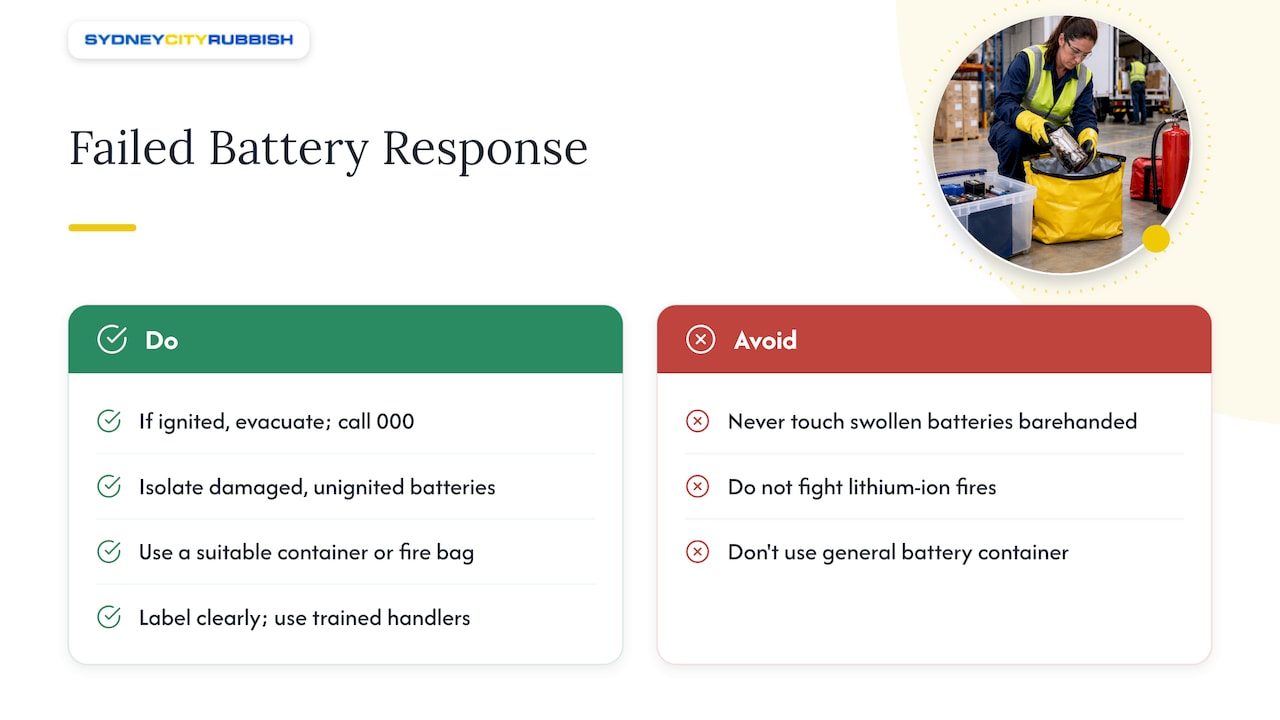
Train staff to recognise the warning signs. Fire and Rescue NSW lists pungent odours, discolouration, blistering, bulging or swelling of the casing, leaking electrolyte, extreme heat and popping, hissing or crackling sounds. Staff should never touch a swollen or ruptured battery with bare hands.
If a lithium-ion battery catches fire or explodes, SafeWork NSW advises people to not attempt to put out the fire, evacuate the area and call Triple Zero (000) immediately. Put that instruction in your emergency plan in plain words.
For a damaged battery that has not ignited, the same SafeWork NSW page advises isolating it from other materials. Store it in a suitable container or fire-resistant bag in a cool, dry, well-ventilated area, label it clearly, and have it handled by personnel trained in emergency response. Do not drop it into the general battery container with everything else.
A simple workplace battery plan
Start with an audit. Walk the site and note where batteries are used, charged and discarded. Include vehicles, tools, security systems, backup power and staff e-bikes. This usually shows one or two hotspots, often the IT room and the maintenance area.
Next, set up labelled collection points, assign a person to manage them, and choose your recycling route based on volume. Set a collection schedule that never exceeds 12 weeks, in line with the B-cycle standard. Then write the failed-battery response into your emergency procedures and brief staff.
Batteries rarely arrive alone. They turn up in office clear-outs, tenancy handbacks, warehouse make-goods and strip-outs, mixed in with old monitors, cabling and furniture. Our team at Sydney City Rubbish removes hazardous materials, including batteries, as part of commercial rubbish removal across Sydney, and we use registered recycling partners for responsible disposal. If you are also clearing end-of-life IT equipment, see our page on business computer recycling in Sydney. You can read more about what we take on our batteries page.
Have batteries removed with your next clear-out
If your office, retail space, construction site or strata building has batteries stacking up alongside other waste, we can coordinate directly with building management for access, quote quickly online and clean up thoroughly. Carbon-neutral removal is available as an opt-in for corporate clients. See our commercial waste removal service or the full list of what we do. Get a free quote now.
FAQ
Can I put used batteries in the recycling bin at work?
No. Used batteries should never go in general waste or mixed recycling bins, because they can be crushed or damaged during collection and processing, causing sparks and fires. Take them to a B-cycle drop-off point or use a collection service instead.
How many batteries can a business drop off for free?
B-cycle drop-off is free up to 5 kg. Above that, businesses can become drop-off points with an accredited collector, whose fee is substantially subsidised by B-cycle rebates, or use a prepaid box service for larger volumes.
How should we store batteries before they are collected?
Tape the terminals with clear sticky tape and store the batteries in a fire-resistant container, in a cool, dry and well-ventilated place away from heat and sunlight. Do not use paper bags. Sort by chemistry where you can, and arrange collection at least every 12 weeks.
What should we do with a swollen or hot battery?
Do not touch it with bare hands. Isolate it from other materials in a fire-resistant container or bag, in a cool, well-ventilated place, and label it. If it smokes or catches fire, evacuate and call Triple Zero (000) without trying to extinguish it.
Do lead-acid batteries follow the same rules?
No. Lead-acid batteries are dangerous goods with their own storage and transport rules, which vary by state. In NSW, loads over 200 kg need an environment protection licence to transport. Use a licensed transporter and confirm requirements with your state EPA.
Sources
- B-cycle Resource FAQs
- B-cycle: battery types accepted
- B-cycle Industry FAQs
- Find a B-cycle drop-off point
- B-cycle Drop off point Code of Practice
- Recycling Near You: single-use batteries
- Recycling Near You: prepaid battery box listing
- NSW EPA: Never bin a battery
- NSW EPA: Waste lead acid batteries
- EPA Victoria: Storage and Management of Waste Batteries Guideline
- WorkSafe Victoria: Lithium-ion battery catches fire
- SafeWork NSW: Lithium-ion batteries
- Fire and Rescue NSW: What to do if your battery is smoking or on fire
- Fire and Rescue NSW: Position statement on lithium battery sites
- Fleet battery maintenance explained
- E-bike battery recycling options