Retail Strip Out Cost in Sydney: What You’ll Pay Per m²
Most published guides put a retail strip out in Sydney at roughly $40 to $100 per square metre, rising to $80 to $150 or more per square metre once services removal is involved. Those are guide figures, not quotes. The number you actually pay depends on your lease make good clause, how dense the fit-out is, how the waste leaves the building and whether asbestos is present. This guide explains each of those drivers, shows a worked example and sets out how to get a quote you can rely on.
TL;DR
- Published Sydney guides range from about $40 to $100 per m² for a retail strip out, and higher where services are removed or the job is a full reinstatement.
- Your lease make good clause often decides the scope more than floor area does: broom clean handover and return to base building are very different jobs.
- Shopfronts, signage, joinery, access windows, asbestos and waste disposal are the usual reasons one retail quote differs from another.
- A site inspection and a written scope tied to your lease are the most reliable route to a firm price.
- Sydney City Rubbish handles strip out and waste removal together, with quotes prepared per project.
Table of Contents
- What a retail strip out costs per square metre
- Why retail costs more than office work
- What is included in a retail strip out
- The factors that move your quote
- Asbestos and hazardous materials
- How long a retail strip out takes
- How to get an accurate quote
- Get a retail strip out quote in Sydney
- FAQ
- Sources
What a retail strip out costs per square metre
There is no single rate, and the published ranges differ because they describe different scopes. Here is what Australian contractors and fit-out firms have published for 2026.
| Scope described | Published range | Basis |
|---|---|---|
| Retail strip out, Sydney | $40 to $100 per m² | Sydney strip out guide |
| Complex project including services removal | $80 to $150+ per m² | Sydney strip out guide |
| Commercial strip out and defit, Australia | $80 to $180 per m², excluding GST | Strip out and defit cost guide |
| Basic strip out and clean (make good), Sydney | $50 to $100 per m² | Sydney make good guide |
| Moderate make good with partitions and service reinstatement | $100 to $200 per m² | Sydney make good guide |
| Full reinstatement to base building | $200 to $350 per m² | Sydney make good guide |
Read the table as a map of scope rather than a price list. The low end of the $80 to $180 range covers an open-plan space with a suspended ceiling and carpet, worked during business hours. The high end covers a fully partitioned tenancy with extensive joinery and after-hours access only, according to the same cost guide. A retail tenancy with a glazed shopfront, timber feature walls and a mezzanine sits much closer to the top of that spectrum than a bare shell with a few shelving units.
A worked example
Take a 150 m² shop. At the $40 to $100 per m² retail range, the strip out alone works out at $6,000 to $15,000. At $80 to $180 per m², the same shop comes to $12,000 to $27,000 before GST. That is an illustration of the arithmetic, not a quote. The gap between the two results shows why a per-square-metre figure is only useful once you know what it includes.
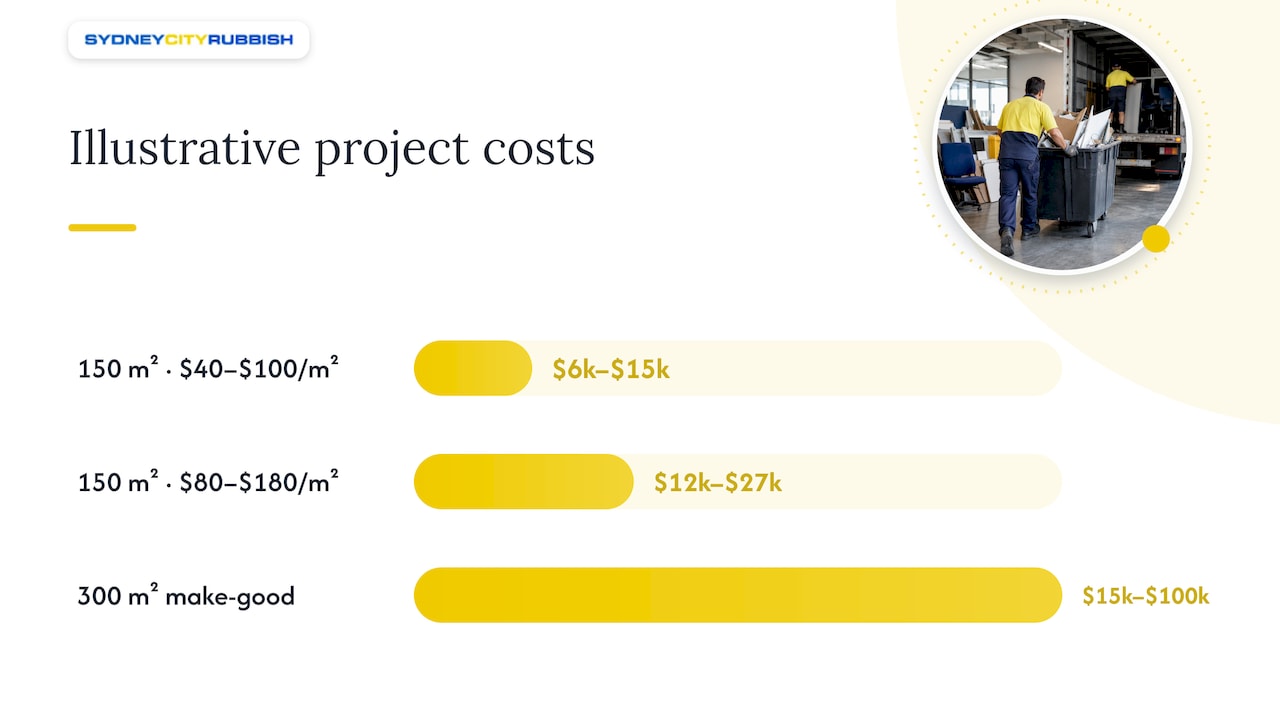
For larger make good projects, one Sydney fit-out firm suggests a 300 m² tenancy should budget between $15,000 and $100,000 depending on scope. A spread that wide is normal when the scope runs from a clean and repair to a full return of the premises to base building condition.
Why retail costs more than office work
Retail premises tend to cost more to strip out than offices. Make Good Quotes explains that shopfitting, joinery, signage and specialty finishes take longer to remove and dispose of, and that retail jobs often run on tighter access windows set by the shopping centre.
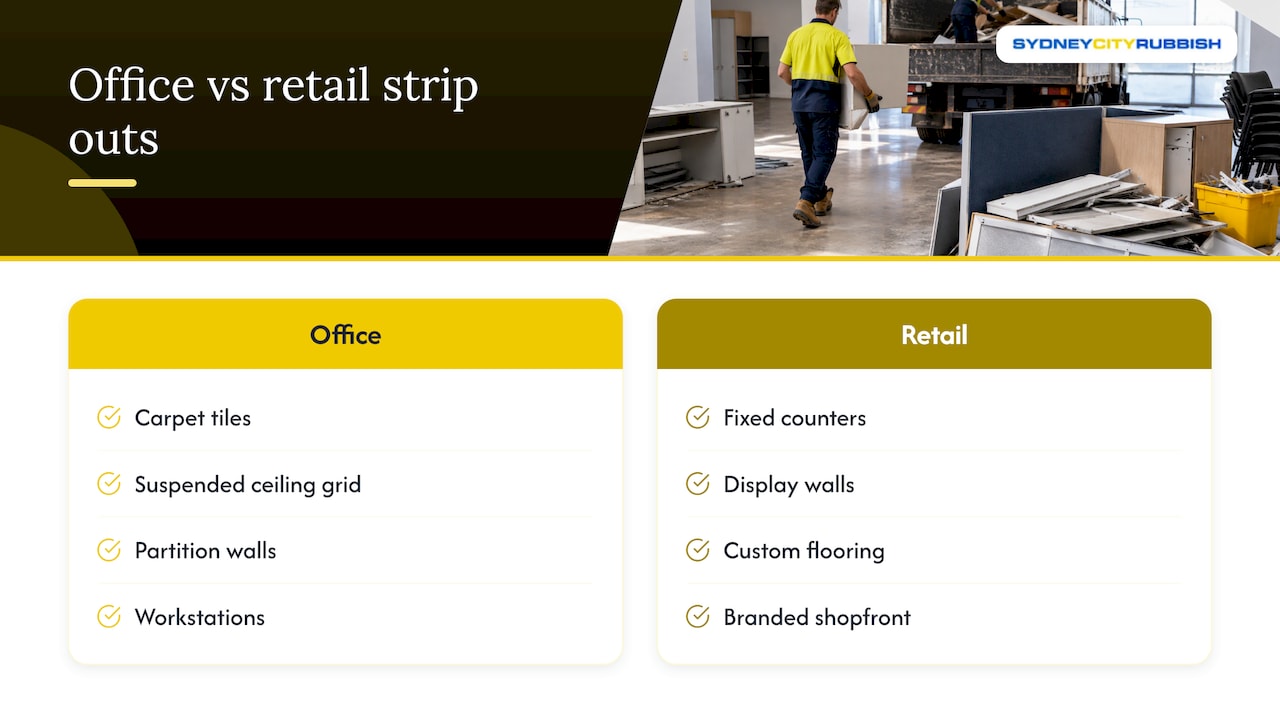
That matches what crews see on site. An office strip out is mostly carpet tiles, a suspended ceiling grid, partition walls and workstations. A retail fit-out brings fixed counters, cash wrap, display walls bonded to the wall lining, feature lighting, custom flooring and a branded shopfront. Each of those is heavy, awkward to carry through a mall and has to be broken down into loads that suit the loading dock rather than the job.
If you are comparing retail with office pricing, the same source advises quoting both against the same make good schedule so you can see the difference for your own space.
What is included in a retail strip out
The lease determines the required scope. Typically a retail defit covers removal of fixtures, fittings, joinery and signage, services made safe, make good of walls, floors, ceilings and penetrations, and waste segregation and disposal.
Two points follow from that. First, strip out is only the demolition stage of a wider defit. If your lease requires you to hand back patched walls, painted surfaces or a reinstated ceiling, that work is priced on top of the removal. Second, bundling removal, services make safe, waste handling and make good into one coordinated scope can reduce the number of trades on site and the risk at handover, a point made in retail defit guidance.
Services need particular care. Electrical, hydraulic and mechanical systems may need isolation, hydraulic capping and mechanical decommissioning by licensed trades. A shop with a coffee machine, a sink in the back room or split-system air conditioning will have this line in its quote.
At Sydney City Rubbish, our building strip out and makegood and de-fit services cover ceilings, walls and doors, furniture and joinery removal, and floor finish removal, with the waste taken away by the same team. Our retail strip out process page walks through how a retail job runs from inspection to handover.
The factors that move your quote
Strip out pricing is driven by fit-out density and type, shopfront and signage removal, joinery, flooring, ceiling systems, service complexity, waste volume and material type, access, location, working hours and the required handover standard. The ones that most often separate two quotes for the same shop are below.
Your lease make good clause
This is usually the largest variable. One tenancy may only require broom clean handover and minor repairs, while another may require a return to base building or shell condition, including services and finishes. Two shops of identical size can therefore carry very different prices.
The NSW Small Business Commissioner explains that make good provisions typically require the tenant to return the premises in a similar condition to the start of the lease. Retail leases often add that if landlord and tenant cannot agree on make good costs, an independent certified quantity surveyor nominated by an industry body makes a binding determination. Read your clause before you ask anyone to price the job, and give the contractor a copy.
Access, lifts and working hours
Limited goods-lift access can add a 15% to 25% premium. In shopping centres and CBD arcades, work is often restricted to after-hours windows, loading dock bookings and protected common-area routes. The charges that sit outside a per-square-metre rate commonly include after-hours work, lift bookings and protection to common areas.
When we coordinate directly with building management, access, dock times and protection requirements are settled before the crew arrives, which keeps these costs predictable.
Density of the fit-out
Floor area alone cannot tell a contractor how much there is to remove. A site inspection matters because area does not reveal fit-out density, concealed services, access constraints, hazardous materials or the landlord’s handover requirements. A sparse boutique and a crowded fashion store of the same size are different jobs.
Waste volume and disposal
Disposal is billed by weight and by waste stream, so heavy materials such as plasterboard, masonry and timber joinery carry different costs from light fittings and packaging. Waste levies and disposal charges are among the items that typically sit outside the headline strip out rate.
This is where combining strip out and waste removal makes sense. We use registered recycling partners for responsible disposal, and our guidance on separating construction and demolition waste explains why sorting on site helps keep loads moving through the right streams.
Floor finishes and concrete
Glued vinyl, epoxy coatings, tiles and polished screeds can add time, especially when the lease wants the slab returned to a particular condition. We offer floor finish removal and grinding, plus concrete cutting and core drilling where a slab needs to be opened for service reinstatement. These sit on our what we do page.
Asbestos and hazardous materials
If your shop sits in an older building, asbestos has to be settled before demolition starts, and it affects both cost and timing. In NSW, where asbestos is identified, the person with management or control of the workplace must ensure an asbestos register and an asbestos management plan are prepared.
For commercial buildings constructed or refurbished before 31 December 2003, the register and plan must be reviewed before demolition or refurbishment, and asbestos likely to be disturbed should, so far as reasonably practicable, be removed before work begins.
Removal itself is licensed work. SafeWork NSW states that you need a Class A licence to remove any amount of friable asbestos, and a Class B licence to remove more than 10 m² of non-friable asbestos. Friable and non-friable material are treated differently, and an air monitoring and clearance process normally follows removal before other workers re-enter the area.
Older Sydney CBD buildings in particular may contain asbestos that requires licensed contractors and substantially increases cost and timeline. Ask your building manager for the asbestos register early and pass it to your contractor with the lease. For the rules on handling and disposal, see our guide to asbestos disposal regulations in NSW. Other hazardous items found in retail tenancies, such as old fluorescent tubes, chemicals and electronics, also need their own disposal route.
Services work can add a further line. Mechanical decommissioning and HVAC reinstatement typically run $30 to $80 per m² on their own, which is why a 500 m² tenancy can spend $15,000 to $40,000 on that item alone when the lease requires it.
How long a retail strip out takes
Timeframe depends on the same things as price: fit-out density, floor area, access windows, services isolation and whether hazardous materials need to be cleared first. A small shop with simple fittings and open loading access can be cleared quickly. A multi-level or heavily fitted tenancy with after-hours restrictions takes longer, and asbestos removal and clearance add a separate stage ahead of general strip out.
The practical point is that time on site affects cost, because crews, trucks and dock bookings are billed against it. Our retail strip out process guide sets out how we sequence inspection, approvals, removal and handover so the job fits your lease end date. Build in a margin between the end of works and your handover deadline, because landlord inspections can raise further items.
How to get an accurate quote
Quotes vary most when contractors price without knowing the property type or the handover standard. Give each contractor the same information so the quotes can be compared on a like-for-like basis.
Start with your lease make good clause and any landlord or centre management requirements. Add the asbestos register, if the building has one, and the floor plan with the shop dimensions. Photos of the shopfront, back of house and loading route help, but a site inspection is what turns a range into a figure, because it shows concealed services and access constraints that photos miss.
Then ask for an itemised, written scope. It should state what is being removed, how services are made safe, what happens to the shopfront and signage, how waste is separated and disposed of, what access and after-hours arrangements are assumed, and what condition the premises will be in at handover. If the lease requires a reinstatement, confirm whether patching, painting and ceiling work are in or out. Check whether the price is quoted excluding GST, because most commercial figures are.
Finally, confirm the exclusions. Hazardous materials, services capping, slab penetrations, fire services recertification and waste levies are the usual items that move a quote after work begins when they are not stated up front.
Get a retail strip out quote in Sydney
Sydney City Rubbish works with corporate and commercial clients across Sydney, including retail tenants, property managers and strata managers. We handle strip out, makegood and de-fit, furniture and joinery removal and waste disposal, and we coordinate directly with building management for access. Our quotes are prepared electronically and per project, and we back punctuality with compensation if we are late. Clients can also opt in to carbon-neutral waste disposal.
If you have a lease end date and a make good clause in hand, send us both and we will scope the job against them. Get a free quote now for your retail strip out, or see our commercial waste removal service if the job is mostly waste clearance.
FAQ
How much does a retail strip out cost per square metre in Sydney?
Published Sydney guides put retail strip outs at $40 to $100 per m², with complex projects including services removal at $80 to $150 or more. Other Australian guides quote a wider commercial range of $80 to $180 per m² excluding GST. Your own figure depends on the lease scope, fit-out density and access.
What is included in a retail strip out?
Typically it covers removal of fixtures, fittings, joinery and signage, making services safe, and segregating and disposing of waste. Make good of walls, floors, ceilings and penetrations follows where the lease requires it, as described in retail defit guidance. The lease decides the final scope.
Does asbestos change the cost of a strip out?
Yes, where it is present. Removal must be done by a licensed removalist, and SafeWork NSW sets out the Class A and Class B licence rules. Testing, removal and clearance add both cost and time, so check the building’s asbestos register before you request quotes.
Who decides how much make good work is required?
Your lease does. The NSW Small Business Commissioner notes that retail leases often provide for an independent quantity surveyor to make a binding determination if the parties disagree on make good costs. Give your contractor the clause so the quote matches the handover standard.
Why do retail strip out quotes vary so much?
Contractors often price different scopes. Differences in handover standard, access hours, services work, waste disposal and exclusions can each move a quote, which is why quoting against the same make good schedule gives a fairer comparison.
Sources
- Sydney commercial strip out costs, process and timeline guide
- Strip out and defit cost guide
- Commercial make good costs in Sydney
- Commercial retail defit and make good scope
- Commercial strip out process, cost and timing
- Commercial stripout cost in Australia
- Commercial strip out by property type
- NSW Small Business Commissioner: understanding the costs of leasing
- SafeWork NSW asbestos blueprint
- Asbestos management handbook for commercial property
- SafeWork NSW: working as a licensed asbestos removalist