CBD Waste Rules: 5 Checks Sydney CBD Businesses Need by July 1, 2026
Sydney CBD businesses must arrange a commercial waste collection contract, label and store bins correctly, and prepare for staged FOGO mandates that begin from 1 July 2026. City of Sydney rules require every business to keep contact and service details on hand, while duty of care under NSW law means you remain responsible for your waste even after a contractor collects it. The sections below set out exactly what to check and when.
TL;DR:
- Measure weekly residual bin capacity now: FOGO obligations begin for the largest generators on July 1, 2026, with lower thresholds following in 2028 and 2030.
- Keep contracts, collection dockets, and disposal receipts together; businesses remain legally responsible if a contractor sends waste to an unauthorized facility.
- Placing bins on footpaths or laneways generally requires council approval, while CBD collection time zones may restrict pickup schedules near light rail corridors.
- Keep asbestos, batteries, chemicals, and e-waste out of standard bins; arrange separate specialist disposal and retain records for commercial electronics.
Table of Contents
- What you must do now: a compliance checklist for Sydney CBD businesses
- FOGO mandates: who must comply, staging dates and practical implications for CBD premises
- Bin storage, labelling and placement in public places
- Permits, approvals and collection time zones in the Sydney CBD
- Prohibited, hazardous and restricted wastes for CBD businesses
- Duty of care and contractor due diligence
- Construction and demolition waste disposal requirements in Sydney CBD
- Managing e-waste in commercial settings
- Scheduling commercial waste pickups and choosing collection frequency
- Sustainable and carbon-neutral waste disposal options in Sydney
- How Sydney City Rubbish helps Sydney CBD businesses stay compliant
- FAQ
- Sources
What you must do now: a compliance checklist for Sydney CBD businesses
Most enforcement action against CBD businesses comes from gaps that are simple to close once you know where to look. Start with the basics and work through the detail before the FOGO deadlines tighten things further.
- Arrange and keep a current commercial waste contract, with contact and service details ready to show council on request.
- Label every bin with your business name, address and contractor details, as recommended by City of Sydney, which also advises storing bins inside your premises where possible.
- Keep bin lids closed and bins clean. Loose waste or bags left beside a bin counts as illegal dumping under City guidance.
- Present bins only during your authorised collection window and bring them back inside immediately after pickup.
- Keep every collection docket, weighbridge receipt and disposal record on file for at least the period your contract or council requires.
A few extra habits make the difference between a tidy audit trail and a scramble when council asks questions:
- Photograph your bin room setup once a quarter so you have a record of compliant storage.
- Nominate one staff member to own the waste contract and renewal dates.
- Check your weekly residual bin capacity now, because that figure determines when FOGO mandates apply to your site.
Pro Tip: Keep a single folder, digital or physical, with your waste contract, labels template and the last six months of collection dockets. It is the first thing an inspector or auditor will ask for.
FOGO mandates: who must comply, staging dates and practical implications for CBD premises
NSW has staged mandates requiring many businesses to separate food organics from general waste, with the largest generators captured first from 1 July 2026 and further thresholds applying through to 1 July 2030, according to EPA NSW. The staging is tied to weekly residual bin capacity rather than business type, which means a busy CBD café can be captured at the same time as a large institutional kitchen.
Businesses most likely to be captured early include:
- Supermarkets and large grocery retailers with high food turnover.
- Hospitality venues with commercial kitchens, including hotels and large cafés.
- Institutions such as hospitals, universities and aged care facilities.
The first weekly residual capacity threshold for FOGO mandates applies from 1 July 2026, with lower thresholds following in 2028 and 2030, per EPA NSW. That figure sounds generous until you measure it against a CBD food business running multiple bins a week.
For CBD bin rooms and loading docks, the practical issues are space, collection frequency and odour control. A food organics stream usually needs its own labelled bin, often collected more frequently than general waste, which can strain tight basement storage. The sensible next step is to audit your current volumes against the threshold, then speak to your council and your waste contractor about adding a FOGO collection before the deadline forces the conversation.
Bin storage, labelling and placement in public places
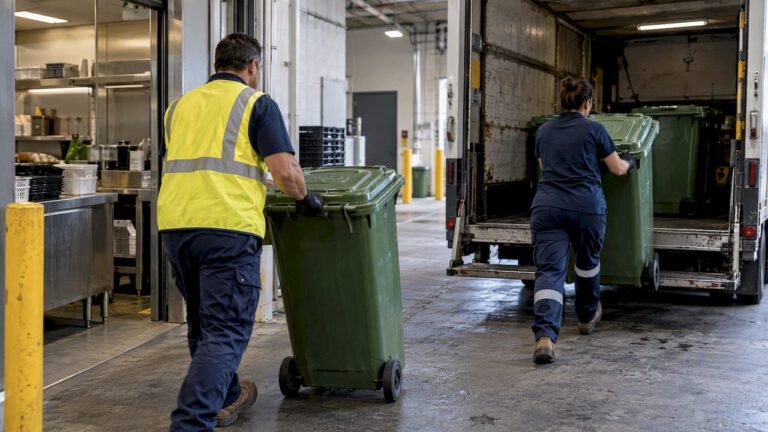
City of Sydney requires all commercial waste to be stored and presented so that every item sits fully inside a bin with the lid closed, and treats loose waste as illegal dumping. The rules are straightforward, but they are also where most minor breaches happen.
- Label bins clearly with your business name, address and the servicing contractor, and order replacement labels from council when they fade.
- Keep lids fully closed at all times, and ensure large bins have working brakes and reflectors where fitted.
- Never place bags, boxes or loose items on top of or beside a bin: anything not fully contained counts as illegal dumping.
- Store bins inside your premises or in a dedicated bin room wherever possible, out of public view, to avoid neighbour and pedestrian complaints.
Good bin discipline also protects you from a related, separate offence: placing your waste in someone else’s bin without permission is treated as illegal dumping under NSW law, regardless of intent.
Permits, approvals and collection time zones in the Sydney CBD
Placing commercial waste in a public place, such as a footpath or laneway, generally requires council approval unless your situation falls under a specific exemption set out in the Local Approvals Policy. The policy also defines collection time zones across the CBD, which dictate when trucks can legally collect from different precincts.
- Check whether your collection point is within an approved time zone before locking in a schedule with your contractor.
- Confirm whether your situation needs a special approval, particularly if your building fronts a light rail corridor or a high-pedestrian laneway.
- Lodge any bin-placement or special-approval request with supporting evidence, such as a site plan and your waste contractor’s details.
- Coordinate directly with your building manager and transport operator so collection times do not clash with light rail movements or loading dock restrictions.
Getting this sequence right the first time avoids repeat applications and keeps your collections running on schedule. We cover the finer detail of navigating waste removal permits in the Sydney CBD if your site needs a closer look.
Prohibited, hazardous and restricted wastes for CBD businesses
Some materials must never enter your general or recycling bins, regardless of how small the quantity.
- Asbestos must be removed by a licensed contractor and transported to a licensed facility; it must never go in a kerbside or public bin, as outlined in council guidance on licensed asbestos disposal.
- E-waste and batteries need a dedicated drop-off point or a contractor-managed collection, never the general waste stream.
- Chemicals, solvents and other hazardous liquids require specialist handling and documented disposal.
- Many “compostable” cups and packaging are not accepted in commercial FOGO or recycling systems because they fail contamination checks at the processing facility.
Store any of these materials safely and separately until a specialised collection can be booked, rather than letting them accumulate near general waste bins.
Duty of care and contractor due diligence
Under NSW law, the owner of the waste and the waste transporter can both be found guilty of an offence if that waste ends up at a facility that is not authorised, according to Service NSW. That means handing waste to a contractor does not end your legal responsibility: you need evidence that it was disposed of lawfully.
Documents worth demanding from any contractor include:
- A signed collection contract setting out scope, frequency and FOGO handling procedures.
- Weighbridge dockets or disposal facility receipts for each collection.
- Current insurance certificates and, for hazardous streams, a written procedure for handling and transport.
- A clear facility name and licence reference for every load, not a vague description.
Pro Tip: Ask any prospective contractor for a sample weighbridge docket before you sign. A contractor who can produce one instantly is usually the one who already runs a compliant operation.
Vague answers about where waste actually ends up are the clearest red flag. Collection dockets and disposal receipts are provided after every job, which gives building managers and finance teams the paper trail duty of care requires.
Construction and demolition waste disposal requirements in Sydney CBD
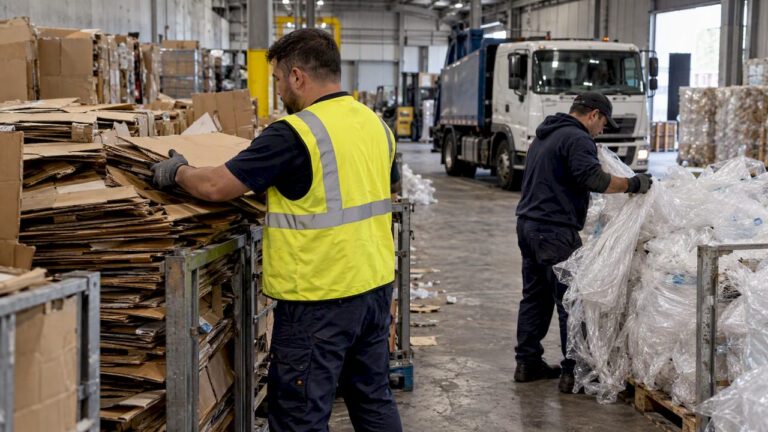
Construction and demolition (C&D) waste from fit-outs, strip-outs and renovations in CBD buildings is treated separately from general commercial waste, and most sites generate a mix of timber, plasterboard, metal, concrete and packaging that each has its own recycling pathway. The Better practice guide for commercial and industrial waste from EPA NSW recommends separating C&D streams at source wherever site space allows, since mixed loads are harder and costlier to recover at a sorting facility.
For CBD sites, the practical constraint is almost always space: a loading dock built for retail deliveries rarely has room for multiple skips. A staged approach, where smaller sealed bins are swapped more frequently rather than one large skip sitting on site, tends to work better in tight CBD buildings.
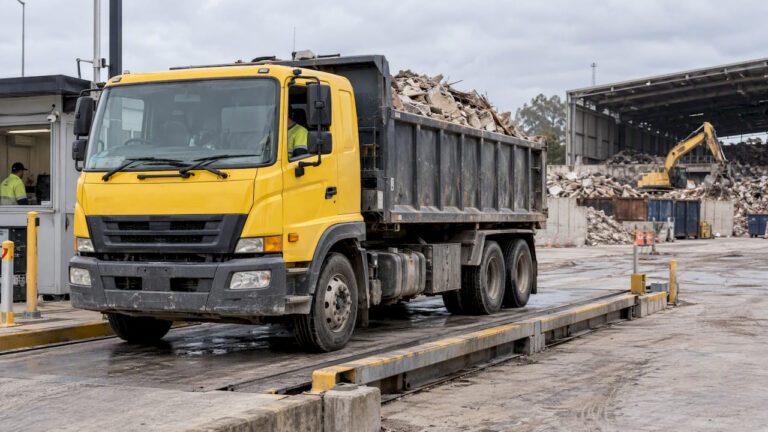
Any C&D waste still needs to go to a licensed facility, and your contractor should be able to confirm which one before the job starts. We manage construction waste disposal for fit-outs and demolitions across the CBD, separating recoverable materials from residual waste on site so building managers get a clean, documented outcome rather than a mixed skip heading to landfill.
Managing e-waste in commercial settings
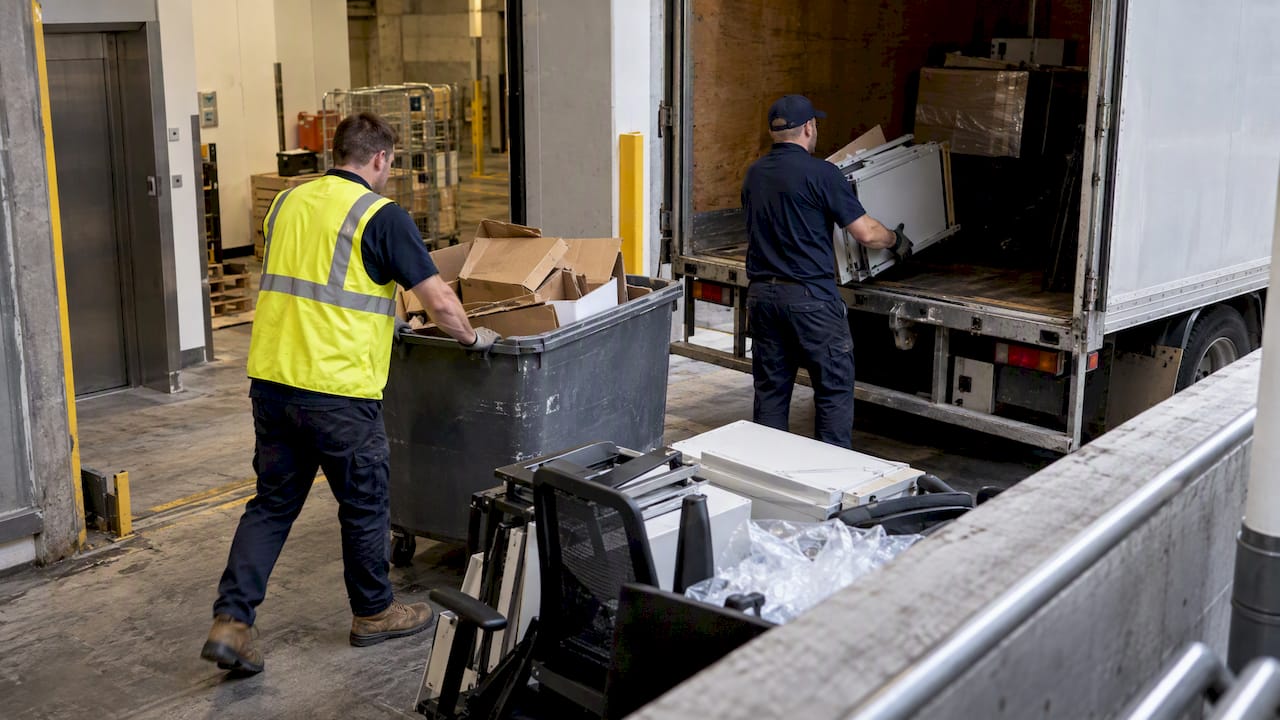
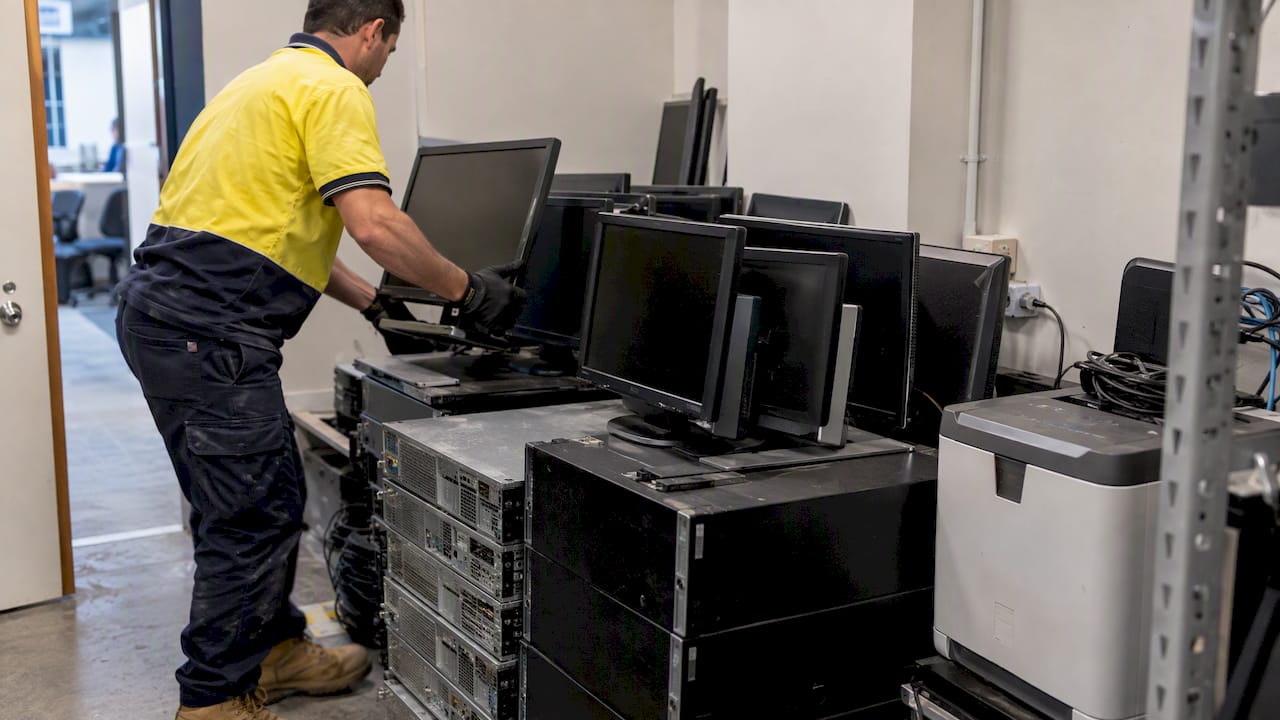
Office equipment, monitors, servers and old appliances fall under e-waste rules that are separate from general recycling, and dumping them in a standard bin is both a compliance risk and a missed recovery opportunity, since most electronic components contain materials that can be recovered rather than landfilled. Retailers including Bunnings accept small household e-waste items such as batteries and light globes through in-store drop-off points, but larger commercial volumes, including decommissioned IT equipment and office appliances, are better suited to a contractor-managed collection that can handle bulk quantities and provide disposal evidence.
For a CBD office or retail fit-out clearing out old electronics, the safest approach is to keep e-waste separate from general waste from the moment it is decommissioned, store it in a dedicated area, and book a collection specifically for that stream. We outline practical steps for avoiding improper e-waste disposal when clearing office or retail electronics, which is worth a read before a large decommissioning project begins.
Scheduling commercial waste pickups and choosing collection frequency
Collection frequency depends on your waste volume, available storage space and the streams you need collected, whether that is general waste, recycling, FOGO or a one-off construction clear-out. Most CBD businesses settle into a weekly or twice-weekly general waste collection, with FOGO added as a separate, often more frequent, stream once volumes justify it.
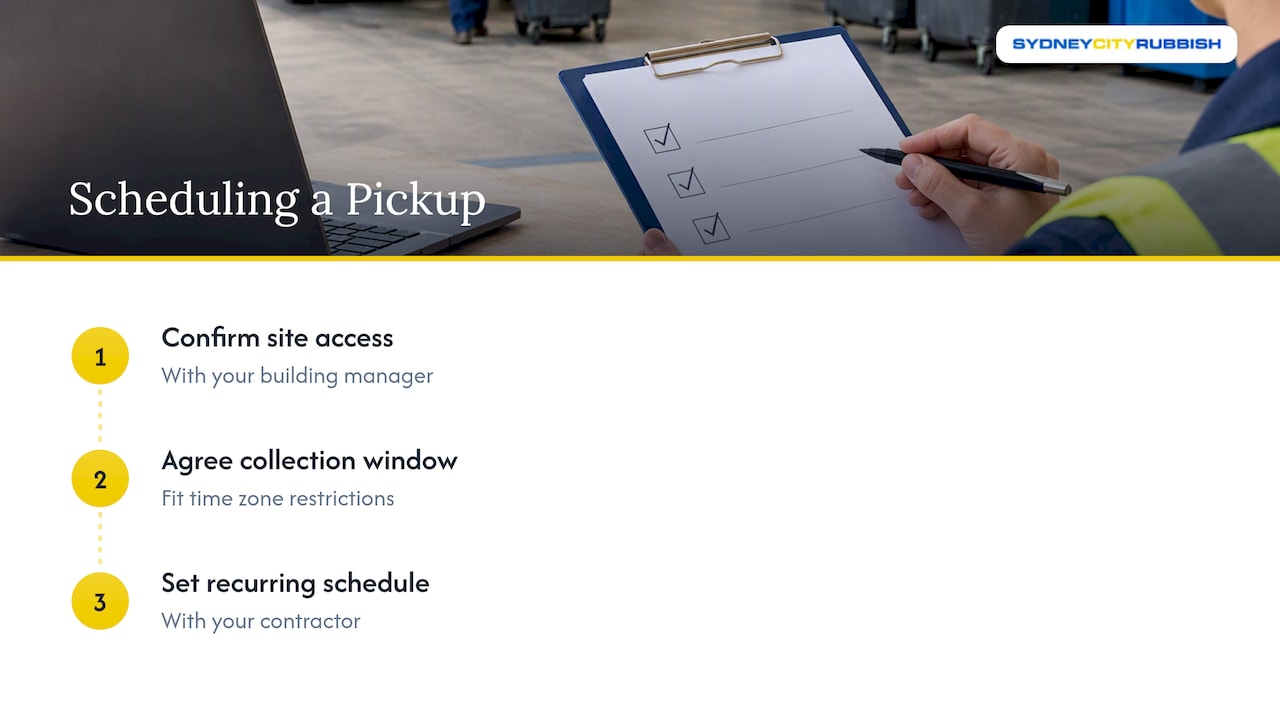
Scheduling a pickup typically means confirming your site access arrangements with your building manager, agreeing a collection window that fits the relevant time zone restrictions, and setting a recurring schedule with your contractor rather than booking ad hoc. One-off jobs, such as a post-renovation clear-out or an end-of-lease clean, are usually booked separately and priced per load. We detail recurring and one-off options through our commercial waste collection and disposal service, including how documentation is provided after each pickup.
Sustainable and carbon-neutral waste disposal options in Sydney
Sustainable waste management for CBD businesses generally means three things: diverting as much material as possible from landfill, choosing contractors who use licensed recycling facilities, and, where available, opting into carbon-neutral disposal arrangements. None of these require a business to overhaul its operations overnight, but they do require choosing a contractor that actually tracks where waste ends up.
A carbon-neutral opt-in is offered for corporate clients through a partnership with Carbon Neutral, giving businesses a straightforward way to offset their waste footprint without changing how collections run day to day. For a CBD office or retail tenant, that usually sits alongside standard waste separation, which is the simpler of the two components and makes the biggest practical difference when recycling streams are kept clean and uncontaminated.
How Sydney City Rubbish helps Sydney CBD businesses stay compliant
The commercial service is built around the exact checklist above: compliant collections, clear documentation and a contractor relationship that holds up under council scrutiny. For CBD offices, retail tenancies, construction sites and strata buildings, that means:
- Scheduled or one-off commercial collections, including general waste, construction debris and food organics.
- Hazardous and e-waste handling, diverted to appropriate licensed facilities rather than mixed with general waste.
- Weighbridge dockets and disposal receipts supplied after every job, so you have duty of care evidence on file.
- A carbon-neutral disposal opt-in through our Carbon Neutral partnership, for businesses that want a lower-footprint result.
We also coordinate directly with building management to handle CBD access and collection windows, so your team is not left negotiating permits on top of everything else. Request a quote through our commercial waste removal Sydney page and we will confirm scheduling, documentation and sustainability options before the first collection.
FAQ
What are the new recycling rules in 2026?
From 1 July 2026, NSW businesses that generate above a set weekly residual waste threshold must separate food organics from general waste under staged FOGO mandates. Further thresholds apply in 2028 and 2030, gradually capturing smaller generators as the rollout continues.
Is it illegal to put rubbish in someone else’s bin in NSW?
Yes, placing waste in a bin that belongs to another household or business is treated as illegal dumping under NSW rules, regardless of the quantity involved. Councils, including City of Sydney, can issue penalties for this, and it also breaches the bin presentation standards businesses are required to follow.
What cannot be put in a recycling bin?
Hazardous items such as asbestos, batteries, chemicals and most e-waste must never go in a standard recycling bin and need separate, licensed disposal pathways. Many compostable-labelled cups and packaging are also rejected by commercial recycling and FOGO systems because they commonly fail contamination checks.
Does Bunnings accept e-waste?
Bunnings accepts small household e-waste items, such as batteries and light globes, through in-store drop-off points at many locations. Larger commercial quantities, including decommissioned office electronics, are generally better handled through a contractor-managed e-waste collection that can issue disposal documentation.
Sources
- Waste management for businesses | Service NSW
- FOGO mandates and rollout | EPA NSW
- Businesses and waste services – City of Sydney