Construction Waste Recycling Rates: Sydney Buyers’ $180.20 Levy
Construction waste recycling rates are the fees you pay a licensed facility or waste contractor to recycle or dispose of construction and demolition material. The figure on your invoice is driven chiefly by the state waste levy, the facility’s per-tonne or per-load handling fee, and any contamination or mixed-load surcharge added when materials are not separated.
TL;DR:
- For 2026–27, the New South Wales metropolitan levy is $180.20 per tonne versus $103.80 regionally, so location changes the baseline before handling fees.
- Keep concrete, timber, metals, and plasterboard in separate streams; mixed loads can be reclassified as general waste and incur sorting surcharges.
- Facilities may bill loads below their minimum tonnage at a flat charge, so consolidate partial pickups to reduce the effective cost per tonne.
- Require itemized rates, weighbridge receipts, and receival dockets, and verify each facility’s approval before delivery to check charges and document lawful disposal.
Table of Contents
- What determines construction-waste recycling rates
- Typical fee ranges and real-world examples
- How to reduce recycling and disposal costs on site
- Essential items for your WMP and contract to protect cost and compliance
- Current average construction waste recycling rates in Sydney and comparison to national benchmarks
- Trends and recent improvements in construction waste recycling rates over time
- Common types of construction waste and their specific recycling streams
- Regulations and targets on construction waste recycling rates in NSW beyond levies
- Case studies or examples of projects with high recycling rates and methods used to achieve them
- Technologies and methods used to improve construction waste recycling rates
- How Sydney City Rubbish helps control recycling rates and compliance
- FAQ
- Sources
What determines construction-waste recycling rates
Every disposal or recycling invoice is built from a small number of components, and knowing them lets you query a quote line by line rather than accepting a lump sum.
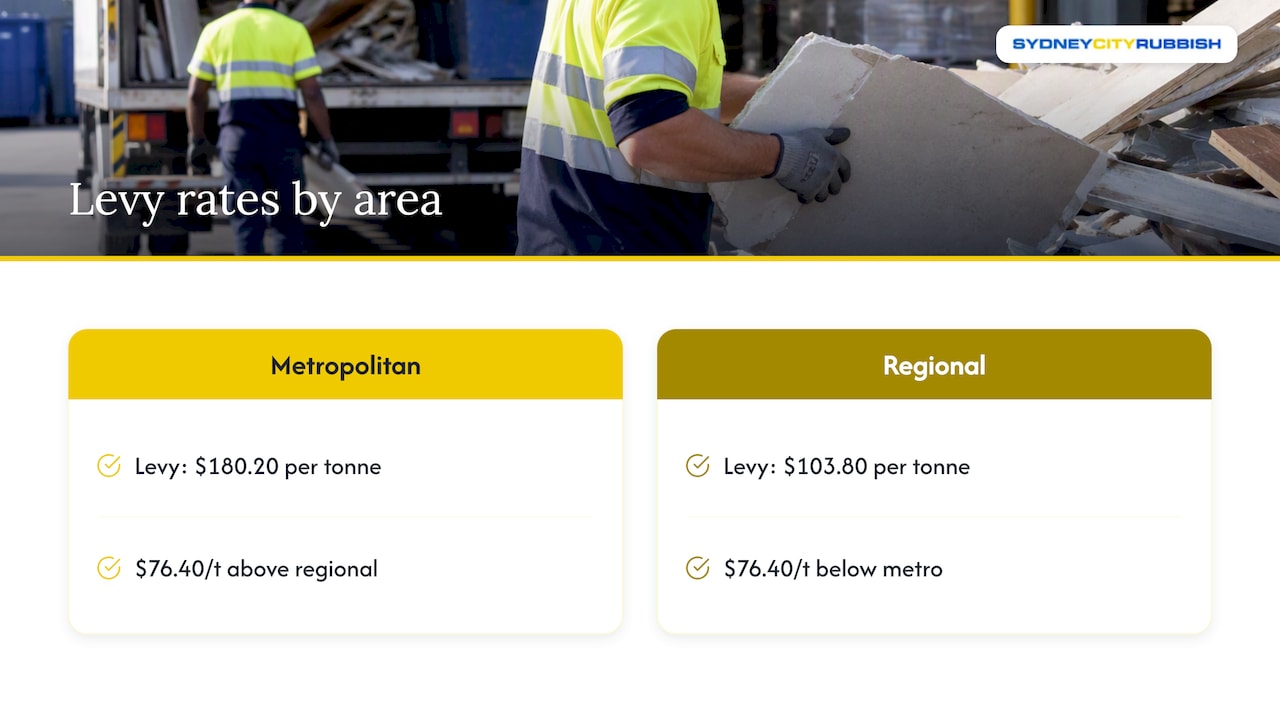
The largest and least negotiable component is the government waste levy. In New South Wales, the Metropolitan Levy Area rate for 2026–27 is $180.20 per tonne, while the Regional Levy Area rate is $103.80 per tonne. Licensed receival facilities pass this levy straight through to the customer, so it appears on your invoice regardless of which contractor you use.
On top of the levy sits the facility’s own handling fee, which varies by material stream and by how the load is measured:
- Construction and demolition inert material (brick, concrete, rubble) is typically charged per tonne, with cleaner loads attracting the lower end of the range.
- General waste and mixed loads are charged at a higher per-tonne rate than sorted inert material.
- Greenwaste and FOGO (food organics and garden organics) often sit on a separate schedule again, usually cheaper than general waste but still levy-bearing.
- Small loads below a facility’s minimum tonnage are billed at a flat minimum charge rather than a true per-tonne rate.
One of the more consequential figures on a commercial waste contract is the levy itself: $180.20 per tonne in the Metropolitan Levy Area for 2026–27. That single line can account for more than half the total cost of disposing of mixed waste, which is exactly why separating recyclable streams matters so much.
Contamination and mixed-load surcharges are where quotes blow out. A skip that mixes timber, plasterboard, metal and general rubbish gets reclassified and billed at the higher general waste rate, and facilities often apply an additional handling surcharge for sorting it themselves. Special waste categories, including asbestos-contaminated material and contaminated soil, attract premium rates well above standard inert pricing because of the extra testing, handling and disposal controls involved.
Typical fee ranges and real-world examples
Regional fee schedules give a useful benchmark for what a reasonable quote should look like, even though exact figures shift between councils and facilities.
- Construction and demolition inert material commonly sits around $77.93 to $125 per tonne depending on load type and council rules, before any levy is added.
- Many regional schedules, including EMRC and various council fee lists, set minimum charges for small loads so a half-full trailer can cost almost as much as a full one.
- Special waste items such as asbestos or heavily contaminated fill carry their own higher rates on council fee schedules, separate from standard C&D pricing.
A worked example shows how these pieces combine. Say a site generates 10 tonnes of sorted concrete rubble destined for a Sydney metropolitan facility. The levy alone, at $180.20 per tonne, adds $1,802 to the invoice. Add a facility handling fee of, say, $90 per tonne for inert material and you get another $900, bringing the subtotal to $2,702 before transport. Mix that same load with timber and general rubbish and the facility fee alone jumps to the general waste rate, often double the inert rate, while the levy stays fixed. The arithmetic makes the case for separation on its own.
Small loads are the trap most procurement teams miss. A single trailer or ute load that falls under a facility’s minimum tonnage threshold is billed at that flat minimum, which can make the effective per-tonne rate far higher than a full truckload of the same material. Consolidating smaller loads into fewer, fuller trips is often the single easiest way to bring the effective rate down.
How to reduce recycling and disposal costs on site
Cost control on a construction site comes down to a short list of habits, applied consistently.
- Source-separate the major streams, concrete, timber, metals and plasterboard, into their own bins or stockpiles so each is billed at its own lower rate instead of the blended general waste rate.
- Schedule full loads rather than frequent partial ones, since minimum charges and transport costs are paid per trip regardless of how full the vehicle is.
- Negotiate contract terms that let you pay the receival facility directly for levy and facility fees, with the hauler invoicing separately for transport, which keeps each cost component visible.
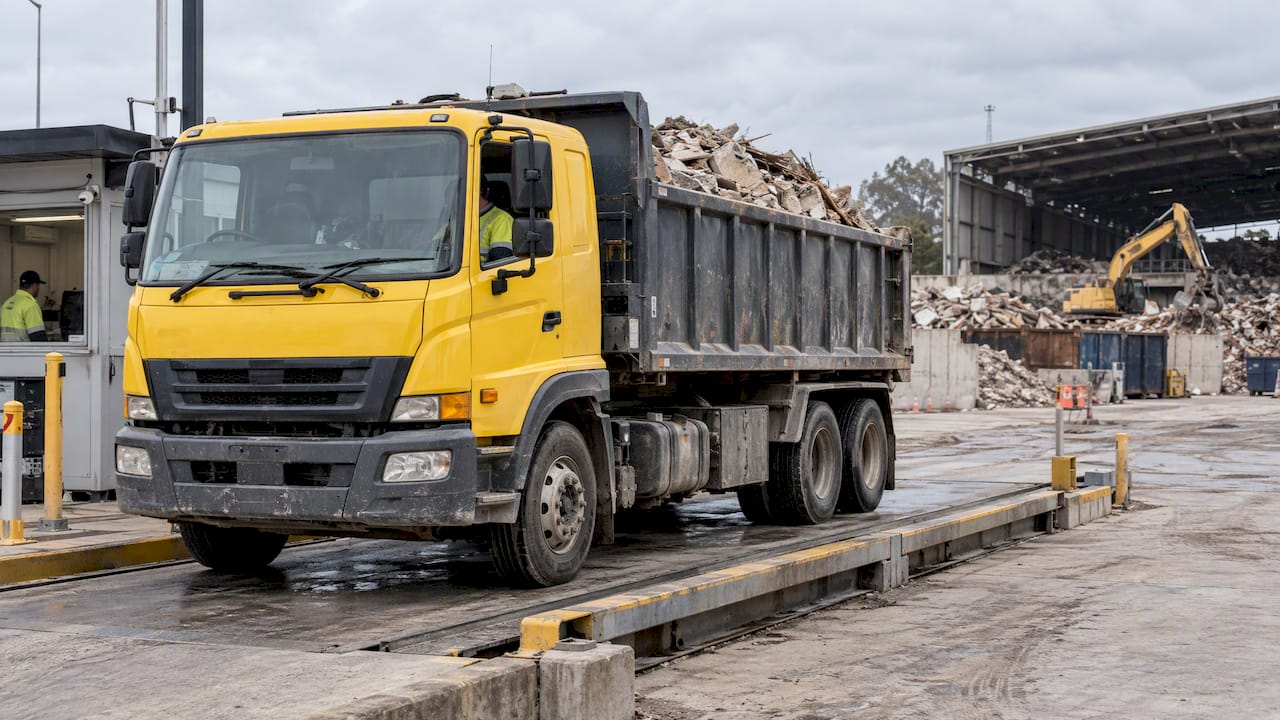
- Request weighbridge receipts and receival dockets for every load so the tonnage and material classification on your invoice can be checked against what was actually delivered.
- Where volumes justify it, negotiate a per-tonne rate card with your contractor rather than accepting ad hoc pricing load by load.
Contamination at the point of generation is the cheapest place to fix it. Once a skip is contaminated, the cost is locked in, but a labelled staging area for concrete, timber and metal, with signage crews can read at a glance, keeps streams clean before they ever reach a bin.
Pro Tip: Keep a running tally of weighbridge receipts against your waste management plan’s estimated quantities, discrepancies usually mean a stream has been contaminated or misclassified.
These habits also feed directly into your construction waste management plan, which is where cost control and compliance documentation come together.
Essential items for your WMP and contract to protect cost and compliance
A waste management plan that only lists waste types without pricing and approvals leaves you exposed to surprise charges later. The EPA’s construction and demolition waste management toolkit sets out what a usable plan and contract schedule should contain.
- Classify each waste stream against NSW EPA waste classification guidelines so the correct levy and facility rate applies from the start.
- Estimate quantities per stream so you can compare invoiced tonnage against expected volumes.
- Name the receival sites you intend to use, along with their Environment Protection Licence or development consent details, so you know the facility is lawfully permitted to accept the material.
- Attach an itemised schedule of rates by waste type to the contract, rather than a single lump-sum disposal line.
- Require weighbridge receipts and receival dockets as a condition of payment, giving you evidence of lawful re-use or recycling for every load.
- Check the subcontractor’s environmental compliance history and request WasteLocate consignment numbers where tracked waste is involved.
Paying the receival facility directly where the contract structure allows, and linking milestone payments to proof of lawful disposal, keeps the financial incentive aligned with compliance rather than against it. These are the same documents an auditor or principal will ask for if a dispute over levy charges or waste classification arises later.
Current average construction waste recycling rates in Sydney and comparison to national benchmarks
Because metropolitan regions have relatively few licensed processing facilities, per-tonne pricing for sorted construction and demolition material tends to be fairly consistent across a metro area at any given time, with the waste levy being the dominant shared cost regardless of which facility you use. The Metropolitan Levy Area rate of $180.20 per tonne applies uniformly across Sydney facilities, which means the gap between a good quote and a poor one usually comes down to facility handling fees and contamination surcharges rather than the levy itself.
Regional areas outside the Metropolitan Levy Area pay the lower Regional Levy Area rate of $103.80 per tonne, a difference of more than $76 per tonne on the levy component alone. For a construction company comparing a metropolitan Sydney job against a regional one, that levy gap is often the single biggest driver of a cost difference between sites, well before facility fees or transport are considered.
This uniformity has a practical consequence for procurement: because facility pricing clusters tightly within a metro area, shopping around for a dramatically cheaper disposal rate rarely delivers much. The bigger savings lever is operational, separating streams properly and avoiding minimum-charge small loads, rather than searching for a facility with unusually low fees.
Trends and recent improvements in construction waste recycling rates over time
Waste levy rates are reviewed and adjusted periodically, and the NSW EPA’s scheduled 2026–27 rates reflect the latest step in that ongoing adjustment. Businesses that budget for construction waste disposal should expect periodic increases to the levy component specifically, since it is set by government policy rather than facility competition.
Head contracts and government waste management agreements also show a pattern of periodic price updates tied to levy changes, meaning a supplier’s invoice can change mid-contract when the levy itself changes, independent of anything the contractor does. Procurement teams should build a contract clause that explicitly ties the levy component of pricing to the current published rate, rather than locking in a fixed disposal price that may no longer reflect the levy in force at the time of collection.
The practical trend for commercial buyers is straightforward: the levy component of your disposal cost is on a predictable upward trajectory over time, while facility handling fees for sorted, clean material tend to move more slowly. That gap reinforces the same conclusion as the cost-reduction tactics above, the portion of your bill you can actually influence is the facility fee and contamination surcharge, through separation and load planning, while the levy itself is largely a fixed, rising cost of doing business in the sector.
Common types of construction waste and their specific recycling streams
Construction and demolition sites generate a predictable set of material streams, each of which is priced and processed differently at a receival facility.
Concrete, brick and masonry rubble form the bulk of most demolition jobs and are generally the cheapest stream to dispose of when kept clean, since they are classified as inert C&D material. Timber, including formwork and framing offcuts, is typically processed separately from masonry because it is handled through different recycling or mulching pathways. Metals, structural steel, reinforcing bar, copper pipe and aluminium fittings, are usually the most valuable stream and are frequently collected separately because scrap value can offset disposal costs entirely.
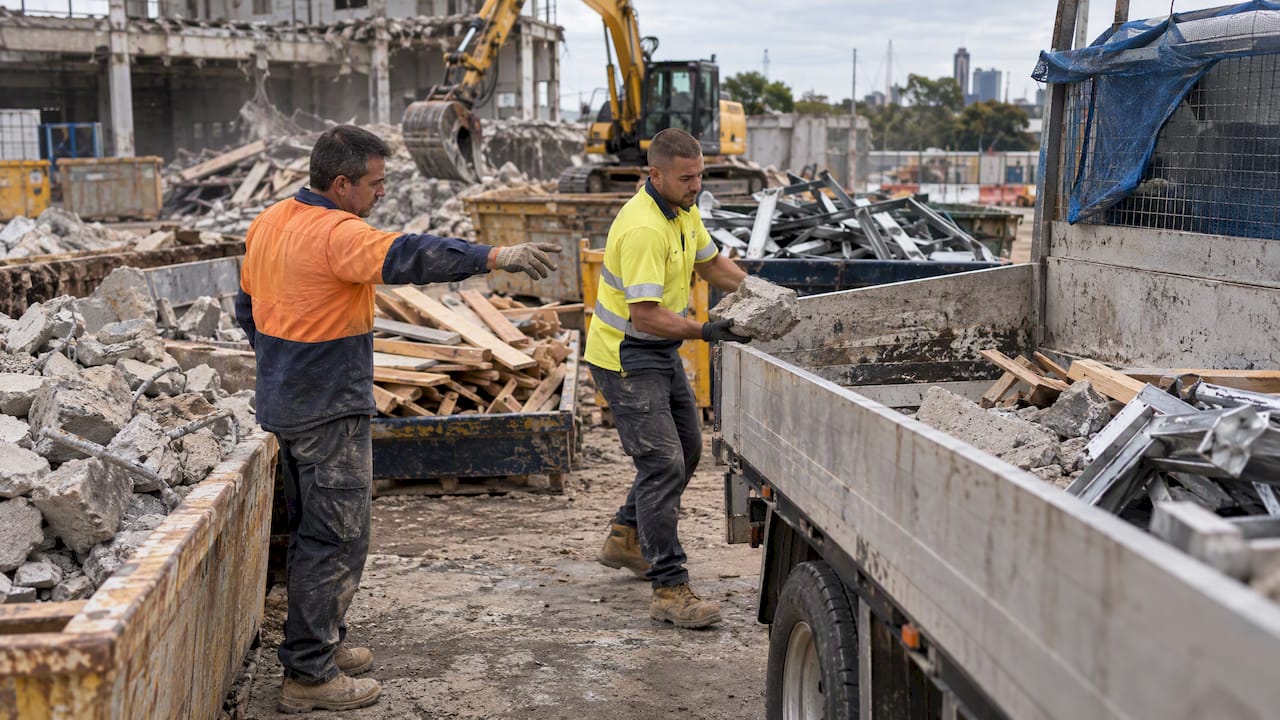
Plasterboard and gyprock require dedicated recycling pathways due to the gypsum content, and mixing it into general rubble reduces the overall load’s eligibility for the lower inert rate. Greenwaste and FOGO from site clearing sit on their own pricing schedule, generally cheaper than general waste but still levy-bearing. Mixed general waste, anything that cannot be cleanly sorted into the above streams, attracts the highest per-tonne rate and the broadest levy exposure.
Special waste categories, asbestos-containing material and contaminated soil, sit outside standard C&D pricing entirely and require licensed handling, testing and a facility specifically approved to receive that waste type. Our guide to the construction waste your business must be recycling breaks these streams down further for site planning purposes.
Regulations and targets on construction waste recycling rates in NSW beyond levies
Beyond the levy itself, the regulatory framework around construction and demolition waste in New South Wales is built on the licensing and documentation requirements set out in the EPA’s construction and demolition waste management toolkit. Receival facilities must hold an Environment Protection Licence or operate under development consent conditions that permit them to accept specific waste classes, and principals contracting waste services are expected to verify that approval before sending material to a site.
The Waste Levy Guidelines set out the measurement, deduction and recordkeeping rules that sit underneath the headline levy rate, including when a levy deduction can be claimed for material genuinely reused in construction works rather than landfilled. Claiming that deduction depends on the receival facility holding the correct approvals and keeping the documentation to support it, which is why verifying a facility’s licence status before committing to a reuse arrangement protects you from an unexpected levy bill later.
For commercial buyers, the practical regulatory takeaway is less about a single target number and more about documentation discipline: waste classification, facility approvals, weighbridge records and consignment tracking are what regulators and principals actually check, and they are the same records that let you query a disposal invoice with confidence.
Case studies or examples of projects with high recycling rates and methods used to achieve them
Projects that keep disposal costs down tend to share the same operational pattern rather than relying on any single clever trick. Sites that set up dedicated, clearly labelled bins for concrete, timber and metal from the first day of demolition consistently avoid the mixed-load surcharge that catches less organised jobs, because each stream reaches the receival facility already sorted to the classification that attracts the lower inert rate.
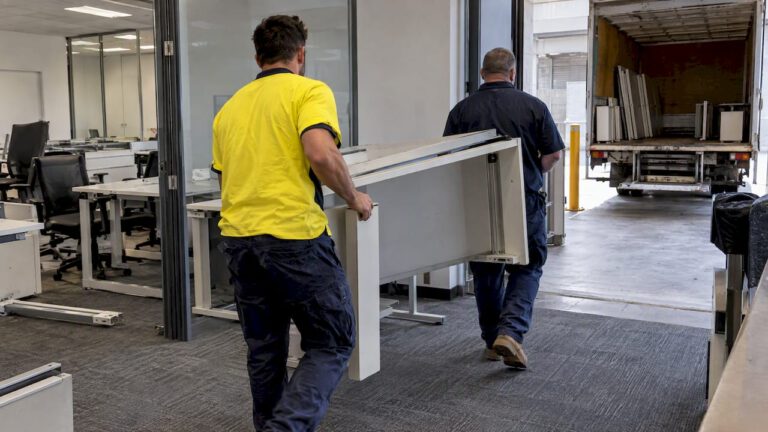
Fit-out and strip-out projects that separate structural demolition material from furniture, joinery and fit-out waste also tend to see materially lower blended disposal costs, since furniture and joinery removal is billed differently from structural rubble and mixing the two forces the whole load into the higher-cost category. Our own strip-out and makegood work applies this separation as standard practice, splitting structural, joinery and floor finish waste into distinct streams before they leave site.
Jobs that schedule full-load collections rather than frequent partial pickups also avoid the small-load minimum charge trap described earlier, consolidating two half-loads into one full truck run is a simple scheduling change that directly reduces the effective per-tonne cost. The consistent thread across these examples is that the biggest cost wins come from site-level planning and separation, not from negotiating a lower headline rate with a facility.
Technologies and methods used to improve construction waste recycling rates
On-site sorting is the most effective lever available to a construction team, and it does not require new technology, just dedicated containers, clear signage and a staging area positioned where materials are generated rather than where it is convenient to park a skip. Concrete grinding and crushing equipment, used either on site or at a processing facility, turns demolished masonry into reusable aggregate, which both reduces the tonnage sent for disposal and can qualify for a levy deduction when the material is reused in construction works under the correct approvals.
Reuse strategies applied before demolition even starts, salvaging fittings, doors and fixtures for resale or reuse, reduce the total volume that needs classifying and disposing of at all. Floor finish removal and grinding, handled as its own stream rather than mixed into general rubble, keeps that material out of the higher-cost general waste category.
Weighbridge and docket systems, now standard at licensed receival facilities, give site managers the paper trail needed to verify tonnage and classification against invoices, closing the gap between what a contract promises and what actually gets billed. None of these methods require exotic technology: the gains come from disciplined separation, direct reuse of recoverable material, and verified documentation at every handover point.
How Sydney City Rubbish helps control recycling rates and compliance
We provide commercial construction waste removal services and build our quotes around the principle of itemised pricing by material stream, rather than a single lump-sum disposal fee. When you book with us, we provide weighbridge receipts and receival dockets for your records, coordinate with site and building managers for access, and aim to be punctual.
We also offer carbon-neutral disposal as an opt-in feature, allowing clients to meet sustainability commitments without adding complexity to the procurement process. Whether you need construction waste disposal, a full building strip out, or ongoing commercial waste removal, we can supply a WMP-aligned quote with an itemised schedule of rates. Get in touch for a free quote tailored to your site.
FAQ
What is included in a construction waste recycling rate?
A construction waste recycling rate typically includes the state waste levy, the facility’s per-tonne or per-load handling fee, and any surcharge applied for contamination or mixed loads. In New South Wales, the levy alone is $180.20 per tonne in the Metropolitan Levy Area for 2026–27, which is usually the largest single component.
Why does separating construction waste lower the cost?
Sorted, clean material such as concrete or timber qualifies for the lower inert waste rate, while mixed loads get reclassified as general waste and billed at a higher rate plus a handling surcharge. Keeping streams separate on site, in dedicated bins or stockpiles, is one of the most reliable ways to avoid that surcharge.
How do minimum charges affect small construction loads?
Facilities set a minimum tonnage threshold, and any load below it is billed at a flat minimum charge rather than a true per-tonne rate, which can make a small trailer load cost almost as much as a much larger one. Consolidating smaller loads into fewer full trips reduces the effective rate per tonne.
What documents should I request to verify a disposal invoice?
Ask for a weighbridge receipt and a receival docket for every load, which show the actual tonnage delivered and how it was classified. These documents, recommended in the EPA’s construction and demolition waste management toolkit, let you check invoiced charges against what was actually collected.
Does Sydney City Rubbish provide itemised pricing for construction waste?
Yes, we quote construction waste removal by material stream rather than as a single lump sum, and we supply weighbridge receipts and receival dockets with every job. Get a free quote through our construction waste disposal page for an itemised schedule aligned to your waste management plan.