Avoid claims in NSW strata: bulk waste checklist and contractor pack

Under NSW law, the owners corporation carries legal responsibility for bulk waste dumped on common property. Before clearing anything, you must attempt to contact the responsible owner and issue a formal disposal notice. Once that step is done, engage a licensed contractor who can supply disposal receipts and manage asbestos or hazardous items correctly.
TL;DR:
- Contact the owner and issue a formal disposal notice before removing bulk waste from shared areas; skipping this step risks disputes.
- Use a licensed contractor with proper permits and disposal receipts for hazardous materials, especially when asbestos is involved.
- Recognize that council collections are unsuitable for large or hazardous waste; scheduling immediate, professional bulk removals prevents safety and compliance issues.
- Provide clear, detailed briefs to contractors covering waste types, site access, timing, and resident notifications to ensure accurate quotes and smooth operations.
- Keep all records, including contact attempts, disposal notices, contractor licences, and photos, to safeguard the owners corporation from future claims or audits.
Table of Contents
- What the owners corporation must do under NSW strata law
- When do you actually need a bulk-waste contractor?
- How to choose and brief a bulk-waste contractor
- Cost drivers and budgeting for strata bulk removals
- Running the removal day: logistics, safety and communication
- Compliance and recordkeeping after disposal
- How Sydneycityrubbish supports compliant strata bulk removals
- Sources
What the owners corporation must do under NSW strata law
The Strata Schemes Management Act 2015 places clear legal responsibility on the owners corporation for managing, maintaining and controlling common property. That includes anything dumped, abandoned or left behind on shared land, stairwells, car parks or storage areas. It’s not a grey area. If a couch turns up in the visitor car park, it’s the owners corporation’s problem to solve, not the building manager’s personal judgement call.
Before removing what looks like abandoned property, NSW Government guidance sets out a sequence you need to follow: attempt to contact the owner or occupier, issue a formal disposal notice, and keep a written record of both steps. Skipping this process exposes the scheme to disputes over unlawful disposal of someone’s belongings.
By-laws give you a second lever entirely. A registered by-law lets the owners corporation recover disposal costs directly from the resident responsible, rather than spreading the expense across every lot owner through the general fund. Waverley Council’s waste by-law template shows how to structure this properly, and the Strata Schemes Management Regulation reinforces that leaving waste on common property without approval is a breach that by-laws can enforce.
Practically, this means:
- Adopt or update a by-law specifically covering waste storage, disposal and move-in/move-out conduct
- Attach a cost recovery clause so the owners corporation can invoice the responsible owner, not the whole scheme
- Keep every disposal notice and contact attempt on file as evidence of due process
When do you actually need a bulk-waste contractor?
Most bulk waste problems in strata buildings follow familiar patterns, and recognising them early saves you a scramble later.
- Abandoned furniture or belongings left in common areas after a tenant vacates without proper removal arrangements.
- Renovation debris from a lot owner’s bathroom or kitchen upgrade that spills into shared corridors or loading docks.
- Move-in and move-out clashes, particularly in larger complexes where several settlements happen in the same fortnight.
- Safety hazards, such as blocked fire egress points or trip hazards in car parks that can’t wait for a scheduled clean-up.
Council hard-waste collections aren’t built for any of this. They’re slow, limited in volume, and not designed for commercial or common-property removals. A licensed contractor gives you same-week turnaround, correct handling of hazardous materials, and documentation the owners corporation actually needs for compliance.
The smarter play is proactive scheduling. Experienced strata managers line up bulk removal jobs around known pressure points, coordinated move-in weekends, upcoming AGMs, or fire-safety inspections, so common areas are clean and compliant before anyone’s watching closely.
How to choose and brief a bulk-waste contractor
A vague instruction to “come and clear the basement” invites a vague quote and a messy job. Give contractors a proper brief and you’ll get accurate pricing and fewer surprises on the day.
Your brief should specify:
- The types and volume of items involved, including anything suspected to contain asbestos
- Site access constraints, lift bookings, loading dock hours, and whether a hoist is required
- Parking and traffic control needs, especially in high-density buildings with narrow driveways
- Expected timeframe and any resident notice periods you need the contractor to work around
Before signing off, check the contractor holds a current ABN, public liability insurance, and, where asbestos is present, the specific licences NSW requires for that work along with a Safe Work Method Statement. Sydneycityrubbish’s asbestos disposal regulations guidance outlines what licensed handling actually involves, useful reading before you approve any quote involving suspected hazardous material.
Pro Tip: Ask for an itemised quote that separates labour, vehicle costs and disposal fees, and request confirmation of the diversion or recycling rate upfront. It’s far easier to negotiate before the truck arrives than after.
For jobs valued at $30,000 or more, NSW guidance requires the owners corporation to obtain at least two independent quotes. Even below that threshold, comparing two contractors on price and documentation standards is worth the extra day it takes.
Cost drivers and budgeting for strata bulk removals
Bulk removal quotes vary more than most committees expect, and the difference usually comes down to a handful of factors rather than the contractor simply charging what they like.
- Volume and vehicle size, since a single-item pickup costs far less than a full truck-and-crew job clearing a whole basement
- Labour hours, particularly where lift access, stairs or long carry distances slow the crew down
- Asbestos or hazardous handling, which requires specialist licensing and adds disposal certification costs
- Hoist or permit hire for buildings without adequate loading access
- Disposal and tipping fees, which shift depending on how much material can be diverted to recycling versus landfill
Pre-sorting items before the contractor arrives, separating e-waste, timber and general waste, genuinely lowers disposal costs because recyclable material often attracts lower fees than mixed landfill loads. For anything beyond a routine clean-up, build bulk removal into the scheme’s capital works plan rather than treating it as an unplanned expense, or approve a special levy where the job is genuinely one-off and significant.
Running the removal day: logistics, safety and communication
A well-run removal day is mostly about sequencing. Get the order wrong and you’ll have a truck idling in a loading zone while residents complain in the group chat.
- Before the day, send resident notices with clear timing, book the lift if one is needed, arrange parking or traffic control, and confirm any hoist or council permit is in place.
- On the day, induct the contractor on-site rules, verify any asbestos assessment has been completed before items are touched, and have a building representative present to supervise and sign off on the clean-up.
- After the day, collect every disposal receipt and waste-transfer document, and photograph the cleared area as a record of condition.
Pro Tip: Building managers who nominate one point of contact for the entire job, rather than leaving contractors to knock on random doors, consistently report fewer resident complaints and faster sign-off.
Compliance and recordkeeping after disposal
None of this matters if the paperwork disappears once the truck leaves. Keep disposal receipts and waste-transfer forms from the contractor as your primary evidence of lawful disposal, since documentation protects the owners corporation from later claims that items were removed improperly.
Retain records of:
- Every attempted contact with the owner or occupier, with dates
- The formal disposal notice issued, and when
- Contractor licences and disposal certificates for any asbestos-related work
- Photographic evidence of the site before and after removal
A single consolidated pack, receipts, transfer forms, diversion summary and photos, handed over at job completion makes levy recovery and future audits considerably faster.
How Sydneycityrubbish supports compliant strata bulk removals
Sydneycityrubbish works directly with strata and property managers across Sydney on exactly this kind of job, from strata and tenant rubbish removal to construction debris clearance and asbestos-aware disposal. These contractors often provide disposal documentation to help with compliance, and some offer carbon-neutral disposal options to support sustainability reporting.
When you request a quote, ask directly for licence details, current public liability insurance, a Safe Work Method Statement where relevant, and confirmation that disposal receipts will be provided on completion. That’s the standard your by-laws and your insurer will expect anyway, so it’s worth locking in before the job starts.
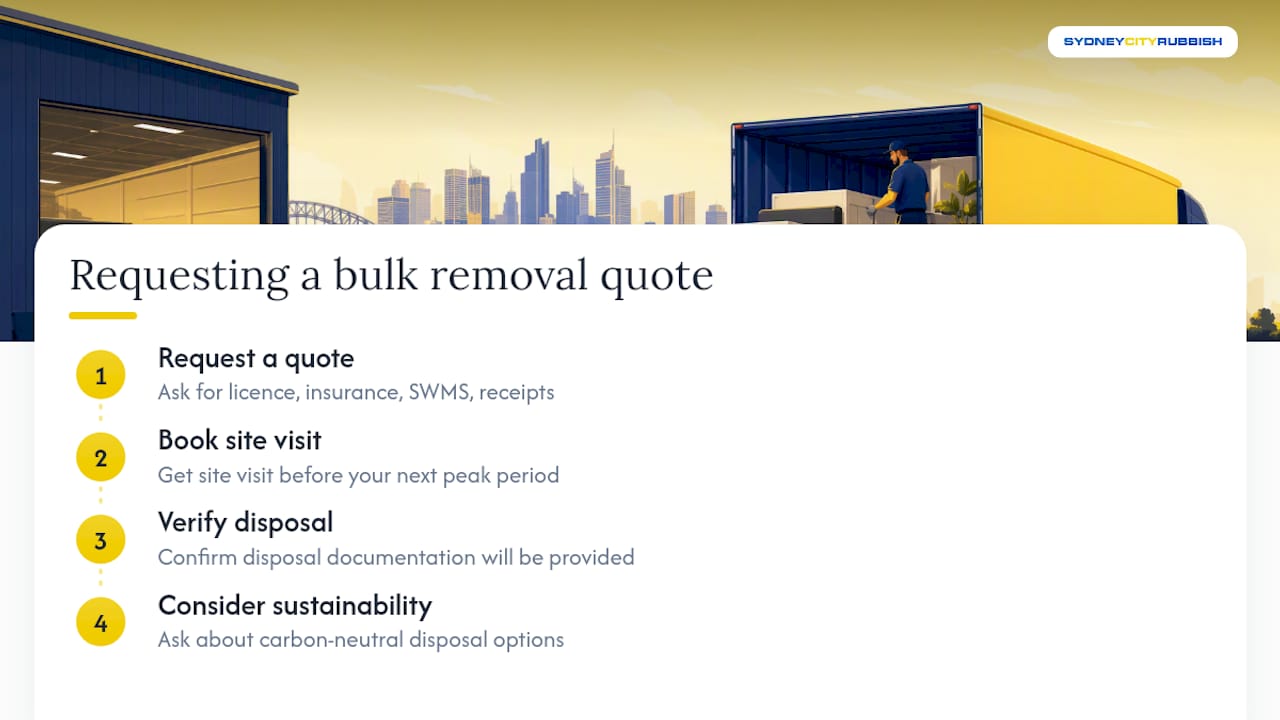
If you’re weighing up a bulk removal for common property, an AGM-driven clean-up, or a move-out backlog, request a quote through Sydneycityrubbish and get a site visit booked in before your next peak period hits.
Sources
- Strata Schemes Management Act 2015 No 50
- Disposal of abandoned goods on common property (NSW Government guidance)
- A guide for creating by-laws to manage waste (Waverley Council)
- Strata Schemes Management Regulation 2016 (waste provisions)