Skip bin size guide for Sydney facility managers
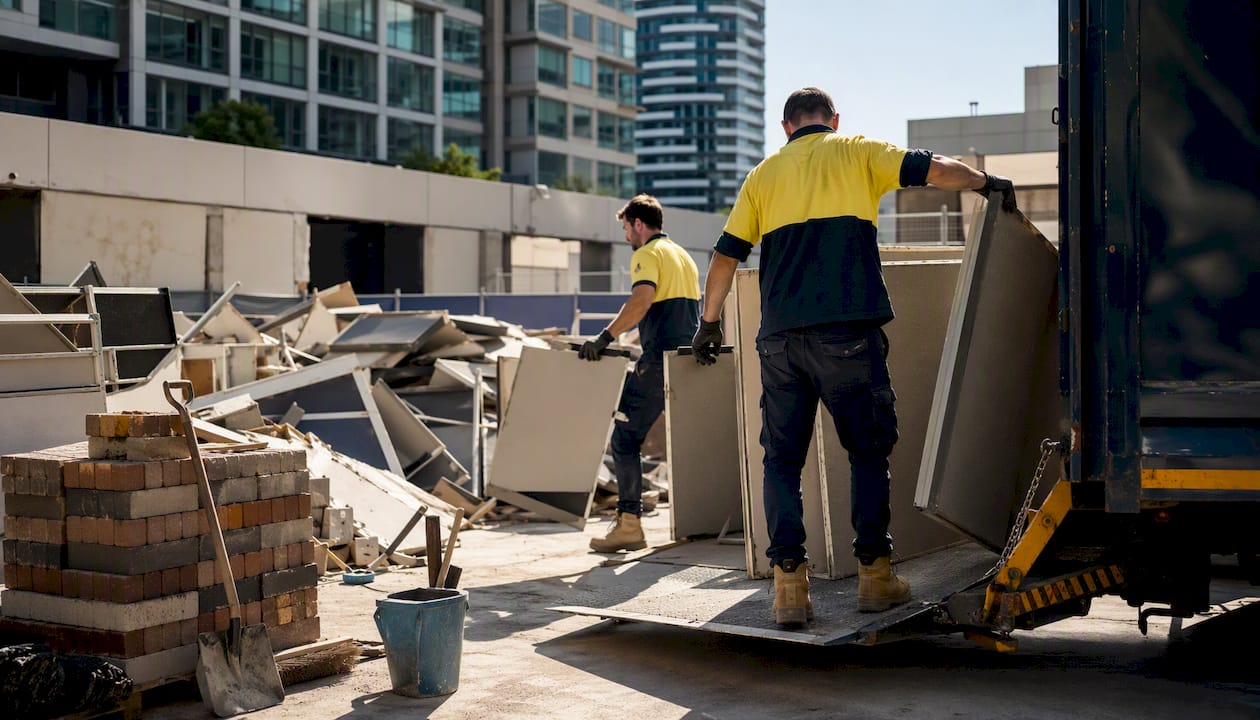
For a single-office de-fit, book one truck and crew handling a moderate volume. A full-floor de-fit typically requires multiple hauls or a scheduled strip-out crew. Small retail strip-outs generally involve a moderate volume, construction waste loads vary, and demolition debris with dense concrete or masonry can reach a truck’s weight capacity. When your estimate sits on a boundary between service levels, book up — a second haul costs more than upsizing once.
Three rules of thumb to act on now:
- A standard commercial truck carries a typical volume range; a large truck or trailer can carry a larger volume. Match your estimated volume to the nearest truck size, then add a margin for the “fluff factor” that bulky, disassembled furniture creates.
- Front-lift bins (1.5–4.5 m³) suit ongoing scheduled collections from strata buildings, retail centres and office lobbies, not one-off de-fits.
- Book a truck and crew for any job where loading, stair carry or disassembly is involved. Book a strip-out or demolition package when structural elements, flooring or fixed joinery are coming out.
Pro Tip: Request a free site assessment from Sydneycityrubbish before confirming your booking. A 15-minute walk-through eliminates the guesswork on volume, access and compliance documentation.
Key takeaways
Accurate volume estimation, matched to the right service level and backed by compliant documentation, is what separates a smooth commercial cleanout from a costly re-haul or a compliance gap at handover.
| Point | Details |
|---|---|
| Do the cubic-metre check first | Apply the 0.07–0.15 m³ per m² multiplier by material type before calling for a quote. |
| Account for density and weight | Dense demolition debris hits truck weight limits before volume limits; size by weight for concrete and masonry. |
| Factor access before booking | Confirm lift capacity, overhead clearance and permit lead times; access constraints often push you to a smaller vehicle and more hauls. |
| Allow realistic lead time | Standard bookings need two to five business days; strip-out and demolition packages need five to ten. |
| Insist on compliance paperwork | Waste transport certificates and transfer dockets are mandatory for NSW commercial generators; request them before the truck leaves. |
| Use Sydneycityrubbish’s free assessment | A site walk-through confirms volume, access and documentation requirements and locks in an itemised quote. |
Table of Contents
- How do you estimate commercial waste volume quickly on site?
- What bin sizes and truck equivalents do Sydney commercial sites actually use?
- Which service level should you book for your job?
- What site access and permit constraints affect your booking?
- NSW compliance: what documentation must you receive?
- What are the typical lead times and booking steps for Sydney commercial removals?
- How do you prepare the site and what happens on collection day?
- Quick sizing cheat-sheet: which service level should you book?
- Sydneycityrubbish: free site assessment and how to book
- Sources
How do you estimate commercial waste volume quickly on site?
The fastest method is a square-metre multiplier. Measure the floor area of the space being cleared, then apply a multiplier based on the dominant material type. For a lightly furnished office de-fit, industry guidance suggests roughly one cubic yard of waste per 250–500 sq ft of floor area; converted to metric, that is approximately 0.07–0.15 m³ per m² of floor area. A 300 m² office floor therefore generates roughly 21–45 m³ before compaction, which is why full-floor de-fits almost always require multiple truck hauls.
Adjust the multiplier for material density. Retail fit-outs with heavy shelving and concrete bases sit toward the upper end. Construction debris, tiles and masonry are dense and heavy, so weight limits often constrain the load before volume does. Demolition debris with structural concrete can hit truck weight limits at half the volumetric capacity.
| Job type | Approximate floor area multiplier (m³ per m²) | Density note |
|---|---|---|
| Light office de-fit | Lower range typical | Volume-light; fluff factor applies |
| Heavy office fit-out | Moderate range typical | Mixed furniture and partitioning |
| Retail strip-out | Higher moderate range typical | Shelving, fixtures, concrete bases |
| Construction waste | Upper moderate range typical | Mixed; weight limits often bind first |
| Demolition debris | High range typical | Dense; size by weight, not volume |
Account for the fluff factor when bulky items are disassembled. Flat-pack partitions, dismantled workstations and rolled carpet take up far more truck space than their weight suggests. If your estimate lands between two service levels, choose the larger — the cost of a second haul almost always exceeds the premium for upsizing once.
Request an on-site survey rather than relying on estimates when the job involves hazardous materials, unknown structural elements, or restricted access. An experienced crew can assess density, segregation requirements and access constraints in a single visit, producing a quote that holds on the day.
Pro Tip: Walk the space with a laser measure and note the number of full rooms, the dominant material type, and any items that cannot be disassembled. That three-point brief is enough for a provider to give you a reliable preliminary estimate by phone.
What bin sizes and truck equivalents do Sydney commercial sites actually use?
Sydney commercial waste contracts use several standard wheelie bin sizes for regular scheduled collections. Smaller bins suit small offices and retail tenancies with low weekly waste output. Mid-size bins serve mid-size strata buildings and retail centres. Larger bins handle high-volume sites such as food courts, large office floors and construction site amenities.
For one-off or project-based removals, front-lift bins from approximately 1.5 m³ to 4.5 m³ are the standard commercial option across Sydney. A 1.5 m³ bin suits a small tenancy cleanout or end-of-lease clear. A 3 m³ bin covers a medium retail strip-out. A 4.5 m³ bin handles larger volumes but still fits within most loading dock footprints.
Placement constraints matter as much as volume. Front-lift bins need overhead clearance of at least 6 m for the lifting arm. Trucks servicing CBD sites often require a loading dock booking or a council street permit. Freight lifts with low weight ratings can prevent bin placement above ground level entirely.
Which service level should you book for your job?
The right service level depends on volume, material type and how much labour the job involves. Four tiers cover most commercial scenarios in Sydney.
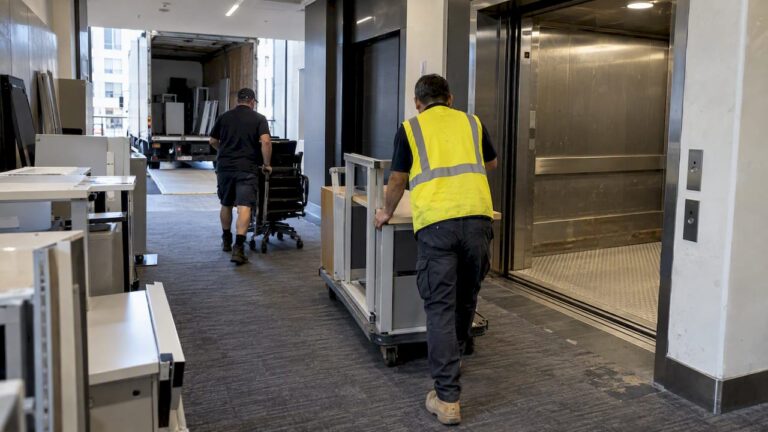
A truck and crew express removal suits single-office de-fits, end-of-lease clearances and retail tenancy cleanouts where items are already loose or partially staged. One crew of two to three people with a 6–10 m³ truck typically completes a 200–300 m² office clearance in three to five hours, depending on stair carry and lift access.
A front-lift bin scheduled collection suits strata buildings, retail centres and office parks with ongoing or recurring waste volumes. The bin is placed, filled over a set period, then collected on a scheduled day. This tier does not include loading labour.
A strip-out package combines a crew with demolition capability for jobs involving fixed joinery, flooring removal, ceiling grid demolition and partition removal. These jobs generate mixed waste streams and typically require multiple truck hauls across one or two days.
Multi-truck project management covers full-floor or multi-level de-fits, major construction waste removal and staged demolition projects. Volume, crew size and haul frequency are scoped at the site assessment stage.
Pricing for all tiers reflects volume, weight, labour intensity, access difficulty and any special-handling requirements such as e-waste, appliances or clinical waste. Hidden fees including fuel levies, access surcharges and after-hours premiums can add meaningfully to a base quote, so always request an itemised breakdown.
Pro Tip: Ask your provider to separate labour, tipping fees, fuel and any access surcharges in the quote. Pricing transparency is the most common source of disputes on commercial jobs — an itemised quote protects both parties.
What site access and permit constraints affect your booking?
Access constraints directly change which service level and equipment you can book. A loading dock with a 3-tonne lift limit rules out a fully loaded large truck. A laneway with a 4 m overhead clearance rules out front-lift bin collection. Identifying these constraints before booking prevents day-of delays and surcharges.
Work through this checklist before confirming your service level:
- Vehicle access: confirm the maximum truck length, width and weight the site can accommodate.
- Overhead clearance: measure any covered entry points, boom gates and undercover loading areas.
- Freight lift capacity: check the rated load and internal dimensions; note whether the lift needs a booking.
- Stair carry: flag any floors without lift access and the number of flights involved.
- Turning radius: CBD sites often need a rigid truck rather than an articulated vehicle.
For street placement of bins or trucks, a street-use permit from the relevant Sydney council is required. Lead times vary: the City of Sydney Council and North Sydney Council typically require five to ten business days for a standard street-use permit. Apply early, particularly for CBD sites where loading zones are restricted. Sydneycityrubbish can advise on permit requirements as part of the site assessment.
Where access constraints force a smaller vehicle, plan for multiple hauls rather than one large load. Two smaller drops are often faster and cheaper than waiting for a permit or a dock window that does not materialise.
NSW compliance: what documentation must you receive?
Under NSW duty-of-care obligations, any business that generates commercial waste is responsible for ensuring that waste is transported and disposed of lawfully, even after it leaves the site. That obligation does not end when the truck drives away.
For every commercial removal, you must receive a waste transport certificate or transfer docket confirming the waste type, the licensed carrier, and the receiving facility. For regulated waste streams including asbestos, clinical waste and certain chemical waste, a full waste tracking certificate under the NSW Protection of the Environment Operations Act 1997 is mandatory.
Segregate waste streams before collection: general waste, co-mingled recyclables, organics, sanitary or clinical waste, and hazardous materials must be kept separate. Mixed loads that contaminate a recyclable stream can attract additional tipping fees and may void your diversion records, which matter at project handover and for NABERS or Green Star reporting.
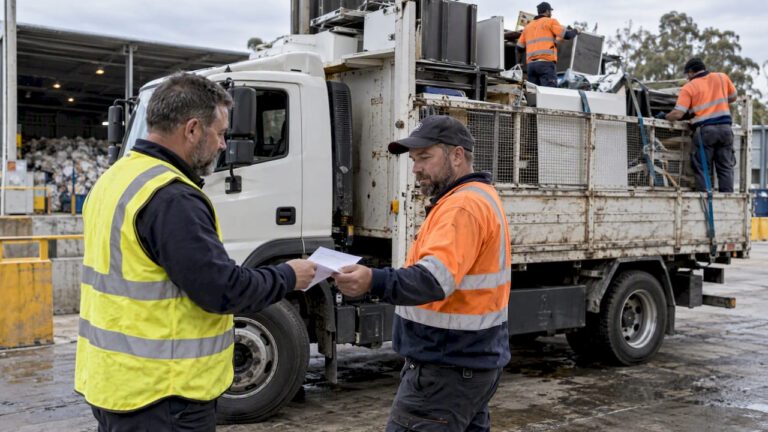
Ask your provider for documentation before the truck leaves the site. A licensed provider will carry transfer dockets and can supply waste-tracking certificates for regulated streams on request. If a provider cannot produce these documents, that is a compliance risk your organisation carries.
What are the typical lead times and booking steps for Sydney commercial removals?
Standard bookings for truck and crew services in Sydney typically require two to five business days’ notice. Urgent or same-day collections are available from some providers but carry an after-hours or priority premium. Strip-out and demolition packages generally need five to ten business days to scope, permit and crew correctly.
The booking process follows four steps. First, provide an initial volume estimate and job description by phone or online form. Second, confirm whether a site assessment is needed — for jobs above roughly 10 m³ or involving access constraints, an on-site visit produces a more accurate and binding quote. Third, receive a confirmed quote with itemised line items covering labour, tipping fees, fuel and any access or permit costs. Fourth, agree on a collection window and confirm site access arrangements including dock bookings and lift reservations.
For multi-haul jobs, confirm the number of collection visits upfront and whether the quote is per-haul or for the full project. Rental duration for front-lift bins affects pricing; bins held beyond the agreed period typically attract a daily or weekly extension fee.
Pro Tip: Book your freight lift and loading dock window before you confirm the rubbish removal booking. A crew that arrives to find the lift unavailable will either wait at an hourly rate or reschedule — both outcomes cost more than a five-minute call to building management.
How do you prepare the site and what happens on collection day?
Preparation directly affects how long the crew spends on site and whether any surcharges apply. A well-staged site can reduce a half-day job to two hours.
Before the crew arrives:
- Segregate waste into streams: general, recyclable, hazardous and any regulated materials.
- Disassemble bulky items where safe to do so — flat furniture loads faster and takes less truck space.
- Stage items as close to the loading point as possible, within safe stacking height.
- Book the freight lift for the collection window and notify building security.
- Brief your site contact on the crew’s arrival time and access route.
On arrival, the crew will conduct a brief safety check, confirm the waste manifest with your site contact, and begin loading. A two-person crew with a 6–10 m³ truck typically takes two to four hours on a pre-staged site. Unstaged or mixed-access sites take longer.
If the crew discovers hazardous or regulated items during loading — asbestos-containing materials, clinical waste or unknown chemicals — loading stops until those items are assessed and a compliant handling plan is confirmed. Do not attempt to mix regulated waste into a general load to speed up the job; the liability stays with the waste generator.
Quick sizing cheat-sheet: which service level should you book?
Use this table to match your estimated volume to the right service level before calling for a quote.
| Estimated volume | Dominant material | Suggested service level |
|---|---|---|
| Up to 6 m³ | Light office furniture | Truck and crew, single haul |
| 6–15 m³ | Mixed office/retail fit-out | Truck and crew, one to two hauls |
| — | Full-floor de-fit, retail strip-out | Strip-out package or multi-haul truck |
| — | Construction waste (mixed) | Large truck, weight-check required |
| — | Demolition debris, concrete | Multi-truck project; size by weight |
Before placing a booking, confirm five things: estimated m³, dominant material type, access constraints, required turnaround, and what compliance documentation the project requires. If your volume estimate sits between two rows in the table above, book the larger service level. A re-haul costs more than the difference between tiers, and the time cost to a handover schedule is rarely worth the saving.
For large-scale or multi-site projects, circular procurement options such as shared bin arrangements can reduce costs and improve diversion rates across a portfolio.
Pro Tip: Confirm the final service level with a free site assessment rather than relying solely on the table above. Dense materials and restricted access regularly push jobs into the next tier up.
Sydneycityrubbish: free site assessment and how to book
When the sizing decision carries real consequences for a handover deadline or a compliance audit, the right move is a confirmed quote from a provider who has seen the site.
Sydneycityrubbish serves property managers, strata managers, construction companies and corporate offices across Sydney, including the CBD, Parramatta, North Sydney, Ryde and Greater Western Sydney. The service range covers truck and crew removals, scheduled front-lift bin collections, strip-out and demolition packages, and multi-truck project management. Every job includes waste-tracking certificates and documented duty-of-care chains as standard. For corporate clients, a carbon-neutral disposal opt-in is available, supporting NABERS and sustainability reporting requirements. Trucks are licensed and crews are insured, with flexible scheduling and 24/7 on-call collection for urgent jobs.
The free site assessment confirms volume, access constraints, waste stream segregation requirements and final pricing before any commitment is made. Request yours at Sydneycityrubbish and get a confirmed, itemised quote within one business day.
Sources
The technical points in this guide draw on the following sources. Pricing references from US-based guides have been adapted for context; Sydney rates will differ and should be confirmed with a local provider.
- Estimate Waste Volume for Commercial Cleanouts: 2026 Guide – Book Your Dumpster USA
- Factors That Affect Commercial Junk Removal Pricing – Trash Bandits Junk Removal
- Commercial Junk Removal Pricing in 2026: What Businesses Actually Pay (And How to Stop Overpaying) — JunkPro