Avoid POEO Fines: Hazardous Waste Pickup Rules for Sydney Managers
Engage an EPA-licensed transporter, confirm the receival facility holds a valid environment protection licence, and hold back final payment until you have disposal dockets in hand. The waste producer, not the contractor, carries the legal duty of care under the POEO Act, so verification sits with you. Get those three steps right and the rest of the compliance picture falls into place quickly.
TL;DR:
- Confirm that the waste transporter is EPA-licensed for the specific waste category, and verify the receival facility holds a valid environment protection license before disposal.
- Structure contracts so that payment is linked to documented proof of lawful disposal, such as disposal dockets, weighbridge receipts, and receival facility EPL numbers.
- Ensure all hazardous waste is correctly classified, contained, and packaged according to its hazard class before pickup to avoid mixing and handling errors.
- Maintain detailed records of all disposal documentation for at least the duration insurers or regulators may audit, and regularly review records against invoices.
- Use the EPA’s public register to verify licensed waste transporters and receival facilities, and demand their license and EPL numbers before scheduling pickups to ensure compliance.
Table of Contents
- Practical steps for hazardous waste pickup at a Sydney commercial site
- Procurement controls that cut your liability
- What happens if you get it wrong
- A checklist for meeting your duty of care
- Where to find a licensed hazardous waste contractor in Sydney
- How Sydney City Rubbish helps you meet the rules for hazardous waste pickup in Sydney
- Sources
- FAQ
Practical steps for hazardous waste pickup at a Sydney commercial site
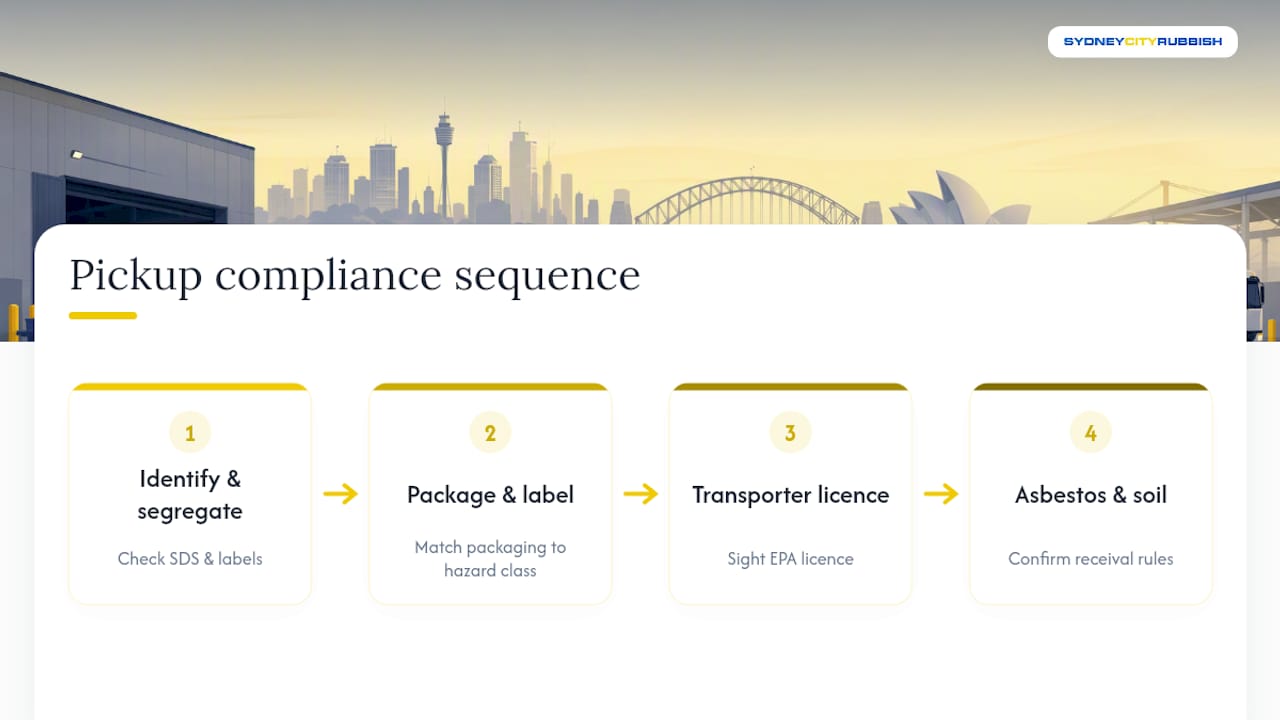
Before any truck arrives, the waste needs to be correctly identified. That means checking safety data sheets, product labels, and, for anything ambiguous, commissioning a written classification report rather than guessing based on appearance. Fluorescent tubes, batteries, paint, solvents, oils, and e-waste all carry different handling requirements, and mixing them in one bin defeats the purpose of segregation.
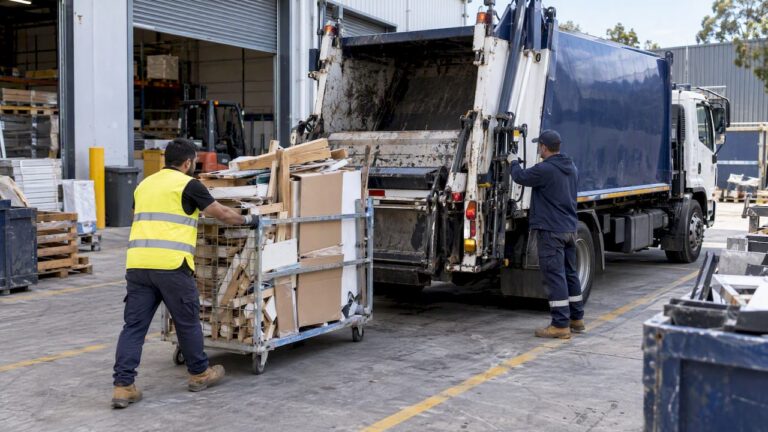
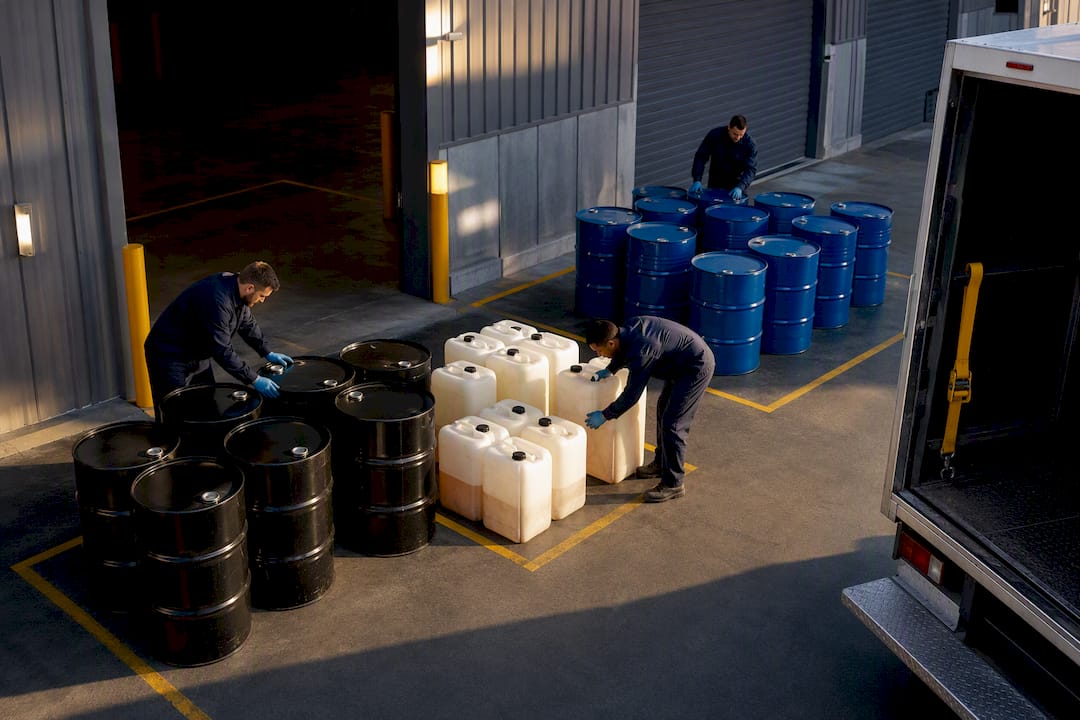
Containment comes next. Liquids need bunded, leak-proof drums; corrosives and flammables need separation from each other, not just from general waste; and anything that could be classed as a Dangerous Good under the Australian Dangerous Goods Code needs the correct DG class labelling on the container before it leaves site. Sydney construction sites in particular tend to generate mixed loads: demolition debris sitting next to old electrical fittings or leftover adhesives. Each stream needs its own segregated area and its own labelling, even if they’re headed to the same transporter.
Packaging should match the waste’s hazard class, not just whatever bin happens to be free. Once loaded, the transporter should be EPA-licensed for the specific waste category, and you should be able to sight that licence on request. If your project generates asbestos-contaminated material or contaminated soil, treat it as a higher-priority stream with its own receival rules and possible development consent requirements at the receiving facility.
Procurement controls that cut your liability
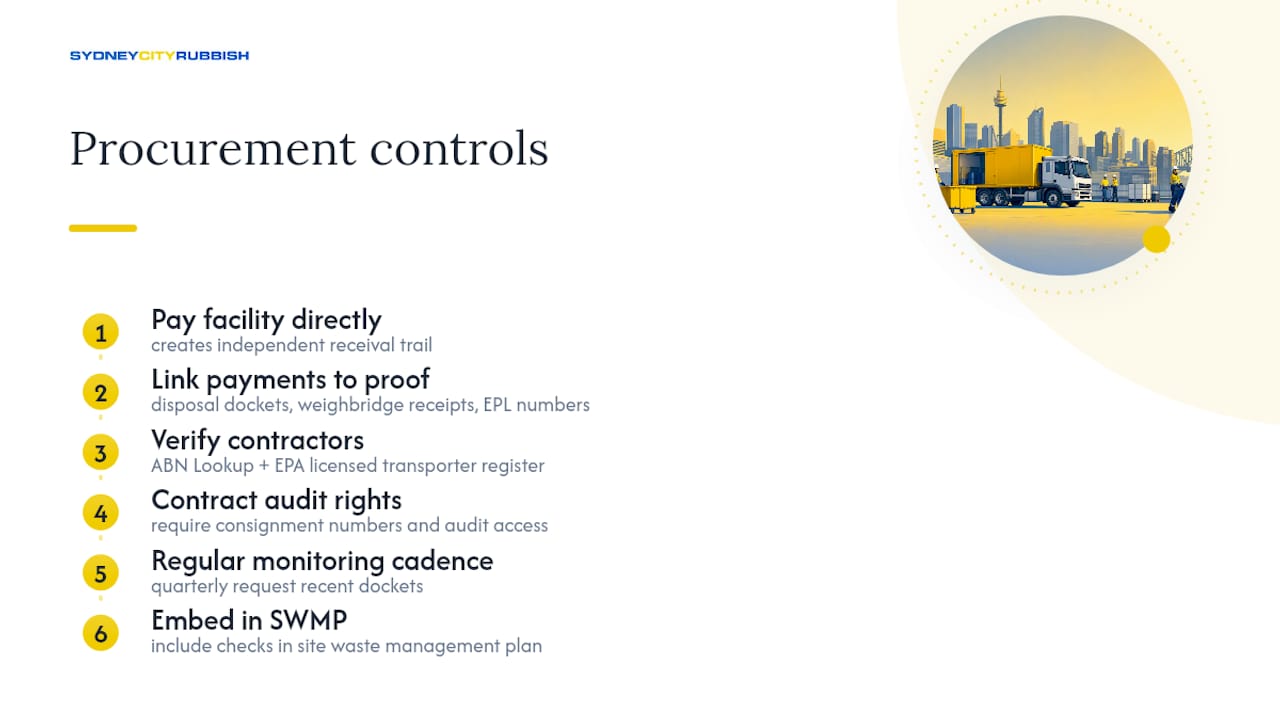
The single most effective control is paying disposal facilities directly rather than routing every dollar through a head contractor. That creates an independent receival trail: the facility confirms it actually got the waste, separate from whatever the transporter tells you. Practitioners who adopt this approach report it discourages contractors from misreporting where loads actually end up.
Structure contracts so payment milestones are tied to documented proof of lawful disposal, not just to a truck leaving site. The construction and demolition waste toolkit from the NSW EPA recommends exactly this: linking invoicing to disposal dockets, weighbridge receipts, and receival facility EPL numbers, not to a contractor’s word.
Before you sign anyone up, run their ABN through ABN Lookup and cross-check them against the EPA’s public register of licensed transporters. Contract clauses should require the transporter to supply consignment numbers for any tracked waste, and should give you the right to audit their disposal records on request, not just at contract signing. Build a simple monitoring cadence, even quarterly, where you request copies of recent dockets rather than waiting for a problem to surface.
For construction procurement teams managing multiple trades and multiple waste streams, embedding these checks into the site waste management plan keeps the paperwork traceable across the life of the project rather than scattered across separate invoices.
What happens if you get it wrong
Non-compliance under the POEO Act is a strict-liability matter in many cases, meaning the regulator doesn’t need to prove intent, only that the breach occurred. That’s a meaningful shift for property and facilities managers used to negligence-based frameworks: not knowing your contractor dumped illegally is not automatically a defence.
Penalties scale with the offence and the entity. Corporations face substantially higher maximum penalties than individuals, and repeat or aggravated offences (illegal dumping of hazardous waste, falsified tracking records) attract the top end of the scale, including custodial risk for company officers in serious cases. Clean-up and remediation costs are recoverable by the EPA on top of any fine, and a prosecution or penalty notice against your business becomes part of the public record.
There’s also a slower-moving cost: reputational damage with strata owners, tenants, or head contractors who discover a compliance failure after the fact. For property and facilities teams, that can outlast the fine itself. The EPA’s guidance on tracking responsibilities makes the point directly: engaging an agent to handle logistics does not transfer legal responsibility away from the waste producer. You remain on the hook even when someone else drove the truck.
A checklist for meeting your duty of care
Work through this sequence for every hazardous waste stream your site generates, and keep the paperwork from each step.
- Classify the waste in writing, using a lab report where the composition is uncertain, rather than relying on visual inspection.
- Check whether the waste sits within Schedule 1 or Table 3 thresholds that trigger mandatory tracking.
- Confirm the transporter’s EPA licence covers the specific waste category you’re handing over, not just a general waste permit.
- Verify the receival facility’s EPL or development consent before the first load leaves site, and keep a copy on file.
- Require consignment numbers and disposal dockets for every tracked load, matched against the volumes you actually handed over.
- Pay the disposal facility directly where the contract structure allows it, and tie contractor payment milestones to verified docket evidence.
- Retain all documentation for the period your insurer or the EPA may reasonably request it, and review it against invoices at least quarterly.
Strata and facilities managers running multiple properties should apply this checklist per site, per waste stream. A single fluorescent tube collection and a demolition project generating contaminated soil carry very different documentation loads, even though both fall under the same duty of care.
Where to find a licensed hazardous waste contractor in Sydney
Start with the EPA’s public register of licensed waste transporters and receival facilities. It’s the only way to confirm a contractor’s authorisation actually covers the waste category you need moved, rather than taking a sales pitch at face value. Cross-reference the ABN against ABN Lookup before signing anything.
For property managers and construction teams who want a local operator that already builds compliance into its process, there are companies that handle corporate and construction hazardous waste pickup across the Sydney metro area, including fluorescent tubes, e-waste, and general commercial hazardous streams, with disposal dockets supplied as standard. That’s the kind of documentation trail the checklist above requires, without you having to chase it down after the fact.
Whichever contractor you choose, ask for their EPA licence number and the EPL of their receival facility before the first pickup is booked, not after. A legitimate operator will have both ready to hand over, usually within a day.
How Sydney City Rubbish helps you meet the rules for hazardous waste pickup in Sydney
Most managers don’t need another compliance lecture. They need a contractor who already builds the paperwork into the job, so the disposal docket lands in your inbox without a follow-up email. Certain local contractors handle corporate, retail, and construction hazardous waste pickup across the Sydney metro area, including fluorescent tubes, e-waste, and mixed demolition waste streams, and structure their process around the audit trail the POEO Act requires.
That means dedicated trucks, punctual scheduling that fits around trading hours or site programs, and a carbon-neutral disposal option for organisations that need to report on sustainability alongside compliance, reflecting best practice similar to UK businesses’ approach to confidential waste duty of care. Every job comes with documented proof of lawful disposal, which is the exact evidence your procurement controls should be demanding anyway.
If your site or building needs a hazardous waste pickup arranged with the paperwork sorted from the start, request a compliance-focused quote and get a licensed truck booked in without chasing a contractor for evidence after the fact.
FAQ
Who is legally responsible for hazardous waste on a Sydney site?
The waste producer retains legal responsibility under the POEO Act, even when a contractor or agent handles transport and disposal on their behalf.
Which hazardous wastes need to be tracked in NSW?
Wastes listed in Schedule 1 or exhibiting the hazard characteristics in Table 3 of the POEO Waste Regulation must be tracked, with additional thresholds applying to larger or interstate loads.
What documents prove a hazardous waste pickup was lawful?
Disposal dockets, consignment numbers for tracked waste, and copies of the receival facility’s EPL together form the audit trail regulators and insurers expect.
Can I be penalised if my contractor dumped waste illegally?
Yes. Breaches under the POEO Act are frequently strict-liability offences, meaning your business can be penalised even without direct knowledge of the contractor’s actions.
Does Sydney City Rubbish provide hazardous waste pickup for businesses?
Yes. Sydney City Rubbish handles corporate, retail, and construction hazardous waste pickup across Sydney, including fluorescent tubes and e-waste, with disposal dockets supplied for every job.