Waste Classification in NSW: A Guide for Commercial Clients
In NSW, every load of commercial waste belongs to one of six legal classes, and the class decides where the waste can go, who can carry it and what paperwork travels with it. For an office fit-out, a retail makegood or a demolition site, most of the waste is general solid waste (non-putrescible), which is the simplest class. Asbestos, lead paint, batteries, tyres and slurry fall into other classes with stricter rules. Sydney City Rubbish removes commercial, construction and hazardous waste for offices, retailers, strata and property managers, and delivers it to registered recycling partners.
TL;DR
- NSW has six waste classes: special, liquid, hazardous, restricted solid, general solid (putrescible) and general solid (non-putrescible).
- Most office, retail and building waste, such as timber, plasterboard, carpet and furniture, is general solid waste (non-putrescible). Asbestos, tyres and lead paint are not.
- The NSW EPA sets a six-step process for classifying waste. Waste that is not classified after the first four steps must be treated as hazardous.
- As the waste owner, you are legally responsible for proving your waste went to a lawful place, and advice from a contractor is no defence.
- Hazardous waste cannot go to any NSW landfill and must be treated first.
Table of Contents
- Why waste classification matters to your business
- The six NSW waste classes
- How offices, retailers and building sites map onto the classes
- The six-step process for classifying waste
- When testing is and is not required
- Hazardous waste: what the rules require
- Where your responsibility starts and ends
- What happens to your waste after collection
- A worked example: an office end-of-lease cleanout
- How Sydney City Rubbish handles commercial waste
- FAQ
- Sources
Why waste classification matters to your business
Classification is not paperwork for its own sake. The NSW EPA explains that grouping wastes into classes with similar risks to the environment and human health is what allows each to be managed and disposed of appropriately. It also means waste can only be accepted at a facility that is lawfully authorised to receive that specific class.
That is the point where commercial clients get caught. A skip or truck that arrives at the wrong facility is a breach by the person who generated the waste, not just by the driver. Under section 143 of the POEO Act 1997, waste must go to a place that can lawfully accept it, and the maximum penalty is $1,000,000 for a corporation or $250,000 for an individual. The Act is the Protection of the Environment Operations Act, the main NSW law on pollution and waste.
For property managers and strata managers, the practical consequence is simple. When a tenant leaves, a lobby is refurbished or a floor is stripped, someone has to know what the material is before it is loaded. That someone is the waste owner, and the owner can hand the job to a specialist but cannot hand over the legal responsibility.
The six NSW waste classes
The NSW EPA lists six classes based on risk. Transport for NSW’s Waste Management Guideline (May 2023) gives practical examples of each, which are the easiest way to see where your own waste sits.
| Class | What it covers | Typical examples |
|---|---|---|
| Special waste | Waste with its own specific rules | Asbestos, tyres |
| Liquid waste | Waste that is a liquid or flows as one | Oily water, concrete slurry |
| Hazardous waste | Waste with hazardous properties | Lead-acid batteries, lead paint from removal work |
| Restricted solid waste | A middle class between general and hazardous | Currently no pre-classified wastes |
| General solid waste (putrescible) | Waste that can rot | Litter bin waste, food waste, manure |
| General solid waste (non-putrescible) | Solid waste that does not rot significantly | Building and demolition waste other than asbestos, glass, plastic, asphalt, metals |
Two terms in that table need a plain explanation. Putrescible means capable of significant biological breakdown, which is why food waste and bin waste sit apart from timber and plasterboard. Restricted solid waste is a class for waste whose contaminant levels exceed the general solid waste limits but stay below the hazardous threshold. At present, no waste is pre-classified into it, so it only arises from testing.
The same guideline notes that any waste has both a definition (what stream it came from, such as construction and demolition waste) and a classification (its statutory risk class). A pile of mixed building debris is described by its source, but it is only legally disposable once its class is known.
How offices, retailers and building sites map onto the classes
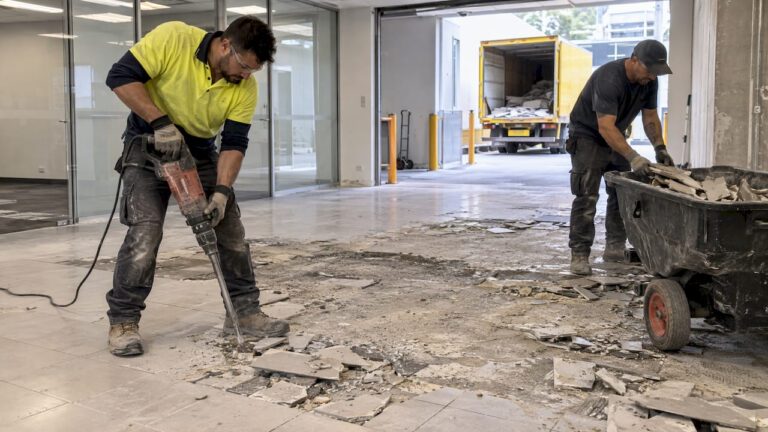
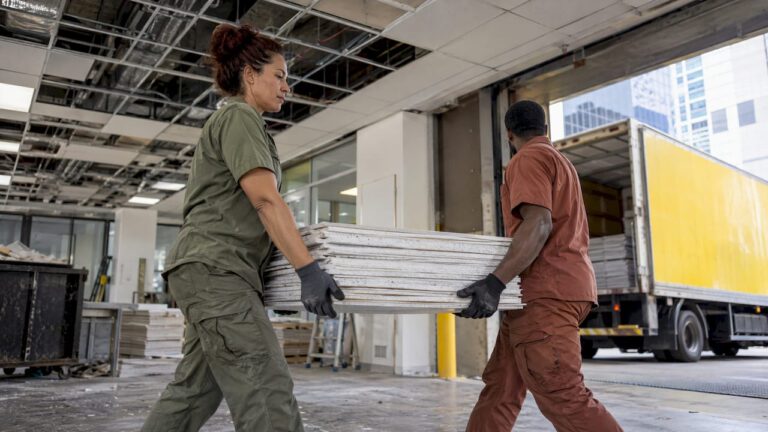
Most of what leaves a commercial fit-out or strip-out is general solid waste (non-putrescible). Think of old workstations, joinery, partition framing, ceiling tiles, plasterboard, carpet tiles, cabling and e-waste awaiting recycling. Under the Transport for NSW examples, building and demolition waste is non-putrescible, apart from the specific materials listed separately, such as asbestos.
The exceptions are where mistakes happen. A pre-1990 building can contain asbestos in ceiling sheets, vinyl flooring backing or pipe lagging, and asbestos is special waste with its own rules. Lead paint removed during refurbishment is hazardous. Tyres from a workshop or warehouse are special waste. Concrete slurry from cutting or grinding is liquid waste, not solid waste. Food and organics from a retail food court or café tenancy are putrescible, which changes which facility can take them.
A tenancy cleanout therefore often produces several classes in one job: general solid waste for most of the volume, plus a small amount of something that needs separate handling. Separating these at the source, before loading, is what keeps the rest of the load simple.
The six-step process for classifying waste
The NSW EPA’s Waste Classification Guidelines, Part 1 sets out six steps. You work through them in order and stop when the waste is classified.
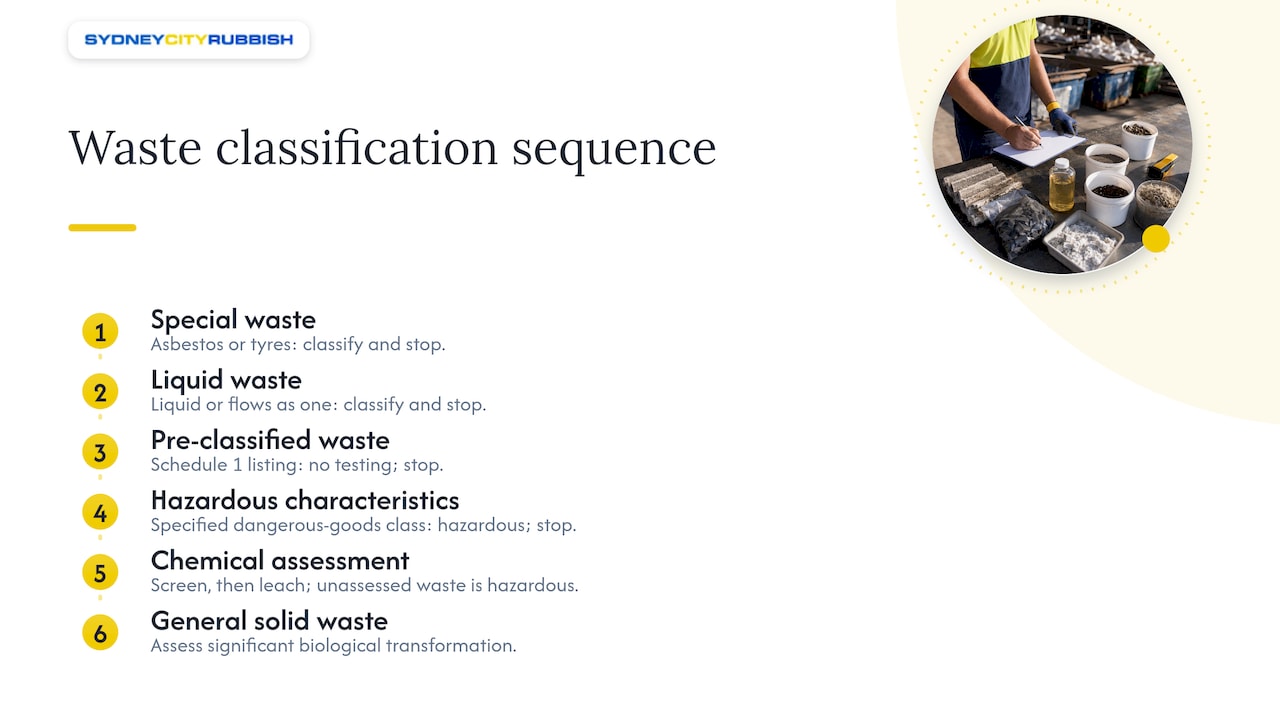
Step 1: check for special waste. If the waste is asbestos, tyres or another special waste, it is classified there and the special rules apply.
Step 2: check for liquid waste. Anything that is liquid, or flows as one, is liquid waste.
Step 3: check whether it is pre-classified. Schedule 1 of the POEO Act 1997 lists wastes that are already classified, so no testing is needed. Many common building materials are handled this way.
Step 4: check for hazardous characteristics. Waste is hazardous if it is a dangerous good in the specified transport classes or divisions of the Australian Dangerous Goods Code, such as certain flammable, toxic or corrosive materials, subject to some listed exclusions.
Step 5: carry out a chemical assessment. For waste not classified in the earlier steps, the chemical contaminants are measured. The NSW EPA bases this on the waste’s potential to release contaminants when contacted by liquids, so a screening test of total contaminant concentration is followed by a leaching test. Waste that is not chemically assessed has to be classified as hazardous.
Step 6: decide putrescible or non-putrescible. If the waste is general solid waste, a final assessment decides whether it is capable of significant biological transformation.
The rule that matters most for a busy manager is the default. Waste not classified after the first four steps must be treated as hazardous, so uncertainty is never a safe harbour.
When testing is and is not required
Most commercial clients never commission a chemical test, because most building waste is pre-classified or obviously non-hazardous. Testing becomes relevant for soil, fill, residues and waste of unknown history.
The guidelines allow you to skip testing where you know the process that produced the waste and are certain its maximum possible contaminant levels do not exceed the test values for a classification. The reasons must be documented, and records kept for three years. If you choose contaminants to test for, you must also be able to justify the choice, and if you suspect others are present you must test for them and seek advice from the EPA.
Excavated natural material is a separate case. Transport for NSW’s April 2022 fact sheet says it must be sampled and tested against the order criteria before it is transported to a receiving site, with test reports kept for six years. If your project involves excavation, plan for that before trucks are booked, not after.
Hazardous waste: what the rules require
Hazardous waste cannot be disposed of in any NSW landfill. The EPA’s landfill audit summary states that waste above the hazardous thresholds cannot go to any NSW landfill, and it must be treated before disposal. That makes correct identification a safety and cost matter at the start of a job, not a point to settle at the tip.
Some hazardous and special wastes are also trackable. Under Part 4 of the POEO (Waste) Regulation 2014, trackable waste moved into, within or out of NSW must be tracked, with a consignment authorisation in place before transport. Carrying more than 200 kg or litres of trackable waste in a load requires the transporter to hold a NSW environment protection licence. Tyres are the exception, needing interstate tracking but no NSW transporter licence.
Tracking has also moved online. The EPA’s Integrated Waste Tracking Solution replaced WasteLocate for waste tyres on 19 September 2023, and for asbestos waste and other trackable waste on 28 February 2024. If a guide you hold still refers to the older systems, it is out of date.
We cover the hazardous side in more depth in our guides to hazardous waste rules in Sydney and hazardous waste pickup rules.
Where your responsibility starts and ends
The NSW EPA’s guidance on construction and demolition waste is blunt: both the waste owner and the transporter are legally responsible for showing the waste went to a lawful place, and relying on advice from consultants or contractors is no defence.
The EPA recommends that you check the facility’s council consent and environment protection licence, give the facility the waste classification, origin and quantity, and prepare a waste management plan with records such as weighbridge dockets. To confirm a facility holds a licence, the EPA points to the POEO public register, and for unlicensed facilities, to local council consent.
In practice this gives a manager four things to keep for each job: a description of what was removed, the class it was assigned, the facility it went to, and the dockets showing the weights. Keep them with the project file. If a tenant dispute, a council inquiry or an EPA audit comes up a year later, those four items answer most of the questions.
Our commercial waste regulations guide walks through the compliance steps, and the demolition waste handling guide covers what changes when structural work is involved.
What happens to your waste after collection
Knowing the destination helps you see why the class matters. According to the EPA’s landfill audit summary, incoming vehicles are weighed at the weighbridge and the loads inspected so that only approved wastes are accepted. The waste is then deposited at the active tipping face, spread and compacted in a designated cell, and typically covered daily with soil or similar material to control fire, odour, windblown litter and vermin. Special wastes such as asbestos have additional covering requirements.
A load that is misdescribed is caught or not caught at that inspection point, and the consequences land on the party that supplied the description. Vehicles are also regulated on the way: clause 70 of the POEO (Waste) Regulation 2014 requires waste carried by motor vehicle or trailer to be covered, and the vehicle built and maintained to avoid spilling, except where the load is solely tyres or scrap metal.
A worked example: an office end-of-lease cleanout
Take a 600 square metre office on a Sydney CBD floor, returned to the landlord under a makegood clause. The tenant must remove workstations, meeting tables, partitions, carpet tiles, a kitchenette and old IT equipment.
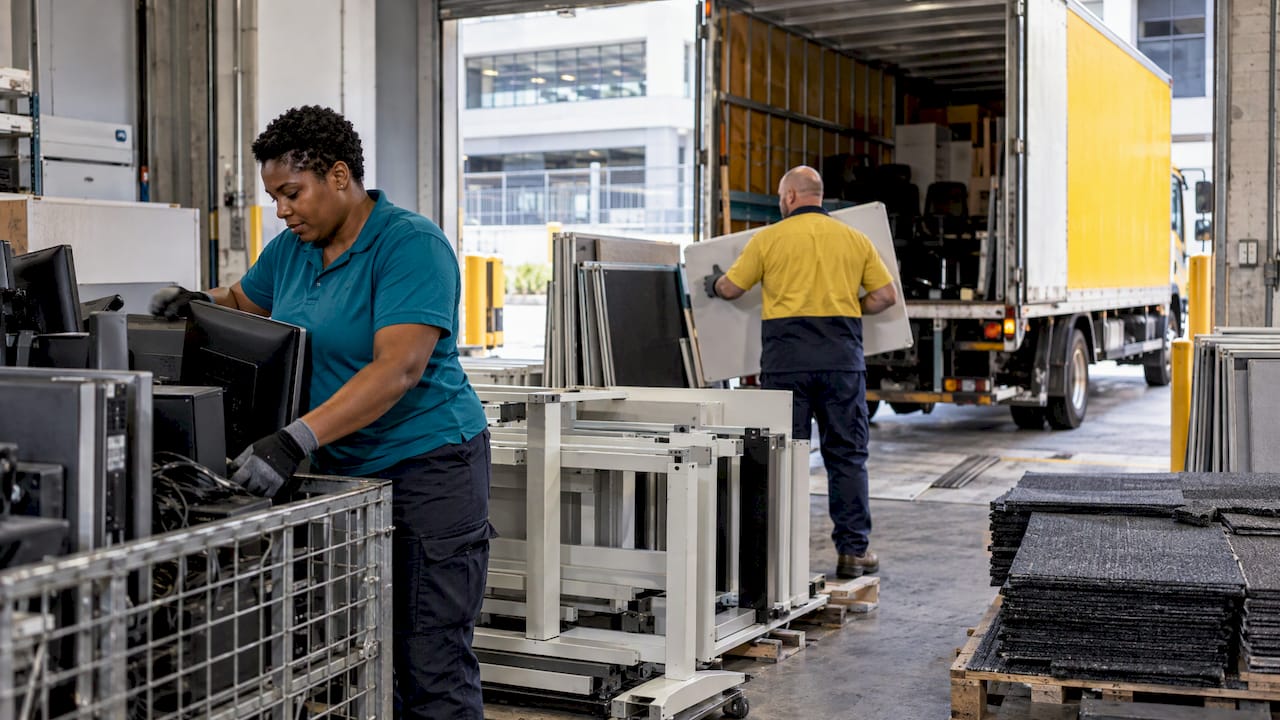
Most of that is general solid waste (non-putrescible): furniture, joinery, partition framing, carpet and plasterboard. Electronic items such as monitors and old computers are e-waste and are best directed to recycling rather than treated as ordinary bulk waste. A small amount of kitchen waste from the pantry is putrescible and should be kept out of the building waste load. If the building was constructed before asbestos was banned and any ceiling or flooring work is planned, the material has to be checked for asbestos before it is disturbed, because asbestos is special waste.
The manager’s job on this project is to record the classes, confirm the destination facility is licensed for them, and keep the dockets. The classification step takes minutes when the waste is ordinary and the building history is known, and it is the step that protects the rest of the project.
How Sydney City Rubbish handles commercial waste
Our work covers offices, retail locations, construction sites, strata-managed buildings and end-of-lease cleanouts across Sydney, including removal of furniture, appliances, electronics, construction debris and hazardous materials. We coordinate directly with building management for access, and disposal goes through registered recycling partners. Corporate clients can also opt in to carbon-neutral waste disposal.
If your job is a tenancy cleanout, see our commercial waste removal service. For strip-outs, makegood and demolition, the full list of services shows what we take on, and for site debris there is construction waste disposal. We provide fast electronic quotes, so you can get a free quote before the work is scheduled.
FAQ
What are the four types of waste in NSW?
NSW law uses six classes rather than four: special, liquid, hazardous, restricted solid, general solid (putrescible) and general solid (non-putrescible). In everyday commercial work, the groups you meet most are general solid waste, hazardous waste and special waste such as asbestos.
Who is responsible for classifying waste?
The waste owner, also called the generator, must classify it using the EPA’s six-step process. Transporters share responsibility for taking it to a lawful place, and the EPA says advice from a contractor is no defence. Keep your classification records with the project file.
Is building and demolition waste general solid waste?
Usually yes. Transport for NSW lists building and demolition waste as general solid waste (non-putrescible), with specific exceptions such as asbestos. Materials contaminated with lead paint or other hazardous substances need to be classified separately.
Can hazardous waste go to a NSW landfill?
No. Hazardous waste cannot be disposed of in any NSW landfill and must be treated first. Some hazardous and special wastes must also be tracked in the EPA’s Integrated Waste Tracking Solution, with a consignment authorisation in place before transport.
Sources
- Classifying waste | EPA NSW
- Waste classification guidelines | EPA NSW
- Waste Classification Guidelines Part 1 (EPA NSW, 2014)
- Waste Classification Guidelines Part 1, record-keeping text (2014)
- Waste management guideline, May 2023 | Transport for NSW
- Excavated Natural Material fact sheet, April 2022 | Transport for NSW
- Transporting waste | EPA NSW
- Tracking and transporting hazardous waste | EPA NSW
- Waste transporters’ tracking responsibilities | EPA NSW
- Integrated waste tracking solution | EPA NSW
- Construction and demolition waste | EPA NSW
- Solid waste landfills compliance audit summary | EPA NSW