Office Recycling Program Setup: Get Australia’s Four Streams Right
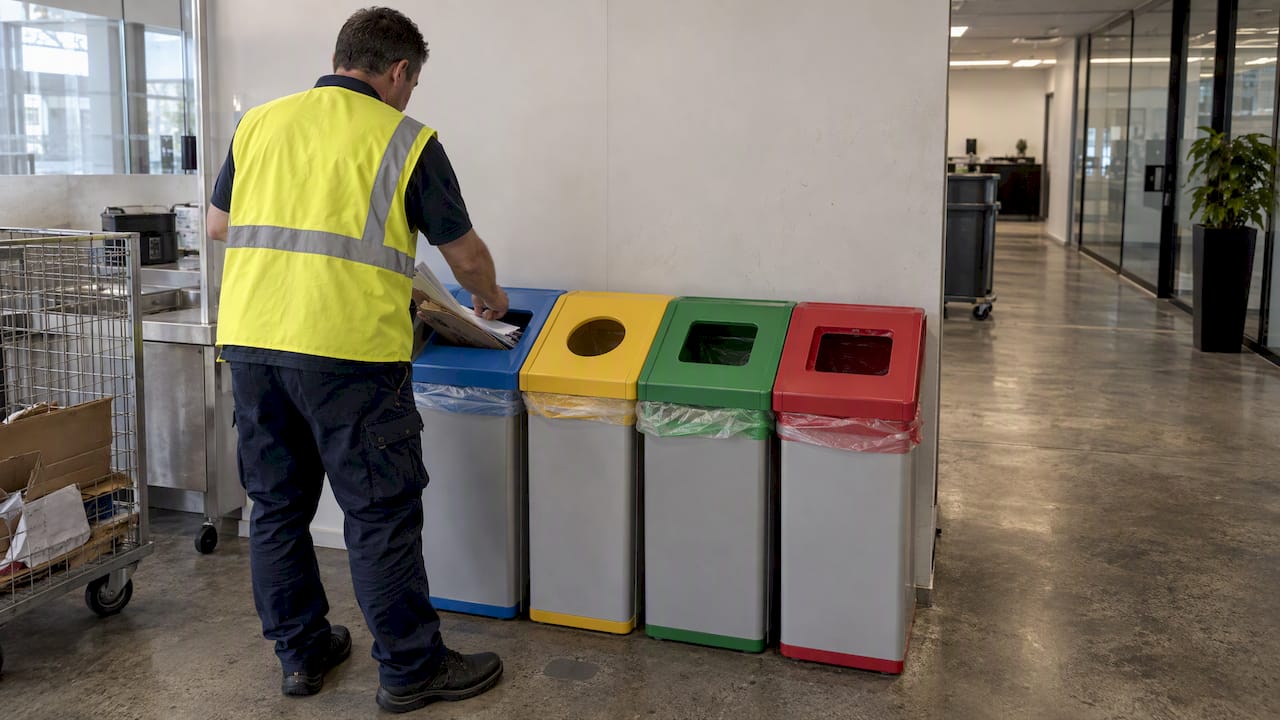
A practical route to an effective office recycling program is to form a small team, run a quick waste audit, and install centralised four-stream stations in the colours set out in AS4123.7, then confirm your collection partner before launch. Government better-practice guidance for office waste anchors this approach, and the sections below show how to put it into practice.
TL;DR:
- Name a program lead, cleaner liaison, contractor contact, and communications owner, then confirm dock access, storage rules, and collection restrictions with building management.
- Sample bins by zone, measure waste by weight or volume, and use cleaner observations or contractor records when sorting is impractical; never hand sort sharps.
- Use eye level signs with images that match bin colors, pair recycling with general waste, and correct confusing labels before retraining staff.
- Pilot one floor, track capture rate, contamination, bin fullness, and feedback, then adjust signs, locations, bin sizes, or collection frequency before expanding.
- The national target is 80% resource recovery by 2030; South Australia’s 90% diversion goal by July 1, 2027, applies to government offices, not private ones.
Table of Contents
- How do you build a green team and win stakeholder buy-in?
- How do you run a baseline waste audit?
- Which waste streams should you collect, and in what colours?
- Where should bins and stations go?
- How do you work with cleaners and your waste contractor?
- What signage and engagement tactics change behaviour?
- How do you pilot the program and launch it?
- Which KPIs show whether the program works?
- What about organics, problem items and tight spaces?
- How can a commercial waste partner make rollout easier?
- FAQ
- Sources
How do you build a green team and win stakeholder buy-in?
A recycling program fails quietly when nobody owns it. Before you buy a single bin, put together a small group with enough authority to change how the office handles waste. Government better-practice guidance stresses consulting cleaners, facility managers and waste contractors early, and the same logic applies to any private office.
Invite people who touch the waste stream or influence behaviour:
- Facilities or office management: owns the budget, the building relationship and day-to-day decisions.
- Cleaners or the cleaning contractor: knows how bins are emptied and where contamination happens.
- HR or internal communications: shapes the launch messages and induction material.
- Procurement: controls what comes into the office and which suppliers take packaging back.
- An executive sponsor: signs off on spending and signals that the program matters.
- Floor champions: one willing person per floor or team who answers questions in the moment.
Give four roles a name and a person. The programme lead keeps the project moving. The cleaner liaison handles the day-to-day handoffs. The contractor contact manages collection schedules and queries. The communications owner writes the launch emails and keeps signage current.
For sign-off, bring the executive sponsor a one-page case: the baseline audit plan, a likely bin and signage budget, and a request for time from cleaners and the building manager. Ask the building manager early about loading dock access, bin storage and any restrictions on contractors.
At the first meeting, aim to leave with an agreed scope, named roles, an audit date, a pilot area and a date for the next check-in. Keep the meeting focused.
How do you run a baseline waste audit?
An audit turns opinions into evidence. Practical Australian guidance says a successful program starts with a waste audit to establish a baseline, and that regular audits keep it accurate as occupancy, purchasing and disposal habits change. The result shapes your stream choices, bin sizes and collection frequency.
You can do it with a simple method:
- Choose a representative period, not a holiday period or a move.
- Collect the contents of the office’s bins on representative days, keeping each floor or zone separate.
- Sort the material into paper and cardboard, co-mingled containers, organics, general waste and problem items such as batteries or cables.
- Weigh or measure each stream by volume, and photograph what you see.
- Note which areas generate the most waste, typically the kitchen, print room and reception.
- Record the contamination you find, for example food in paper bins or soft plastics in co-mingled recycling.
A full bin dive is not always practical in a busy office. A safer alternative is to sample bins in each zone, or to use the cleaners’ observations and the contractor’s collection records, with gloves, closed footwear and tongs for anything sharp or wet. Never hand-sort needles, broken glass or unknown liquids.
Repeat the audit after the pilot, then at regular intervals. Regular reviews and full audits can help keep the baseline accurate as conditions change. To convert your results into collection needs, the Green Industries SA office waste and recycling performance calculator estimates volumes, recycling levels, collection costs and greenhouse gas tonnes avoided.
If your office is large or generates heavy cardboard volumes, a partner resource such as the Compact can help you structure the audit and think through equipment such as balers and compactors.
Which waste streams should you collect, and in what colours?
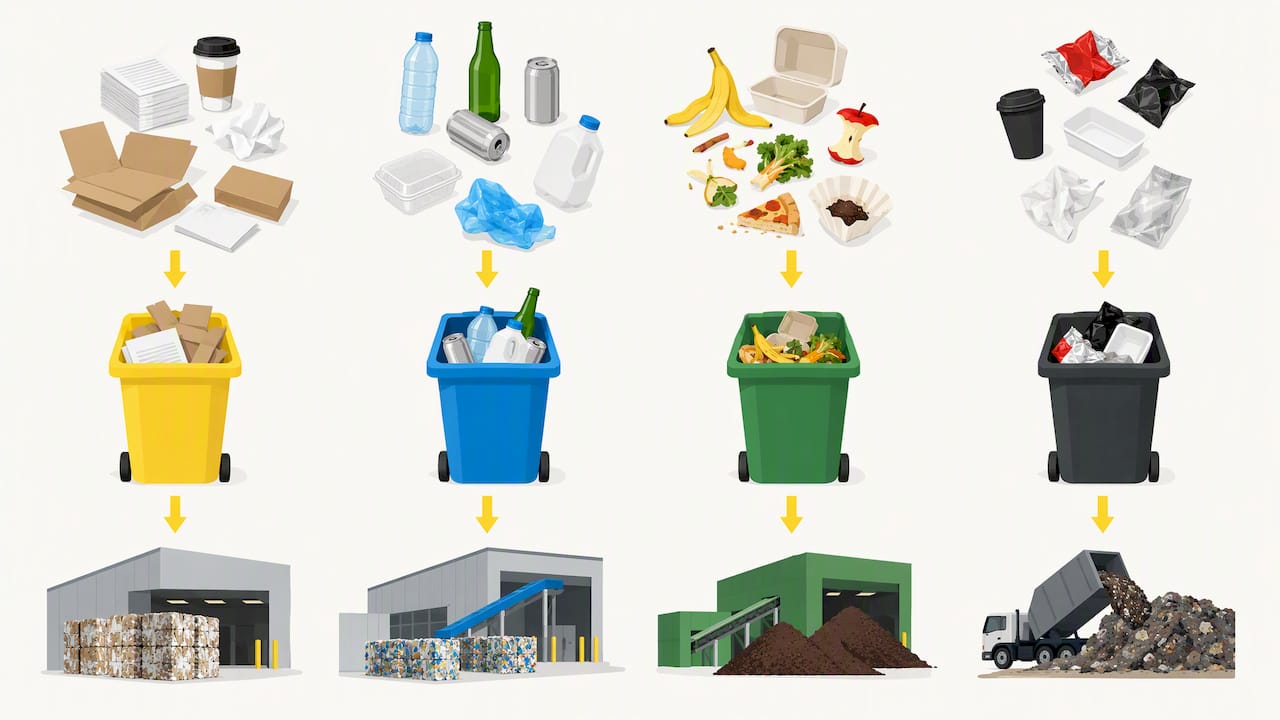
Most offices work well with four streams, using the colour conventions in Australian Standard AS4123.7-2006. A bin colour guide aligned with the standard describes the model this way:
- Blue: paper and cardboard.
- Yellow: co-mingled recycling such as bottles, cans and hard plastics.
- Red: general waste that cannot be recycled.
- Green: organics, including food scraps.
Let your audit decide the order of rollout. If paper and cardboard dominate your bins, start with blue and red and add yellow once people are comfortable. If the kitchen produces a large share of waste by volume, organics may be your biggest opportunity, though it needs a collection partner that can take it.
Each stream has a typical contamination problem. Paper bins collect coffee cups and food wrappers. Co-mingled bins collect soft plastics, bagged recyclables and liquids. Organics bins collect compostable-looking packaging that the processor cannot accept. Your stream choice also shapes your collection options, because a contractor needs a destination for each stream you separate, and a stream with no processing pathway just becomes expensive general waste.
The national picture backs a focus on recovery. The national waste and resource recovery reporting shows recovery rates by stream and sets a national target of 80% average resource recovery by 2030. For an office, that means getting the main streams right before chasing exotic ones.
Where should bins and stations go?
Participation depends more on convenience than goodwill. A convenient layout can make it easier for people to use the right bin, so place the right bin at the point of disposal.
Government guidance recommends removing under-desk bins in favour of centralised stations, and the waste management hierarchy puts avoidance and reduction ahead of recycling, so a station setup should prompt fewer, better choices rather than casual dumping. Centralised hubs improve separation quality because people stop and decide where an item goes.
Practical rules for stations:
- Pair every recycling bin with a general waste bin so nobody has to hunt for the “right” place to throw rubbish. Public-place recycling guidance supports pairing to reduce contamination.
- Choose bin sizes for the waste volume and the cleaners’ handling needs. A commercial bin guide discusses the trade-offs between emptying frequency and liner handling.
- Prefer durable HDPE, restrictive lids matched to the stream, bag retention and simple icons.
- Keep stations within a short walk of workstations, and keep them off emergency routes.
Suggested layouts:
- Kitchen: a full four-stream station, including organics and a container for coffee pods or cups if you have a take-back option.
- Print room: a paper and cardboard bin, a general waste bin and a labelled collection point for cartridges.
- Reception: a compact paired station so visitors can sort correctly.
- Meeting rooms: a single pair near the door, emptied on the cleaners’ regular rounds.
Pro Tip: Plan storage and collection access when you plan the stations. Better-practice design guidance recommends settling storage, collection points and signage early in a fit-out or refurbishment.
How do you work with cleaners and your waste contractor?
Cleaners handle your bins more than anyone, so they should have a say in the design. How bins are placed and collected greatly affects contamination, and a system the cleaners find awkward will drift back to mixed bags.
Cover these points with your cleaning and waste contractors:
- Ask cleaners where bins slow them down or where staff behaviour causes problems, and adjust before you buy more bins.
- Update cleaning and collection contracts so they reflect the new streams, bin locations and collection frequency.
- Brief cleaners on safe handling: gloves, correct lifting, no hand-sorting of sharps, and a clear route for reporting hazards. Government guidance names cleaners among the people to consult.
- Ask your waste contractor where each stream is processed, what happens to a load that is too contaminated, and whether you will receive collection data.
- Confirm access with the building manager, including dock times and any restrictions on bin storage.
Our own commercial waste collection service is built around this kind of coordination, so we can talk through contract options with you before launch.
What signage and engagement tactics change behaviour?
Clear signs matter more than long policies. NSW commercial audits suggest that wrong or confusing signage is a common source of recycling contamination, and that clear visual diagrams at the point of disposal are the most effective way to reduce it.
Build your signage on a few principles:
- Lead with images of the actual items accepted, not just words.
- Match the sign’s colour to the bin lid, using the AS4123.7 colours.
- Use high-contrast artwork, minimal text and standard icons.
- Mount signs at eye level on or directly above the bin, with the same sign used everywhere.
For engagement, a short sequence works better than one big announcement. Here is a staged messaging plan:
- Launch: send an email from the executive sponsor, with a short explanation of why and what is changing.
- Demonstrate: have floor champions show people how to use the stations.
- Share results: report early findings, such as the first weights collected, and answer common questions.
- Follow up: thank teams, fix any problem spots, and announce the next review.
Incentives can be light-touch: a shared floor target or a recognition note in the all-staff update. For more tactical ideas, see our own tips on recycling office waste.
How do you pilot the program and launch it?
Start with one floor or department so you can fix mistakes cheaply. Run the pilot long enough for habits to settle and contamination patterns to appear. Track four things: capture rate (how much recyclable material lands in the right bin), contamination, bin fullness and user feedback.
Use a day-one launch checklist:
- Bins and stations are in place and positioned as planned.
- Signage is mounted at eye level and matches bin colours.
- The contractor has confirmed collection days and the cleaners have been briefed.
- The launch communication has gone out and floor champions are ready.
- A feedback channel, such as a shared inbox or a short form, is open.
After the pilot, repeat a short audit and compare it with your baseline. If one stream is heavily contaminated, change the signage or bin location before blaming staff. If bins overflow, adjust sizes or collection frequency. Only then roll out to the remaining floors, applying what the pilot taught you.
Which KPIs show whether the program works?
Choose a small set of measures you can actually collect. Four cover most offices:
- Diversion rate: the share of total waste that goes to recycling or organics rather than general waste.
- Contamination rate: the share of recycling bins containing the wrong items.
- Weight or volume collected by stream.
- Cost per collection, so you can see whether changes to frequency or bin size are paying off.
The policy context gives you a sense of scale. The 2024 National Waste Policy Action Plan sets an 80% average resource recovery target by 2030, while government office guidance in South Australia’s better-practice guide aims for 90% diversion by 1 July 2027 in government offices.
Government offices in South Australia are guided toward a 90% diversion target by 1 July 2027, which gives private offices a useful benchmark rather than a requirement.
Review regularly and conduct full audits as needed. If contamination rises, look first at signage, a recent change in staff or a moved bin before running another training session. If volumes change sharply, check occupancy and procurement. Use contractor data and your own audit findings to set targets you can realistically meet, then raise them once you are consistently reaching them.
What about organics, problem items and tight spaces?
Add organics once your core streams are stable, or sooner if the kitchen audit shows food waste dominating the bins. Small offices without room for a green bin can look at compact composting or a shared collection with neighbouring tenants.
Set up dedicated collection points for items that do not belong in any standard bin:
- Batteries and printer cartridges.
- E-waste such as cables, keyboards and old phones.
- Light bulbs and other items your contractor identifies.
WasteSorted’s workplace guidance suggests supplying dedicated collection points for items like printer cartridges and batteries and labelling them clearly. For reuse ideas on larger items, see our guide to reusing and recycling office rubbish.
When space is tight, use slimline paired stations, wall-mounted bins or fewer larger stations in shared areas, and consider more frequent collections instead of bigger bins. Commercial audits in New South Wales found that cost and space are common barriers, even where management is keen. Talk to your landlord or building manager early about storage and collection access, since they often control the loading dock and bin room.
How can a commercial waste partner make rollout easier?
Once your audit and layout are settled, the collection side is where many programs stall. We handle commercial waste removal across Sydney, and we can support office collection logistics and coordinate access with building management.
For clients who want it, we offer an opt-in carbon-neutral service. Because we work directly with building managers on access, loading times and bin storage, the practical details that often delay a launch get sorted early.
A sensible next step is a trial collection. We can discuss collection options for your pilot floor before you sign on for the whole office. Our commercial waste removal service covers this, and current quote details are on our commercial waste disposal page. For office-specific details, start with our commercial and office rubbish removal service.
FAQ
What is the best first step in setting up office recycling?
Form a small team and run a baseline waste audit. The audit shows which streams you generate and where contamination happens, so your bin choices and collection schedule rest on evidence instead of guesswork.
How many waste streams does an office need?
Most offices do well with four: paper and cardboard, co-mingled recycling, general waste and organics. Start with the streams your audit shows are largest, and add others once people are using the first ones correctly.
What bin colours should an office use?
Follow AS4123.7-2006: blue for paper and cardboard, yellow for co-mingled recycling, red for general waste and green for organics, as described in this bin colour guide. Matching signage to bin colours reduces confusion.
How do you reduce contamination in office recycling?
Put clear, image-led signs at the point of disposal and place recycling bins beside general waste bins. A NSW commercial bin guide notes that confusing signage is a common cause, so fix signs before retraining staff.
How often should you audit an office recycling program?
Run a baseline audit before launch, a check after the pilot, and then regular reviews and full audits as needed. Practical guidance recommends regular audits as occupancy and habits change.
Sources
- How to Set Up an Effective Office Recycling System: The Professional A
- Government office waste: Strategy and better-practice guide (2024)
- National waste and resource recovery report 2026 – DCCEEW
- Epa